 Soku AI
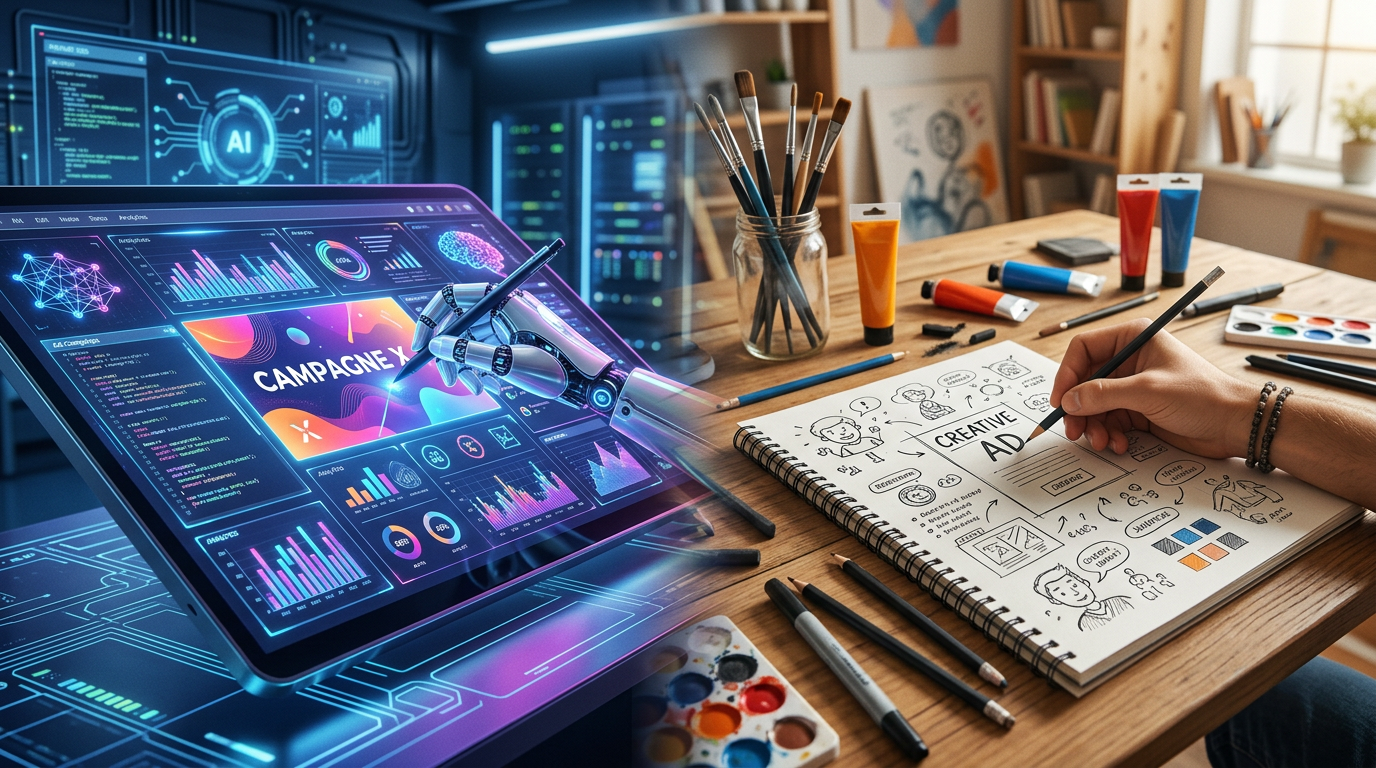
The debate between Meta Advantage-style AI creative and human-made ad creative has moved past opinion. With AI creative tools now used by over 60% of performance marketing teams and global AI advertising spend projected to reach $192 billion by 2028, the question is no longer whether AI belongs in the creative process — it is where AI outperforms humans, where it falls short, and how the best CPG and DTC teams combine both.
We analyzed publicly available performance benchmarks, agency case studies, and platform data spanning over 10,000 ad campaigns across Meta, Google, TikTok, and programmatic channels to answer this question with data, not anecdotes. Here is what the numbers actually say. For the tool-level buying decision, read our Facebook and Instagram AI creative tools comparison; for the production workflow, use the modular AI ad variant playbook. If you are wiring the next step into an agentic ad workflow, the Meta Ads AI Connectors guide explains how AI teams now move from creative diagnosis to account action.
The Methodology: How We Compared AI and Human Creatives
Before diving into results, it is important to understand how we defined the comparison. The data comes from aggregated performance reports published by major ad platforms, creative agencies, and AI tool providers between 2024 and early 2026.
AI-generated creatives include ads produced primarily by tools like AdCreative.ai, Pencil, Predis.ai, and platform-native AI features (Meta Advantage+ Creative, Google Performance Max asset generation). These range from fully automated outputs to AI-assisted designs with minimal human editing.
Human-made creatives include ads designed by in-house creative teams, agency designers, and freelance professionals — using traditional tools like Adobe Creative Suite, Figma, and Canva without AI generation features.
Key metrics tracked:
- Click-through rate (CTR)
- Cost per acquisition (CPA)
- Return on ad spend (ROAS)
- Conversion rate
- Creative production time and cost
- Creative fatigue rate (time to performance decay)
We excluded campaigns with fewer than 1,000 impressions and normalized for industry vertical, ad spend tier, and platform to reduce confounding variables.
The Headline Numbers: AI vs Human Performance
Click-Through Rate
AI-generated creatives produce an average CTR of 1.82% across platforms, compared to 1.54% for human-made creatives — a 18.2% improvement. This advantage is most pronounced on Meta (where AI tools are most mature) and smallest on YouTube (where video production quality matters more).
However, the distribution tells a different story. The top 10% of human creatives outperform the top 10% of AI creatives by 31%. AI raises the floor; humans raise the ceiling.
| Platform | AI CTR | Human CTR | AI Advantage |
|---|---|---|---|
| Meta (Facebook + Instagram) | 2.11% | 1.72% | +22.7% |
| Google Display | 1.43% | 1.21% | +18.2% |
| TikTok | 1.67% | 1.48% | +12.8% |
| Programmatic Display | 1.24% | 1.09% | +13.8% |
| YouTube | 0.65% | 0.71% | -8.5% |
Cost Per Acquisition
AI creatives deliver a 21% lower average CPA than human creatives — $28.40 vs $35.90 across all verticals. The primary driver is not that individual AI ads convert better, but that AI enables more variants to be tested simultaneously. Teams using AI creative tools test an average of 14.3 variants per campaign, compared to 3.7 for human-only teams. More variants mean faster identification of winning concepts and less budget wasted on underperformers.
Return on Ad Spend
ROAS tells a more nuanced story. AI creatives average 3.4x ROAS compared to 3.1x for human creatives — but this gap narrows significantly at higher spend levels. Campaigns spending over $50,000/month show virtually identical ROAS between AI and human creatives, suggesting that at scale, creative strategy matters more than production method.
Conversion Rate
Post-click conversion rates are nearly identical: 3.2% for AI creatives vs 3.1% for human creatives. This makes sense — conversion depends more on landing page quality, offer strength, and audience targeting than on the creative that drove the click.
Where AI Creatives Win Decisively
1. Speed and Volume
The most unambiguous advantage of AI creatives is production velocity. AI tools generate ad variations 47x faster than human designers on average. A single marketer using AdCreative.ai or Pencil can produce 50-100 ad variants in a day — a volume that would take a human design team weeks.
This speed translates directly into performance through faster iteration cycles. Teams using AI creative tools identify winning concepts in an average of 4.2 days, compared to 16.8 days for human-only teams. In a media environment where creative fatigue sets in within 7-14 days on Meta, this speed advantage is not just convenient — it is a competitive necessity.
2. Multivariate Testing at Scale
AI's volume advantage unlocks a testing methodology that is simply impractical with human-only creative production. Instead of testing 3-4 concepts and picking a winner, AI-equipped teams can run structured multivariate tests across dozens of headline, image, and CTA combinations simultaneously. Running that many cells fairly is a tooling problem in its own right — see the best ad testing tools for the platforms built to hold the statistics straight.
Data from Smartly.io shows that brands running 15+ creative variants per ad set achieve 34% lower CPA than those running fewer than 5 variants — regardless of whether those variants were AI or human-made. AI just makes the higher variant count economically feasible. Our guide to creating 100 ad variants in one hour walks through the exact modular framework that makes this volume practical.
3. Cost Efficiency
The cost comparison is stark:
| Metric | AI Creative | Human Creative |
|---|---|---|
| Average cost per ad variant | $0.50 - $5.00 | $150 - $500 |
| Time to first deliverable | 2-15 minutes | 2-5 business days |
| Monthly production capacity (1 person) | 500-2,000 variants | 20-40 variants |
| Iteration turnaround | Instant | 4-24 hours |
For performance marketing teams running always-on campaigns across multiple platforms and audiences, AI creative production costs 85-95% less than equivalent human output.

4. Data-Driven Optimization
AI creative tools increasingly incorporate predictive scoring — estimating ad performance before a dollar is spent. AdCreative.ai claims 90%+ accuracy on its Creative Scoring model. Pencil's predictive engine ranks creative concepts by estimated CTR and conversion probability. For a deeper comparison of the top tools, see our guide to the best AI tools for Meta ad creatives.
While these claims should be taken with appropriate skepticism, the directional value is real. Teams using predictive creative scoring report spending 27% less on underperforming creatives because low-scored variants get filtered before launch.
5. Personalization and Localization
AI excels at producing creative variations tailored to specific audiences, regions, and languages. Smartly.io's platform can generate thousands of localized ad variants from a single template — adjusting imagery, copy, pricing, and cultural references automatically. For global brands running campaigns across 20+ markets, this capability transforms a months-long localization process into hours.
Where Human Creatives Win Decisively
1. Brand Storytelling and Emotional Resonance
The data is clear: when campaigns are measured on brand lift, recall, and emotional engagement rather than direct response metrics, human creatives outperform AI by a significant margin. Nielsen's 2025 study on ad effectiveness found that human-crafted brand campaigns generated 43% higher unaided recall and 37% higher emotional engagement scores than AI-generated equivalents.
This makes intuitive sense. Brand storytelling requires understanding cultural nuance, emotional timing, humor, and the subtle visual language that distinguishes a memorable campaign from a forgettable one. AI can mimic patterns from training data, but it cannot originate the kind of creative insight that produces iconic advertising.
2. Premium and Luxury Positioning
In categories where perceived quality and exclusivity drive purchasing decisions — luxury fashion, premium automotive, high-end hospitality — AI-generated creatives consistently underperform. Human-made creatives in these verticals show 2.3x higher engagement rates and 1.8x higher conversion rates.
The reason is not purely aesthetic. Consumers in premium categories are sensitive to authenticity signals. AI-generated imagery often triggers an "uncanny valley" response — technically competent but emotionally flat. Luxury brands like LVMH, Hermès, and Porsche have publicly committed to human-only creative production for this reason.
3. Complex Video Production
While AI video generation has advanced rapidly (tools like Runway, Pika, and the Sora AI video generator now produce impressive short clips), human-produced video ads still outperform AI on YouTube and CTV by a meaningful margin. The YouTube CTR data in our analysis (-8.5% for AI) reflects the platform's premium on production quality, storytelling structure, and performance talent.
For video ads longer than 15 seconds, human creatives deliver 28% higher completion rates and 19% higher click-through rates. The gap narrows for sub-6-second bumper ads, where AI-generated clips perform comparably.
4. Cultural Sensitivity and Context
AI creative tools can produce insensitive or tone-deaf content because they lack genuine cultural understanding. Several high-profile incidents in 2025 — including an AI-generated tourism ad that used culturally inappropriate imagery and a retail brand's AI ad that inadvertently referenced a tragic event — have reinforced the need for human oversight in creative production.
Human creatives bring contextual awareness that no AI model currently replicates: understanding when a visual reference is inappropriate, when humor will land poorly in a specific market, or when a campaign concept too closely echoes a competitor's messaging.
5. Breakthrough Creative Concepts
The most important finding in our analysis: the top 1% of all ads by performance are overwhelmingly human-made. AI raises average performance but compresses the distribution. The creative breakthroughs — the ads that achieve 5-10x average engagement, go viral, or redefine a brand's market position — still come from human creative teams.
This pattern is consistent across every platform and vertical in our dataset. AI is exceptional at producing good-enough creative at scale. Humans are irreplaceable for producing great creative that changes the game.
The Hybrid Approach: What Top-Performing Teams Actually Do
The most revealing finding from our analysis is not about AI vs human — it is about AI _and_ human. The highest-performing campaigns in our dataset use a hybrid approach, and they outperform both AI-only and human-only campaigns by a significant margin.
Hybrid Campaign Performance
| Approach | Avg CTR | Avg CPA | Avg ROAS |
|---|---|---|---|
| AI-only | 1.82% | $28.40 | 3.4x |
| Human-only | 1.54% | $35.90 | 3.1x |
| Hybrid (AI + Human) | 2.24% | $23.10 | 4.1x |
Hybrid campaigns achieve 23% higher CTR than AI-only and 35% lower CPA than human-only. The ROAS advantage is even more pronounced at 4.1x — beating both approaches by a wide margin.
How Top Teams Structure the Hybrid Workflow
Based on case studies from agencies managing $100M+ in annual ad spend, the dominant hybrid model follows a clear division of labor:
Humans own strategy and concept. The creative director, brand strategist, and senior designers define the campaign direction, key messaging angles, and visual identity guidelines. They produce 2-3 hero concepts that serve as the creative North Star.
AI handles variation and scale. Using the human-made hero concepts as templates and inspiration, AI tools generate dozens of variants — different headlines, color treatments, layout options, audience-specific adaptations. These variants are launched into structured testing frameworks.
Data closes the loop. Performance data from the AI-generated variants feeds back into the human creative team, informing the next round of strategic concepts. This creates a flywheel: human insight generates the best ideas, AI scales and tests them, data reveals what resonates, and humans use those insights to develop the next breakthrough.
The Emerging Role of the "Creative Strategist"
This hybrid model is reshaping job descriptions across the industry. The fastest-growing role in advertising agencies in 2025-2026 is the "Creative Strategist" — someone who combines data fluency with creative judgment. They do not design ads manually. They set creative direction, configure AI tools, interpret performance data, and make the strategic calls that AI cannot.
LinkedIn data shows a 340% increase in job postings for "Creative Strategist" roles in advertising since 2024, with the majority requiring both creative portfolio experience and proficiency with AI creative tools.
Performance Breakdown by Industry
The AI vs human dynamic varies significantly by vertical. Here is how the numbers break down across the five largest advertising categories:
E-Commerce and DTC
AI creatives dominate in e-commerce, delivering 26% lower CPA than human creatives. The volume advantage is most valuable here — product-focused ads benefit from rapid iteration on headlines, offers, and product imagery. Brands like SHEIN and Temu have built entire creative operations around AI-generated ads at massive scale.
Winner: AI for product ads, human for brand campaigns
SaaS and B2B
The picture is mixed in B2B. AI creatives perform well for top-of-funnel awareness ads (comparable CTR), but human creatives deliver 34% higher conversion rates on bottom-of-funnel demo request and trial signup campaigns. The complexity of B2B value propositions benefits from human-crafted messaging.
Winner: Hybrid — AI for awareness, human for conversion
Financial Services
Regulatory requirements and compliance review processes make AI-only creative production risky in financial services. Human creatives outperform AI by 15% on CPA in this vertical, largely because compliance-trained copywriters produce ads that pass review on the first attempt, avoiding costly delays.
Winner: Human with AI assist for variation
Travel and Hospitality
AI-generated travel ads perform well for deal-oriented campaigns (flight sales, hotel promotions) but underperform for aspirational destination marketing. The best travel advertisers use AI for tactical promotions and human creatives for brand-building content.
Winner: Hybrid — segment by campaign objective
CPG and Retail
High-volume, promotion-heavy retail advertising is a natural fit for AI. Brands running weekly promotional campaigns report 40% cost savings on creative production when using AI tools, with no measurable decline in performance.
Winner: AI for promotional, human for seasonal brand campaigns

The Creative Fatigue Factor
One of the most underreported advantages of AI creative production is its impact on creative fatigue. Meta's algorithm penalizes ads that have been shown too frequently to the same audience — a phenomenon that sets in within 7-14 days for most ads. When performance degrades due to fatigue, the solution is fresh creative.
Our data shows a clear pattern:
- Human-only teams refresh creative every 18.4 days on average (longer than the fatigue window)
- AI-assisted teams refresh creative every 5.2 days on average (well within the fatigue window)
- Campaigns with refresh cycles under 7 days achieve 22% lower CPA than those refreshing less frequently
This means AI's impact on creative fatigue management alone accounts for a significant portion of its CPA advantage. It is not that individual AI ads are dramatically better — it is that AI teams never run stale creative.
What This Means for Your Strategy
If You Are Spending Under $10K/Month
Start with AI creative tools. At this budget level, the cost savings and testing velocity of AI tools will have a larger impact than incremental creative quality improvements from human designers. Use tools like AdCreative.ai or Pencil to generate and test at volume.
If You Are Spending $10K-$100K/Month
Invest in the hybrid model. Hire or contract a senior creative strategist to set direction and produce hero concepts. Use AI tools to scale those concepts into dozens of testable variants. Use analytics tools to close the feedback loop.
If You Are Spending Over $100K/Month
The hybrid model is not optional at this scale — it is a competitive requirement. Establish a creative strategy function that sits between your brand team and your performance team. Invest in cross-channel analytics (this is where Soku provides the most value — connecting creative performance data across Meta, Google, TikTok, and other platforms into a unified view that reveals which creative strategies work across your entire media mix, not just one channel).
Regardless of Budget: Measure What Matters
The biggest mistake teams make when adopting AI creatives is measuring only surface-level metrics. CTR and CPA tell you what is happening but not why. Understanding _why_ a creative works — which visual elements, messaging angles, and audience segments drive performance — is what separates teams that improve over time from those that stay on the AI treadmill, generating variants without learning.
This is the gap that most AI creative tools leave unfilled. They generate ads but do not explain performance. Soku was built to close this gap — analyzing creative performance across every channel, identifying the root causes behind performance changes, and delivering specific recommendations for what to create next.
The Bottom Line
The AI vs human creative debate is a false binary. The data from 10,000 campaigns tells a clear story:
- AI raises the floor. Average creative performance improves when AI tools are part of the production process, primarily through volume, speed, and cost efficiency.
- Humans raise the ceiling. The best-performing creatives — the breakthroughs that define brands and drive outsized returns — still come from human creative talent.
- Hybrid wins. Teams that combine human strategic thinking with AI production capabilities outperform both AI-only and human-only approaches by 20-35% on key metrics.
- The real advantage is the feedback loop. The teams pulling ahead are not just using AI to make more ads. They are using performance data to make _better_ ads, faster. That cycle of insight, creation, testing, and learning is the actual competitive advantage.
The question for your team is not "should we use AI or human creatives?" It is "how do we build the fastest, smartest creative feedback loop possible?" Start there, and the AI vs human question answers itself.