 Soku AI
Meta's own research shows that creative quality drives up to 56% of auction outcomes — more than targeting, bidding, or placement combined. Yet most marketing teams still produce ad creatives the old way: one designer, one brief, one round of revisions, one final asset. Repeat. It takes weeks to produce a handful of variations, and by the time they launch, the market has already moved.
The math has changed. AI ad generators can now produce dozens of on-brand creative variants in minutes. But raw speed is not enough. The teams winning at creative testing in 2026 are not just generating more ads — they are generating smarter, using a modular framework that turns a small set of building blocks into hundreds of testable combinations.
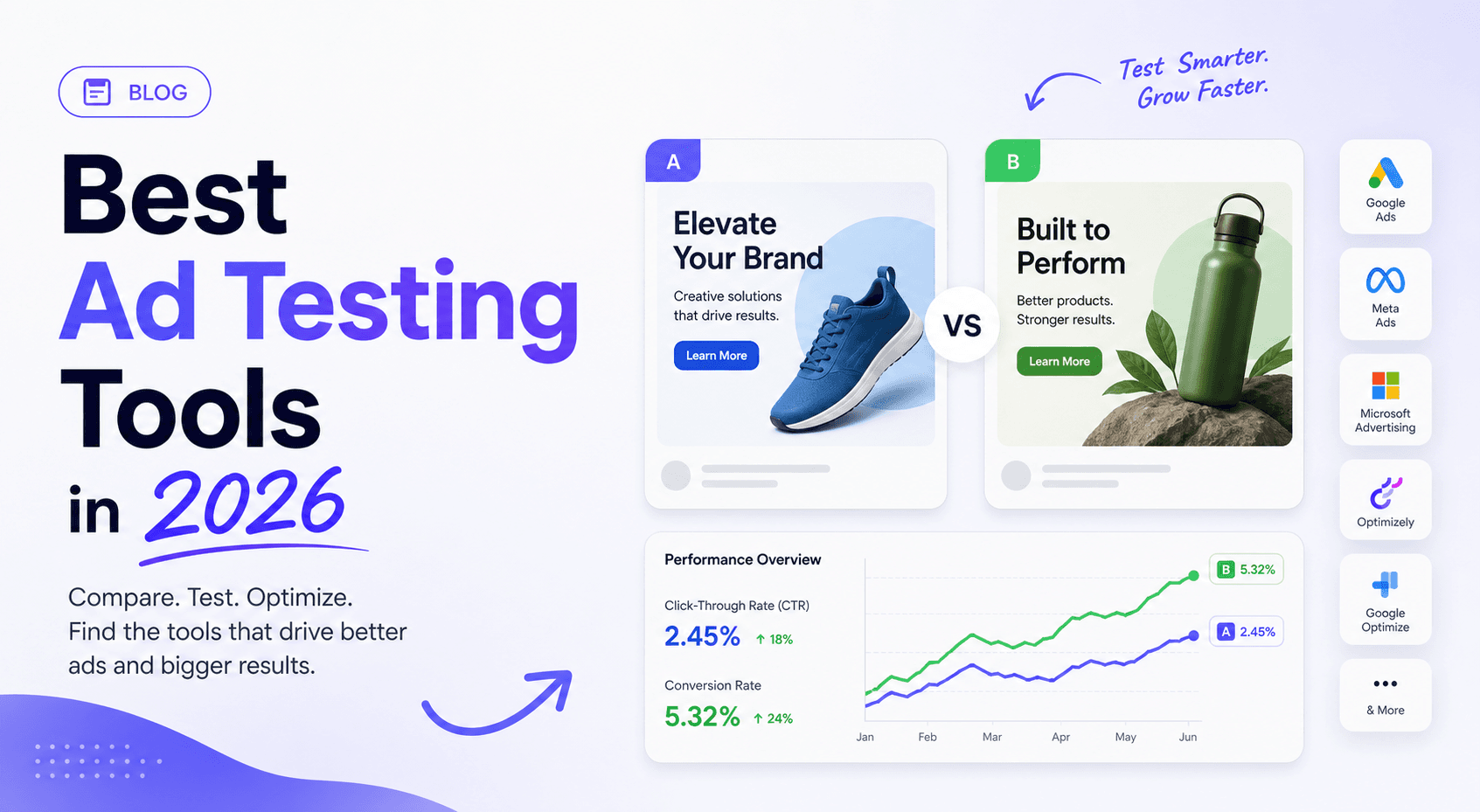
This guide walks you through the exact workflow for video ad variant generation and static creative variation: how to create 100 ad variants in one hour, which tools make it possible, and which testing structure turns volume into performance. If you are deciding which Meta-specific generator or analytics platform to use, compare the options in our best AI tools for Facebook and Instagram ad creatives guide; if you need the performance proof for AI-made assets, use the AI vs human ad creative benchmark. Once the variants exist, the best ad testing tools guide covers the platforms that decide which of them wins. For Shorts-specific creative testing, the YouTube Shorts vs TikTok vs Reels testing guide shows how to allocate variants across short-form channels, while the Performance Max creative guide shows how to feed Google's asset algorithm without random sprawl. If you want an agent to decide which variants to generate next, read the GPT-5.6 Sol ad automation test and the Meta Business Agent guide for how campaign agents and conversation agents change the creative brief.
Why 100 Variants? The Math Behind Creative Testing

One hundred is not an arbitrary number. It is a direct result of modular creative math.
The Hook/Body/CTA modular framework breaks every ad into three interchangeable layers:
- Hook (first 3 seconds): The attention-grabber. A bold claim, a surprising stat, a visual pattern interrupt.
- Body (middle section): The value proposition. Product demo, social proof, problem-agitation-solution.
- CTA (final seconds): The ask. Urgency-based, value-driven, or curiosity-focused.
When you build a library of interchangeable modules for each layer, the combinations multiply fast:
| Hooks | Bodies | CTAs | Total Variants |
|---|---|---|---|
| 3 | 2 | 2 | 12 |
| 5 | 4 | 3 | 60 |
| 5 | 5 | 4 | 100 |
| 10 | 5 | 4 | 200 |
Five hooks, five bodies, and four CTAs give you exactly 100 unique combinations. You are not creating 100 ads from scratch — you are assembling 14 building blocks into 100 permutations. That is the difference between weeks and minutes.
Why This Matters for Performance
Creative fatigue is accelerating. On TikTok, the average ad creative burns out in 7 days. On Meta, top-performing creatives lose 20-30% of their effectiveness within two weeks. The only defense is volume — not random volume, but structured variation that lets you test hypotheses at speed.
Research from Neurons Inc shows that brands using AI-led modular production see a 42-minute time savings per hour of creative work. IBM used this approach with Adobe Firefly to generate 200+ original images with 1,000+ character variations, cutting production from six weeks to two weeks and achieving 26x higher engagement versus their benchmark.
The 5-Step Workflow
Here is the step-by-step process to go from zero to 100 variants in under an hour.
Step 1: Set Up Your Foundation (10 minutes)
Before generating anything, you need three inputs:
Brand assets:
- Logo files, brand colors, font files
- Product images (high-res, multiple angles)
- Any existing templates or style guides
Messaging angles (pick 3-5):
- Pain point: What problem does your product solve?
- Social proof: What results have customers achieved?
- Feature highlight: What makes you different?
- Urgency: Why should they act now?
- Aspiration: What does their life look like after purchase?
Audience segments (pick 2-3):
- Who are your highest-value audiences?
- What language and visual style resonates with each?
- Which platforms will these run on? (Format specs differ)
This step is pure strategy. Skip it, and your 100 variants will be 100 versions of the same mediocre ad.
Step 2: Build Your Modular Library (15 minutes)
Now create the building blocks. For each module type, write out your variants:
5 Hooks:
| # | Type | Example |
|---|---|---|
| 1 | Stat hook | "Brands waste 68% of their ad budget on creatives that never convert." |
| 2 | Question hook | "What if you could test 100 ad versions before spending a dollar?" |
| 3 | Contrarian hook | "The best-performing ad creative is almost never the one your team likes most." |
| 4 | Story hook | "We burned through $40K in ad spend before we figured this out." |
| 5 | Result hook | "This framework cut our CPA by 47% in three weeks." |
5 Bodies:
| # | Angle | Content Focus |
|---|---|---|
| 1 | Problem-agitation-solution | Name the pain, twist the knife, offer the fix |
| 2 | Feature demo | Show the product in action, highlight key differentiator |
| 3 | Social proof | Customer quote, case study data, logos |
| 4 | Comparison | Before/after, us vs. old way, speed contrast |
| 5 | Educational | Teach something valuable, position product as the enabler |
4 CTAs:
| # | Style | Example |
|---|---|---|
| 1 | Urgency | "Start your free trial — offer ends Friday" |
| 2 | Value-driven | "See how much you could save →" |
| 3 | Curiosity | "See what your competitors are running" |
| 4 | Low-friction | "Watch the 2-minute demo" |
That is 14 modules. Combined: 5 × 5 × 4 = 100 unique ad variants.
Step 3: AI Batch Generation (20 minutes)
This is where AI ad generators turn your modular library into finished assets. Feed your brand assets and module library into your tool of choice, and let it render combinations at scale.
For static image ads:
- Upload brand assets and product images (use an AI image upscaler to ensure high-res source files)
- Input each hook/body/CTA combination as a prompt
- Generate multiple visual layouts per combination — an AI thumbnail maker can help produce platform-optimized hero images
- Most tools produce 4-10 visual variations per text prompt
For video ads:
- Use a hook/body/CTA video editor (tools like Sovran or Creatify specialize in this — see our full AI video ad generator comparison for the top options)
- Already have a clip that nearly works? Restyle it — a new grade, a new background, a new time of day — with the AI video editor instead of regenerating from scratch
- No footage? Generate fresh clips from text with a dedicated video model like Seedance 2.0 or the Sora video generator — we scored the main options on cost per variant in Omni Flash vs Veo 3.1 vs Seedance vs Sora
- Upload raw footage or product clips for each module
- The tool automatically stitches combinations and renders
- Add platform-specific formatting (9:16 for Reels/TikTok, 1:1 for feed)
For copy-only variants:
- AI copywriting tools can generate all 100 text combinations in seconds
- Review for brand voice consistency
- Pair with your top 3-5 visual templates
The key: batch generation, not one-at-a-time creation. The tools listed in the next section are built specifically for this workflow.
Step 4: Score and Filter (10 minutes)
One hundred variants does not mean you launch all 100 at once. You need a quality filter.
AI scoring:
Many AI ad generators include predictive scoring — an algorithm that estimates how a creative will perform before you spend a dollar. AdCreative.ai claims 90%+ accuracy on its scoring model across 780,000 assets tested.
Brand review checklist:
- Logo placement correct?
- Colors on-brand?
- Copy free of errors?
- CTA clear and actionable?
- Format specs correct for target platform?
Filter to your test set:
- Take the top 20-30 scored variants
- Ensure diversity: at least 2-3 from each hook type, body angle, and CTA style
- Do not just take the top 20 by score — you want to test different hypotheses, not 20 variations of the same approach
Step 5: Launch, Test, and Iterate (5 minutes to launch)
Structured testing turns volume into insight.
Budget allocation:
- Set aside 10-20% of your total ad budget for creative testing
- Split evenly across your test variants
- Wait for statistical significance before declaring winners (1,000+ impressions or 100+ conversions per variant)
Testing rules:
- Change only one variable per test when possible (e.g., test hooks against each other with the same body and CTA)
- Use the staged testing framework: test hooks first → winning hooks + body variations → winning combos + CTA variations
- Kill losers fast: if a variant has 2x the CPA of your control after 500+ impressions, pause it
- Scale winners gradually: increase budget by 20-30% every 2-3 days to avoid auction penalties
The iteration loop:
Your first 100 variants are not the finish line — they are the starting gun. Use performance data to:
- Identify winning hook types, body angles, and CTA styles
- Generate new modules inspired by winners
- Retire burned-out variants and replace with fresh combinations
Teams running this loop continuously report significant gains. Hatch, a sleep wellness brand, used this modular approach to cut production time by 50%, reduce costs by 97%, and achieve an 80% jump in CTR with 46% higher engagement.
AI Ad Generator Tools That Make This Possible
You do not need one tool to do everything. Most high-performing teams use a combination. If you're specifically optimizing for Meta, start with our roundup of the best AI tools for Facebook & Instagram ad creatives, then layer in the variant-generation workflow below:
| Tool | Best For | Key Strength |
|---|---|---|
| AdCreative.ai | Static ad generation at scale | Predictive scoring across 780K+ assets |
| Creatify | Video ads from product URLs | URL-to-video, e-commerce focus |
| Sovran | Hook/Body/CTA video editing | Modular video assembly, bulk editing |
| Smartly | Full-funnel creative automation | UGC, video, image, display, CTV |
| Celtra | Enterprise creative operations | End-to-end from generation to activation |
| The Brief AI | Bulk editing and resizing | Edit 100 ads at once, one-click resize |
The missing layer: knowing _what_ to create.
Most AI ad generators are excellent at producing assets. But they cannot tell you which messaging angles to test, which audiences are fatiguing, or why your Meta creatives are underperforming while Google converts. That strategic layer — connecting creative decisions to cross-channel performance data — is where Soku fits in.
Soku connects to your entire marketing stack (Meta Ads, Google Ads, TikTok Ads, GA4, Shopify, and more) and acts as an AI agent that surfaces actionable creative insights: "Hook type A is burning out on Meta but still converting on TikTok. Test a social proof angle for your next batch targeting audience segment 3." Pair Soku's strategic intelligence with any generation tool above, and you get a closed loop: insight → creation → testing → insight.
Real Results: What the Data Shows
The shift from manual to AI-powered modular creative production is not theoretical. Here are the numbers:
| Metric | Traditional | AI + Modular | Improvement |
|---|---|---|---|
| Campaign development | 23 days | 5.8 days | 75% faster |
| Creative production cost | Baseline | -41.7% avg | Significant savings |
| Video production (20 variants) | $7,500-$10,600 | ~$99 | 98-99% reduction |
| CTR vs. manual creatives | Baseline | +47% | Facebook + Google combined |
| Conversion rate | Baseline | +28% | Cross-platform |
| ROAS | Baseline | +72% | Cross-platform |
Case study highlights:
- IBM + Adobe Firefly: Generated 200+ original images with 1,000+ character variations. Production cut from 6 weeks to 2 weeks. 26x higher engagement versus benchmark.
- Hatch (sleep wellness): Agency created 3 personas, 3 videos, 60 ad variants. 50% production time reduction, 97% cost reduction, 31% better cost-per-purchase.
- DCO at scale: One brand tested 2,000+ ad variations automatically, achieving a 58% ROAS increase and 30% CPA reduction.
Common Mistakes to Avoid
Creating 100 variants is the easy part. Testing them well is where most teams fail.
1. Testing too many variables at once.
If you change the hook, body, CTA, and visual simultaneously, you have no idea what drove the result. Use staged testing: isolate one variable at a time.
2. Declaring winners too early.
A variant with 200 impressions and a 3% CTR is noise, not signal. Wait for statistical significance — 1,000+ impressions or 100+ conversions per variant at a 95% confidence threshold.
3. Optimizing for vanity metrics.
A creative with high CTR but low conversion rate is a curiosity trap, not a performer. Always optimize for your actual business metric: CPA, ROAS, or revenue.
4. Not killing losers fast enough.
Every dollar spent on an underperforming variant is a dollar not spent on a potential winner. Set clear kill criteria before launch and enforce them.
5. Treating it as a one-time exercise.
The modular framework is a continuous process. Your best-performing hooks today will fatigue in two weeks. Plan for ongoing module creation and variant generation as part of your weekly workflow.
Putting It All Together
The 100-variant workflow is not about flooding platforms with noise. It is a structured approach to creative testing that uses AI to remove the production bottleneck and let performance data drive decisions.
Here is the one-hour timeline:
| Time | Step | Output |
|---|---|---|
| 0:00-0:10 | Foundation setup | Brand assets, 5 messaging angles, 2-3 audiences |
| 0:10-0:25 | Build modular library | 5 hooks + 5 bodies + 4 CTAs = 14 modules |
| 0:25-0:45 | AI batch generation | 100 unique combinations rendered |
| 0:45-0:55 | Score and filter | Top 20-30 variants selected for testing |
| 0:55-1:00 | Launch test campaigns | Structured A/B tests live |
The teams that master this workflow are not just faster — they are systematically better at finding what works. When your competitors are debating one creative brief, you are already on your second round of test results.
Start with the modular framework. Use AI to handle the production. Let performance data tell you what to make next. And if you want an AI agent that connects the dots across all your channels and tells you exactly which creative angles to test — give Soku a try.