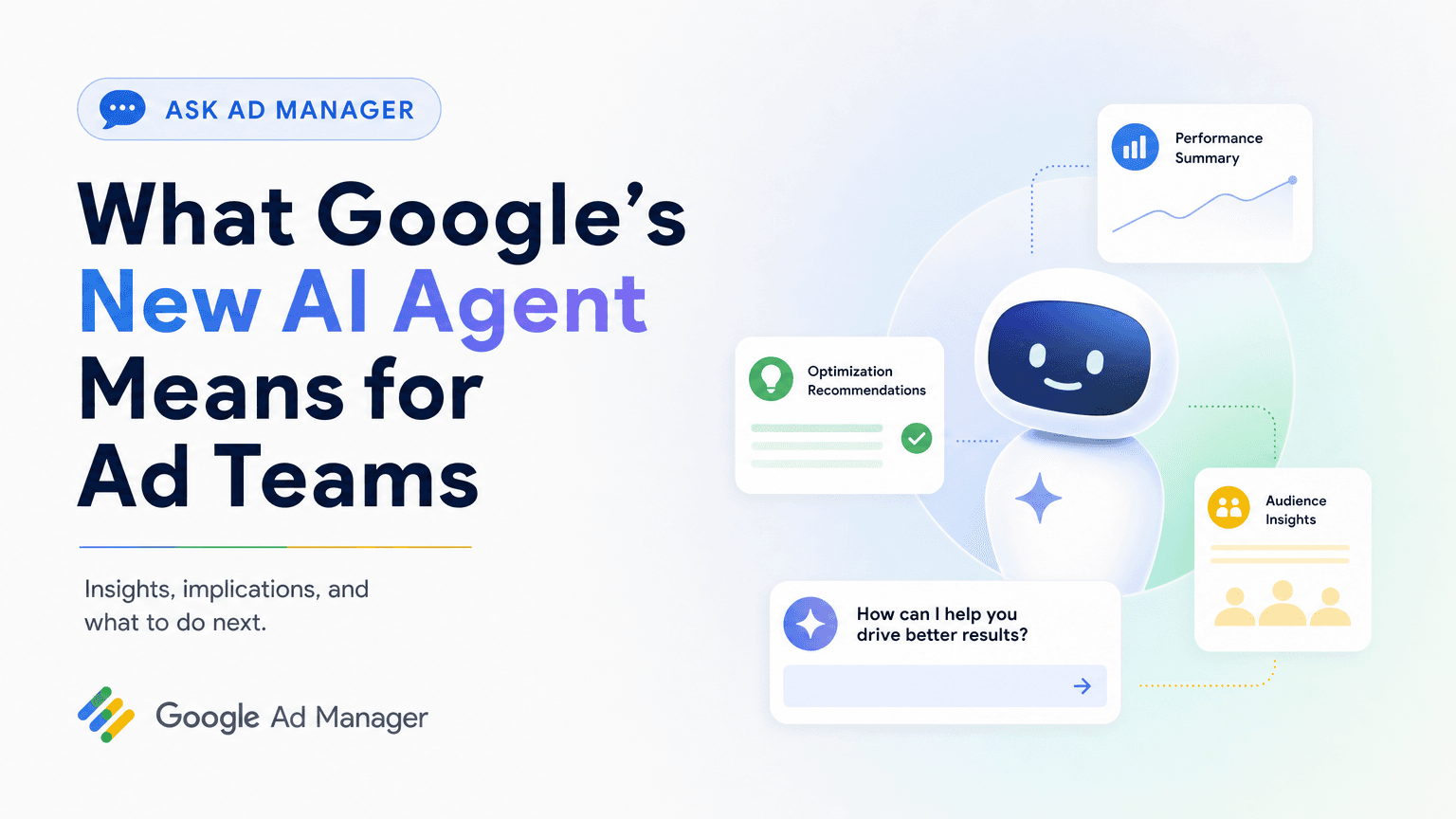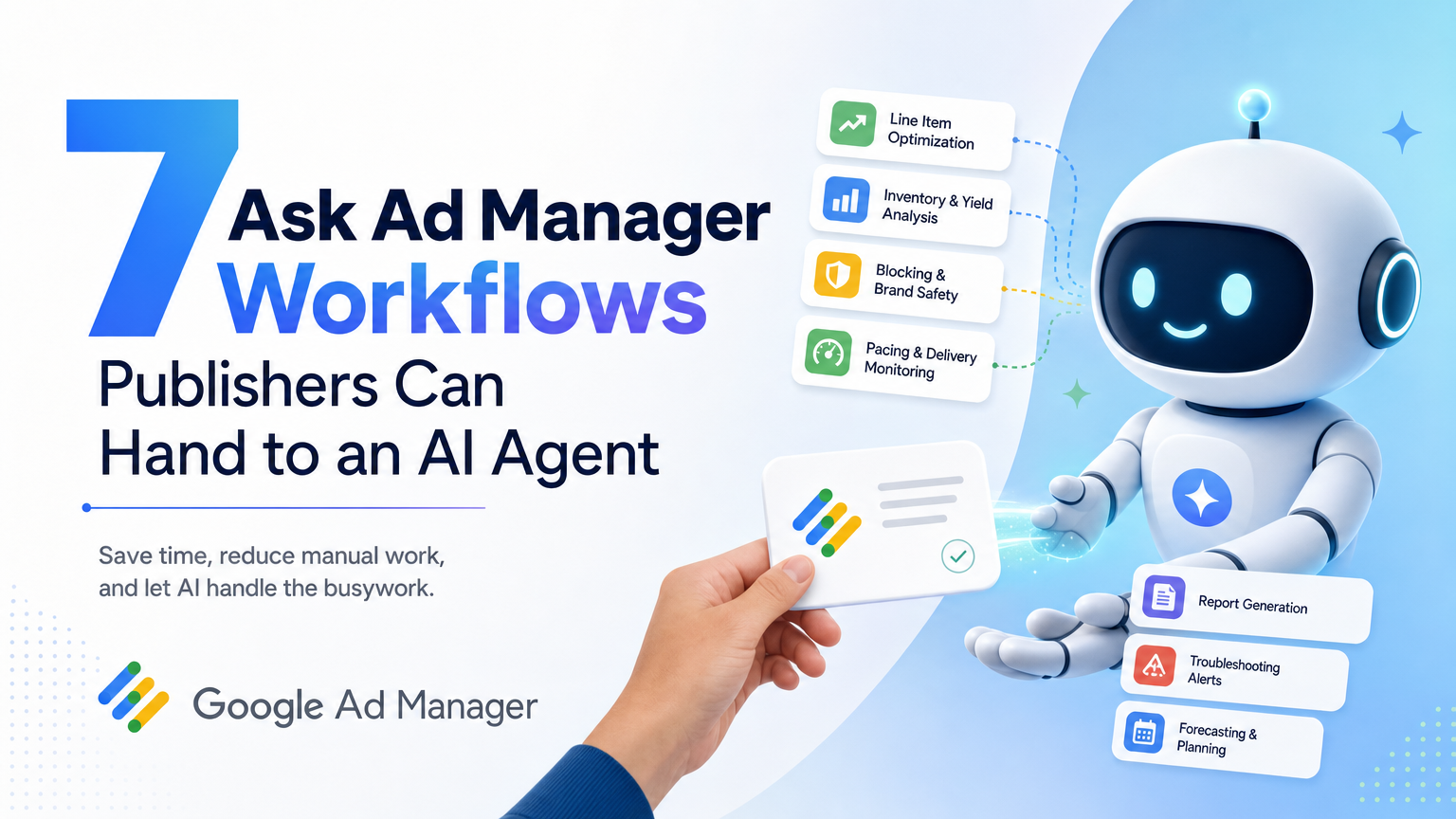
Google's Ask Ad Manager announcement is not valuable because it adds a chat box. It is valuable because the chat box sits near the ad-ops workflows publishers repeat every day: troubleshooting, reporting, navigation, and eventually trafficking.
The mistake would be to treat it as a general assistant. The practical move is to turn repeated operational questions into bounded workflows.
This is the workflow library we would build first.
1. Underdelivery Diagnosis
Prompt shape: Why is order X pacing behind this week, and which constraints are most likely responsible?
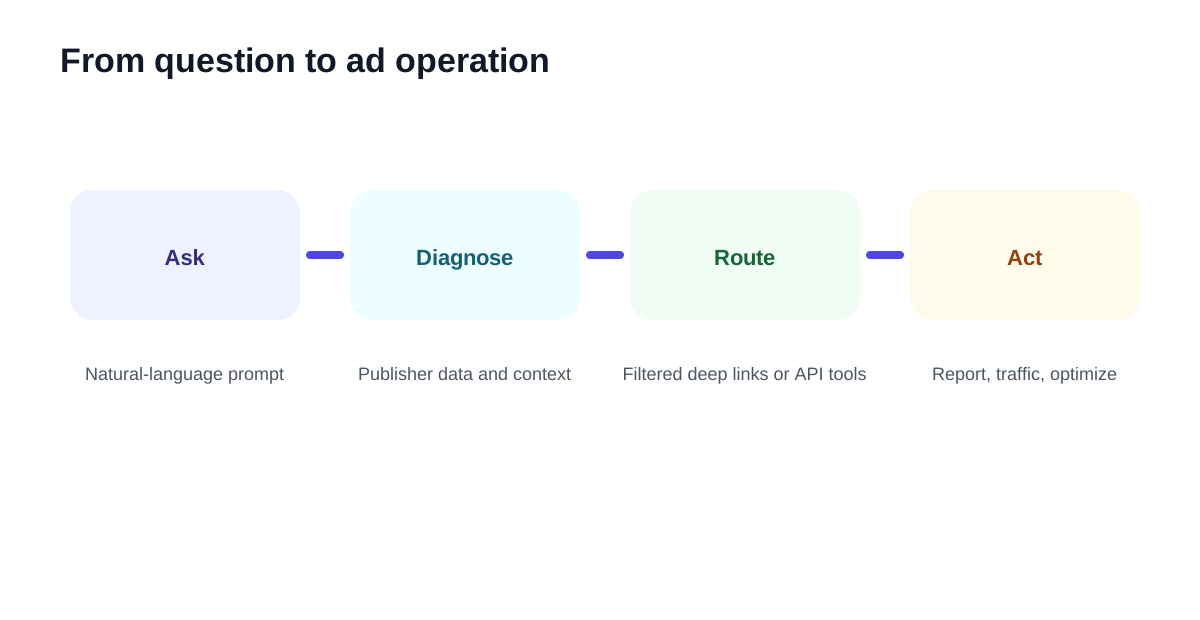
The agent should inspect line-item priority, dates, targeting, creative assignment, inventory availability, and recent performance. The output should not be "increase budget." For publishers, the better output is a ranked diagnosis: targeting too narrow, competing priority, missing creative, low eligible inventory, or reporting lag.
Human checkpoint: approve any priority, targeting, or inventory allocation change.
2. Custom Performance Report
Prompt shape: Show revenue, impressions, fill, viewability, and [CTR](/glossary/ctr) by advertiser, format, and inventory segment for the last 14 days.
This is the most obvious early win. Ad ops teams lose time building one-off reports. Ask Ad Manager can collapse that report-building work into a prompt, then return a table or benchmark.
Human checkpoint: approve export or external sharing.
3. Line-Item QA Before Launch
Prompt shape: Check this line item before launch and flag anything likely to block delivery.
The agent should inspect dates, targeting, creatives, sizes, frequency caps, priority, pacing, and expected inventory. This is a QA assistant, not an autopilot.
Human checkpoint: approve activation.
4. Inventory Availability Forecast
Prompt shape: Can we support a proposal for this audience, placement, and date range?
The value is not just a yes/no answer. The agent should explain which constraint drives the forecast: audience size, placement scarcity, seasonality, competing sponsorships, or creative format.
Human checkpoint: approve forecast language before it reaches a sales team or buyer.
5. Creative Serving Triage
Prompt shape: Which creatives are preventing this campaign from serving correctly?
This should catch missing sizes, rejected creatives, wrong assignments, inactive assets, or mismatched inventory. It is a high-value workflow because creative problems are often simple but time-consuming to find.
Human checkpoint: approve replacement or reassignment.
6. Revenue Anomaly Explanation
Prompt shape: Why did revenue drop yesterday for this section or advertiser?
The agent should compare impression volume, fill, CPM, viewability, demand source, format mix, and major campaign changes. The right output is a ranked explanation with links to the relevant objects.
Human checkpoint: approve corrective action.
7. Navigation With Context
Prompt shape: Take me to the exact settings I need to inspect for this underdelivery issue.
Google specifically called out navigation as a capability. That sounds small, but it is useful because Ad Manager has deep menus and many object types. A context-aware deep link can save a senior operator from five minutes of clicking every time.
Human checkpoint: none for navigation; checkpoint only when a change is made.
The Rule for Delegation
Delegate workflows where the agent gathers evidence, ranks causes, and routes the operator. Keep human approval around anything that changes delivery, revenue, pricing, inventory allocation, or customer-facing commitments.
| Safe early delegation | Keep human-reviewed |
|---|---|
| Reporting, triage, navigation, QA checks | Trafficking writes, priority changes, package commitments |
That boundary is also how Soku thinks about buyer-side agents. Let the agent collect context and propose the move; let a human approve spend or operational risk.
FAQ
What is the best first Ask Ad Manager workflow?
Underdelivery diagnosis is the best first workflow because it is frequent, expensive, and bounded. The agent can collect evidence without immediately changing revenue-critical settings.
Should Ask Ad Manager make trafficking changes automatically?
Not at first. Teams should start with read-heavy diagnostics and human-approved changes until the permission model, audit logs, and tool scopes are proven.
How does this relate to Soku?
Soku diagnoses buyer-side performance across channels. Ask Ad Manager diagnoses publisher-side delivery and inventory. The future workflow connects both sides through bounded, auditable agent actions.