Soku AI
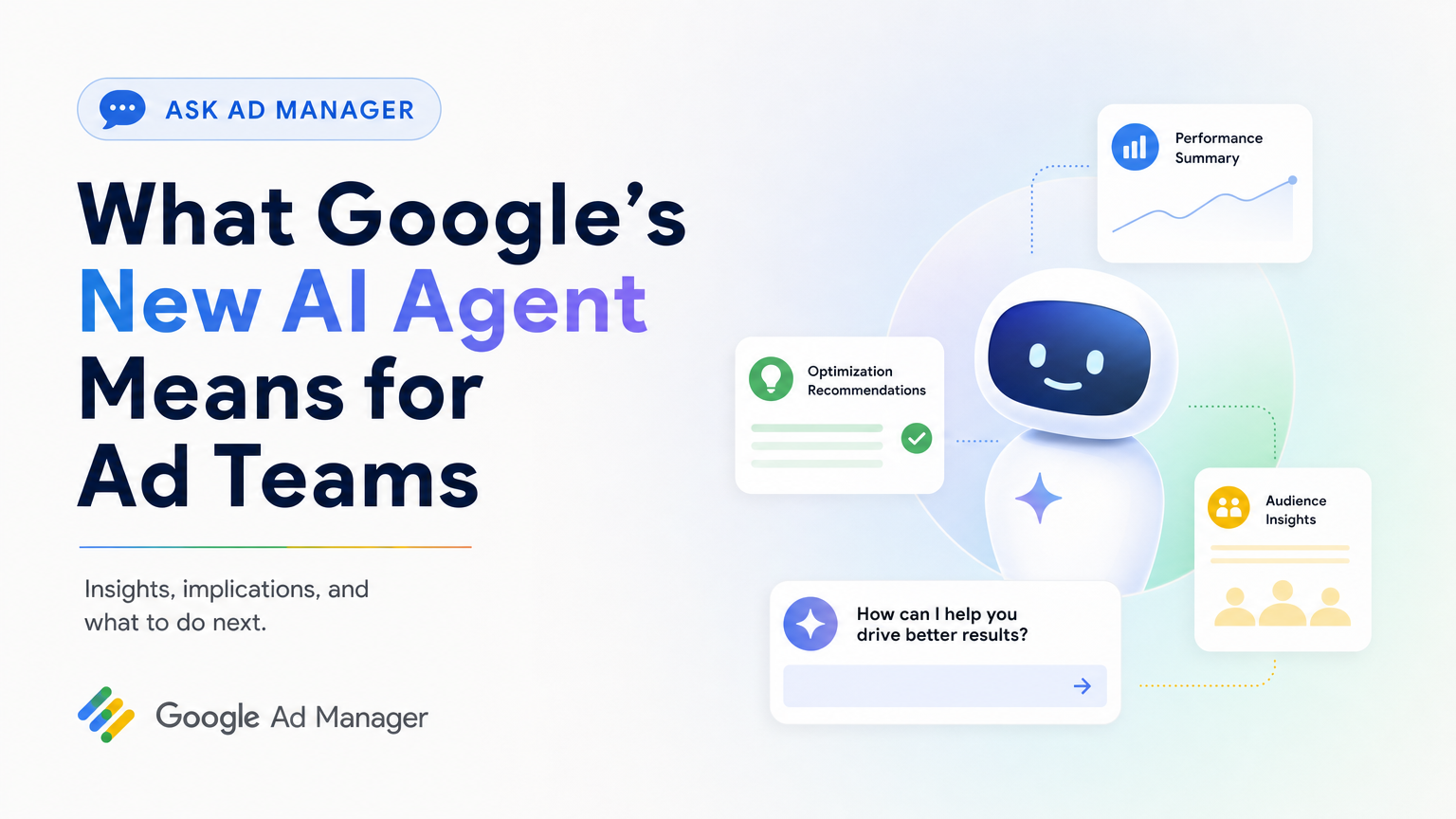
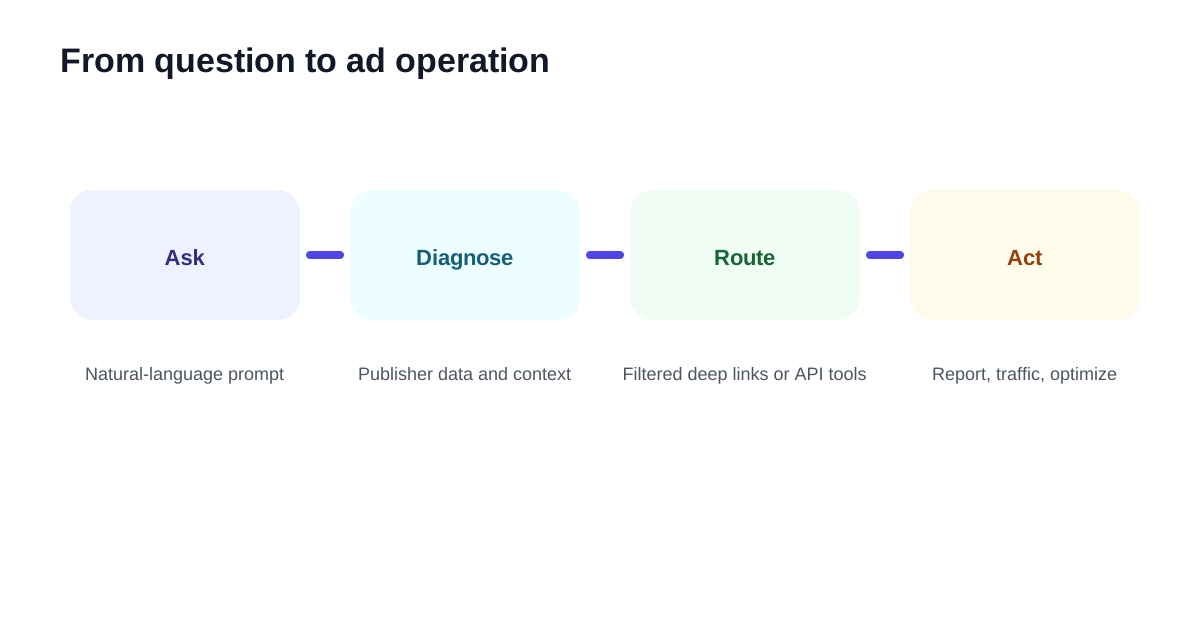
Google quietly made the ad-platform agent race more interesting on June 18, 2026. In a Google Ad Manager announcement, Google introduced Ask Ad Manager, a Gemini-built conversational agent for publishers that can troubleshoot issues, generate custom performance reports, and route users to the right Ad Manager settings.
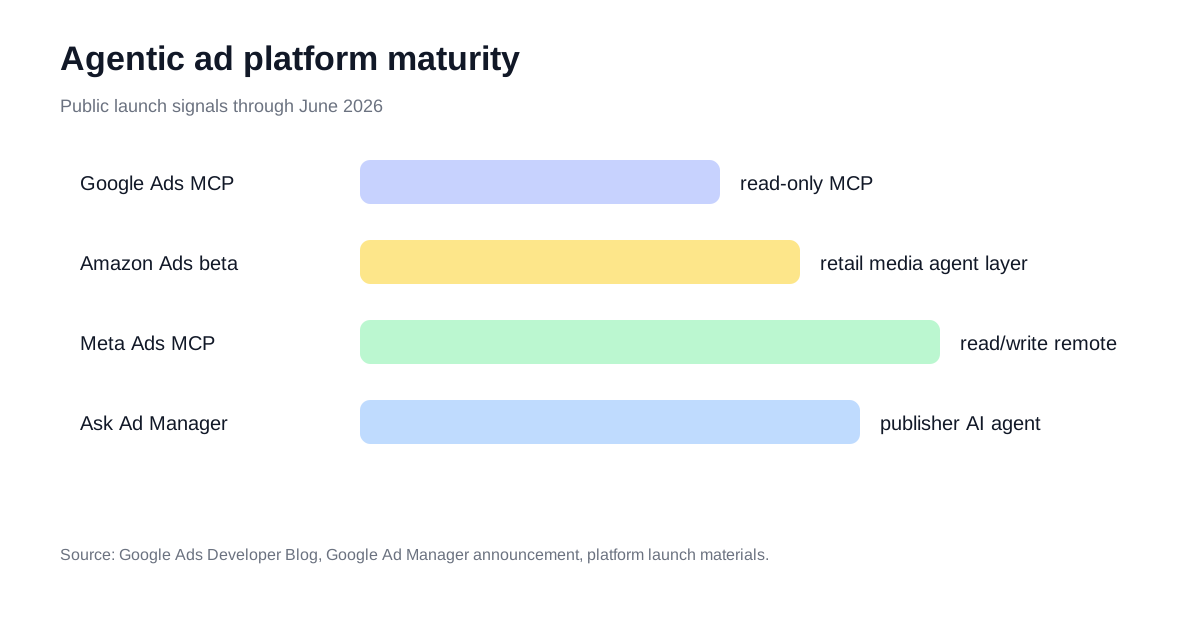
This is not another generic chatbot wrapper. The important detail is where it sits: inside Google Ad Manager, with each publisher's own data, and with future REST APIs and an MCP server planned for trafficking workflows. That puts Ask Ad Manager on the same strategic map as Google Ads MCP, Meta Ads MCP, TikTok Ads MCP, and Amazon Ads' retail-media agent direction.
For the wider map of agentic ad-platform connectors, start with our TikTok Ads MCP guide and Google Ads MCP guide. This post focuses on the publisher side: what Ask Ad Manager changes for ad operations teams.
What Google Announced
Ask Ad Manager is a multi-turn agent built with Gemini. Google says it is designed to help publishers get deeper insights, understand performance, and make decisions faster while using only their own publisher data.
The initial capability set is narrow but practical:
| Workflow | What Ask Ad Manager does |
|---|---|
| Troubleshooting | Diagnose line-item or delivery issues without manually stitching reports together |
| Performance monitoring | Generate custom reports, tables, and benchmarks from prompts |
| Navigation | Send the user to the right settings with context and filters preloaded |
| Future developer layer | REST APIs and an MCP server for key trafficking workflows later in 2026 |
The beta is expected in June 2026, with more skills rolling out through the year. That matters because publisher ad operations are full of fragmented, repetitive decisions: pacing, inventory availability, line-item setup, yield trade-offs, and campaign troubleshooting.
Why This Matters for Marketers
Most AI-in-ads coverage focuses on buyers: campaign creation, budget reallocation, bidding, and creative generation. Ask Ad Manager is different because it starts on the sell side.
If you are an advertiser, that still matters. Publisher operations determine inventory quality, deal execution, forecasting accuracy, and the speed at which campaign issues get resolved. As publisher-side agents mature, buyers should expect fewer manual delays and more machine-readable inventory workflows.
The market is splitting into two agent layers:
| Layer | Examples | Primary job |
|---|---|---|
| Buyer-side agents | Google Ads MCP, Meta Ads MCP, TikTok Ads MCP, Soku AI | Plan, launch, optimize, diagnose spend |
| Publisher-side agents | Ask Ad Manager, future Ad Manager MCP | Forecast, traffic, troubleshoot, package inventory |
Soku sits on the buyer-side operating layer. It needs to understand the publisher-side shift because the same campaign may soon involve one agent negotiating or diagnosing with another.
Ask Ad Manager vs Google Ads MCP
It is tempting to file Ask Ad Manager under the same bucket as Google Ads MCP. Both are Google, both are AI-for-ads, and both point toward agentic advertising. But they solve different jobs.
| Dimension | Ask Ad Manager | Google Ads MCP |
|---|---|---|
| Side of market | Publisher / seller | Advertiser / buyer |
| Primary user | Ad ops, publisher revenue, yield teams | PPC, performance marketing, media buyers |
| First job | Troubleshoot, report, navigate Ad Manager | Query and inspect Google Ads accounts |
| Data context | Publisher inventory, line items, delivery, revenue | Campaigns, ad groups, keywords, assets, performance |
| Write risk | Trafficking, inventory, revenue commitments | Budget, bids, targeting, campaign changes |
| Soku connection | Explains supply-side constraints | Feeds buyer-side diagnosis and action |
The biggest difference is the object model. Google Ads is built around campaigns and demand. Google Ad Manager is built around inventory, orders, line items, creatives, and delivery constraints. Google's planned Ad Manager MCP server would extend this publisher-side layer into developer workflows.
Why the Split Matters
Ad performance problems often cross this boundary. A buyer sees poor delivery, weak placement quality, or unexpected performance. A publisher sees inventory constraints, underdelivery, or trafficking friction. Today, humans translate between those worlds through emails, spreadsheets, screenshots, and support tickets.
Agentic ads make that translation more structured. The future workflow could look like this:
- Soku detects a performance anomaly in the buyer's cross-channel data.
- Google Ads MCP provides campaign/account evidence.
- Ask Ad Manager or Ad Manager MCP explains the publisher-side delivery state.
- A human approves the commercial or operational change.
- The relevant platform tool executes and logs the action.
That is not science fiction. It is the logical result of every ad platform exposing natural-language and MCP-style surfaces.
What Each Layer Should Own
Buyer-side agents should own diagnosis, experiment planning, creative iteration, budget recommendations, and cross-channel trade-offs.
Publisher-side agents should own delivery diagnosis, inventory forecasting, line-item QA, yield explanation, and trafficking support.
The overlap is where the opportunity lives: a buyer-side agent can ask better questions when it understands publisher constraints, and a publisher-side agent can propose better fixes when it understands buyer outcomes.
The First Useful Use Cases
The near-term value is not "AI runs the entire ad business." It is boring, high-frequency operations.
- Ask why a guaranteed line item is underdelivering.
- Pull a custom report by advertiser, inventory segment, and time window.
- Compare performance against a benchmark without building a report from scratch.
- Jump to the exact Ad Manager screen with the right filters already applied.
- Explain which setting or constraint is blocking revenue.
These are the tasks that slow down ad ops teams because they require knowing where data lives. A conversational layer is useful when it shortens the path from "what is wrong?" to "which knob do I change?"
Seven Workflows Publishers Can Delegate First
Ask Ad Manager is only useful if teams know which workflows to hand over. The mistake would be to treat it as a general assistant; the practical move is to turn repeated operational questions into bounded workflows. This is the workflow library we would build first.
1. Underdelivery diagnosis. Prompt shape: Why is order X pacing behind this week, and which constraints are most likely responsible? The agent should inspect line-item priority, dates, targeting, creative assignment, inventory availability, and recent performance. The output should not be "increase budget." For publishers, the better output is a ranked diagnosis: targeting too narrow, competing priority, missing creative, low eligible inventory, or reporting lag. Human checkpoint: approve any priority, targeting, or inventory allocation change.
2. Custom performance report. Prompt shape: Show revenue, impressions, fill, viewability, and [CTR](/glossary/ctr) by advertiser, format, and inventory segment for the last 14 days. This is the most obvious early win. Ad ops teams lose time building one-off reports. Ask Ad Manager can collapse that report-building work into a prompt, then return a table or benchmark. Human checkpoint: approve export or external sharing.
3. Line-item QA before launch. Prompt shape: Check this line item before launch and flag anything likely to block delivery. The agent should inspect dates, targeting, creatives, sizes, frequency caps, priority, pacing, and expected inventory. This is a QA assistant, not an autopilot. Human checkpoint: approve activation.
4. Inventory availability forecast. Prompt shape: Can we support a proposal for this audience, placement, and date range? The value is not just a yes/no answer. The agent should explain which constraint drives the forecast: audience size, placement scarcity, seasonality, competing sponsorships, or creative format. Human checkpoint: approve forecast language before it reaches a sales team or buyer.
5. Creative serving triage. Prompt shape: Which creatives are preventing this campaign from serving correctly? This should catch missing sizes, rejected creatives, wrong assignments, inactive assets, or mismatched inventory. It is a high-value workflow because creative problems are often simple but time-consuming to find. Human checkpoint: approve replacement or reassignment.
6. Revenue anomaly explanation. Prompt shape: Why did revenue drop yesterday for this section or advertiser? The agent should compare impression volume, fill, CPM, viewability, demand source, format mix, and major campaign changes. The right output is a ranked explanation with links to the relevant objects. Human checkpoint: approve corrective action.
7. Navigation with context. Prompt shape: Take me to the exact settings I need to inspect for this underdelivery issue. Google specifically called out navigation as a capability. That sounds small, but it is useful because Ad Manager has deep menus and many object types. A context-aware deep link can save a senior operator from five minutes of clicking every time. Human checkpoint: none for navigation; checkpoint only when a change is made.
The Rule for Delegation
Delegate workflows where the agent gathers evidence, ranks causes, and routes the operator. Keep human approval around anything that changes delivery, revenue, pricing, inventory allocation, or customer-facing commitments.
| Safe early delegation | Keep human-reviewed |
|---|---|
| Reporting, triage, navigation, QA checks | Trafficking writes, priority changes, package commitments |
That boundary is also how Soku thinks about buyer-side agents. Let the agent collect context and propose the move; let a human approve spend or operational risk. The same logic maps every repeated decision to the right surface:
| Decision | Likely agent/tool |
|---|---|
| Why did CPA jump? | Soku plus buyer-side ad APIs |
| Which creative angle should we test next? | Soku plus creative tools |
| Why is this publisher campaign underdelivering? | Ask Ad Manager / Ad Manager MCP |
| Which campaign setting changed? | Google Ads MCP / platform API |
| Which inventory package can support this spend? | Ad Manager MCP once available |
What Is Still Unknown
The announcement does not publish the MCP tool list, REST endpoint shapes, auth model, permission model, or beta availability details. Google also does not say whether the agent will write trafficking changes autonomously or keep humans in the loop.
That distinction matters. A read-only agent is a reporting assistant. A read-write agent is an operator. The future MCP server will decide where Ask Ad Manager lands.
For now, treat Ask Ad Manager as a strong signal, not a complete API surface.
How to Prepare
Publisher and agency teams should prepare in three tracks.
| Track | What to do now |
|---|---|
| Data hygiene | Standardize advertiser, order, line-item, inventory, and custom-targeting naming |
| Permission design | Decide which roles can ask, diagnose, and eventually change trafficking state |
| Agent workflows | Write the prompts your team already repeats: pacing checks, delivery debugging, inventory forecasts |
The teams that benefit first will not be the teams with the fanciest prompt library. They will be the teams whose ad operations data is clean enough for an agent to reason over.
Soku's Take
Ask Ad Manager confirms that ad platforms are becoming agent surfaces, not just dashboards. The next competitive advantage is not knowing where every menu lives. It is knowing which decision should be delegated, which should stay human-reviewed, and how to connect buyer-side performance signals with publisher-side execution constraints.
That is why Soku's operating model matters: one agent to read cross-channel performance, form a diagnosis, and decide which platform-specific agent or API should do the next move.
FAQ
What is Ask Ad Manager?
Ask Ad Manager is Google's Gemini-built AI agent for Google Ad Manager. It helps publishers troubleshoot delivery issues, generate custom reports, and navigate to relevant Ad Manager settings using their own publisher data.
Is Ask Ad Manager available now?
Google said Ask Ad Manager would be available in beta in June 2026, with additional skills rolling out throughout the year.
Does Ask Ad Manager include an MCP server?
Not yet as a public surface. Google said it will release developer tools later in 2026, including REST APIs and an MCP server to support key trafficking workflows.
Is Ask Ad Manager for advertisers or publishers?
It is primarily for publishers and ad operations teams using Google Ad Manager. Advertisers should still care because publisher-side automation affects inventory packaging, troubleshooting, and campaign execution speed.
Is Ask Ad Manager the same as Google Ads MCP?
No. Ask Ad Manager is for Google Ad Manager and publisher ad operations. Google Ads MCP is for Google Ads accounts and buyer-side campaign inspection. They sit on opposite sides of the market, with different object models.
What is the best first Ask Ad Manager workflow?
Underdelivery diagnosis is the best first workflow because it is frequent, expensive, and bounded. The agent can collect evidence without immediately changing revenue-critical settings.