 Soku AI

Google's Gemini Omni Flash launched to developers on June 30, 2026 as a video model you can edit by talking to it. The benchmark crowd is arguing about fidelity versus Veo and Sora. The more useful question for anyone who ships ads is narrower: what does conversational, per-second-priced video actually change about how a creative team works? Three things, concretely — and one thing it deliberately does not change.
For the full model overview, pricing, and limits, start with the complete guide. This piece is about the workflow.
1. Iteration replaces re-rolling
The old text-to-video loop was lossy: you wrote a prompt, got a clip, disliked one thing, changed the prompt, and got a different clip — often losing the parts you liked. Every iteration was a gamble against your own budget.
Omni Flash's Interactions API breaks that loop. Each edit chains off the previous result via a previous_interaction_id, and the model "applies your changes while preserving elements you did not mention." So the loop becomes: generate a near-right clip, then "swap the can for the bottle, keep the lighting" — and the lighting survives.
For a creative team this is the difference between exploration and convergence. You still explore with cheap stills (see point 3), but once a concept is close, Omni Flash lets you walk it to final without starting over. The practical output metric that moves is concept-to-final time, not clips-per-dollar.
2. Budget discipline becomes a real skill, not an afterthought
Because Omni Flash costs $0.10 per second with no free tier (Gemini API pricing), and because each edit turn re-bills per second, sloppy iteration is now a line item. A team that "just keeps tweaking" will spend more editing one hero clip than generating a whole batch of drafts on a budget model.
That flips the creative economics. The winning pattern is:
- Diverge cheap. Explore the concept space in stills, not video.
- Animate the survivors only. Move to Omni Flash for the handful of frames that already work.
- Converge in few, deliberate edit turns. Each turn is a paid render — treat it like one.
Teams that internalize this ship faster and cheaper. Teams that don't will quietly burn budget on fiddling. The skill that used to be "prompt engineering" is now "knowing when to stop editing."
3. The still-first pipeline becomes standard
Google shipped Nano Banana 2 Lite next to Omni Flash on purpose. Lite renders 1K stills in ~4 seconds at $0.034 each — cheap enough to generate dozens of directions before you spend a cent on video. The intended flow, and the one ad teams should adopt as default, is: ideate the frame → animate the winner → refine by chat.
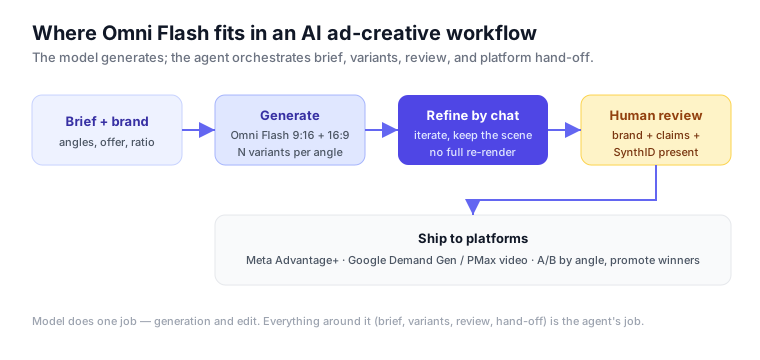
This is a genuine org change, not just a tooling one. It means your ideation surface (stills) and your production surface (video) are different models with different costs, and the handoff between them is where creative judgment lives. The person who picks which still gets animated is doing the highest-leverage work in the pipeline.
4. What it does NOT change: the human gate still owns brand and claims
Conversational editing makes it dangerously easy to generate a polished, on-brand-looking clip in minutes. That raises — not lowers — the stakes on review. Two non-negotiables:
- Brand and claims review stays human. A model that faithfully "keeps the scene" will also faithfully keep a wrong logo lockup or an unsubstantiated claim. Faster generation means more to review, not less.
- Check the SynthID watermark. Every Omni Flash clip carries an invisible SynthID watermark, verifiable in the Gemini app, Chrome, and Search. For AI-disclosure-sensitive categories, confirming the watermark is present is now part of QA.
The model got faster at generating. Your obligation to review what ships did not get smaller.
Where the ad agent fits
Notice that only one step in that whole workflow is the model's job: generate and edit the clip. Everything else — turning a brief into prompts, fanning variants across angles and ratios, enforcing the human gate, checking SynthID, and pushing approved cuts into Meta Advantage+ or Google Demand Gen with proper naming and attribution — is orchestration.
That orchestration is the actual product an AI ad team runs on. The model is a capability you rent by the second; the agent is the operating system that turns it into shipped, measured ads. This is the same lesson from evaluating the best AI tools for Meta ad creative: the tool is never the strategy, and the team that wins is the one with the tighter loop around the tool.
Soku runs Omni Flash inside that loop — brief in, still-first ideation, conversational refinement, a human gate before spend, and platform hand-off with attribution — so a faster model becomes a faster program, not just a faster clip.
The bottom line
Omni Flash's contribution to ad teams isn't fidelity — it's a new production loop: diverge in stills, converge in conversation, gate before you ship. The teams that restructure around that loop turn the model's iteration speed into more shipped variants per week. The teams that treat it as a fancier text-to-video box will overpay to fiddle.
Next: see how it actually stacks up against Veo, Seedance, and Sora for ad work, or go straight to the setup guide.