 Soku AI
Every "best AI video generator" list ranks these models on cinematic fidelity. Ad creative has different priorities: cost per variant, native vertical ratios, how fast you can fix a near-right clip, and whether the output is safe to run. So we scored Gemini Omni Flash, Veo 3.1 Fast, Seedance 2.0, and Sora 2 on the criteria that actually decide an ad program — not a film festival. If the clip you already have is close and only the look is wrong, fixing it in the AI video editor is usually cheaper than regenerating it on any of them.
For the full Omni Flash overview and pricing, see the complete guide. This is the shootout. If you are shopping for a finished ad tool rather than a raw model, the companion shortlist of the best AI video ad generators for Facebook and TikTok covers the products built on top of these models.
How we scored it (for ads, not films)
Five criteria, weighted the way a paid-social team would weigh them:
- Variant economics (30%) — real cost to produce many angles × ratios, since that's what testing demands.
- Editing / iteration (25%) — how cheaply you can converge a near-final clip.
- Ad-native ratios (15%) — first-class 9:16 and 16:9.
- Fidelity & resolution (20%) — output quality and max resolution.
- Safety & availability (10%) — watermarking, disclosure, and whether it's actually shippable today.
The scores
| Model | Variant econ. | Editing | Ratios | Fidelity | Safety/avail. | Overall for ads |
|---|---|---|---|---|---|---|
| Gemini Omni Flash | 3/5 | 5/5 | 5/5 | 3/5 | 5/5 | Best for converging concepts |
| Veo 3.1 Fast | 3/5 | 3/5 | 5/5 | 5/5 | 5/5 | Best for high-fidelity hero clips |
| Seedance 2.0 Fast | 5/5 | 3/5 | 4/5 | 3/5 | 4/5 | Best for high-volume variant testing |
| Sora 2 | — | — | — | — | 1/5 | Deprecated — not a production path |
The scores encode a simple truth: no model sweeps. Pick by the constraint that dominates your program.
Cost: the number that actually decides batches
At the per-second level the top models are nearly tied — Omni Flash $0.10, Veo 3.1 Fast ~$0.09, Veo 3.1 Lite $0.05, and Seedance 2.0 Fast $0.022 (Gemini API pricing; published 2026 Veo/Seedance rates). But ads aren't billed by the clip — they're billed by the batch.
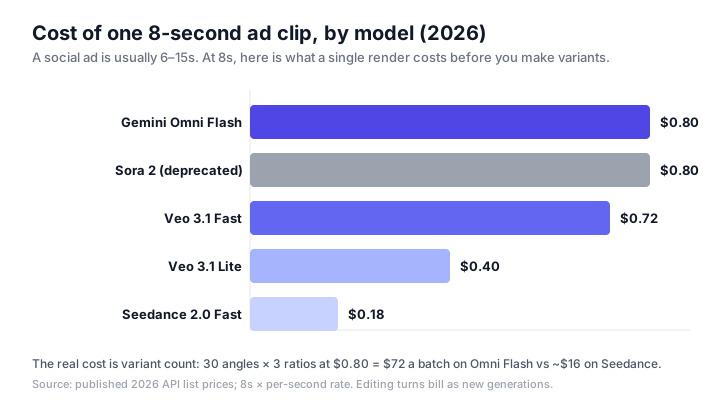
At 8 seconds, a 30-angle × 3-ratio test costs ~$72 on Omni Flash and ~$16 on Seedance. That 4.5× gap is the whole argument. If your edge is volume — throwing many concepts at the platform's algorithm and letting it find winners — the budget models win outright. If your edge is craft — a few strong concepts walked to final — Omni Flash's editing more than pays back its premium. This is why variant economics and editing pull in opposite directions in the scores.
Editing: where Omni Flash is genuinely alone
This is Omni Flash's moat for ad work. Its Interactions API chains edits with previous_interaction_id and preserves what you don't mention — so "keep the model, change the background to a kitchen" is one instruction, not a re-roll. Veo and Seedance are strong generators, but iterating a near-final clip on them still means regenerating and hoping the good parts survive.
For ads, "the client wants the same spot but with the summer packaging" is a weekly request. On Omni Flash that's an edit turn. On the others it's a re-shoot. That single workflow difference is worth more to most teams than a resolution bump — which is why editing carries 25% of the weight here.
Fidelity: where Veo pulls ahead
Omni Flash caps at 720p; Veo 3.1 reaches up to 4K and ships native audio. For feed-native social — Reels, Shorts, Stories, in-feed — 720p is genuinely fine; those placements compress hard anyway, and the platform-side toolset matters more than the raw model does once you are inside a feed (we break that down in how the AI features compare on YouTube Shorts versus TikTok). For anything large-format, connected-TV-adjacent, or where a client will pixel-peep, Veo's headroom is the reason it scores 5/5 on fidelity. Don't pay Omni Flash's editing premium for a placement that needs Veo's resolution.
Ratios and safety: table stakes both clear
Both Omni Flash and Veo 3.1 ship 9:16 and 16:9 natively — the two ratios that cover essentially all paid social. Seedance handles vertical well but its ratio controls are a notch less first-class, hence 4/5. On safety, Omni Flash and Veo both carry SynthID watermarks verifiable across Google surfaces, which matters as platforms tighten AI-content disclosure. Sora 2 scores a 1 for one blunt reason: it's deprecated for new projects — no matter how it once looked, you can't build a 2026 production workflow on it.
The verdict: match the model to the job
- Converging a near-final concept, or handling frequent "same spot, one change" edits? → Gemini Omni Flash. Its editing is worth the premium.
- Need maximum fidelity, 4K, or native audio for a hero asset? → Veo 3.1 Fast.
- Running a high-volume variant test where the algorithm picks winners? → Seedance 2.0 Fast on cost.
- Considering Sora 2? → Don't, for anything new — it's off the table.
Most serious programs end up multi-model: Seedance for volume drafts, Omni Flash to converge the survivors, Veo when a placement demands resolution. The differentiator isn't which single model you standardize on — it's how tight your loop is around all of them. That orchestration is exactly what an AI ad agent handles, and it's the same lesson from ranking the best AI tools for Meta ad creative: the tool is never the strategy.
Ready to build with it? The Gemini Omni Flash guide walks through setup for Meta and Google Ads.