 Soku AI
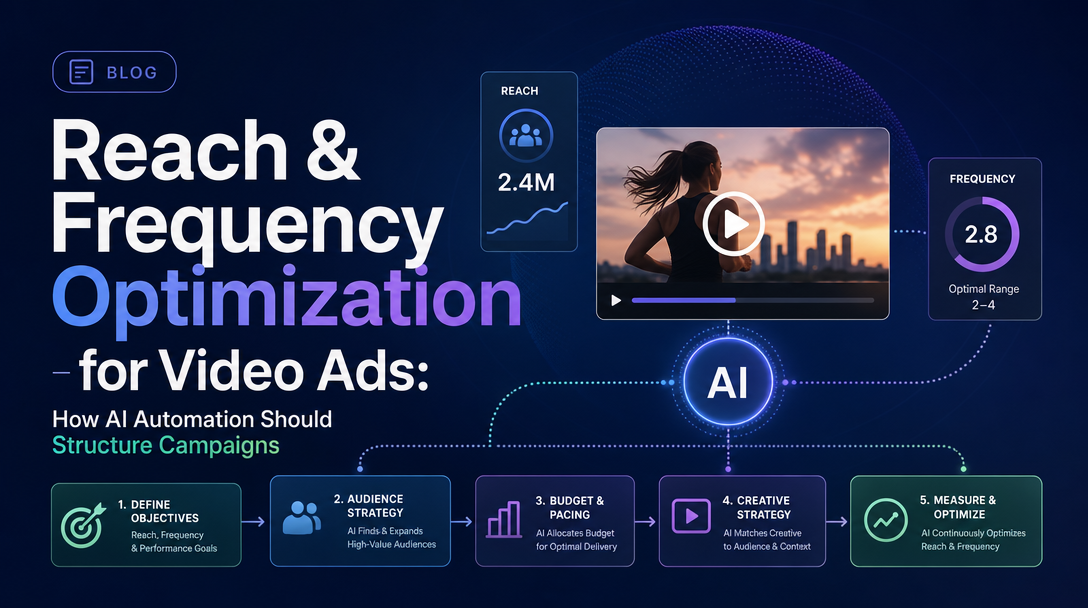
Most guides treat reach and frequency optimization as a slider: pick a frequency cap, set a reach goal, done. That framing is why so many video accounts quietly waste budget. Reach and frequency aren't two dials you tune in isolation — they're a single economic tradeoff on a fixed budget, governed by a curve with a sharp peak and a punishing tail, and the level you set them at almost never matches what a real viewer experiences. The moment you run more than one campaign against overlapping audiences, per-campaign settings stop describing reality.
This post is about the version of the problem that actually matters for anyone automating video spend: not "what number do I type," but "at what level of the account should reach/frequency intent live, and how do I measure whether I hit it." It's the tuning companion to our complete guide to Video campaign groups — the pillar covers what changed and why; this one covers the optimization math and the automation architecture underneath it. The target reader is building or operating an AI ad system and wants the model right, not a glossary.
Reach and frequency are one tradeoff, not two settings
Start with the constraint everyone forgets: for a fixed budget and CPM, reach and frequency are inversely coupled. Every impression you spend showing your ad to someone a second, third, or fourth time is an impression you did not spend reaching a new person. Frequency buys depth against a smaller audience; reach buys breadth at shallower exposure. You cannot maximize both — you're allocating the same finite pool of impressions between them.
That's why "set a high frequency cap and a big reach goal" is incoherent as an instruction. It's like asking for a portfolio that's simultaneously all-cash and fully invested. The real question is the shape of the allocation: how many exposures does a viewer need before the ad works, and at what point do additional exposures stop paying back? Answer that, and reach-versus-frequency stops being a preference and becomes an optimization with a defined objective. Get it wrong in either direction and you lose money — too little frequency and the message never lands; too much and you're burning budget re-serving people who converted (or tuned out) three impressions ago.
The effective-frequency curve: how many exposures the ad actually needs
The lower bound of the useful range has a name and a fifty-year pedigree. In 1972, researcher Herbert Krugman argued that a viewer needs roughly three exposures to process an ad — one to notice it, one to evaluate its relevance, one to act as a reminder — and that psychologically there's no distinct "fourth exposure," only repeats of the third. That idea grew into the concept of effective frequency: the minimum number of exposures required before an ad produces a meaningful response. In planning practice, effective frequency is usually set somewhere between 3 and 7, varying by category, creative format, and competitive noise.
Google's modern data lands right inside that classical range. Its Meridian marketing-mix study of roughly 600 US brands (2023–2025) found an optimal frequency near 2.7 exposures per week, tied to a 19% lift in ROI. Google's own target-frequency tests reported a 93% higher ad-recall lift at 40% cheaper cost per lifted user versus non-optimized delivery, and it says over 95% of Target frequency campaigns hit their frequency goal when set up to best practice. The through-line from Krugman to Meridian: there is a real threshold below which video spend underperforms because the message never accumulates. Reach without enough frequency is impressions that don't convert into memory.
The fatigue tail: where additional frequency destroys ROI
The upside of the curve is only half the story, and it's the half most "reach and frequency" content skips. Push past the effective range and the curve doesn't just flatten — it turns negative. Nielsen's TV benchmarks, cited by Social Media Today, show brand ROI dropping 22% once viewers see an ad more than 5 times a week, and 41% past 6+ exposures. Broader recall research points the same way: Kantar's analysis of large campaign sets finds recall and purchase-intent gains flattening sharply at high average frequency, so beyond that threshold the same budget generates diminishing — then negative — returns. Over-frequency isn't neutral wasted spend; an annoyed viewer is a worse outcome than an un-reached one.
Put the two halves together and you get the actual optimization target: a narrow productive band, roughly the 2.7-per-week peak, flanked by an underexposed zone on the left and a fatigue zone on the right. The chart below is the shape every video-frequency decision is really fighting over — the incremental ROI each successive weekly exposure contributes, and the cumulative ROI that peaks and then declines as fatigue sets in.
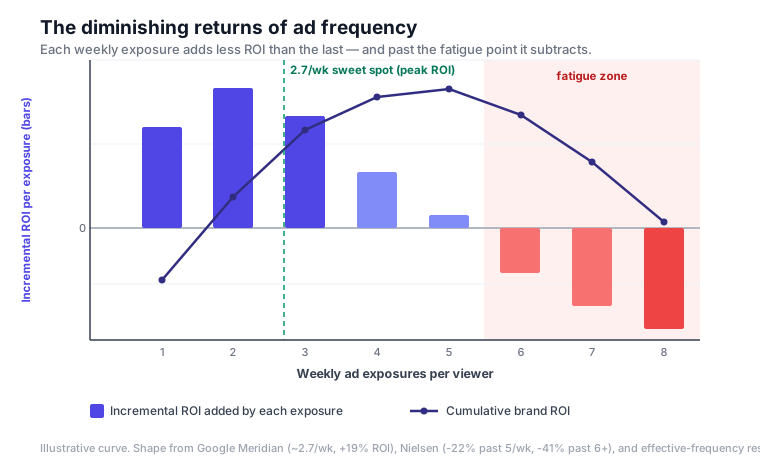
Notice what the marginal view exposes that an average can't: by the sixth or seventh weekly impression, each additional exposure has negative incremental value — it's actively pulling ROI down even while your average frequency still looks reasonable. The difference between the peak and the fatigue zone is only a couple of impressions per person per week. That tight tolerance is exactly why frequency has to be governed at the level the viewer experiences it — and why the way most automation structures campaigns makes hitting the band nearly impossible.
Why per-campaign frequency caps fail at the account level
Here's the structural flaw that no per-campaign setting can fix: a frequency cap is blind to every campaign except its own. For years, reach and frequency on YouTube lived at the campaign level. Run an awareness campaign, a retargeting layer, and a Shorts-first burst against broadly the same audience — the standard playbook — and you set a cap on each. A cap of 3/week on the awareness campaign has no idea the same person also sits in the retargeting pool capped at 3/week and the Shorts campaign capped at 3/week. For a viewer in the overlap of all three, "3/week" silently becomes up to 9/week — deep in the zone where Nielsen says each impression is destroying 22–41% of return.
Every campaign-level report looks disciplined. The viewer's real experience is triple the dose you thought you set. This is the account-level failure mode, and it has two costs that compound:
- Frequency overshoot on overlapping viewers. The people most likely to be in multiple campaigns are your highest-intent audience — exactly the ones you least want to fatigue. Per-campaign caps concentrate over-exposure on your best prospects.
- Wasted reach. Every impression spent re-serving an already-saturated overlapping viewer is one not spent reaching a new person. Overlap doesn't just over-serve; it quietly caps your unique reach below what the budget could have bought. In incremental-reach terms, two channels each "reaching a million" might only reach 1.5 million combined — the incremental reach of the second is far smaller than its raw number implies, and the duplicated half is pure waste.
Teams have papered over this with audience exclusions (brittle, and they suppress reach you wanted) and post-hoc deduplication (tells you what happened last month, governs nothing this week). Neither fixes the root cause, because the root cause is where the intent lives. Frequency is a property of the viewer; a per-campaign cap tries to govern it one campaign at a time. The math can't work.

The core thesis: one reach/frequency intent per audience-overlap group
So here's the design principle an AI ad-automation system should be built on: express one reach/frequency intent per audience-overlap group — not per campaign — and measure the sum.
The unit of reach/frequency structure is not the campaign and not the whole account. It's the audience-overlap group: the set of campaigns that hit substantially the same viewers. Within that group, frequency should be governed exactly once, because the viewer experiences the group's combined delivery as a single stream of impressions. Campaigns underneath the group stay independent on budget, creative, and bid — that's where they should specialize — but they stop each carrying a private frequency cap that's blind to its siblings.
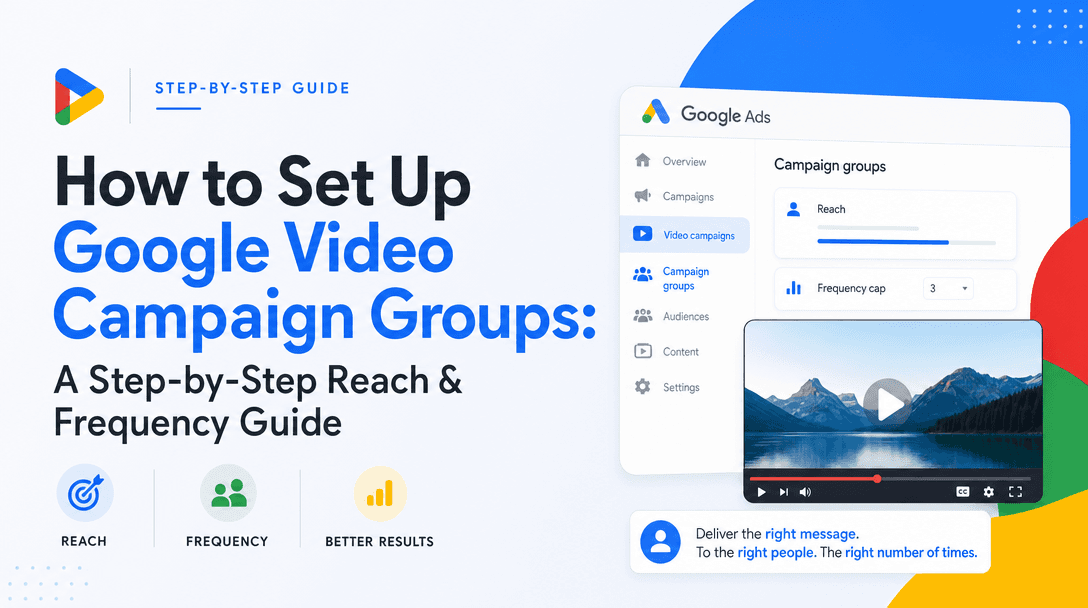
Google's Video campaign groups are the platform primitive that finally makes this expressible: one reach or frequency goal set on the group, optimized across all its campaigns, with native reporting on unique reach and average weekly impressions. But the principle is platform-independent — it's how any automation should model the problem. The diagram below is the loop an AI system should run:
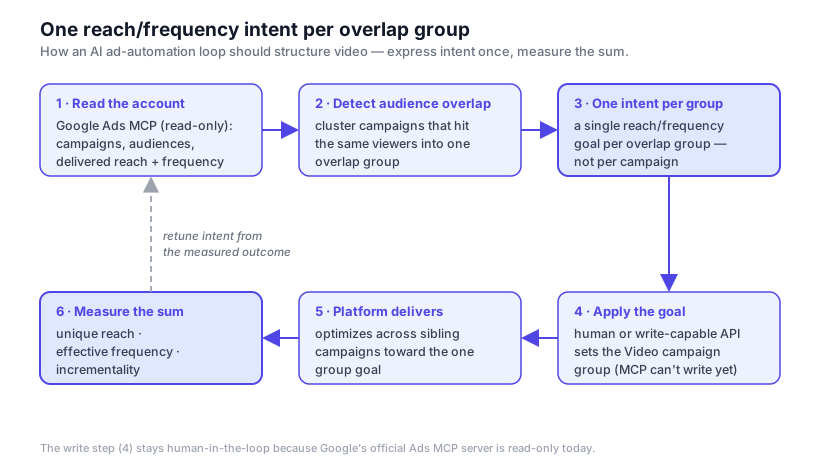
Two steps in that loop are the hard, high-value ones — and neither is "type a number":
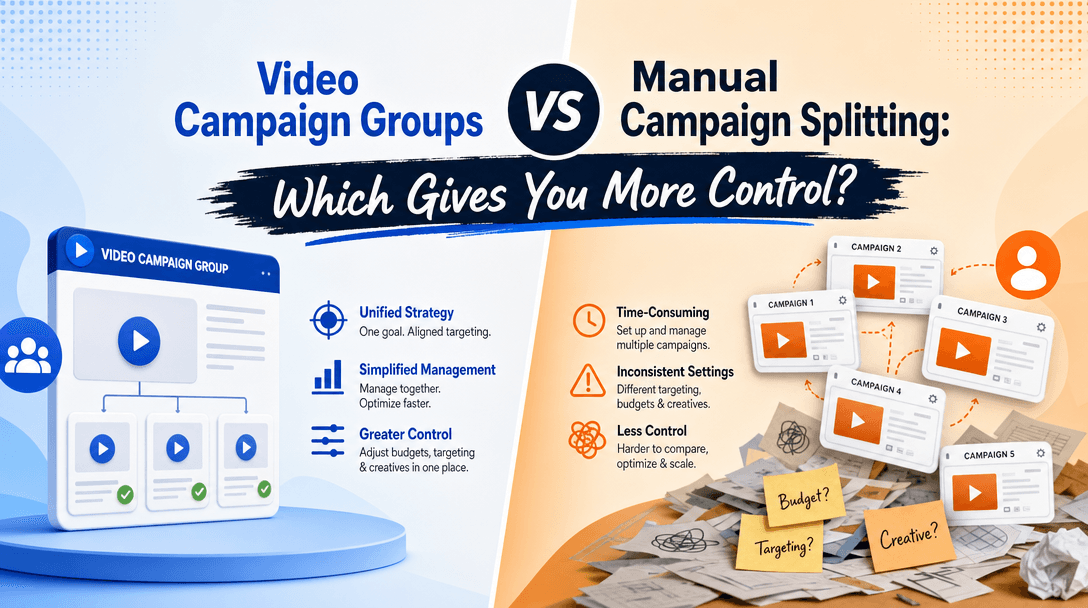
- Detecting overlap (step 2). Deciding which campaigns belong in the same group is an audience-overlap judgment, not an objective or naming convention. Two campaigns can share an objective and target totally different people (group them and you suppress reach); two can carry different objectives and hit the same people (leave them apart and you stack frequency). This clustering is precisely where an analytics or AI layer earns its keep, and it's the decision we break down against the alternative in Video campaign groups vs. manual campaign splitting.
- Setting the intent from economics, not habit (step 3). The group's frequency goal should be anchored to the effective-frequency band — the ~2.7/week peak for multi-format — not ported over from a legacy per-campaign cap that was never meant to be summed. Google's supported target frequencies land in the 2–7/week range for multi-format and 2–4/week for single-format; the productive start is 2–3/week. The hands-on version of dialing this in lives in our step-by-step setup guide.
Measure the sum: unique reach, effective frequency, incrementality
An intent you can't verify is a guess. The other half of the thesis is that automation must measure the group's summed outcome, not the pieces — because the pieces were always the problem. Three metrics, in order of how directly they tie to money:
- Unique reach (deduplicated). How many distinct humans the group actually reached, counted once across all its campaigns. This is the number per-campaign reporting could never give you cleanly, and it's the denominator for everything else. Track it on a rolling 7–30 day window, not lifetime totals — frequency is a weekly phenomenon and lifetime averages hide the tail.
- Effective frequency (the distribution, not the average). Not "what's our average frequency" but "what share of reached viewers sat inside the productive band versus underexposed versus fatigued." An average of 3 can hide a long tail of viewers at 8+. Reading the frequency distribution is the only way to see over-serving — and it's the metric the whole structure exists to control.
- Incrementality. The end of the chain: how many conversions the exposure actually caused versus what would have happened anyway. Incrementality measurement isolates lift by comparing an exposed group against a comparable control — the discipline that separates frequency that built demand from frequency that merely re-touched people who'd already decided. It's also where the fatigue tail shows its true cost: past the effective band, incremental conversions per impression collapse even as impressions keep billing.
Unique reach tells you who you reached, effective frequency tells you how the exposure was distributed, and incrementality tells you whether it worked. Optimize the sum of those three at the overlap-group level and you're actually running reach/frequency optimization. Report a per-campaign average frequency and you're describing a viewer who doesn't exist. For the broader question of tying this exposure data back to business outcomes, see our guide to how to measure AI ad-creative ROI.
How Soku fits
The two hardest judgments in this whole model — which campaigns overlap on the same viewers, and what frequency intent to declare for each group — are exactly the ones the platform leaves to you. That's the layer Soku is built for. It reads how your existing YouTube campaigns overlap on audiences, recommends which ones belong under a single shared reach/frequency goal, sets the intent against the effective-frequency band rather than a legacy cap, and then monitors the summed outcome — unique reach, the frequency distribution, and downstream lift — so you catch an underbid or a fatigue drift before it wastes a week of budget.
One honest constraint shapes how that runs today: Google's official Ads MCP server is read-only, so an agent connected through it can read group-level reach and frequency but can't yet create or edit the group structure itself. That's why the architecture above keeps step 4 human-in-the-loop — the agent detects the overlap, recommends the grouping and the target, a human (or a write-capable API script) applies it, and the agent monitors delivery against intent. The highest-leverage automation right now is the analysis and the recommendation, not a fully autonomous "build my groups" button.
The takeaway is the same one that runs through this whole cluster: reach and frequency optimization isn't a slider you set on a campaign. It's a structure you express once per group of overlapping viewers, and a sum you measure — unique reach, effective frequency, incrementality — instead of a per-campaign average that no real person ever experienced.
FAQ
What is effective frequency, and what number should I target? Effective frequency is the minimum number of exposures a viewer needs before the ad produces a meaningful response — classically 3–7, per effective-frequency research. For YouTube video today, anchor to Google's Meridian finding of a ~2.7/week peak tied to a 19% ROI lift, and start a multi-format group at 2–3 weekly exposures.
Why can't I just set a frequency cap on each campaign? Because each cap is blind to the others. A viewer in the overlap of three campaigns each capped at 3/week can see up to 9/week — deep in the fatigue zone where Nielsen data shows ROI dropping 22–41%. Frequency has to be governed at the level the viewer experiences it: the group of overlapping campaigns, not the individual campaign.
What does "measure the sum" actually mean? Report the deduplicated outcome across all campaigns in an overlap group — unique reach, the frequency distribution (not just the average), and incremental conversions — rather than each campaign's isolated numbers. The per-campaign view is what hid the over-serving in the first place.
Can an AI agent run this optimization end to end? Not entirely, yet. Google's Ads MCP is read-only, so an agent can read reach/frequency and recommend the grouping and target, but a human or write-capable API applies the structure. The durable pattern is recommend-then-verify, with the agent monitoring delivery against the intent.
How is this different from just using Video campaign groups? Video campaign groups are the platform mechanism; reach/frequency optimization is the decision about how to use it — which campaigns to cluster by overlap and what frequency band to target. The setup guide covers the build; this post covers the optimization model behind it.