 Soku AI
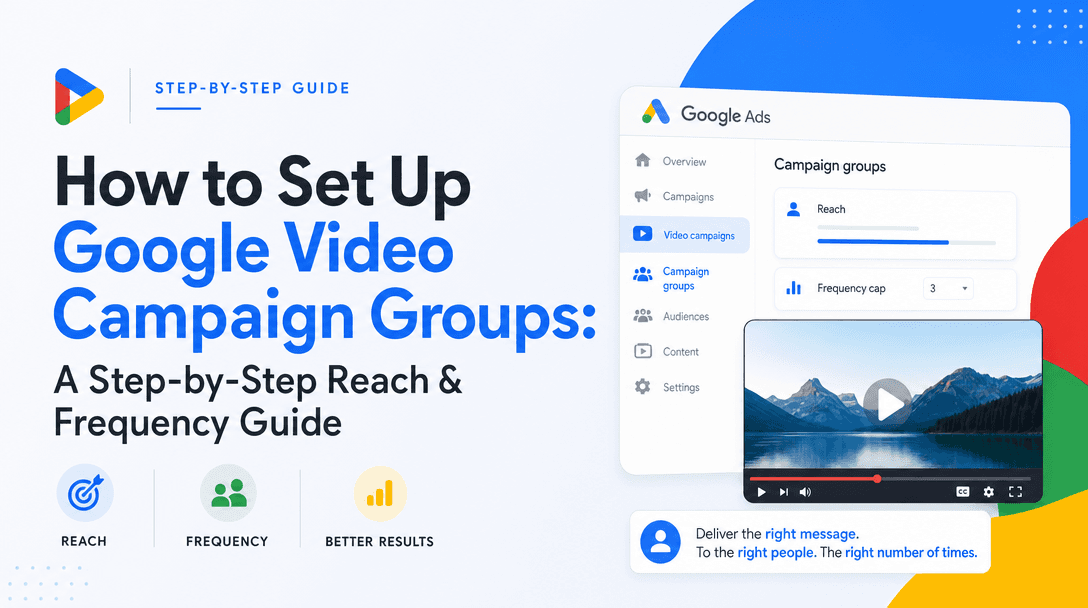
Google just shipped Video campaign groups in Google Ads: you set one reach or frequency goal across multiple video campaigns, and the system optimizes delivery across all of them while each campaign keeps its own budget and creative. It rolled out globally for YouTube, with Display & Video 360 support coming next.
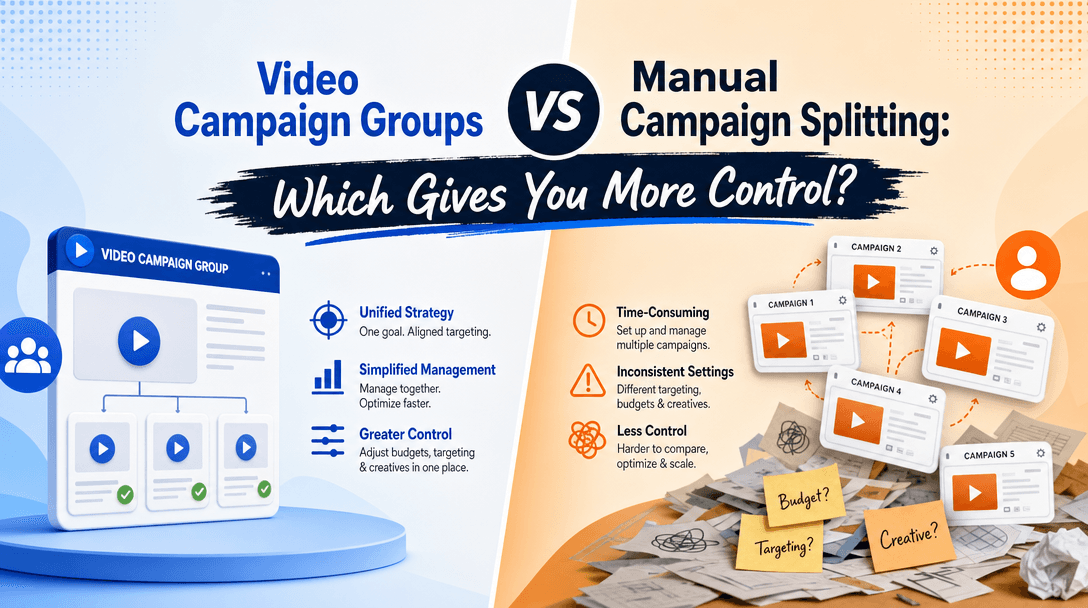
On the surface it reads like a reporting convenience. It isn't. It's a quiet change to where campaign structure lives — and if you run AI-driven or automated video buying, it invalidates a pattern most automation still hard-codes. This is the complete pillar guide: what Video campaign groups are, the reach-and-frequency model underneath them, why Google shipped them, who should use them, how they rewire campaign structure, the frequency-ROI math, how to measure the result, and how an automation layer should model the whole thing. Two companion pieces sit under this one — a hands-on step-by-step setup guide and a head-to-head on Video campaign groups vs. manual campaign splitting — but start here for the framing.
What Video campaign groups actually are
Until now, reach and frequency were per-campaign settings. If you ran three YouTube campaigns to the same audience — say one for awareness, one retargeting, one Shorts-first — each capped frequency on its own. None of them knew the other two existed. The same viewer could get served the "cap" three times over, and your unique-reach number was a guess stitched together after the fact.
Video campaign groups move that governance up one level. The group owns a single reach/frequency goal; the campaigns underneath it stay independent on budget and creative; and you get one dashboard reporting unique reach and average weekly impressions across the whole group instead of three overlapping numbers. Concretely, a Video campaign group is a new container object in Google Ads that:
- Holds a single reach or frequency objective that every child campaign optimizes toward together.
- Lets each campaign keep its own budget, bidding, and creative — the group coordinates delivery, it does not merge the campaigns.
- Reports deduplicated unique reach and average weekly impressions natively, so overlap is measured once, at the level the viewer actually experiences.
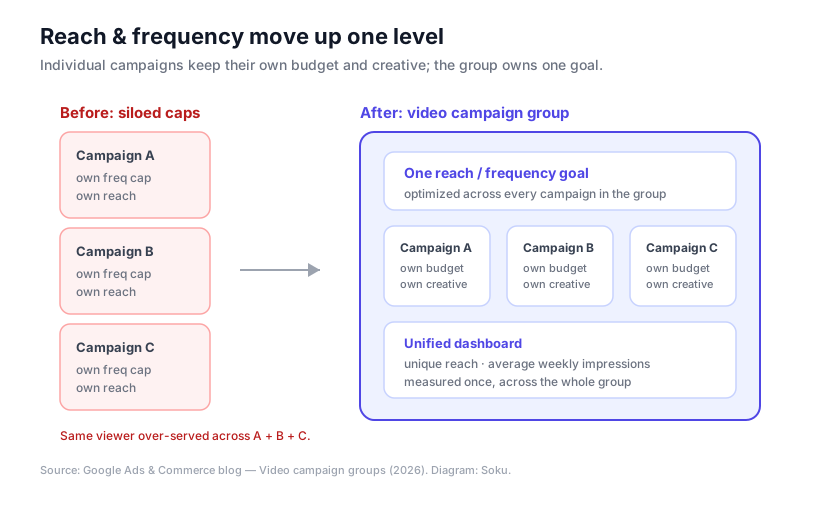
That's the whole idea: frequency is a property of the viewer, not of the campaign — so it finally gets managed at the level where the viewer actually experiences it. Everything else in this guide follows from that one sentence.
The reach-and-frequency model, in plain terms
To see why the container matters, you have to hold three numbers apart that video advertisers routinely collapse into one:
- Reach — the count of unique people who saw your ad at least once. It is a headcount, not an impression count.
- Impressions — the total number of times your ad was served. One person seeing it four times is one reach and four impressions.
- Frequency — impressions divided by reach: the average number of times a reached person saw the ad over a window (usually a week).
The trap is treating frequency as a dial that lands everyone on the same number. It doesn't. Frequency is a distribution. A campaign with an average of 2.7 weekly impressions is not showing everyone the ad 2.7 times — it is showing a big slice of your audience once or twice, a productive core three or four times, and a long tail of heavy viewers six, eight, ten times. The average hides both ends, and the money is lost in the heavy tail.
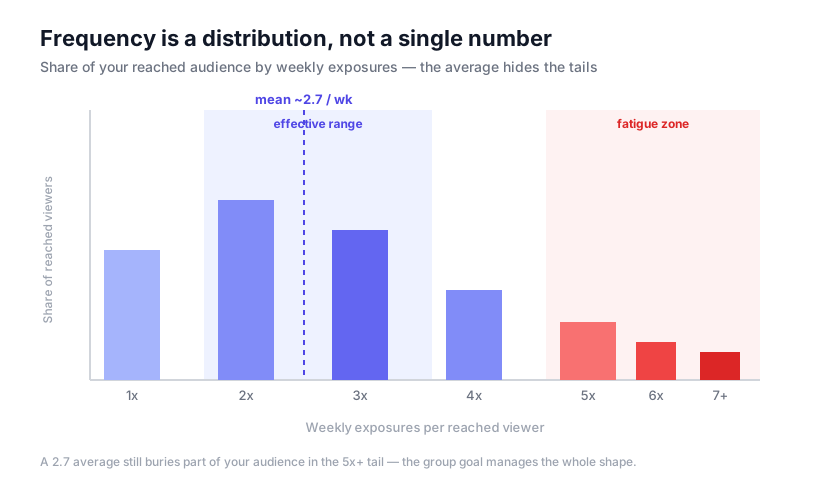
Per-campaign caps make that tail worse, not better, because they operate blind to each other. Three campaigns each capped at 3/week can stack to 9 real exposures on the viewer in the overlap — nobody set that number, the structure produced it. A group-level goal is the first control that governs the shape of the distribution, not just a per-silo ceiling. Unique reach is the metric that makes this legible: it counts a person once no matter how many campaigns, devices, formats, or placements touched them, which is exactly the deduplication you cannot do reliably by hand across separate campaigns (Google Ads Help: Video reach campaigns).
Why Google shipped this now
This is not a feature Google would have prioritized in 2019. Three forces made it necessary in 2026.
Format fragmentation. A modern YouTube presence is no longer one campaign. It is skippable in-stream, non-skippable and bumpers, in-feed, and Shorts — increasingly across mobile, desktop, and connected TV. Google's own March 2026 expansion of non-skip reach ads to CTV added yet another surface. Each surface used to be its own campaign with its own cap, and the viewer moved across all of them. The advertiser's structure fragmented faster than any per-campaign control could keep up with.
Automated bidding needs a viewer-level objective. Smart Bidding and target-frequency delivery optimize toward the goal you give them. If the goal lives on the campaign, the machine optimizes a slice of the viewer. Lifting the objective to the group gives the optimizer the only target that matches how delivery actually happens — the sum. Google's target-frequency tests are the tell here: an optimized frequency campaign delivered a 93% higher absolute ad-recall lift at a 40% cheaper cost per lifted user than non-optimized delivery (Google Ads blog). That efficiency only shows up when the objective sees the whole viewer.
Deduplicated measurement was already the hard part. Advertisers were spending analyst time reconciling unique reach across campaigns after the fact — the least valuable, most error-prone job in video buying. Shipping native cross-campaign unique reach removes the reconciliation work and, not coincidentally, makes Google's own frequency optimization measurable. The container is as much a measurement product as a delivery one.
The frequency-ROI curve and ad-fatigue theory
Google is putting real numbers behind the sweet spot. Its Meridian marketing-mix study of roughly 600 US brands (2023–2025) found an optimal frequency near 2.7 exposures per week, tied to a 19% lift in ROI. Push past the sweet spot and the curve bends the other way: Nielsen's TV benchmarks, cited by Social Media Today, show ROI dropping 22% once viewers see an ad more than 5 times a week and 41% past 6+.
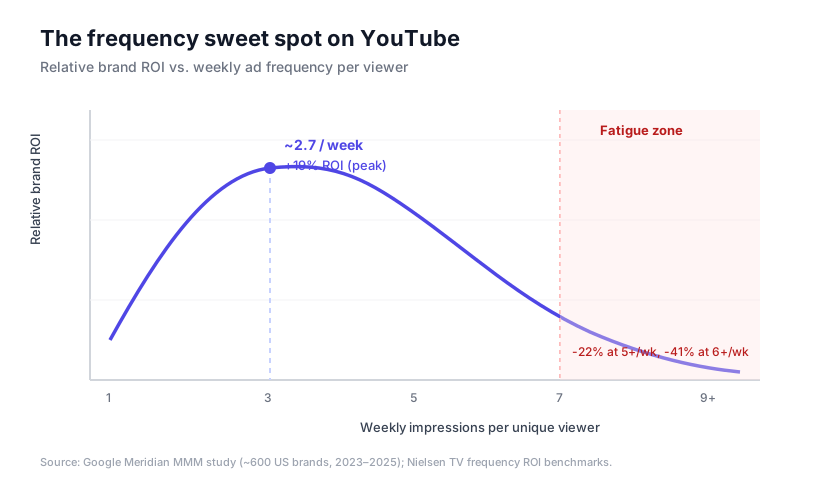
There is a decades-old theory under those numbers, and it is worth naming because it explains the shape, not just the peak. The classic "three-hit" effective-frequency hypothesis (Herbert Krugman, 1972) argues that the first exposure creates recognition, the second creates relevance, and the third is a reminder that triggers the response — everything after that is wear-out, spending impressions on people already converted or already annoyed. Modern platform data compresses and shifts the exact numbers, but the two-phase story holds: a wear-in climb where each exposure adds meaning, then a wear-out decline where each exposure subtracts ROI and adds fatigue risk. The group goal is a tool for keeping the bulk of your distribution in the wear-in band.
| Weekly frequency per viewer | Phase | Directional ROI effect |
|---|---|---|
| 1x | Recognition (under-exposed) | Reach captured, response not yet triggered |
| 2–3x | Wear-in / effective range | Peak — Meridian's ~2.7/week, +19% ROI |
| 4x | Late effective range | Still productive, watch the tail |
| 5x+ | Wear-out / fatigue | ROI ~22% lower (Nielsen) |
| 6x+ | Deep fatigue | ROI ~41% lower (Nielsen) |
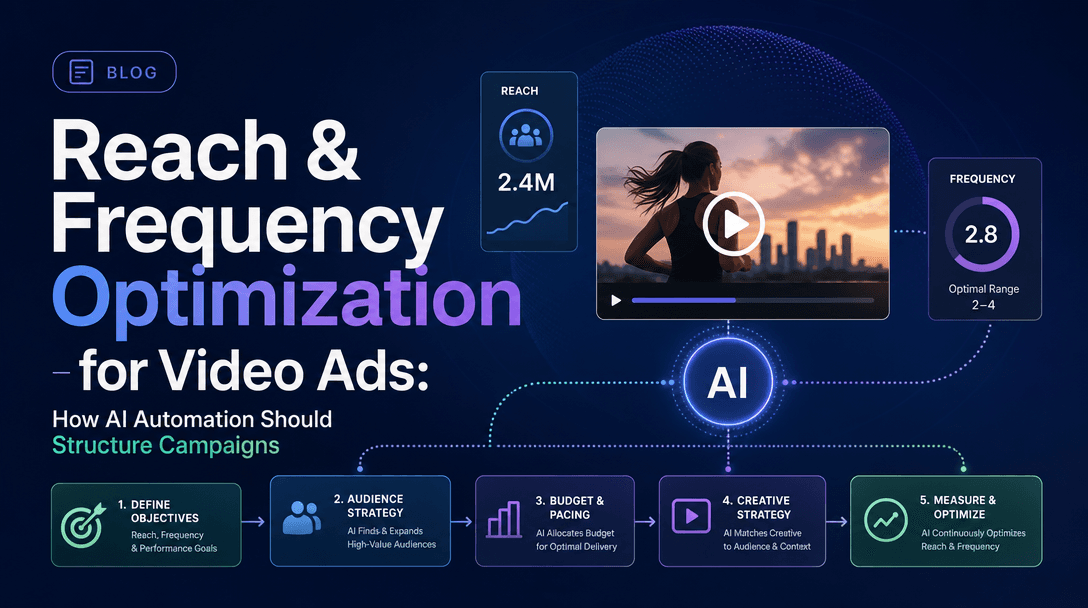
The point for anyone automating spend: the difference between the peak and the fatigue zone is a couple of impressions per person per week. You can't hit that window by tuning campaigns in isolation, because the viewer sees the sum of your campaigns, not each one. That's exactly the gap the group closes — and why supported target frequencies land in the 2–7/week range for multi-format and 2–4/week for single-format, per Google Ads Help. We go deeper on tuning that target across a live portfolio in reach and frequency optimization with AI automation.
Who should use Video campaign groups
Not every account needs a group. The feature earns its keep when you have multiple video campaigns hitting overlapping viewers and you care about controlling the total exposure across them. Here is the honest fit matrix.
| Advertiser profile | Fit | Why |
|---|---|---|
| Brand / awareness buyer running 2+ YouTube campaigns to one audience | Strong | The overlap is real and the whole value prop is unique reach at a controlled frequency |
| Multi-format shop (in-stream + Shorts + bumpers) on the same market | Strong | Formats fragment the viewer; the group is the only place to reunify frequency |
| Retail / DR advertiser running video alongside search & PMax | Medium | Useful for the video slice; frequency still matters, but conversion attribution lives elsewhere |
| Single video campaign, single format | Low | Per-campaign target frequency already covers you; a group adds overhead, not control |
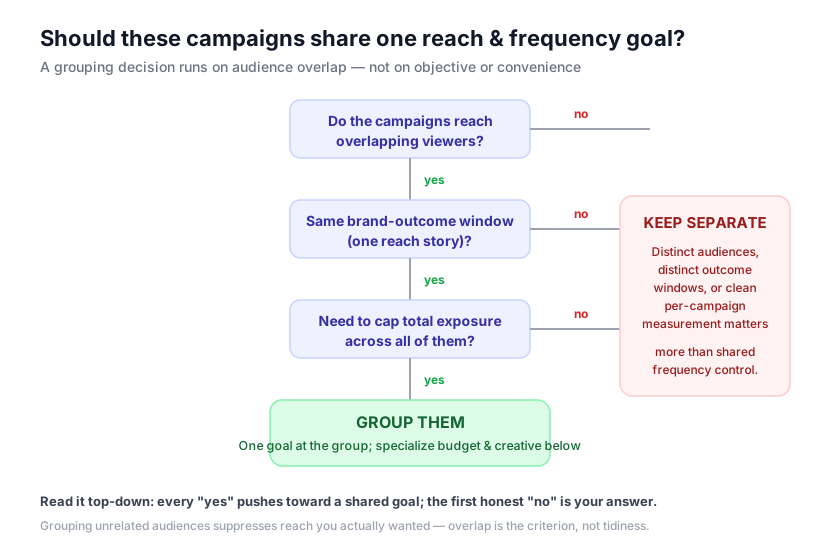
| Campaigns to genuinely distinct audiences | Avoid | Grouping non-overlapping audiences suppresses reach you wanted — overlap is the criterion |
If you are weighing "one big campaign vs. several small ones under a group," that structural call is its own decision, and we break it down separately in Video campaign groups vs. manual campaign splitting.
How Video campaign groups change campaign structure
This is the part that matters for anyone who has built an account architecture or an automation that generates one. The old mental model put every governance decision on the campaign: budget, creative, audience, and frequency all lived at the same level. The group splits that stack. Frequency and reach governance rise to the group; budget, creative, and campaign-type specialization stay below. The result is a two-tier structure where each tier owns exactly one kind of decision.
| Decision | Old model (per-campaign) | New model (with a group) |
|---|---|---|
| Reach / frequency goal | Set N times, once per campaign, blind to each other | Set once, at the group, across all children |
| Unique reach | Reconstructed after the fact from overlapping reports | Reported natively, deduplicated |
| Budget | Per campaign | Per campaign (unchanged) |
| Creative | Per campaign | Per campaign (unchanged) |
| Grouping criterion | N/A — campaigns were islands | Audience overlap decides what shares a goal |
| Risk of self-competition | High — caps stack silently | Managed at the group |
The strategic reading: structure stops being a flat list of campaigns and becomes a shallow tree, where the branch point is "do these hit the same viewer?" That single question is now the most important structural decision in a video account, and it is a judgment call about audience overlap — not about objective, naming convention, or org-chart convenience.
What this means for AI-driven ad structure
If your automation builds video the way most tools do — spin up a fresh campaign per audience, per creative concept, per objective, each with its own frequency cap — you are now building the anti-pattern Google just designed against. Three things change in how an agent or an automated workflow should structure video.
1. The unit of structure is the goal-scoped group, not the campaign. Automation should express reach/frequency intent once at the group, then let campaigns underneath specialize on budget and creative. Duplicating a frequency cap onto every child campaign is now redundant at best and self-competing at worst — how you tune that single intent against the effective-frequency band, and measure the summed outcome, is its own discipline we cover in reach and frequency optimization for video ad automation.
2. Overlap detection moves from reporting to design. The old job — reconcile unique reach across N campaigns after the fact — largely goes away when the group reports it natively. The new job is deciding which campaigns belong in the same group because they hit the same viewer. That's an audience-overlap judgment, and it's a better use of an AI layer than stitching spreadsheets — we break down when to group and when to keep campaigns separate in Video campaign groups vs manual campaign splitting.
3. Creative multiplication gets safer. The reason teams hesitate to ship many video variants is fatigue and cannibalization. With frequency governed at the group, you can run more creative concepts as sibling campaigns without each one silently inflating the viewer's total exposure — the same logic that makes asset volume safe in Performance Max when you feed the algorithm properly. Volume becomes a creative decision again, not a frequency risk.
This is the same directional pattern we've flagged across Google's 2026 releases: control keeps migrating from the knob you set to the goal you declare. AI Max for Search did it for query matching; video campaign groups do it for reach and frequency. The teams that win aren't the ones resisting the abstraction — they're the ones who restructure to speak in goals and keep tight measurement underneath.
Measurement: unique reach, effective frequency, incrementality
A group gives you a cleaner dashboard, but a dashboard is not a result. Three measurement layers should sit under any group, from cheapest to most rigorous.
Layer 1 — Unique reach and average weekly impressions (native). This is the group's built-in reporting and your first sanity check. Confirm the deduplicated reach is climbing and the average weekly frequency is landing where you set it. Treat divergence between the two — reach flat while frequency climbs — as the early signal you're pouring budget into the heavy tail instead of new people.
Layer 2 — Effective frequency, not just average frequency. The average will lie to you if the distribution is skewed. Where the platform exposes frequency buckets, watch the share of your audience sitting at 5x+; that tail is your fatigue exposure regardless of what the average says. The goal is not to hit 2.7 on average — it is to keep most of the distribution inside the wear-in band and starve the tail.
Layer 3 — Incrementality and brand lift. Reach and frequency are inputs; the output is whether the campaign moved anything. Brand Lift studies (ad recall, awareness, consideration) tie the frequency you bought to the perception you changed, and geo-based incrementality tests answer the harder question of whether the spend caused conversions that wouldn't have happened otherwise. Google's target-frequency recall-lift figures live in this layer, and it's the only layer that can tell you the group is working rather than merely tidy. For the full brand-measurement stack on YouTube — including how to measure this on Shorts specifically — see YouTube Shorts brand campaign measurement.
The discipline: never trust a group by its unique-reach number alone. A group can look perfect on the dashboard and still be over-serving a heavy tail into a fatigue zone that only shows up in lift.
How AI and automation should model this
If you're building the automation layer — an agent, a rules engine, a portfolio optimizer — here is the data model the group implies. Stop modeling campaigns as independent rows. Model the account as an overlap graph: nodes are campaigns, edges are shared-audience overlap, and a Video campaign group is a connected cluster you've decided to govern with one frequency goal.
- Build an exposure ledger, not a campaign ledger. The unit of accounting is the viewer's total weekly exposure across all campaigns that touch them, not per-campaign impressions. Everything the optimizer decides should reference that sum.
- Score grouping candidates by overlap, then by outcome window. Two campaigns belong together when they hit the same people and share a brand-outcome window. High overlap plus different outcome windows is a signal to keep them separate for clean measurement, not to merge them.
- Run a recommend-then-verify loop. The agent's durable job today is to read the account, compute overlap, recommend the grouping and the frequency target near the sweet spot, then monitor delivery against effective frequency after a human applies it.
Why "recommend-then-verify" rather than "automate end-to-end"? Because the write path isn't open yet. Google's official Ads MCP server is read-only today, so an agent can read group-level unique reach and average weekly impressions but still can't create or edit the group structure itself. That makes the highest-leverage automated step the analysis and the grouping recommendation — the part the setup UI can't do for you — with a human executing the change. Our step-by-step setup guide walks the whole build; the Google Ads MCP guide covers exactly what the agent can and can't touch.
Pitfalls and anti-patterns
A few things to keep on the automation team's radar before you rip up your video structure.
- It's a coordination layer, not a hard cap. The group optimizes toward your frequency goal across campaigns; it doesn't guarantee every impression stays under a ceiling. Treat the number as a target and verify delivery against your own creative and reach measurement.
- Grouping the wrong campaigns suppresses reach. Campaigns with genuinely different audiences don't belong in one reach group — you'll starve reach you actually wanted. Overlap is the grouping criterion, not objective or convenience.
- The average frequency will mislead you. A healthy-looking 2.7 average can hide a fat 6x+ tail. Watch the distribution, not the mean.
- Don't over-consolidate for measurement. If you need clean per-campaign incrementality read-outs, a group can blur the attribution you were relying on. Group for frequency control; keep separate when the measurement matters more.
- API and connector support lag the UI. Because the official MCP is read-only, the build step is human-in-the-loop for now. Design the automation around recommend-then-verify, not around a write API that isn't there yet.
| Anti-pattern | Why it hurts | Do instead |
|---|---|---|
| One frequency cap copied onto every child campaign | Redundant and self-competing under a group | Set the goal once, at the group |
| Grouping by objective or naming | Ignores the only thing that matters — overlap | Group by shared-audience overlap |
| Trusting the average frequency | Buries the fatigue tail | Watch effective frequency at 5x+ |
| Judging the group by unique reach alone | Tidy dashboard, unmeasured outcome | Add brand lift / incrementality |
Frequently asked questions
Is a Video campaign group the same as a shared budget? No. Campaigns in a group keep their own budgets and bidding. The group shares a reach/frequency goal and dedup'd reporting, not money.
Does it work for Shorts? Yes. Shorts inventory participates in multi-format reach delivery, so it falls under the group's frequency goal — which is precisely why the group matters, since Shorts is one more surface fragmenting the viewer.
What frequency should I set? Anchor near the ~2.7/week Meridian sweet spot. Supported targets are 2–7/week for multi-format groups and 2–4/week for single-format, per Google Ads Help. Start low and let effective-frequency data pull you up, not the other way around.
Can an AI agent build the group for me? Not yet, end to end. The official Google Ads MCP is read-only, so agents read group reach and frequency but can't write the structure. The automated leverage is in the overlap analysis and the grouping recommendation; a human applies it.
Does this replace target frequency on a single campaign? No — it extends it. Target frequency on one campaign still works; the group is what you reach for when the viewer is spread across several campaigns at once.
How Soku fits
Soku's job here is the judgment layer Google didn't ship: reading how your existing video campaigns overlap on the same viewers, recommending which ones belong in a shared reach/frequency group, and flagging where your current structure is quietly pushing people past the 2.7-per-week sweet spot into the fatigue zone. Google gave you the container; deciding what goes in it — and tying it back to actual outcomes rather than a dashboard number — is where AI ad-creative ROI is won or lost.
The takeaway is simple. Video campaign groups aren't a new report — they're a new level of structure. If your automation still thinks in isolated campaigns with isolated caps, it's optimizing a picture of the viewer that no longer matches how Google delivers. Restructure around the goal, group by overlap, and measure the sum.