Soku AI
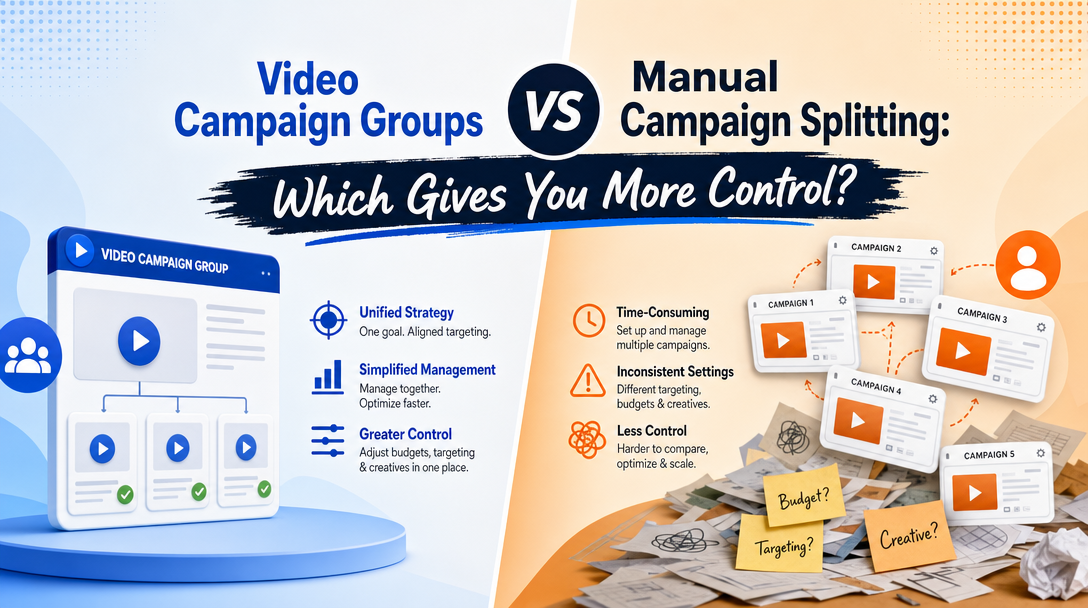
"Which gives you more control?" is the wrong question to ask about Google's Video campaign groups — but it's the question every media buyer asks first, so let's answer it honestly and then reframe it. The short version: manual campaign splitting gives you more control over each campaign. Video campaign groups give you more control over the viewer. Those are not the same thing, and confusing them is how teams end up with a tidy dashboard of well-capped campaigns that are collectively frying their audience.
This is a decision post, not a feature tour. If you want the full landscape and how it fits AI-driven buying, start with our complete guide to Video campaign groups. Here we do one thing: put the old manual approach and the new group-level goal side by side, rank them across the dimensions that actually decide budget efficiency, and tell you which one wins in which situation — including the cases where splitting is still the right call.
How we controlled reach and frequency before campaign groups
For years, reach and frequency on YouTube lived at the campaign level. If you wanted an awareness push, a retargeting layer, and a Shorts-first burst hitting the same broad audience, the standard playbook was to build three separate campaigns — one per objective, audience, or format — and set a frequency cap on each. Splitting was not laziness; it was the only way to get granular control. Separate campaigns meant separate budgets you could pace independently, separate creative rotations, separate bid strategies, and separate reporting you could read without a spreadsheet join.
The catch was always the same, and everyone who ran video at scale knew it: each cap is blind to the others. A cap of 3/week on the awareness campaign has no idea the same person is also in the retargeting pool capped at 3/week and the Shorts campaign capped at 3/week. For a viewer sitting in the overlap of all three audiences, "3/week" quietly becomes up to 9/week. Your campaign-level reports each looked disciplined. The viewer's actual experience was three times the dose you thought you were serving.
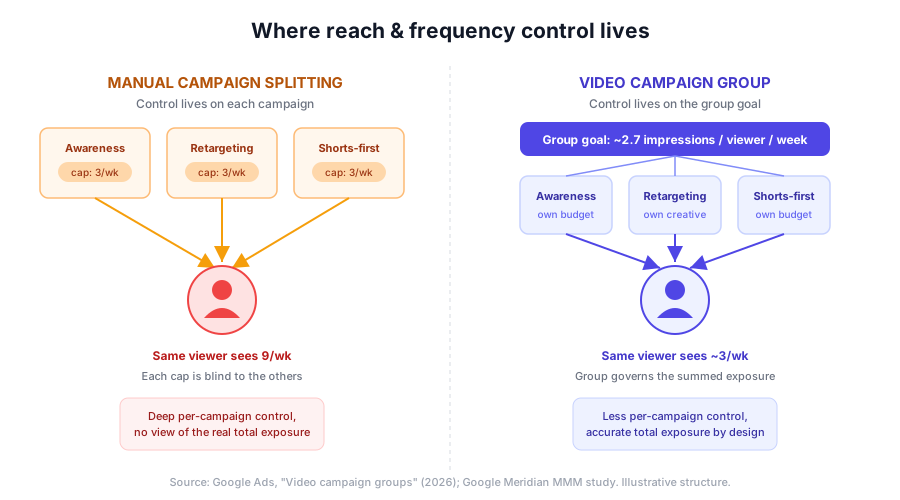
Teams papered over this with two workarounds, both imperfect. The first was audience exclusion — mutually excluding each campaign's audience so no one sat in more than one pool. This works until it doesn't: exclusions are hard to maintain, they suppress reach you often wanted, and they collapse the moment audiences are defined by broad signals rather than tidy lists. The second was post-hoc deduplication — pulling unique reach across campaigns after the flight and reconciling the overlap in a reporting tool or a media-mix model. That tells you what happened last month; it does nothing to govern delivery this week.
So the "control" of manual splitting was real but narrow. You controlled every lever on every campaign. You did not control the one number that determines whether the spend worked: how many times a real human actually saw your brand this week.
What campaign groups actually change
Video campaign groups move the reach/frequency goal up one level. You set a single reach or frequency goal on the group; the campaigns underneath keep their own budgets, creatives, and settings; and the system optimizes delivery across all of them toward that goal. The group reports unique reach and average weekly impressions natively — the deduplicated number you used to reconstruct by hand is now the primary metric. It's live globally in Google Ads for YouTube, with Display & Video 360 support following.
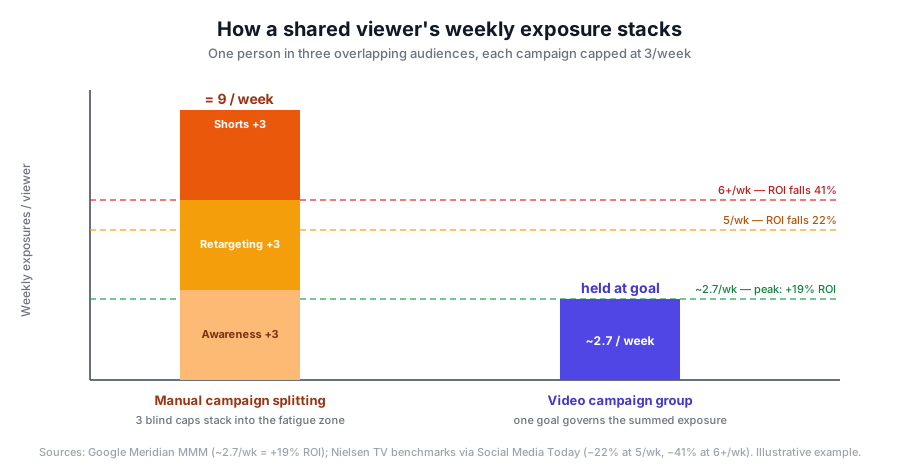
The reason this is worth a structural change and not just a reporting nicety is that frequency has a sharp, well-measured sweet spot. Google's Meridian marketing-mix study of roughly 600 US brands (2023–2025) found an optimal frequency near 2.7 exposures per week, tied to a 19% lift in ROI. Overshoot and the curve turns punishing: Nielsen TV benchmarks cited by Social Media Today show ROI dropping 22% once viewers see an ad more than 5 times a week and 41% past 6 times. Google also reports that over 95% of Target frequency campaigns hit their frequency goal when set up to best practice.
Put the manual-splitting math against those thresholds and the problem is obvious. The overlapping viewer at 9/week isn't just a bit over — they're deep in the zone where each additional impression is destroying return, not building it. Manual caps can't see that; a group goal is designed around exactly it.
The ranked comparison
Here is the head-to-head across the dimensions that decide whether a structure is worth running. The ranking is ours, based on how each approach behaves against the frequency economics above — not a Google marketing claim.
| Dimension | Manual campaign splitting | Video campaign groups | Winner |
|---|---|---|---|
| Per-campaign control | Full: independent budget, bid, creative, cap on every campaign | Preserved underneath, but the frequency lever moves to the group | Splitting |
| Frequency accuracy (real viewer) | Poor: caps are blind to overlap; effective frequency drifts far above target | Strong: one goal governs the summed exposure across campaigns | Groups |
| Wasted reach / overlap | High: overlapping audiences get double- and triple-served with no native check | Low: deduplicated delivery is the optimization target | Groups |
| Reporting clarity | Fragmented: unique reach must be reconstructed across campaigns | Unified: native unique reach + average weekly impressions | Groups |
| Ops overhead | High: caps, exclusions, and dedup all maintained by hand | Lower: set the goal once, let the group coordinate | Groups |
| Automation-friendliness | Brittle: agents must model cross-campaign overlap themselves | Better: the platform exposes the group-level truth to read | Groups |
| Granular experimentation | Strong: clean per-campaign isolation for A/Bs | Weaker: shared goal couples campaigns you might want isolated | Splitting |
| Predictability of a single campaign | High: a campaign behaves exactly as configured | Lower: delivery flexes as the group balances toward the goal | Splitting |
Read the column, not the row count. Groups win the dimensions tied to outcome efficiency — accurate frequency, low waste, clean reporting, lower overhead. Splitting wins the dimensions tied to operational control — per-campaign isolation, predictability, clean experiments. If your goal is "make each campaign do exactly what I set," splitting still gives you more. If your goal is "make the budget produce the most efficient real-world reach," groups win, and it isn't close.
Where each approach actually wins
Frameworks are useless without the cases that break them. Here is where we'd deliberately pick each.
Pick a video campaign group when audiences overlap and the goal is efficient reach. The textbook case: several campaigns — awareness, retargeting, format-specific — all aimed at broadly the same people, where your real objective is a controlled number of quality exposures per person. This is precisely the scenario manual caps handle worst and groups handle best. If you can't confidently say a given viewer is in only one of your campaigns, you want the group.
Pick a group when you want to multiply creative without multiplying fatigue. The reason teams hesitate to ship many video variants is exactly this fatigue risk — every new campaign silently inflates the viewer's total exposure. With frequency governed at the group, you can run more creative concepts as sibling campaigns without each one stacking the dose. It's the same logic that makes asset volume safe in Performance Max when you feed the algorithm properly: volume becomes a creative decision again, not a frequency liability.
Keep manual splitting when audiences are genuinely distinct. If your campaigns target non-overlapping segments — different countries, unrelated product lines, a B2B decision-maker vs. a consumer audience — there is no shared viewer to govern, and forcing them into one reach group only suppresses reach you wanted. Overlap is the grouping criterion; absence of overlap is a reason not to group.
Keep splitting for clean measurement and isolated experiments. When you're running a rigorous creative A/B, an incrementality test, or a campaign whose delivery must be perfectly predictable for a stakeholder, the coupling a group introduces is a bug, not a feature. Isolate it. You can still read group-level truth elsewhere; a controlled experiment wants controlled variables.
Keep splitting when a single campaign carries a hard, independent constraint. A campaign with its own non-negotiable pacing, a separate co-op budget, or a compliance-driven cap sometimes needs to behave exactly as configured regardless of what its siblings do. That's an argument for isolation, at least for that campaign.
The honest read across these: groups are the new default for overlapping reach, and splitting is the specialist tool for isolation and measurement. Most accounts have both situations, which means the answer is usually "group the overlapping cluster, leave the genuinely separate campaigns alone" — not a wholesale migration.
A migration path that won't torch your reach
If you're moving from a split structure to groups, don't rip everything up at once. The failure mode is grouping campaigns that shouldn't share a goal and quietly suppressing reach. A staged path:
- Map overlap first. For each pair of video campaigns, estimate how much of the audience is genuinely shared. Campaigns with high overlap are group candidates; low-overlap pairs stay independent. This audience-overlap judgment is the whole game — it's a better use of an analytics or AI layer than reconciling spreadsheets after the fact.
- Group by shared viewer, not by convenience. Put campaigns in a group because they hit the same people, not because they share an objective label or sit next to each other in the account. Objective is not overlap.
- Set the goal from the economics, not from habit. Anchor the group's frequency goal to the sweet spot — the 2.7/week region for multi-format, tighter for single-format — rather than porting over a legacy per-campaign cap that was never meant to be summed. Google's supported target frequencies land in the 2–7/week range for multi-format and 2–4/week for single-format.
- Preserve isolation where you need it. Keep genuinely distinct campaigns and any live experiments out of the group. Migration is selective by design.
- Verify delivery against your own measurement. The group optimizes toward the goal; it doesn't hard-cap every impression. Watch the native unique-reach and average-weekly-impression numbers for the first few weeks and confirm they match your intent before trusting the structure. For the full build, follow our Video campaign groups setup guide, and for tuning the goal itself, our guide to reach and frequency optimization for video ad automation.
The tradeoff you're actually making
Ceding per-campaign control to a group goal is a real tradeoff, not a free upgrade, and pretending otherwise is how teams get burned. Three things you genuinely give up:
Deterministic per-campaign delivery. Inside a group, a campaign's delivery flexes as the system balances toward the shared goal. A campaign you'd tuned to behave a specific way may now deliver differently because a sibling is picking up slack. If you depended on that determinism, that's a loss.
Clean attribution boundaries. When campaigns coordinate, isolating the contribution of any one of them gets harder. For teams that run tight per-campaign incrementality, the coupling muddies the exact thing you were measuring.
Direct control of the lever, in exchange for control of the outcome. This is the core trade. You stop setting the frequency knob on each campaign and start declaring the frequency result you want across all of them. You lose the knob; you gain governance over the number that actually correlates with ROI. Whether that's a good deal depends entirely on whether your campaigns share viewers — which is why "map overlap first" is step one.
This is the same directional pattern running through Google's 2026 releases: control keeps migrating from the knob you set to the goal you declare. AI Max for Search did it for query matching; Video campaign groups do it for reach and frequency. The teams that win aren't resisting the abstraction — they're deciding, deliberately, which campaigns belong under a shared goal and keeping tight measurement underneath.
How Soku fits
The judgment Google didn't ship is which campaigns belong in a group. That's an audience-overlap decision, and it's exactly where an AI layer earns its keep: reading how your existing video campaigns overlap on the same viewers, recommending which ones should share a reach/frequency goal and which should stay isolated for measurement, and flagging where your current split is stacking people past the 2.7-per-week sweet spot into the fatigue zone. Google's official Ads MCP server is read-only today, so an agent can read group-level reach and frequency but still can't build the structure — which makes the analysis and the grouping recommendation the highest-leverage automated step, with a human executing the change.
The reframe to end on: this was never really "more control vs. less control." Manual splitting hands you more knobs; campaign groups hand you control over the one outcome the knobs were always trying to reach. Pick splitting when your campaigns don't share a viewer or you need isolation. Pick a group when they do and you want the budget spent on efficient reach instead of on the ninth impression nobody needed.