 Soku AI
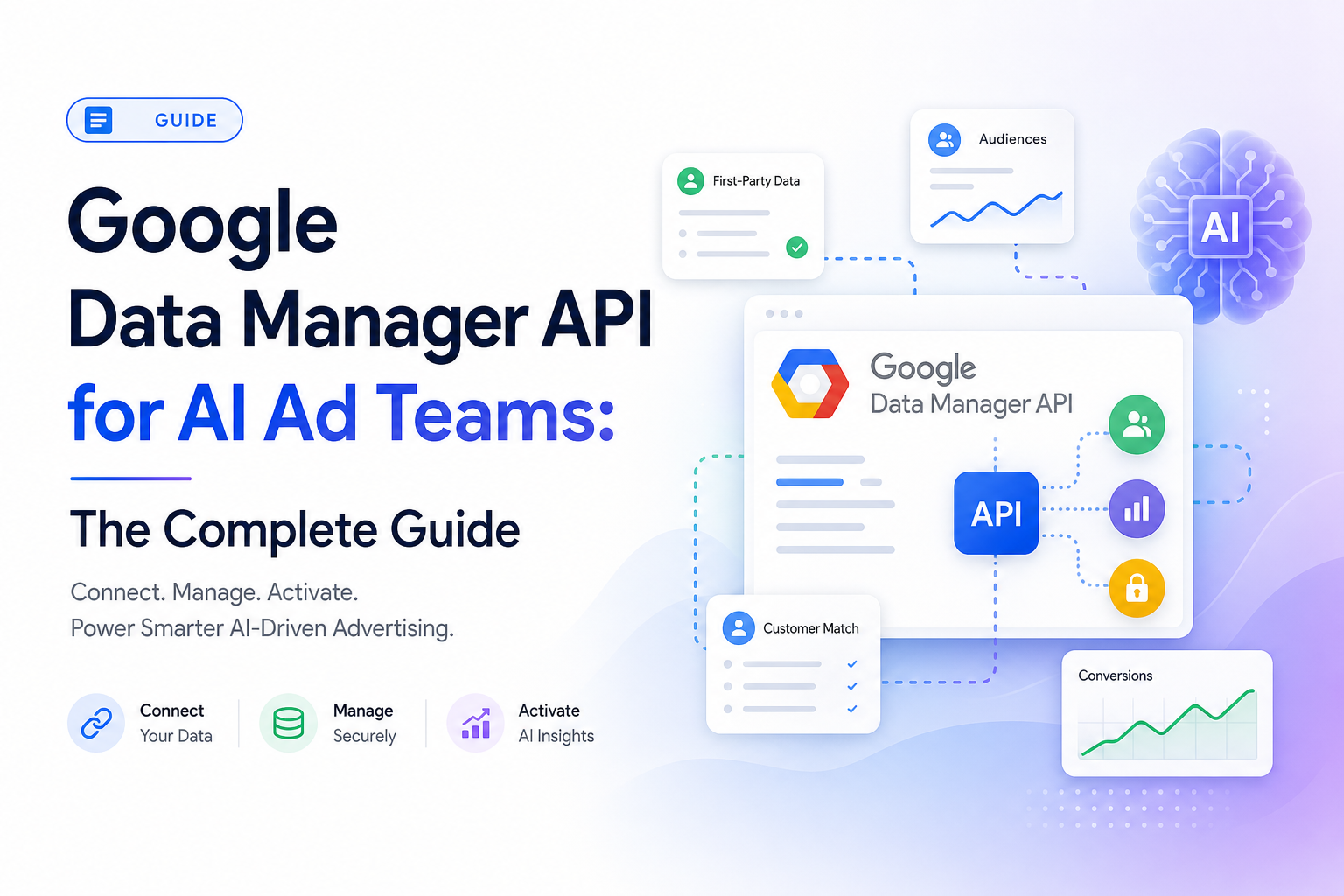
Google now has several ways to move marketing data around, and the names are easy to confuse. Data Manager API, GA4 Measurement Protocol, Google Ads API offline conversion imports, and Google Ads API reporting all touch measurement, but they solve different problems.
For the full strategic overview, start with Google Data Manager API for AI Ad Teams. This comparison is the decision spoke: which API should own which job.
The short answer
Use Data Manager API when the event is first-party, server-side, commercially meaningful, and may need to route into more than one Google advertising or measurement destination. Use Measurement Protocol when your only destination is GA4 and the event is part of an analytics stream. Use Google Ads API reporting or MCP when you need to read campaign data. Use legacy Google Ads API offline uploads only if you already adopted them and are operating within Google's current allowlist rules while migrating.

The four surfaces
| Surface | Primary job | Direction | Best for |
|---|---|---|---|
| Data Manager API | Ingest first-party conversion, audience, and analytics events | Your systems -> Google | Server-side signals across Google Ads, GA4, GMP, Customer Match |
| GA4 Measurement Protocol | Send events directly to GA4 | Your systems -> GA4 | GA4 web/app events when GA4 is the only destination |
| Google Ads API offline uploads | Upload offline conversions to Google Ads | Your systems -> Google Ads | Existing allowlisted offline conversion workflows |
| Google Ads API reporting / MCP | Read ad account data and metrics | Google Ads -> your systems | Diagnostics, reports, agent analysis, GAQL queries |
The distinction is direction. Data Manager API and Measurement Protocol are ingestion paths. Google Ads API reporting and the official Google Ads MCP are reading paths. Do not use the reporting surface to reason about whether your conversion event was well formed.
Why Data Manager API is different
Data Manager API is different because it is designed around a unified schema and destination routing. Google's May 28 update says it can send offline conversion events to Google Marketing Platform destinations and route events to multiple destinations in a single request. Google's May 7 update says it also expands Google Analytics web and app event ingestion and can act as an alternative to Measurement Protocol for recommended and custom events (Google Ads Developer Blog, May 2026 archive).
That matters for teams running serious paid media because the same business event often has multiple jobs.
A purchase might train Google Ads bidding, appear in GA4 revenue reports, support CM360 offline attribution, and update Customer Match audiences. If each job has a separate integration, differences accumulate: one event arrives with a different timestamp, another has a different ID, another lacks a value, another hashes a phone number differently.
Data Manager API does not magically fix bad data, but it gives you a better place to enforce one contract.
When Measurement Protocol is still enough
Measurement Protocol is still useful. If your only need is to send server-side events into GA4, and you do not need Google Ads or GMP routing, it may be simpler.
Good Measurement Protocol use cases:
- Sending a backend subscription renewal event to GA4.
- Sending a server-confirmed purchase to GA4 when browser collection is unreliable.
- Sending a custom analytics event that is not used for Google Ads bidding or Customer Match.
- Keeping a small analytics-only integration lightweight.
The migration trigger is routing complexity. Once the same event needs to serve Google Ads optimization, GA4 reporting, Customer Match, or GMP attribution, Data Manager API becomes the cleaner long-term owner.
Why the Google Ads API upload path is changing
Google's May 15, 2026 announcement says that starting June 15, 2026, the Google Ads API no longer accepts new adopters of offline conversion imports, including enhanced conversions for leads. Existing adopters can continue importing while they integrate with Data Manager API, but new adopters receive CUSTOMER_NOT_ALLOWLISTED_FOR_THIS_FEATURE when attempting ConversionUploadService.UploadClickConversions (Google Ads Developer Blog, May 2026 archive).
That creates a clear planning rule:
- If you are building a new offline conversion import, design for Data Manager API.
- If you already use Google Ads API offline imports, keep them stable while planning a migration.
- If you are an agency or data partner, standardize new client work on Data Manager API unless a specific exception applies.
How this affects AI ad agents
AI ad agents need a clean boundary between read paths and write paths.
Google Ads MCP and Google Ads API reporting are excellent for asking, "Which campaigns lost conversion value this week?" They are not the event ingestion layer. Data Manager API is the layer that determines whether the conversion value the agent reads tomorrow will be complete.
The Soku operating split is:
| Agent job | API surface |
|---|---|
| Diagnose campaign performance | Google Ads API reporting or Google Ads MCP |
| Inspect conversion import health | Data Manager API logs and destination reports |
| Recommend tracking fixes | Agent reasoning layer |
| Send production events | Deterministic Data Manager API pipeline |
| Change bids or budgets | Human-approved campaign write path |
This keeps the agent useful without giving it arbitrary control over measurement writes.
Decision tree
Use this rule set when deciding where a new event belongs.
- If the event only needs to appear in GA4 analytics, consider Measurement Protocol.
- If the event needs to train Google Ads bidding or represent offline revenue, choose Data Manager API for new work.
- If the event needs to reach CM360, SA360, or DV360, choose Data Manager API.
- If the event is an audience update or Customer Match input, evaluate Data Manager API composite data.
- If the task is reporting or diagnostics, use Google Ads API reporting or MCP, not Data Manager API.
- If you already use legacy Google Ads API offline uploads, keep them stable while migrating.
Practical examples
| Scenario | Recommended surface | Reason |
|---|---|---|
| Ecommerce purchase used for Google Ads bidding and GA4 revenue reporting | Data Manager API | One source event, multiple destinations |
| App custom event sent only to GA4 | Measurement Protocol or Data Manager API | Use Data Manager API if richer app metadata or future routing matters |
| B2B opportunity stage imported for value-based bidding | Data Manager API | New offline conversion work should follow Google's migration path |
| Daily MCC performance anomaly report | Google Ads API or MCP | This is read-only reporting |
| Campaign Manager 360 offline conversion upload | Data Manager API | Google explicitly points CM360 workflows toward the upgrade path |
| Customer Match with email, address, and IP observation data | Data Manager API composite data | Composite data is the forward path for richer matching |
The Soku recommendation
Make Data Manager API the owner of durable business events, not every event. Keep GA4 Measurement Protocol for lightweight analytics-only signals. Keep Google Ads API and MCP for reporting and analysis. Do not let every tool in the stack invent its own conversion truth.
The most valuable thing you can do before writing code is create a signal ownership table: event, source system, owner API, destinations, dedupe key, identifiers, and consent rule. Once that exists, implementation becomes an engineering task instead of an attribution debate.
FAQ
Is Data Manager API better than Measurement Protocol?
It is broader, not universally better. Data Manager API is better when you need unified Google advertising and analytics routing. Measurement Protocol can still be simpler for GA4-only events.
Is Google Ads API offline conversion import deprecated?
Existing adopters can continue while migrating, but Google has restricted new adopters starting June 15, 2026 and directs new offline conversion import integrations toward Data Manager API.
Can Data Manager API replace Google Ads MCP?
No. Google Ads MCP reads account data. Data Manager API sends first-party signals. They belong together, but they do opposite jobs.
Should I send browser events through Data Manager API?
Usually no. Browser events still belong in Google Tag, GTM, or GA4 client-side collection. Data Manager API is strongest for server-confirmed events and first-party data.
What should agencies standardize on?
For new offline conversion, store sales, and GMP routing work, standardize on Data Manager API. Keep legacy upload paths only where they already work and migration risk is higher than immediate benefit.