 Soku AI
Google's Data Manager API has quietly become the center of gravity for first-party advertising signals. It is no longer just a niche upload path for offline conversions. In May 2026, Google expanded it across store sales, Google Analytics web and app event ingestion, Google Marketing Platform destinations, and Customer Match composite data. For AI ad teams, that changes the measurement architecture.
The short version: Data Manager API is the Google-side ingestion layer you use when browser tags, GA4 Measurement Protocol, Google Ads offline imports, and Campaign Manager 360 uploads are no longer enough as separate pipes. It gives teams one event contract, encrypted identifiers, and destination routing across Google Ads, Google Analytics, Campaign Manager 360, Search Ads 360, and Display & Video 360.
This pillar is the map for the cluster. Use the setup guide when you need implementation steps, the API comparison when you are choosing between Data Manager API, Measurement Protocol, and Google Ads API uploads, and the Customer Match and GMP destinations guide when your problem is audience matching or multi-destination offline conversion routing.
What Data Manager API is
Data Manager API is Google's server-side ingestion API for sending advertiser-owned data into Google advertising and measurement products. The official Google Ads Developer Blog describes the new support for sending offline conversion events to Google Marketing Platform products such as Campaign Manager 360, Search Ads 360, and Display & Video 360, and it also describes the Customer Match composite data update with IP ingestion beginning to matter for match rates in Q3 2026 (Google Ads Developer Blog).
Earlier in May 2026, Google also announced Data Manager API support for Google Ads store sales and broader Google Analytics event ingestion. That update positioned Data Manager API as an alternative to Measurement Protocol for sending recommended and custom events directly to Google Analytics, with support for web and app data streams, Firebase App IDs, Measurement IDs, app metadata, and additional-data-source event ingestion for events with transaction IDs (Google Ads Developer Blog, May 2026 archive).
The important operational idea is simple: Data Manager API is not a reporting API. It is a signal ingestion API. You use it to send the events and identifiers that make bidding, attribution, audience building, and cross-product measurement more accurate.
Why AI ad teams should care
AI ad teams have a measurement problem before they have an autonomy problem. An agent can write a smart recommendation, but if the conversion signal underneath it is lossy, duplicated, delayed, or routed differently across Google products, the recommendation is working from bad ground truth.
Modern campaign automation depends on three signal layers:
| Signal layer | What it controls | Failure mode |
|---|---|---|
| Conversion events | What bidding systems learn from | Smart Bidding optimizes toward an incomplete or biased sample |
| User identifiers | Whether conversions and audiences match | Reported conversions, Customer Match reach, and retargeting lists are undercounted |
| Destination routing | Which Google products receive the same event | Google Ads, GA4, CM360, SA360, and DV360 disagree about the same customer action |
Data Manager API matters because it pulls those layers closer together. Instead of maintaining one integration for GA4 server events, another for Google Ads offline conversions, another for Campaign Manager uploads, and another Customer Match upload job, you can design around one normalized first-party event and route it deliberately.

The May 2026 update, translated for operators
Google's May 28 update has two big parts.
First, Data Manager API can now send offline conversion events to Google Marketing Platform destinations: Campaign Manager 360, Search Ads 360, and Display & Video 360. The AdIdentifiers object includes identifiers such as dclid, impressionId, matchId, and encrypted user IDs, which matter when a conversion occurs away from the website and needs to be tied back to ad exposure.
Second, Customer Match uploads can use CompositeData, including IP data either alone or alongside user identifiers like email, phone, and address information. Google says providing IP addresses with observation timestamps in IpData will help drive higher match rates for Google Ads Customer Match beginning in Q3 2026. Google also says it will continue supporting user_data, but recommends composite_data so integrations are ready for future improvements.
For an ad team, the practical reading is this:
- If you run GMP products, Data Manager API is becoming the better long-term path for offline conversion uploads.
- If you rely on Customer Match,
composite_datais the future-facing identifier container. - If your measurement is split between Google Ads, GA4, and GMP, you should stop treating each destination as a separate schema design.
The operating model Soku uses
Our recommended operating model is not "send everything everywhere." That creates noisy downstream systems. The better model is a governed event contract.
Start with a source-of-truth event. For ecommerce, that is usually an order confirmation from Shopify, BigCommerce, Stripe, or your backend. For lead generation, it is the CRM stage change, not the initial form submit. For B2B, it may be an opportunity stage or pipeline value event. The source event needs a stable ID, timestamp, value, currency, and consent state.
Then normalize identity once. Email, phone, address, IP, and timestamps should be standardized before they enter any ad-platform integration. This is where most match-rate problems begin. If one job lowercases email and another does not, or one pipeline keeps phone punctuation and another strips it, two destinations can receive technically valid but operationally different users.
Then route by outcome. Google Ads might need the conversion action and value for bidding. GA4 might need a recommended event or custom event for behavioral reporting. CM360 might need impression or match identifiers for offline attribution. Customer Match might need a batch audience update, not a conversion event. Data Manager API is useful because it lets the team design those routes from one contract instead of writing a one-off connector per destination.
Soku's ad-agent angle is to make this measurable before it is autonomous. The agent should inspect which conversions are eligible, which identifiers exist, which destinations receive them, and which data quality warnings need a human before routing changes go live. A measurement pipeline that can be explained is safer than a pipeline that merely "syncs."
Where Data Manager API fits beside existing Google APIs
Do not replace every Google integration with Data Manager API. It has a specific job.
| API or tool | Best job | Do not use it for |
|---|---|---|
| Data Manager API | First-party event, conversion, audience, and identity ingestion | Campaign reporting or bid edits |
| GA4 Measurement Protocol | Lightweight server-side GA4 events when GA4 is the only destination | Multi-product Google Ads/GMP routing |
| Google Ads API offline uploads | Existing allowlisted Google Ads offline conversion workflows | New-adopter offline conversion imports after Google's June 2026 restrictions |
| Google Ads API reporting | GAQL reporting, diagnostics, account analysis | Cross-product event ingestion |
| Google Tag / GTM | Browser-side click and behavioral capture | Confirmed server-side revenue truth |
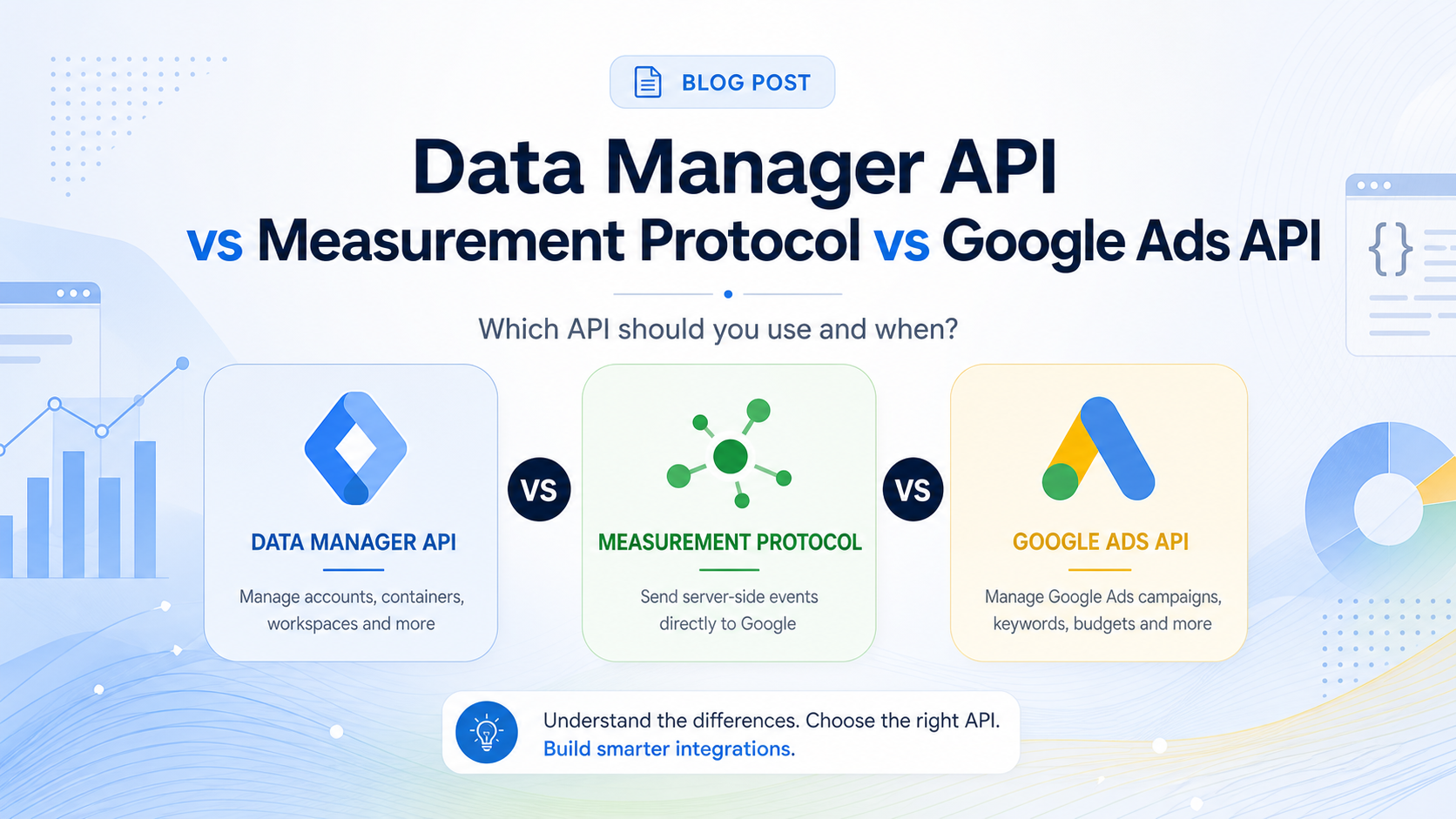
The broader choice is covered in the spoke Data Manager API vs Measurement Protocol vs Google Ads API. The headline is that Data Manager API should own durable first-party signal ingestion, while the Google Ads API and MCP-style reporting surfaces should own analysis.
Migration priority by team type
Not every advertiser needs to migrate at the same speed. The urgency depends on where your current signal path is fragile.
| Team type | Priority | Why |
|---|---|---|
| Agencies managing Google Ads plus CM360 or SA360 | High | Multi-destination offline conversions are exactly the new surface |
| Ecommerce brands with store sales or offline revenue | High | Store sales and value signals improve bidding quality |
| Lead-gen teams importing qualified leads | High | Google has tightened new-adopter offline import paths and is steering teams to Data Manager API |
| App teams sending GA4 app events | Medium | Data Manager API now supports richer app event metadata |
| Small teams with only basic GA4 web events | Low to medium | Measurement Protocol may be enough until routing complexity grows |
The change that matters most for new builds is Google's May 15 notice: starting June 15, 2026, the Google Ads API no longer accepts new adopters of offline conversion imports, including enhanced conversions for leads. Existing adopters can continue while integrating with Data Manager API, but new adopters receive an allowlist error on ConversionUploadService.UploadClickConversions (Google Ads Developer Blog, May 2026 archive).
That does not mean every existing upload breaks. It means the direction of travel is clear: Data Manager API is the primary path for new offline conversion import integrations.
Implementation architecture
A clean Data Manager API implementation has five layers.
| Layer | Owner | What good looks like |
|---|---|---|
| Source events | Backend, ecommerce, CRM | Stable event IDs, timestamps, values, consent flags |
| Identity normalization | Data engineering or growth engineering | Consistent email, phone, address, IP, and timestamp formatting |
| Event contract | Marketing ops | One documented schema for purchase, lead, opportunity, and store-sale events |
| Destination routing | Ads engineering | Explicit mapping to Google Ads, GA4, CM360, SA360, DV360, Customer Match |
| Monitoring | Growth ops and agents | Rejection rates, match-rate signals, missing IDs, duplicate events, lag |
The first-hand Soku recommendation is to add an "event output index" before writing API code. For every event, list which destinations should receive it, which identifiers are required, which identifiers are optional, and which systems are allowed to use it for bidding. That index becomes the guardrail for an AI agent: the agent can recommend a new route only if the destination and consent state are allowed by the index.
Common mistakes
The most common mistake is treating Data Manager API as a drop-in technical migration. It is not. It is a schema migration. If you copy your old offline conversion upload job into a new endpoint without resolving event identity, dedupe, consent, and routing, you have not gained much.
The second mistake is over-routing. A purchase event that should train bidding may not belong in every reporting destination if it lacks the identifiers required for accurate attribution. More destinations is not the goal. More consistent signal is the goal.
The third mistake is leaving agents blind to measurement quality. If your AI media buyer can read ROAS but cannot see whether conversion imports failed yesterday, it will overreact to reporting artifacts. The measurement health layer needs to be part of the agent context.
Where to go next
| Reader intent | Deep dive |
|---|---|
| "How do I implement this?" | Data Manager API Setup Guide for Google Ads and GA4 Events |
| "Which Google API should own this event?" | Data Manager API vs Measurement Protocol vs Google Ads API |
| "What changed for GMP and Customer Match?" | Google Data Manager API Customer Match and GMP Destinations |
| "How does this relate to Google Ads agents?" | Google Ads MCP: The Complete Guide |
| "How does user-object matching work across channels?" | ChatGPT Ads Conversion Tracking: User Objects |
FAQ
Is Data Manager API replacing Measurement Protocol?
No. Google describes Data Manager API as an alternative for sending recommended and custom events directly to Google Analytics, especially when you want a unified schema and broader routing. Measurement Protocol can still be a reasonable lightweight GA4-only server-event path.
Is Data Manager API replacing Google Ads API offline conversion uploads?
For new adopters, Google is steering offline conversion imports toward Data Manager API. Existing offline conversion import users can continue while they migrate, but new adopters face allowlist restrictions for the older Google Ads API upload path.
Does Data Manager API edit campaigns?
No. It ingests first-party data. Use Google Ads API, Google Ads UI, or approved automation paths for campaign changes. Data Manager API improves the signal those systems optimize against.
Why does Customer Match composite data matter?
Composite data lets Google Ads Customer Match uploads combine IP data with user identifiers such as email, phone, and address information. Google says IP data with observation timestamps will help drive higher match rates beginning in Q3 2026.
Should an AI ad agent use Data Manager API directly?
Usually the agent should not freely write events. It should inspect schema health, identify missing identifiers, recommend routing changes, and trigger approved sync jobs. The actual ingestion path should be deterministic and monitored.
What is the first migration step?
Create an event output index: each conversion or audience event, its source system, required identifiers, allowed destinations, dedupe key, and consent rule. The API integration is much easier after that contract is explicit.