 Soku AI

"AI marketing agent" is the most overloaded phrase in martech right now. Every email tool with an "AI" badge and every chatbot bolted onto a CRM is being relabeled as an agent. Most of them aren't.
The distinction matters because it changes what you can delegate. A workflow that follows rules you wrote can only ever do what you already knew to specify. An agent that reasons about a goal can handle the cases you didn't anticipate — which is exactly where marketing teams spend most of their time. This piece is the definition we wish existed when we started building one: what an agent actually is, where the 2026 data says it works, and how to deploy one without handing over the keys.
What an AI marketing agent actually is
An AI marketing agent is software you give a goal and guardrails, not a script. It uses a reasoning model to interpret intent, plan a sequence of actions, call tools (segment builders, journey editors, template engines, analytics APIs), observe the result, and adapt — without a human modifying the workflow between steps.
The difference from marketing automation is architectural, not incremental:
| Marketing automation | AI marketing agent | |
|---|---|---|
| You give it | Rules ("if X, send Y") | A goal + guardrails |
| Decision logic | Predefined branches | Reasoned at runtime |
| Handles novelty | No — only cases you scripted | Yes — plans for unseen cases |
| When it breaks | Reality diverges from the flowchart | You misdefined the goal or guardrails |
| Best at | Repeatable, predictable paths | Open-ended, high-variance work |
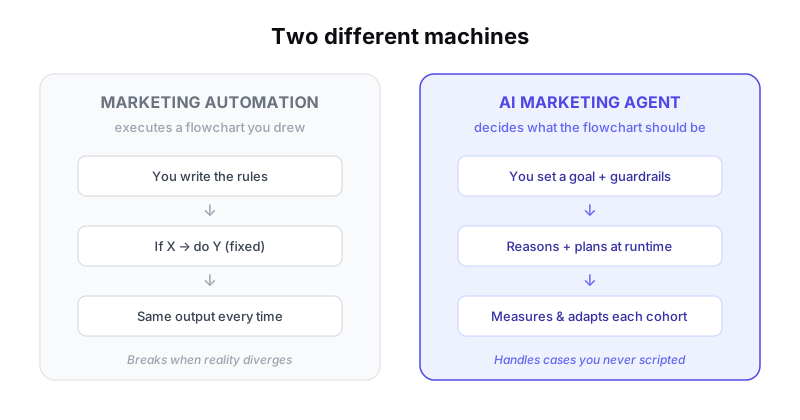
A concrete contrast. Automation: "When a trial user hits day 23 with no activity, send re-engagement email #4." An agent given the goal "reduce trial churn" identifies at-risk customers from dozens of behavioral signals before any fixed day count, picks the channel and message per individual based on their engagement history, launches the intervention, measures lift, and changes its approach for the next cohort — none of which you flowcharted.
The 2026 reality: adoption is real, but narrower than the hype
The headline numbers are genuinely large. 87% of marketers use generative AI in at least one workflow in 2026, up from 51% in 2024. But "uses AI" and "runs an agent" are different sentences, and the gap is the whole story.
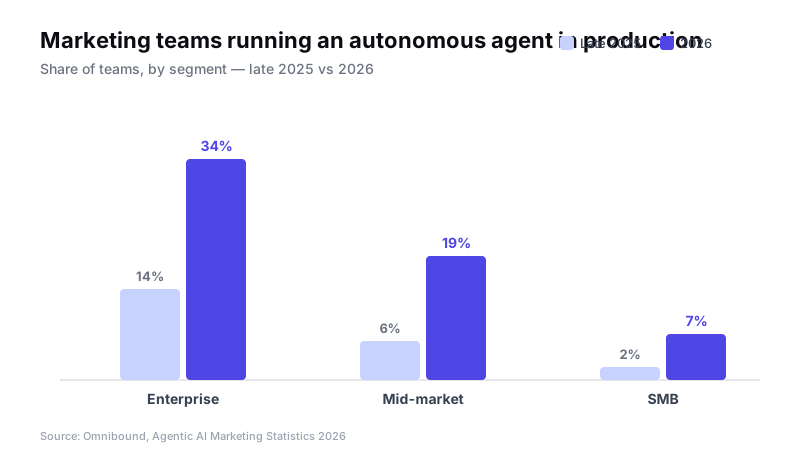
The production numbers are smaller and steeper: 34% of enterprise teams now run at least one autonomous agent in production (up from 14% in late 2025), with mid-market at 19% and SMB at 7%. Among adopters, enterprises run 2.8 distinct agents on average, up from 1.1 six months earlier — yet fewer than a third of all AI-using marketers apply it to high-value agentic work like brand governance or predictive optimization. Most "AI use" is still a copilot writing first drafts.
So the curve is steep but early. Gartner projects 40% of enterprise applications will embed AI agents by the end of 2026, up from under 5% in 2025 — meaning most of this adoption is happening this year, not behind you.
Where the ROI actually shows up
This is where the data gets useful, because it's specific. Successful agent deployments report 4.1x–5.3x ROI on the specific workflow they replace — notably higher than general-purpose AI tooling, because an agent owns an outcome rather than assisting a task. Teams running agent workflows report 27% faster campaign build times, 19% lower cost per qualified lead, and recover around 6 hours per person per week.
The pattern behind those numbers: agents pay off when a workflow is high-variance and high-volume — creative testing, audience reactivation, budget reallocation, per-segment messaging. They underperform when the work is genuinely rote (a fixed weekly report) — that's automation's job, and paying for reasoning there is waste.
The five jobs marketing agents are doing now
Across deployments, the work clusters into five patterns:
- Creative generation and testing at volume — produce dozens of ad variants, launch them, read performance, and double down on winners. (This is where we focus Soku — reasoning over real ad performance, not just generation.)
- Audience and lifecycle orchestration — identify at-risk or high-potential segments from behavioral signals and build the intervention per individual.
- Budget and bid reallocation — shift spend across channels and campaigns toward what's converting, continuously.
- Performance analysis → action — turn raw analytics into "do this next," not another dashboard a human has to interpret.
- Brand governance — check outputs against brand and compliance rules before anything ships.
Notice these aren't features. They're outcomes a human used to own end-to-end.
How to deploy one without losing control

The fear is reasonable: software that decides on its own, spending your budget and speaking in your brand's voice. The teams getting 4x-plus ROI aren't the ones who turned an agent loose — they're the ones who scoped it tightly. A practical sequence:
- Pick one high-variance workflow, not your whole funnel. Creative testing or reactivation are good first bets.
- Write the goal as an outcome, not a task ("lower CPA on prospecting," not "generate 20 ads").
- Set hard guardrails — spend caps, channels it may touch, a do-not-say list, and an approval gate before anything goes live. Agents that propose and wait build trust faster than agents that act and report.
- Instrument the baseline before you start, or you can't prove the 4x.
- Review the agent's reasoning, not just its output. When you can see why it chose a segment or killed a variant, you learn whether to widen its autonomy.
- Widen scope only after it earns it. Expand from propose-and-approve to act-within-bounds one workflow at a time.
Agents don't replace your automation — they sit on top of it
The strongest 2026 marketing systems run both. Automation still handles the deterministic plumbing — the welcome series, the receipt emails, the fixed weekly export. Agents handle the judgment-heavy layer above it: deciding which campaign to build, which segment to chase, which creative to scale. Expect the long tail of single-purpose "AI" point tools to get absorbed into fewer platforms, while the agent layer becomes the thing that actually decides what runs.
The teams winning with agents in 2026 didn't replace their marketers — they moved them up a level: from operating the campaigns to directing the agent that operates them. The skill that's becoming valuable isn't writing the rules. It's writing the goal, drawing the guardrails, and reading the reasoning.
That's the shift worth preparing for — whether you start with the workflow we obsess over (ad creative) or anywhere else your team spends its highest-variance hours.
Where to go next
- Which product to actually buy: Best AI Marketing Agents in 2026: 12 Platforms Compared — all twelve scored on the autonomy ladder (what each one reads, proposes, and writes), plus real 2026 pricing.
- If your surface is paid media: Best AI Media Buying Tools, Ranked.
- If you're mapping the wider stack: The Best AI Marketing Tools (2026).