YouTube Shorts earning MRC brand-safety accreditation makes the format easier to defend in a media plan. It does not make AI-generated ads automatically safe. In fact, the opposite is closer to the truth: once a channel is easier to buy, teams will push more creative into it, and AI will make that volume explode.
This playbook is the operational spoke in the cluster. For the strategic overview, start with YouTube Shorts MRC Accreditation: What It Means for AI Ad Creative Teams. If you are comparing channel allocation, read YouTube Shorts vs TikTok vs Reels for AI creative testing.
The core idea: brand safety is not only a media setting. For AI-generated Shorts, it is a production workflow.
The New Risk Is Review Debt
Before generative AI, a team might have reviewed five or ten video concepts before a launch. With AI voiceover, AI editing, AI product video, AI captions, and prompt-based scripting, the same team can produce fifty concepts in a day. That is useful only if the review process scales with the output.
The common failure mode is simple:
- The team generates a large batch of vertical videos.
- The batch is reviewed quickly for obvious visual problems.
- Variants go live with inconsistent claims, tones, pacing, or suitability assumptions.
- Performance data becomes hard to interpret because every variant tests too many variables.
That is not a brand-safety failure in the old sense. It is a learning failure. The team cannot tell whether Shorts worked, whether the hook worked, whether the offer worked, or whether the AI output was simply too messy.
What YouTube's MRC Accreditation Changes
Google says the MRC accreditation now covers Shorts and YouTube's inventory suitability tiers: Maximum, Moderate, and Limited Mode. Google also points to Shorts averaging 200 billion daily views. Those two facts together matter because they combine scale with a stronger trust signal.
But the accreditation sits at the platform layer. Advertisers still need to control three lower layers:
| Layer | Owner | Example decision |
|---|---|---|
| Platform safety | YouTube / Google | Brand-safety systems and suitability tier validation |
| Campaign suitability | Advertiser / media buyer | Maximum vs Moderate vs Limited Mode, exclusions, buying route |
| Creative safety | Brand / creative team | Claims, visuals, tone, synthetic voice, product proof, disclaimers |
AI-generated ads mostly create risk in the third layer. That is where this playbook focuses.
The Four-Gate QA System
Use four gates before a Shorts variant reaches paid spend.
| Gate | Question | Fail example | Fix |
|---|---|---|---|
| Claims | Is every claim true, specific, and supportable? | "Double ROAS in seven days" with no proof | Change to a testable workflow claim |
| Context | Would this feel appropriate next to mainstream creator content? | Fear-based hook for a normal SaaS feature | Reframe as problem/solution |
| Format | Does it work as a Short, not a cropped ad? | Slow logo intro and delayed product reveal | Put motion or proof in second one |
| Learning | Does this test one idea? | New hook, new offer, new audience, new voice, new CTA all at once | Isolate the variable |
This is intentionally boring. Boring QA is what lets creative teams move fast without turning the account into a random number generator.
Gate 1: Claims Review for AI Scripts
AI copy tends to optimize for confidence. That is dangerous in ads. A script model can turn "helps teams produce more variants" into "guarantees winning creative." It can turn "reduces manual editing" into "automates all production." In regulated categories, the risk is obvious. In ordinary ecommerce and SaaS, the risk is subtler: unsupported certainty erodes trust and can trigger platform review issues.
For each script, mark every claim as one of four types:
| Claim type | Example | Allowed? |
|---|---|---|
| Factual product capability | "Generate voiceover variants from one script" | Yes, if true |
| Workflow claim | "Review more concepts before launch" | Yes, if phrased as capability |
| Performance claim | "Lower CPA by 30%" | Only with evidence and context |
| Superlative claim | "The best AI ad tool" | Avoid unless the page supports it |
The safest AI-generated Shorts ads focus on workflow proof. Show the user what changes in the work: one script becomes five localized voiceovers, one product photo becomes three video hooks, one winning message becomes a test matrix. That is persuasive without overclaiming.
Gate 2: Context and Suitability Review
Shorts is a high-context feed. The same creative can feel harmless in a dashboard and jarring in a feed. That is why suitability settings and creative tone have to match.
Use this matrix:
| Brand risk tolerance | Suitability posture | Creative style |
|---|---|---|
| Conservative brand | Maximum or tighter buying route | Clean product demo, no edgy humor, no shock hooks |
| Standard growth brand | Moderate with exclusions as needed | UGC-style proof, comparison, founder voice |
| Aggressive testing brand | Moderate or broader test cell | Trend-driven cuts, creator formats, faster hook testing |
The mistake is mixing a conservative suitability posture with chaotic creative production. If the brand needs Maximum Mode, the creative should also avoid tricks that create review ambiguity: fake emergencies, misleading countdowns, impersonation, sensational health or finance claims, and unsupported before/after stories.
Gate 3: Format Review for Shorts-Native Creative
A Shorts ad has to earn attention before the viewer understands the brand. That changes the structure.
| Time window | Job | AI creative instruction |
|---|---|---|
| 0-1 seconds | Stop the swipe | Show the problem visually, not with a long setup |
| 1-3 seconds | Prove relevance | Name the audience or use case |
| 3-8 seconds | Demonstrate value | Show the workflow, product, or result |
| 8-15 seconds | Ask for action | Use one CTA, not three |
If the creative does not make sense with sound off, it is not ready. If the voiceover carries the whole message while the visual stays generic, it is not ready. If the first frame is a logo, it is usually not ready.
For teams producing with AI, this means prompting for shots, not just scripts. A good prompt says "show a media buyer comparing five AI voiceover variants on a campaign board" rather than "write an ad about AI voiceover."
Gate 4: Learning Design
AI creative systems tempt teams into testing everything at once. That is fast, but it is not learning.
Structure Shorts tests around one variable at a time:
| Test type | Keep constant | Change |
|---|---|---|
| Hook test | Offer, voice, audience, CTA | First visual and opening line |
| Voice test | Script, visual, offer, CTA | Voice persona or language |
| Proof test | Audience, offer, CTA | Demo proof vs social proof vs workflow proof |
| CTA test | Hook, proof, audience | CTA wording |
| Localization test | Product proof, offer | Language, accent, cultural reference |
Soku is useful here because it can preserve the test structure across creative and performance data. The team should not only ask "which ad won?" It should ask "which creative variable won, and what should we make next?"
A Practical Review Workflow
Here is a workflow a small team can run without creating a compliance department.
| Step | Owner | Output |
|---|---|---|
| Generate 20-40 variants | Creative operator | Draft videos grouped by hypothesis |
| Auto-label variables | Soku / spreadsheet | Hook, voice, proof type, offer, CTA |
| Claims pass | Marketer | Remove unsupported or vague performance claims |
| Suitability pass | Media buyer | Match campaign inventory mode and exclusions |
| Format pass | Creative lead | Cut slow intros, weak captions, unclear first frames |
| Launch 6-10 variants | Media buyer | A controlled test batch |
| Read results | Soku | Winner by variable, not just by asset |
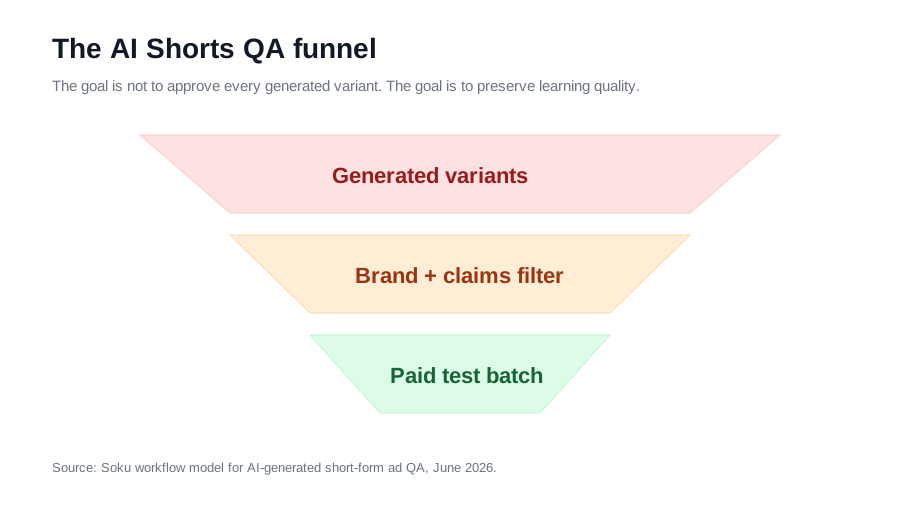
The goal is not to make the review process heavy. The goal is to protect the learning loop. A smaller clean batch beats a huge noisy batch.
Example: Turning One Offer into Safe Shorts Variants
Suppose the offer is Soku's AI voiceover workflow. A risky AI-generated hook might say:
This AI voiceover tool will 10x your ROAS overnight.That fails the claims gate. A safer, still compelling hook:
One product script. Five localized voiceovers. One ad test matrix.Now the creative can show the workflow: product claim, voice persona selection, localized outputs, ad variants, and performance comparison. The ad is still direct. It just sells the real workflow instead of inventing a performance guarantee.
Metrics to Watch After Launch
Do not judge the test only by CTR. Shorts can generate cheap attention that does not become qualified traffic.
Track:
- Hook hold: the share of viewers who stay past the first seconds.
- Click quality: bounce rate, engaged sessions, or landing page depth.
- Conversion rate by creative variable.
- Assisted conversions if Shorts sits high in the funnel.
- Negative feedback, comments, and review issues.
- Performance difference by suitability tier or buying route.
If a variant wins CTR but loses conversion quality, it may be over-hooked. If a safer variant gets fewer clicks but more qualified conversions, it may be the better scaling candidate.
How This Connects to Existing Soku Workflows
This playbook pairs with Soku's existing creative stack:
- Use AI voiceover generation for persona and localization tests.
- Use AI YouTube Shorts generation for channel-native vertical cuts.
- Use video ad variant generation to structure modular tests.
- Use Soku's cross-channel analysis to decide whether Shorts creative is creating real conversion lift or only cheap reach.
Bottom Line
YouTube's MRC accreditation for Shorts makes the media environment easier to trust. It does not make AI-generated creative easier to manage. The winning teams will treat brand safety as a workflow: generate variants, filter claims, match suitability settings, launch clean test batches, and use performance data to decide the next batch.
That is the difference between AI creative scale and AI creative noise.
FAQ
Can AI-generated ads run safely on YouTube Shorts?
Yes, but only with review. Teams should check claims, tone, suitability, format, and learning design before moving generated variants into paid spend.
Does MRC accreditation replace third-party verification?
No. Accreditation validates YouTube's platform-level systems. Advertisers may still use third-party verification, suitability settings, exclusions, and post-buy reporting depending on their risk tolerance.
What is the biggest risk with AI-generated Shorts ads?
The biggest risk is not only unsafe adjacency. It is unsupported claims and noisy testing. AI can generate many variants that look usable but teach the team nothing.
How many Shorts variants should a team launch at once?
A practical first batch is 6-10 reviewed variants grouped around one hypothesis. Larger batches are fine only if the team can label and analyze the variables cleanly.
What should conservative brands do?
Use stricter suitability settings, avoid sensational hooks, require evidence for claims, and keep AI-generated creative focused on product workflow proof rather than exaggerated outcomes.