 Soku AI
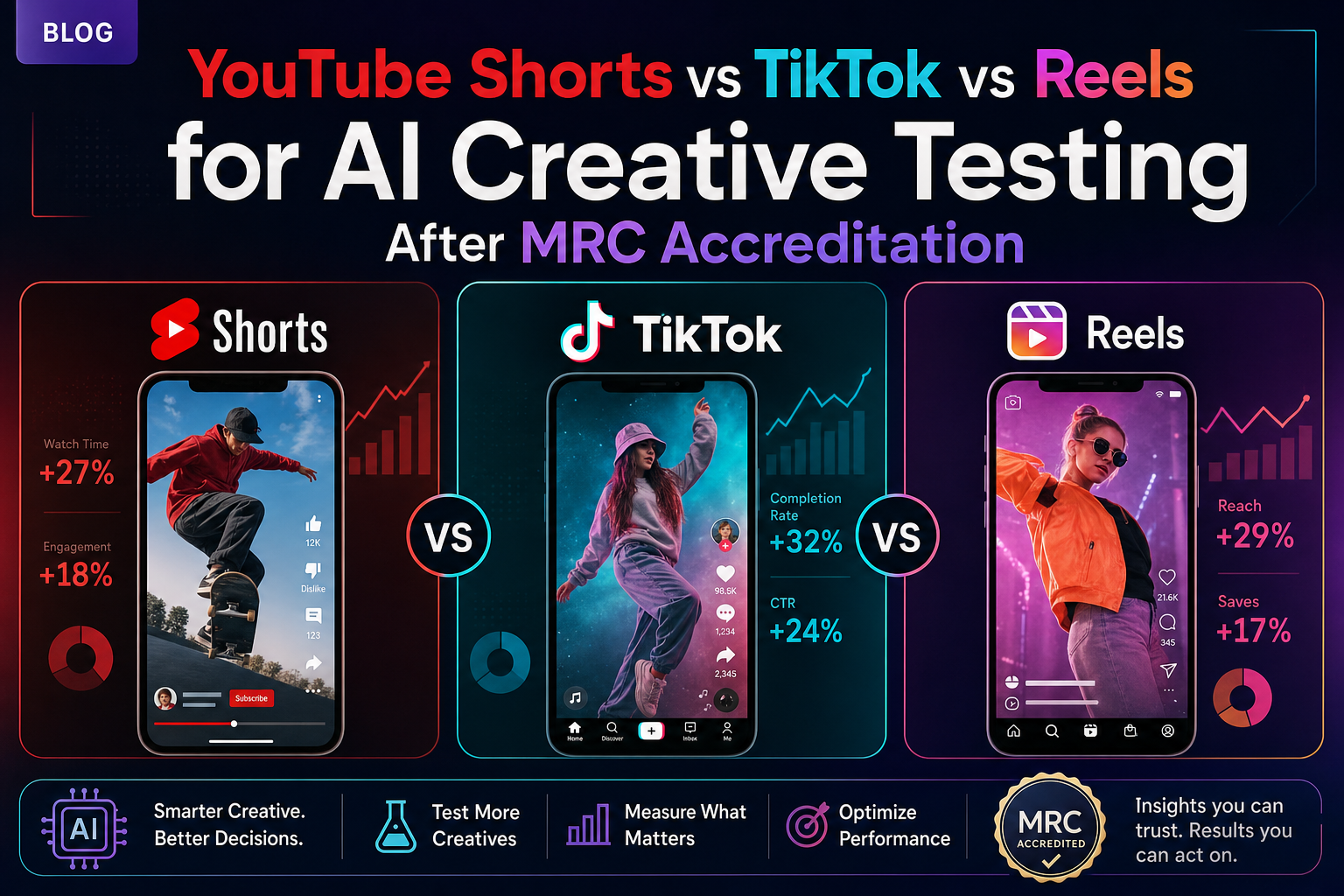
YouTube Shorts earning MRC brand-safety accreditation does not end the short-form budget debate. It makes the debate more interesting. TikTok still owns much of the culture of short-form creative. Instagram Reels still benefits from Meta's social graph and conversion machinery. YouTube Shorts now has a stronger brand-safety trust signal and a direct connection to Google's video and campaign ecosystem.
The wrong response is to ask which platform is "best." The useful response is to decide what each platform should teach your AI creative system.
This guide covers the whole job: how to split tests across the three platforms, what the MRC accreditation actually validates, how to run brand-safety QA on AI-generated Shorts before they reach spend, and how to measure a Shorts campaign as a demand signal rather than a view count.
The Short Answer
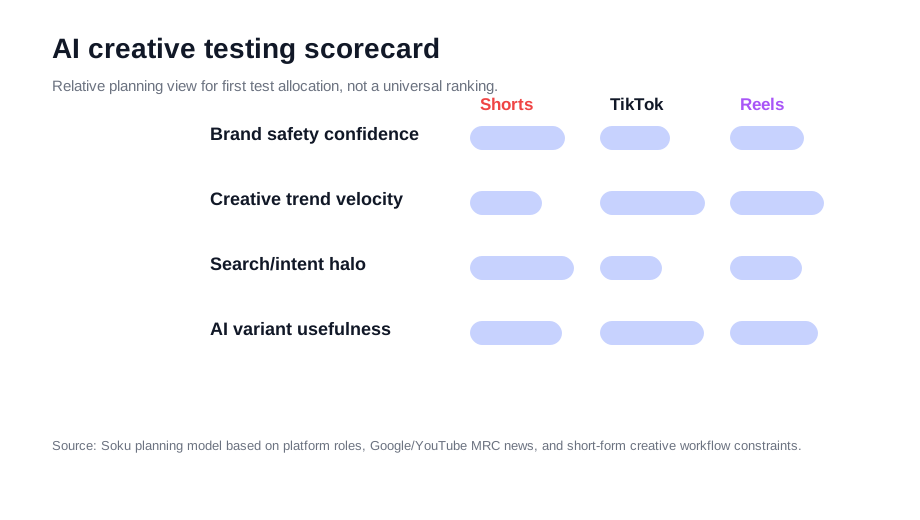
Use YouTube Shorts when you need brand-safety confidence, Google campaign integration, and a better bridge between short-form video and YouTube intent. Use TikTok when you need trend velocity, creator-native hooks, and fast cultural feedback. Use Reels when you need Meta conversion infrastructure, retargeting, and creative patterns that can move across Instagram and Facebook placements.
| Platform | Best first job for AI creative | Primary caution |
|---|---|---|
| YouTube Shorts | Brand-safe short-form tests that can feed Google video and PMax strategy | Do not treat it as a dumping ground for resized YouTube ads |
| TikTok | Hook discovery, creator-native formats, trend-led creative exploration | Trend wins may not translate to high-quality conversion |
| Instagram Reels | Scaling proven social proof and UGC patterns through Meta's ad system | Creative can become too polished or too Meta-native to transfer |
What YouTube's MRC Accreditation Actually Covers
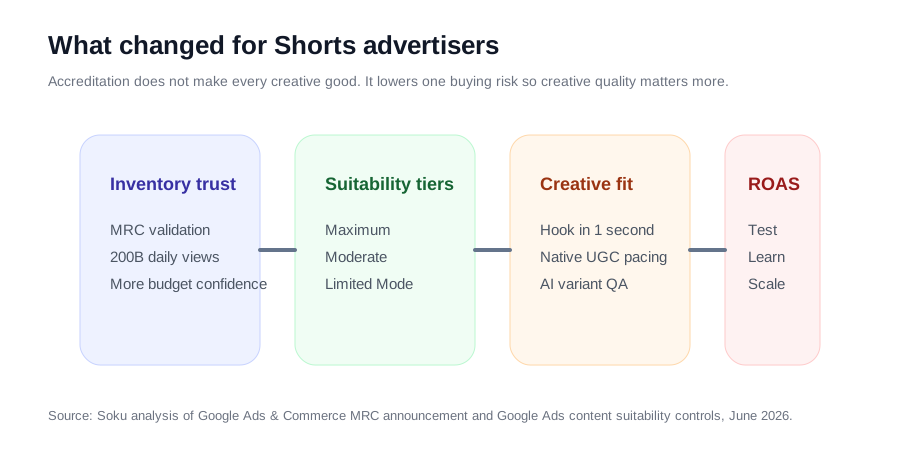
Google says YouTube received its sixth consecutive MRC brand-safety accreditation, and the scope now includes Shorts, making YouTube the first platform to receive Media Rating Council brand-safety accreditation for short-form video. The certification covers YouTube's three inventory suitability tiers: Maximum, Moderate, and Limited Mode. Google also repeats the scale number that changes the budget conversation: Shorts averages 200 billion daily views.
The important distinction is this: the accreditation is about YouTube's brand-safety protections and suitability controls, not about the performance of any one advertiser's campaign. In plain language, the MRC signal gives media buyers more confidence that the platform's systems for avoiding unsuitable content meet an audited standard. It does not guarantee that every impression is perfect, and it does not replace your own suitability settings, exclusions, third-party verification, or post-buy review.
That nuance matters because short-form video is more volatile than long-form video. A Short is dense. The first second carries the hook. The context can be remixed, trend-driven, creator-led, and culturally specific. A long-form video gives classification systems more metadata and more runtime to understand context. A 20-second short-form clip can compress the joke, product, soundtrack, caption, and cultural reference into one tight package. Accreditation says YouTube has a validated system for this environment; it does not mean advertisers can stop thinking.
Most brand-safety news is useful but not operational. This one is operational because Shorts sits at the intersection of three shifts:
| Shift | Why it matters for ad teams | What changes after accreditation |
|---|---|---|
| Short-form scale | Shorts has enough daily consumption to absorb real budget | Brand teams have a stronger reason to include Shorts in formal plans |
| AI creative volume | Teams can now produce dozens of vertical variants quickly | More variants need more QA and clearer suitability rules |
| Performance Max and video expansion | Google campaigns increasingly need short-form video assets | Shorts becomes less of a side experiment and more of a default creative input |
The result is not "move all budget to Shorts." The result is "stop treating Shorts as a leftover resize." If a channel is large enough, brand-safe enough, and algorithmically important enough, then it deserves channel-native creative.
What Accreditation Does Not Solve
The fastest way to misuse this news is to treat accreditation as permission to lower creative standards. It solves one risk class. It does not solve five others.
| Risk | Why it still matters |
|---|---|
| Hook mismatch | A brand-safe impression can still be ignored in the first second |
| Bad AI claims | Synthetic voiceovers and generated scripts can overpromise or create compliance risk |
| Format mismatch | A polished 16:9 brand film still feels wrong inside Shorts |
| Audience mismatch | Shorts reach is broad; conversion quality still depends on targeting and landing page fit |
| Measurement mismatch | Views and efficient CPM do not prove incremental revenue |
The accreditation raises the floor of trust. It does not raise the ceiling of performance. Creative teams still need a repeatable workflow for generating, filtering, launching, and learning.
Where the Accreditation Helps Most
The accreditation helps most when a team was already interested in Shorts but blocked by brand-safety concerns. It gives the media buyer a stronger argument for a controlled test. It helps the creative lead justify Shorts-specific production. It helps the growth lead compare Shorts against TikTok and Reels without treating YouTube as the risky outlier.
It helps less when the bottleneck is creative quality, offer strength, or conversion tracking. If the videos are weak, the page is mismatched, or the event data is broken, accreditation will not save the campaign.
Why MRC Accreditation Changes the YouTube Shorts Role
Before the accreditation news, many performance teams treated Shorts as a secondary placement. They might upload vertical video because the platform asked for it, but they did not always brief Shorts as its own creative environment. Google's MRC update changes the planning conversation because brand teams now have a clearer third-party trust signal for the short-form inventory.
That does not automatically make Shorts the best performance channel. It does make Shorts easier to include in a serious testing matrix, especially for brands that were waiting for stronger safety validation before scaling short-form video outside Meta or TikTok.
The strategic shift is this: YouTube Shorts is now a better candidate for controlled AI creative tests, not just leftover reach.
The AI Creative Team's New Operating Model
Before this announcement, many teams had a simple reason to underinvest in Shorts: short-form feeds felt risky, creator-led, hard to control, and harder to verify than long-form YouTube. That objection did not disappear, but it weakened.
The new operating model has four layers.
| Layer | Old behavior | Better behavior after the MRC update |
|---|---|---|
| Media plan | Treat Shorts as incremental reach | Give Shorts a defined test budget and success criteria |
| Creative production | Crop Reels or TikToks into YouTube | Produce Shorts-native cuts with YouTube pacing and captions |
| AI generation | Generate many vertical videos and hope | Generate variants inside a suitability and claims QA checklist |
| Measurement | Judge by CTR or cheap views | Compare retention, conversion quality, brand safety, and assisted value |
A human can decide the brand tolerance. An AI creative stack can generate hooks, voiceovers, captions, and cuts. The missing layer is the one that connects those assets to downstream performance so the team knows which creative pattern to produce next.
The Three Platform Roles
A good AI creative testing plan assigns each platform a role.
YouTube Shorts: The Trust and Google Ecosystem Test
Shorts is strongest when the question is:
- Can this short-form concept work in a more brand-controlled video environment?
- Can this vertical asset support Google Ads, Demand Gen, or Performance Max learning?
- Can the same idea bridge entertainment and intent?
YouTube's scale and MRC signal make it especially useful for brands that care about suitability controls. Google says the accreditation covers Maximum, Moderate, and Limited Mode. That matters for larger advertisers, regulated categories, and any brand that needs a defensible answer when finance or legal asks why short-form budget is increasing.
Creative implication: Shorts ads should be proof-led and clear. They can be native, but they should not rely entirely on inside jokes or fragile trends. YouTube is a good home for explainer-style UGC, product proof, before/after workflow demonstrations, and creator-led education.
TikTok: The Hook Discovery Test
TikTok is still the strongest place to discover whether a hook feels alive. It rewards speed, creator fluency, and cultural timing. For AI creative teams, TikTok is useful because weak hooks die quickly and strong ones reveal themselves fast.
Creative implication: use TikTok to test the outer edge of the hook space. Try different openings, creator voices, visual metaphors, pacing, and cultural references. Do not assume the winning TikTok version is ready to copy into Shorts or Reels. Translate the learning, not the asset.
Reels: The Meta Conversion Test
Reels sits inside Meta's broader ad system. That makes it useful for retargeting, lookalike expansion, Advantage+ workflows, and conversion-oriented creative. It is often where a proven UGC pattern can scale efficiently once the team knows the message works.
Creative implication: Reels is a good place to test social proof, direct response angles, product demos, founder clips, and testimonial-style variants. It may be less useful for the wildest trend discovery if the brand's buying objective is conversion quality.
A Practical Budget Split for First Tests
For a new AI-generated short-form concept, start with a learning budget, not a scale budget.
| Brand situation | Shorts | TikTok | Reels | Why |
|---|---|---|---|---|
| Conservative brand entering short-form | 50% | 20% | 30% | Use Shorts trust signal and Meta conversion system; keep TikTok exploratory |
| DTC brand with strong UGC motion | 25% | 40% | 35% | Use TikTok for hook discovery, Reels for conversion, Shorts for Google expansion |
| B2B or SaaS with explainer creative | 45% | 15% | 40% | Shorts and Reels handle proof-led creative better than trend-first tests |
| Trend-led consumer product | 20% | 55% | 25% | TikTok should discover the creative language first |
These are not permanent allocations. They are first-test structures. After the first batch, shift budget based on what each platform teaches.
The Creative Translation Rule
Do not repost the exact same video everywhere and call it a test. That only tells you whether one asset happened to survive three different feeds.
Translate the idea by platform:
| Creative element | Shorts version | TikTok version | Reels version |
|---|---|---|---|
| Hook | Clear problem or proof in the first second | Pattern interrupt or trend-native opening | Social proof or direct benefit |
| Voice | Explainer, creator educator, product demo | Creator-native, faster, more conversational | UGC, founder, testimonial |
| Proof | Workflow screen, product use, before/after process | Real-life use, reaction, creator claim | Review, result, offer, product demo |
| CTA | Learn more, try workflow, see how it works | Comment, try, shop, compare | Shop, sign up, get offer, learn more |
AI tools are useful because they make translation cheap. One core script can become three platform-native scripts. One product proof can become three pacing patterns. One voiceover can become multiple personas. But the human strategy is still deciding what each platform is supposed to teach.
For the Shorts version specifically, the base creative brief should include:
- A first-second pattern interrupt.
- A silent-viewing caption plan.
- A voiceover or text rhythm that works without context.
- A visual proof moment by second three.
- A product or offer reveal before the viewer has time to swipe.
- A CTA that does not assume a long story arc.
AI makes that workflow cheaper. A team can use AI copywriting to generate hooks, AI voiceover to test tone, AI video tools to create product movement, and an AI video editor to make the ratio-specific cuts and burn in the silent-viewing captions. But speed creates a new problem: review debt. If you can make 80 Shorts variants in a day, you need a process that prevents 70 weak or risky variants from reaching spend.
How to Build the First AI Creative Matrix
Start with one product, one audience, and one offer. Then create controlled variants:
| Variable | Options |
|---|---|
| Hook | Pain point, proof, contrarian claim |
| Voice | Founder, UGC creator, expert narrator |
| Proof | Workflow demo, customer quote, side-by-side comparison |
| CTA | Try free, see demo, compare options |
For three platforms, do not multiply every option by every channel immediately. Pick six to nine total variants:
- Two Shorts variants: proof-led and explainer-led.
- Three TikTok variants: hook-led, trend-led, creator-led.
- Two or three Reels variants: UGC proof, offer-led, testimonial-led.
This is enough to learn without flooding the account.
The Shorts Creative Brief Template
A useful AI creative prompt for Shorts should be more constrained than a generic "make a video ad" request. It should specify the suitability tier, channel behavior, and measurement goal.
Use this structure:
| Brief field | Example |
|---|---|
| Product | "AI voiceover generator for ecommerce video ads" |
| Audience | "Performance marketer at a DTC brand spending on Meta and YouTube" |
| Shorts hook | "Show the pain of recording five voiceovers for one product launch" |
| Suitability constraint | "No shock, fear, exaggerated income claims, or unsafe before/after language" |
| Creative proof | "Show 5 localized voiceover variants from one product script" |
| CTA | "Try the workflow free" |
| Learning goal | "Test whether localization angle beats production-speed angle" |
This gives the model boundaries. It also gives the media buyer a clean read after launch: if localization wins, make more localization variants; if production speed wins, make more operational-efficiency variants.
Brand Safety for AI-Generated Shorts
Accreditation makes the format easier to defend in a media plan. It does not make AI-generated ads automatically safe. In fact, the opposite is closer to the truth: once a channel is easier to buy, teams will push more creative into it, and AI will make that volume explode. For AI-generated Shorts, brand safety is not only a media setting. It is a production workflow.
The New Risk Is Review Debt
Before generative AI, a team might have reviewed five or ten video concepts before a launch. With AI voiceover, AI editing, AI product video, AI captions, and prompt-based scripting, the same team can produce fifty concepts in a day. That is useful only if the review process scales with the output.
The common failure mode is simple:
- The team generates a large batch of vertical videos.
- The batch is reviewed quickly for obvious visual problems.
- Variants go live with inconsistent claims, tones, pacing, or suitability assumptions.
- Performance data becomes hard to interpret because every variant tests too many variables.
That is not a brand-safety failure in the old sense. It is a learning failure. The team cannot tell whether Shorts worked, whether the hook worked, whether the offer worked, or whether the AI output was simply too messy.
The accreditation sits at the platform layer. Advertisers still need to control three lower layers:
| Layer | Owner | Example decision |
|---|---|---|
| Platform safety | YouTube / Google | Brand-safety systems and suitability tier validation |
| Campaign suitability | Advertiser / media buyer | Maximum vs Moderate vs Limited Mode, exclusions, buying route |
| Creative safety | Brand / creative team | Claims, visuals, tone, synthetic voice, product proof, disclaimers |
AI-generated ads mostly create risk in the third layer. That is where the rest of this section focuses.
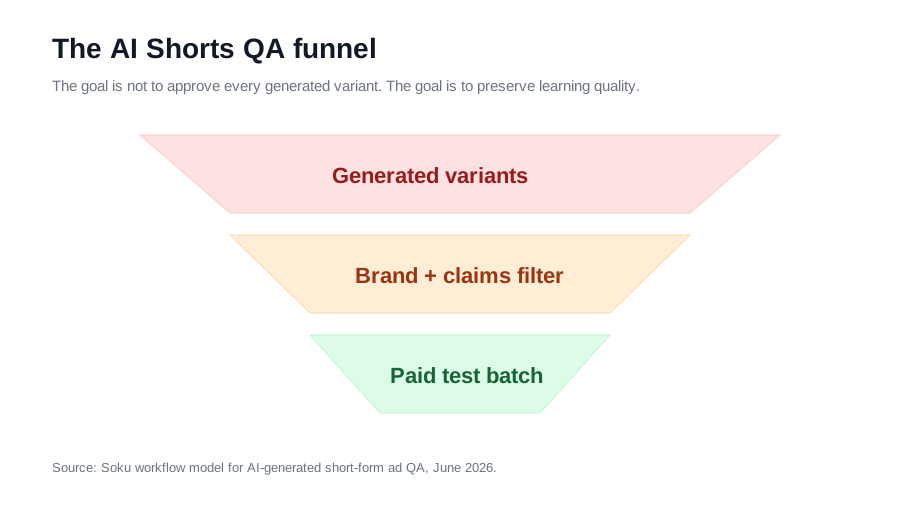
The Four-Gate QA System
Use four gates before a Shorts variant reaches paid spend.
| Gate | Question | Fail example | Fix |
|---|---|---|---|
| Claims | Is every claim true, specific, and supportable? | "Double ROAS in seven days" with no proof | Change to a testable workflow claim |
| Context | Would this feel appropriate next to mainstream creator content? | Fear-based hook for a normal SaaS feature | Reframe as problem/solution |
| Format | Does it work as a Short, not a cropped ad? | Slow logo intro and delayed product reveal | Put motion or proof in second one |
| Learning | Does this test one idea? | New hook, new offer, new audience, new voice, new CTA all at once | Isolate the variable |
This is intentionally boring. Boring QA is what lets creative teams move fast without turning the account into a random number generator.
Gate 1: Claims Review for AI Scripts
AI copy tends to optimize for confidence. That is dangerous in ads. A script model can turn "helps teams produce more variants" into "guarantees winning creative." It can turn "reduces manual editing" into "automates all production." In regulated categories, the risk is obvious. In ordinary ecommerce and SaaS, the risk is subtler: unsupported certainty erodes trust and can trigger platform review issues.
For each script, mark every claim as one of four types:
| Claim type | Example | Allowed? |
|---|---|---|
| Factual product capability | "Generate voiceover variants from one script" | Yes, if true |
| Workflow claim | "Review more concepts before launch" | Yes, if phrased as capability |
| Performance claim | "Lower CPA by 30%" | Only with evidence and context |
| Superlative claim | "The best AI ad tool" | Avoid unless the page supports it |
The safest AI-generated Shorts ads focus on workflow proof. Show the user what changes in the work: one script becomes five localized voiceovers, one product photo becomes three video hooks, one winning message becomes a test matrix. That is persuasive without overclaiming.
Gate 2: Context and Suitability Review
Shorts is a high-context feed. The same creative can feel harmless in a dashboard and jarring in a feed. That is why suitability settings and creative tone have to match.
Use this matrix:
| Brand risk tolerance | Suitability posture | Creative style |
|---|---|---|
| Conservative brand | Maximum or tighter buying route | Clean product demo, no edgy humor, no shock hooks |
| Standard growth brand | Moderate with exclusions as needed | UGC-style proof, comparison, founder voice |
| Aggressive testing brand | Moderate or broader test cell | Trend-driven cuts, creator formats, faster hook testing |
The mistake is mixing a conservative suitability posture with chaotic creative production. If the brand needs Maximum Mode, the creative should also avoid tricks that create review ambiguity: fake emergencies, misleading countdowns, impersonation, sensational health or finance claims, and unsupported before/after stories.
Gate 3: Format Review for Shorts-Native Creative
A Shorts ad has to earn attention before the viewer understands the brand. That changes the structure.
| Time window | Job | AI creative instruction |
|---|---|---|
| 0-1 seconds | Stop the swipe | Show the problem visually, not with a long setup |
| 1-3 seconds | Prove relevance | Name the audience or use case |
| 3-8 seconds | Demonstrate value | Show the workflow, product, or result |
| 8-15 seconds | Ask for action | Use one CTA, not three |
If the creative does not make sense with sound off, it is not ready. If the voiceover carries the whole message while the visual stays generic, it is not ready. If the first frame is a logo, it is usually not ready.
For teams producing with AI, this means prompting for shots, not just scripts. A good prompt says "show a media buyer comparing five AI voiceover variants on a campaign board" rather than "write an ad about AI voiceover."
Gate 4: Learning Design
AI creative systems tempt teams into testing everything at once. That is fast, but it is not learning.
Structure Shorts tests around one variable at a time:
| Test type | Keep constant | Change |
|---|---|---|
| Hook test | Offer, voice, audience, CTA | First visual and opening line |
| Voice test | Script, visual, offer, CTA | Voice persona or language |
| Proof test | Audience, offer, CTA | Demo proof vs social proof vs workflow proof |
| CTA test | Hook, proof, audience | CTA wording |
| Localization test | Product proof, offer | Language, accent, cultural reference |
The team should not only ask "which ad won?" It should ask "which creative variable won, and what should we make next?" That requires preserving the test structure across both creative and performance data.
Two Checks the Gates Miss
Two more pass conditions are worth adding before an AI-generated variant moves into paid testing.
| Check | Pass condition | Why it matters |
|---|---|---|
| Brand fit | Tone, voiceover, visuals, and creator style match the brand's tolerance | Brand-safe inventory does not protect against off-brand creative |
| Conversion fit | The landing page repeats the same promise as the Short | Message mismatch kills post-click performance |
A Practical Review Workflow
Here is a workflow a small team can run without creating a compliance department.
| Step | Owner | Output |
|---|---|---|
| Generate 20-40 variants | Creative operator | Draft videos grouped by hypothesis |
| Auto-label variables | Soku / spreadsheet | Hook, voice, proof type, offer, CTA |
| Claims pass | Marketer | Remove unsupported or vague performance claims |
| Suitability pass | Media buyer | Match campaign inventory mode and exclusions |
| Format pass | Creative lead | Cut slow intros, weak captions, unclear first frames |
| Launch 6-10 variants | Media buyer | A controlled test batch |
| Read results | Soku | Winner by variable, not just by asset |
The goal is not to make the review process heavy. The goal is to protect the learning loop. A smaller clean batch beats a huge noisy batch.
Example: Turning One Offer into Safe Shorts Variants
Suppose the offer is Soku's AI voiceover workflow. A risky AI-generated hook might say:
This AI voiceover tool will 10x your ROAS overnight.That fails the claims gate. A safer, still compelling hook:
One product script. Five localized voiceovers. One ad test matrix.Now the creative can show the workflow: product claim, voice persona selection, localized outputs, ad variants, and performance comparison. The ad is still direct. It just sells the real workflow instead of inventing a performance guarantee.
Post-Launch Safety Signals
Do not judge the test only by CTR. Shorts can generate cheap attention that does not become qualified traffic. Alongside the standard performance read, track:
- Negative feedback, comments, and review issues.
- Performance difference by suitability tier or buying route.
- Assisted conversions if Shorts sits high in the funnel.
If a variant wins CTR but loses conversion quality, it may be over-hooked. If a safer variant gets fewer clicks but more qualified conversions, it may be the better scaling candidate.
How to Measure the Test
If you do not already have a measurement stack you trust for this, the ad testing tools shortlist breaks the category into the three jobs — analytics, testing infrastructure and generation — so you buy the one you are actually missing rather than all three.
A short-form test should produce a creative decision, not just a channel report.
Use this table:
| Metric | What it tells you | Watch out for |
|---|---|---|
| First-second hold | Whether the hook stops the swipe | Trendy hooks can win attention but lose intent |
| Completion or retention | Whether the story resolves | Very short ads can inflate completion |
| CTR | Whether the viewer wants the next step | Clickbait can inflate CTR |
| Landing page engagement | Whether traffic is qualified | Platform-level CTR may not match site quality |
| Conversion rate | Whether the message sells | Needs enough data before judging |
| Creative variable winner | What to make next | Requires clean labeling |
The job is to connect the creative label to downstream outcomes. If the "localized voiceover" angle wins on Shorts but the "creator proof" angle wins on TikTok, the team should not declare one platform better. It should create the next batch around those channel-specific learnings.
Measuring Shorts as a Brand Campaign
Google's June 2026 brand-campaign update changes the job of a Shorts test. A Shorts campaign is no longer only a cheap-reach experiment or a direct-response CTR bet. It can be measured as a demand-creation system: did the creative make more people search for the brand, return through another channel, or convert later with better intent?
That update says Attributed Branded Searches is now available globally as a Google Ads reporting metric. The metric tracks searches triggered by an ad impression or view, which helps connect brand media to later search intent. Google also states that every additional branded search generated on Google is associated with an average $31 increase in sales.
That does not mean every brand can turn one extra branded search into exactly $31. It is an aggregate benchmark, not a guarantee. But it does give media buyers a better language for Shorts: a short-form brand ad can be judged by the downstream demand it sparks, not only the immediate click. Combined with the MRC accreditation, Shorts now has both a stronger safety argument and a clearer intent-lift reporting story.
The Measurement Mistake: Treating Shorts Like a Lower-Funnel Ad
Most Shorts measurement mistakes start with the wrong expectation. A 15-second vertical video can drive direct clicks, but that is not always its best job. Shorts can introduce the brand, make a product category legible, show a workflow, or create the search behavior that converts later.
If you judge every Shorts variant only by last-click CPA, you will kill useful creative too early. If you judge every variant only by views, you will scale entertaining creative that may never produce qualified demand. The middle path is to label each variant by the job it is supposed to do, then read the metric that matches that job.
| Creative job | Primary signal | Secondary signal | What to do next |
|---|---|---|---|
| Create category memory | Attributed Branded Searches | Branded search trend | Make more proof-led explainers |
| Introduce a product workflow | Engaged views | Landing page engagement | Turn the best sequence into direct-response cuts |
| Test a hook | First-second hold | Qualified clicks | Keep the hook, rewrite the proof |
| Test a proof point | Completion / retention | Assisted conversions | Scale the proof across Search and PMax |
| Retarget warm viewers | Conversion rate | CPA / ROAS | Move winners into lower-funnel campaigns |
The Measurement Stack
The useful unit is not "video." The useful unit is a labeled creative hypothesis.

A Soku-style measurement stack has four layers:
- Creative input. Label the hook family, proof type, creator style, offer, CTA, and suitability tier before launch.
- Attention. Read first-second hold, completion, engaged views, and qualified clicks.
- Intent lift. Read Attributed Branded Searches, branded search trend, assisted conversions, and post-view conversion quality.
- Next action. Decide whether to scale, translate, rewrite, or kill the creative pattern.
The key is preserving labels. If the winning variant is "founder proof + workflow demo + soft CTA," that is what the next batch should produce. If the winner is just stored as video_17_final_final.mp4, the team learns almost nothing.
How to Use Attributed Branded Searches
Attributed Branded Searches is most useful when the creative is supposed to create intent. It is less useful when the campaign is only retargeting people who already know the brand.
Use it for three decisions:
| Decision | How to read the metric |
|---|---|
| Which concept creates memory? | Compare branded search lift by creative theme, not only by campaign |
| Which audience is learning? | Segment by audience or campaign group if the data volume supports it |
| Which channel deserves the next asset? | Compare Shorts-generated search lift against TikTok/Reels direct engagement and Google Search follow-through |
Do not use it alone. A creative can generate curiosity searches that never convert. Pair it with landing page engagement, assisted conversions, and the quality of the branded search terms that rise. If searches spike for the wrong phrase, the creative may be memorable but unclear.
A Practical Readout Template
After a first Shorts brand test, the readout should fit on one page.
| Field | Example |
|---|---|
| Hypothesis | "Workflow proof creates more qualified branded search than generic benefit copy." |
| Winning hook | "One product script becomes five localized Shorts." |
| Primary lift | Attributed Branded Searches increased in the workflow-proof cell. |
| Quality check | Landing page engagement held steady, so the search lift did not look like empty curiosity. |
| Next batch | Three more workflow-proof variants: localization, speed, and creative-fatigue angles. |
| Kill list | Generic "AI makes ads faster" hook underperformed attention and search lift. |
This is where AI helps. A model can generate the next set of hook variants, captions, and proof sequences quickly. But the measurement system decides what the model should generate next.
How This Changes the Creative Brief
A Shorts brand-campaign brief should include the measurement goal before the script.
Weak brief:
Make a YouTube Shorts ad about our AI ad tool.Better brief:
Create three YouTube Shorts variants that should increase branded search from performance marketers.
Keep the offer constant. Vary only the proof style:
1. workflow demo,
2. founder explanation,
3. before/after campaign board.
Each variant must make the brand name memorable by second four without using exaggerated performance claims.
That brief gives the creative system a learning goal. It also gives the media buyer a reason to care about Attributed Branded Searches after the campaign runs.
Once Shorts runs alongside other YouTube campaigns, govern their combined exposure with Google's new Video campaign groups so the same viewer is not over-served across all of them.
Where This Fits with PMax and Google Video Strategy
The accreditation also matters because Google campaign types increasingly reward complete creative coverage. A Performance Max or Demand Gen advertiser that provides only static assets or only horizontal video is underfeeding the system. Shorts-ready creative gives Google another surface to test.
That does not mean PMax should receive every AI-generated video. PMax can combine assets broadly, so weak Shorts variants can pollute the learning environment. The right move is to pre-filter Shorts creative with a tighter QA process, then feed the winners or strongest challengers into broader Google campaigns.
For a deeper PMax creative strategy, read our guide to feeding Performance Max better AI creative assets.
Recommended Decision Framework
Use this decision tree:
| If your priority is... | Start with |
|---|---|
| Brand-safe short-form expansion | YouTube Shorts |
| Fast hook discovery | TikTok |
| Conversion scaling inside paid social | Reels |
| Product education or explainer creative | YouTube Shorts and Reels |
| Trend participation | TikTok first, then translate |
| Cross-channel creative learning | All three with a labeled matrix |
How Soku Fits
Soku is not just another generator in this workflow. It is the layer that keeps the test honest.
Use Soku to:
- Decide which product or campaign deserves short-form creative next.
- Generate hypotheses from existing ad performance.
- Label each creative variant by hook, proof type, voice, offer, CTA, and campaign cell.
- Compare immediate attention metrics with downstream branded search and conversion signals.
- Compare downstream conversion quality by platform.
- Identify whether a winning pattern should be scaled inside YouTube, translated into Reels/TikTok, or turned into Search/PMax creative.
- Turn the winner into the next creative brief.
That last step is the one teams skip. They launch a test, find a winning asset, and ask for more of it. A better workflow asks what made it win and how that learning should translate to the next channel.
This pairs with the rest of the Soku creative stack:
- Use AI voiceover generation for persona and localization tests.
- Use AI YouTube Shorts generation for channel-native vertical cuts.
- Use video ad variant generation to structure modular tests.
This is how AI creative becomes compounding. Each test makes the next generation prompt sharper.
Bottom Line
YouTube Shorts MRC accreditation does not make TikTok or Reels less important. It makes Shorts more credible as a controlled testing environment for serious advertisers. The best AI creative teams will not pick one short-form platform. They will assign each platform a job, generate platform-native variants, and use performance data to decide what to make next.
Shorts is now the trust-and-Google-ecosystem test. TikTok is the hook-discovery test. Reels is the Meta-conversion test. The creative team that understands those roles will learn faster than the team that simply exports one vertical video three times.
The same discipline applies inside the channel. Brand safety is a production workflow, not a checkbox: generate variants, filter claims, match suitability settings, launch clean test batches, and let performance decide the next batch. And measurement has to match the job of the creative, so a Shorts ad that creates demand is not killed by a last-click CPA report.
FAQ
Should I move budget from TikTok to YouTube Shorts after the MRC accreditation?
Not automatically. The accreditation strengthens Shorts as a brand-safe testing environment, but TikTok may still be better for trend discovery and creator-native hooks. Run a structured test instead of a blanket budget shift.
Is YouTube Shorts safer for brands than TikTok or Reels?
YouTube now has a specific MRC brand-safety accreditation covering Shorts. That is a meaningful trust signal, but brand safety still depends on campaign settings, creative review, exclusions, and verification.
Can I use the same AI-generated video on Shorts, TikTok, and Reels?
You can, but it is a weak test. Better practice is to translate the same concept into platform-native variants so each feed gets the pacing, proof, and CTA it expects.
Which platform is best for B2B AI ads?
For many B2B teams, YouTube Shorts and Reels are better first tests than TikTok because explainer and proof-led creative can work naturally there. TikTok can still be useful for hook discovery if the brand has a creator-native angle.
How many platforms should I test at once?
If budget is small, test two platforms with a clean matrix. If budget is moderate, test all three but keep the number of variables controlled so the results produce a clear next creative brief.
What is MRC accreditation for YouTube Shorts?
MRC accreditation is third-party validation from the Media Rating Council. In this case, Google says YouTube's brand-safety accreditation has expanded to include Shorts, making YouTube the first platform with MRC brand-safety accreditation for short-form video.
Why does this matter for AI-generated ads?
AI makes it easy to produce many short-form variants. Accreditation gives advertisers more confidence in the inventory, but AI-generated creative still needs claim review, brand fit checks, suitability controls, and performance measurement.
Does MRC accreditation replace third-party verification?
No. Accreditation validates YouTube's platform-level systems. Advertisers may still use third-party verification, suitability settings, exclusions, and post-buy reporting depending on their risk tolerance.
Can AI-generated ads run safely on YouTube Shorts?
Yes, but only with review. Teams should check claims, tone, suitability, format, and learning design before moving generated variants into paid spend.
What is the biggest risk with AI-generated Shorts ads?
The biggest risk is not only unsafe adjacency. It is unsupported claims and noisy testing. AI can generate many variants that look usable but teach the team nothing.
How many Shorts variants should a team launch at once?
A practical first batch is 6-10 reviewed variants grouped around one hypothesis. Larger batches are fine only if the team can label and analyze the variables cleanly.
What should conservative brands do?
Use stricter suitability settings, avoid sensational hooks, require evidence for claims, and keep AI-generated creative focused on product workflow proof rather than exaggerated outcomes.
What is Attributed Branded Searches in Google Ads?
It is a reporting metric that tracks branded searches triggered by an ad impression or view. Google announced global availability for the metric in its June 2026 YouTube brand-campaign update.
Should YouTube Shorts brand campaigns be judged by CPA?
Not alone. CPA is useful for lower-funnel or retargeting cells, but brand campaigns should also be judged by attention, branded search lift, landing page quality, assisted conversions, and whether the creative pattern teaches the team what to make next.
How does MRC accreditation affect measurement?
MRC accreditation does not change your performance metrics directly. It makes Shorts easier to include in brand-safe media plans, which makes measurement design more important because more serious budget can move into the format.
What should Soku users do next?
Pick one Shorts hypothesis, generate a small labeled batch, launch it with clear suitability settings, then use Soku to connect attention, branded search, and conversion quality before generating the next round.