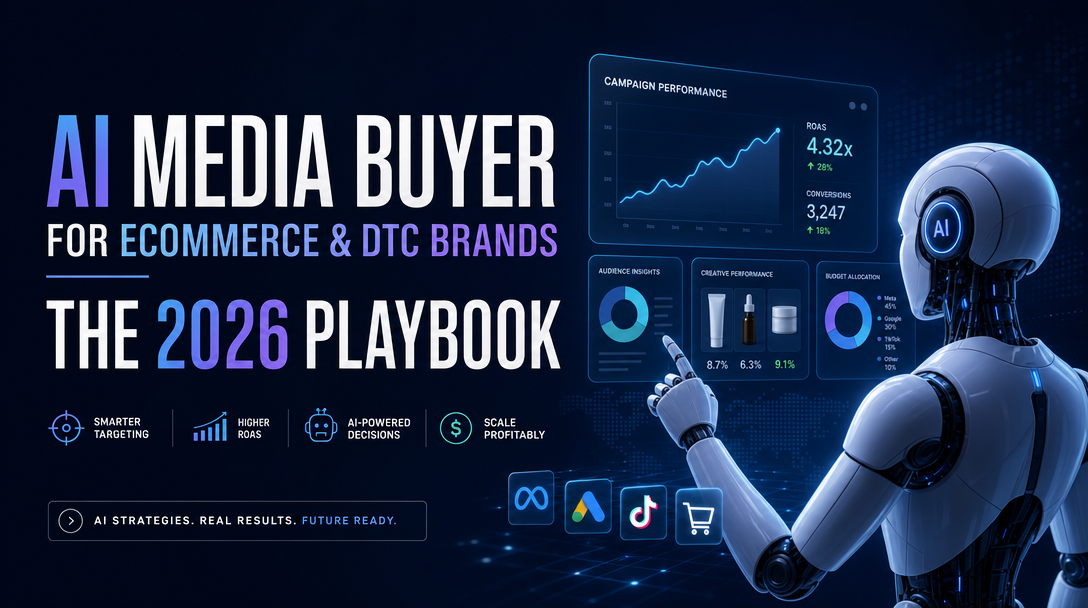
If you run paid media for an ecommerce or DTC brand, you already live inside two machines that learned to optimize without you: Meta Advantage+ Shopping Campaigns and Google Performance Max. They are good at the auction. They are not good at knowing your margin, refreshing creative before it fatigues, or pacing spend across the funnel the way a sharp buyer would. That gap is exactly where an AI media buyer earns its keep — and where most of the confusion lives in 2026.
This is the vertical playbook. It assumes you already know what an AI media buyer is in the abstract (if not, start with our complete guide to AI media buyers) and goes straight to the question DTC operators actually ask: how do I run my store's accounts with one? You'll get an original funnel-to-automation map, a weekly operating cadence, and an honest answer to whether your budget is big enough yet.
The DTC reality: appetite is high, so is the incident rate
The demand is not hypothetical. Roughly 60% of US ad buyers already use or plan to use AI for media buying, according to eMarketer. But the same research is a warning label: about 70% of marketers hit at least one AI-related ad incident, and 40% paused or pulled ads as a result. For a DTC brand running on thin contribution margin, a runaway test or a misfired audience isn't a line-item anomaly — it's a week of profit.
So the goal is not "let the AI run the account." It's to let the AI run the daily loop inside guardrails you set, and to keep the strategic decisions — margin floors, offer, brand — firmly human. The rest of this playbook is built around that division of labor.
How an AI media buyer sits on top of Advantage+ and Performance Max
Advantage+ Shopping (ASC) and Performance Max (PMax) are ecommerce-native by design: they ingest your product catalog, optimize toward a purchase or revenue goal, and spread delivery across placements automatically. They are the engine. They are not the driver.
An AI media buyer is the layer above them. It reads performance every cycle and acts on three levers the native automation won't pull on its own:
- Product feed and ROAS targets. It keeps catalog segments and conversion-value rules aligned with your actual margin, not platform-default revenue. ASC and PMax optimize to whatever target you feed them; the AI keeps that target honest as costs move.
- Creative velocity. Catalog campaigns starve without fresh creative. The AI rotates new variants in before fatigue sets in and retires losers — the single biggest performance lever in a DTC account that platform auto-bidding cannot manufacture for you.
- Cross-channel pacing. It moves budget between Meta and Google, and between funnel stages, toward whatever is returning today — instead of the static splits a human sets once a month and forgets.
That third lever is where an agent like Soku fits a DTC operation: it connects to both Meta and Google Ads, reads ROAS across the stack, and reallocates inside your limits. Vendors in this category commonly claim a 15–25% blended CPA reduction in the first quarter and optimization cycles every 15–60 minutes (those are vendor claims — treat them as a ceiling to validate, not a promise). The mechanism behind the claim is real: more decisions, made more often, on fresher data than a human can sustain by hand.
For the step-by-step of wiring this layer onto your accounts, see how to automate media buying with AI for Meta and Google Ads.
The original DTC funnel-to-automation map
Here is the operating model. Three funnel stages, each mapped to the channel it runs on, what the AI handles daily, and what you — the owner — set and leave alone.
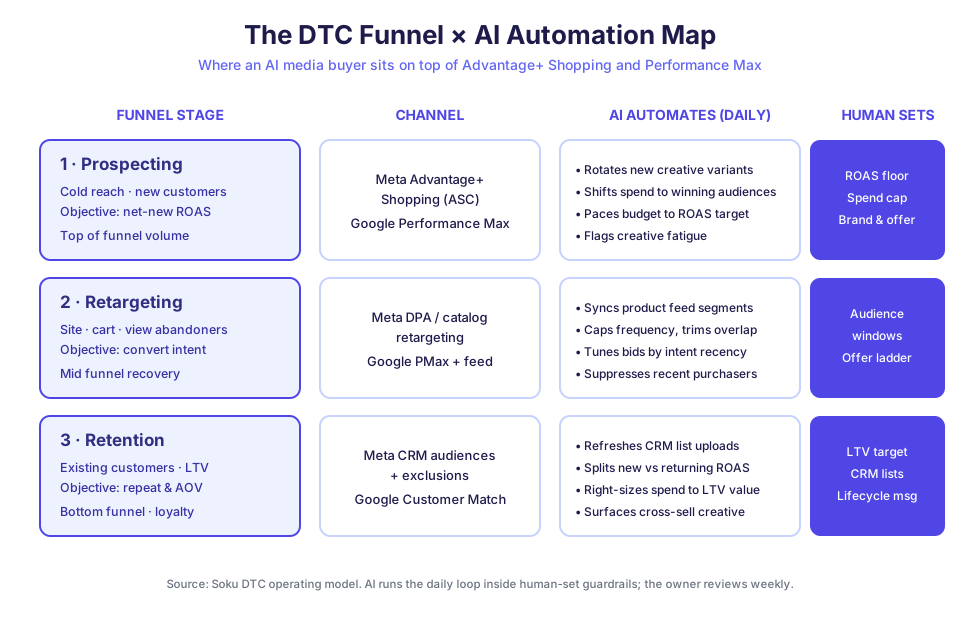
The table version, for the part you'll actually copy into your own ops doc:
| Funnel stage | Objective | Channel | What AI automates (daily) | What the human sets |
|---|---|---|---|---|
| Prospecting | Net-new customers at target ROAS | Meta Advantage+ Shopping, Google Performance Max | Rotates new creative variants, shifts spend to winning audiences, paces budget to ROAS target, flags creative fatigue | ROAS floor, spend cap, brand and offer |
| Retargeting | Convert existing intent | Meta DPA / catalog retargeting, Google PMax + feed | Syncs product-feed segments, caps frequency and trims audience overlap, tunes bids by intent recency, suppresses recent purchasers | Audience windows, offer ladder |
| Retention | Repeat purchase and higher AOV | Meta CRM audiences + exclusions, Google Customer Match | Refreshes CRM list uploads, splits new-vs-returning ROAS, right-sizes spend to LTV, surfaces cross-sell creative | LTV target, CRM lists, lifecycle messaging |
Two principles hold this together. First, the human owns the targets, the AI owns the moves. You decide a 2.5x ROAS floor and a daily cap; the AI decides which ad set gets the next dollar. Second, creative is the throughput constraint. Every stage in the map depends on fresh assets, which is why creative velocity — not bid tweaking — is where DTC accounts win or stall. If you're building that supply, see how to create 100 ad variants with AI and the best AI tools for Meta ad creatives.
The weekly operating cadence
An AI media buyer changes who does what, when — not whether work happens. Here's a realistic week for a DTC team running with one.
What the AI does daily (unattended):
- Reads yesterday's ROAS, CPA, and spend by campaign, stage, and channel.
- Reallocates budget toward what's returning, within your caps.
- Rotates fresh creative into prospecting before fatigue, retires losers.
- Adjusts frequency and exclusions on retargeting; refreshes CRM lists on retention.
- Logs every change with a reason, and pauses anything that breaches a guardrail.
What the owner reviews weekly (30–45 minutes):
- Blended ROAS and contribution margin against target — the only number that ultimately matters.
- New-vs-returning customer split, so retention isn't quietly cannibalizing prospecting.
- The AI's change log: which moves it made, which guardrails tripped, anything it flagged for a human call.
- Creative pipeline — is there enough fresh supply for next week, or is the account about to starve?
- One strategic decision: an offer test, a new ROAS floor, a budget-ceiling change. That's the human's job, and the AI executes it.
The shift is from making every decision to setting the boundaries and auditing the decisions. That's the whole value: your time moves from the dashboard to strategy, creative, and offer — the things a DTC brand actually competes on.
A useful gut check: if your weekly review ever turns into re-doing the AI's daily work — manually moving budget, hand-pausing ad sets — your guardrails are too loose or your targets are wrong. Tighten the rule, not your grip. The whole point is that the boundaries do the supervising so you don't have to babysit the account between reviews. When the cadence is working, the weekly meeting is mostly you confirming the AI made the calls you would have made, and spending the saved hours on the next offer or creative concept.
Is your budget big enough yet? An honest decision rule
Here's the part most vendor pages skip. Many AI media-buying platforms quote an effective floor around $50K per month in ad spend (a vendor-stated minimum) before their model has enough conversion signal and their pricing makes sense. Below that, two things break: the optimization is starved for data, and a percentage-of-spend or high flat fee eats your margin.
So apply a simple rule before you buy:
| Monthly ad spend | What it usually means for an AI media buyer |
|---|---|
| Under ~$15K | Too early. Native ASC/PMax auto-bidding plus disciplined creative testing is your best ROI. An external AI layer is starved for signal. |
| ~$15K–$50K | The judgment zone. Worth it if the tool is usage- or seat-priced (not a steep % of spend) and your bottleneck is creative velocity or cross-channel pacing, not bid math. |
| $50K+ | The sweet spot. Enough conversion volume to optimize on, and the operator hours saved clearly outweigh the cost. |
If you're under the floor, the honest move is to wait — or to use an agent priced by usage rather than a percentage of spend, so a small budget isn't penalized. Either way, run the math against a human buyer or agency before committing; we break that comparison down in AI media buyer cost vs. agency.
The deeper point: an AI media buyer is a force multiplier, not a substitute for having something to optimize. If your creative is weak or your offer is wrong, faster optimization just finds the bottom faster. Fix the inputs first.
Frequently asked questions
Does an AI media buyer replace Advantage+ Shopping or Performance Max?
No. It sits on top of them. ASC and PMax run the auction and placement; the AI media buyer manages targets, creative rotation, and cross-channel pacing that the native tools don't touch. They're complementary layers, not competitors.
Will it work for a small DTC brand under $50K/month?
It can, but be selective. Below roughly $50K in monthly spend the optimization has thinner signal and percentage-of-spend pricing hurts. If your tool is usage-priced and your real bottleneck is creative velocity, it can still pay off — but under ~$15K, native auto-bidding plus disciplined creative testing is usually the better ROI.
What's the biggest risk?
Letting it run unsupervised. With 70% of marketers reporting an AI ad incident, the protection is guardrails — ROAS floors, spend caps, and a weekly review of the change log. The AI should pause, not push past, anything that breaches a limit.
How fast will I see results?
Vendors claim 15–25% blended CPA improvement within a quarter; treat that as a ceiling to validate, not a guarantee. Most of the early gain in DTC comes from killing creative fatigue and pacing spend better, both of which show up within the first few weeks if your creative pipeline can keep up.
Can one agent handle both Meta and Google?
Yes — that's the point of cross-channel pacing. An agent like Soku connects to both Meta and Google Ads, reads ROAS across the stack, and moves budget toward whatever is returning, rather than locking each platform to a fixed split.
The takeaway
For a DTC brand in 2026, an AI media buyer isn't about handing over the keys. It's about running a clean division of labor: the platform engines optimize the auction, the AI runs the daily loop across prospecting, retargeting, and retention, and you set the targets and review the moves once a week. Get the budget threshold right, keep your creative supply ahead of the spend, and the result is the thing every DTC operator actually wants — more decisions made on fresher data, with your time freed for the strategy and creative that the machine can't do for you.