 Soku AI
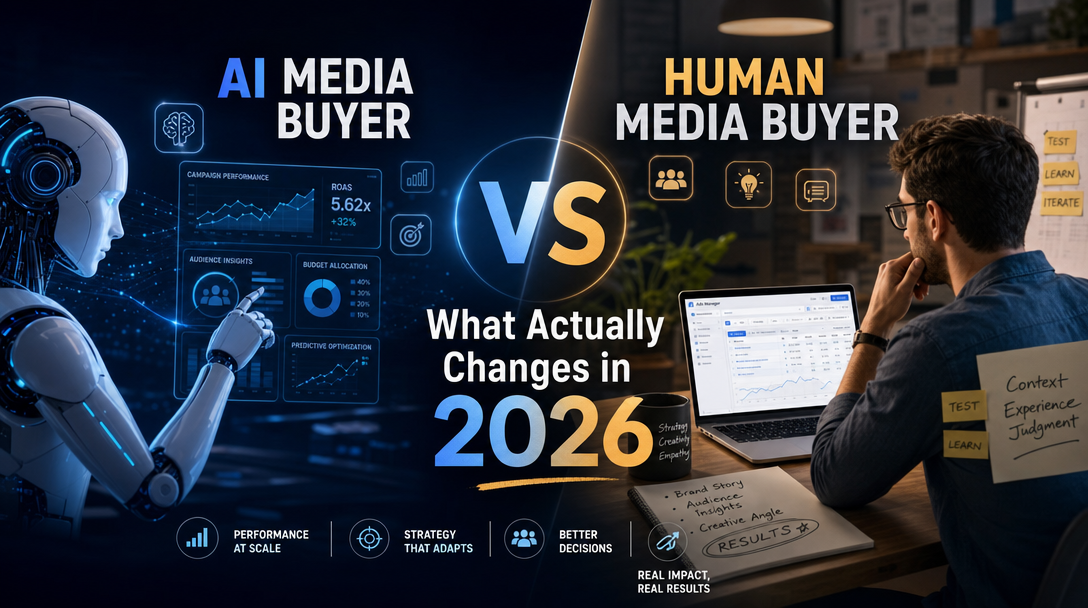
"AI media buyer vs human media buyer" is usually framed as a cage match: one walks out, the other gets replaced. That framing is wrong, and it leads teams to either over-trust automation or refuse it entirely. The honest answer is more useful and more boring — the two are not substitutes, they are different layers of the same job. For the complete overview of how AI media buying works end to end, see our pillar guide to AI media buyers. This post owns one narrow question: when you put a machine and a person side by side on the media-buying job, who actually wins each task, and what changes for the human in 2026?
The short version: AI is winning the execution layer decisively, humans are keeping the judgment layer, and the role of the human media buyer is shifting from button-pusher to AI supervisor. It is not vanishing — it is moving up the stack.
The adoption is real, but trust hasn't caught up
Before decomposing the job, it helps to see where the market actually sits, because the gap between "we use AI" and "we trust AI" is exactly where the human role survives.
Roughly 60% of US ad buyers already use or plan to use AI for media buying, and 81.3% of senior agency professionals say AI will shape the next decade of the industry (eMarketer). That is near-consensus on direction. But the same research shows adoption is running ahead of confidence. The top barriers are remarkably even: 62% cite complexity, 62% data security, 61% understanding, and 60% transparency (eMarketer).
The risk side is sharper still. 70% of teams have hit an AI ad incident — a misfire, an error, or an unsafe output — and 40% have paused or pulled ads because of one. Only 6% fully trust their AI safeguards, and 14% have no one who owns AI governance at all (eMarketer).
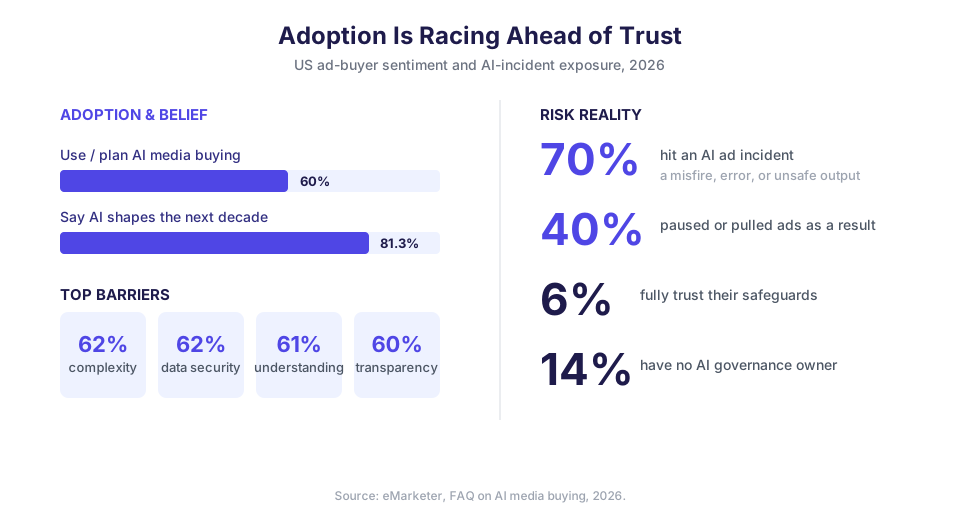
Read those two numbers together — 70% have had an incident, 6% fully trust the safeguards — and you have the entire case for keeping a human in the loop. The automation is good enough to deploy and not good enough to leave alone. That is the precise shape of the job in 2026.
Decomposing the media-buying job
The mistake in most "AI vs human" debates is treating media buying as one indivisible role. It isn't. It is a stack of distinct tasks with very different characteristics — some are high-frequency and data-dense, others are ambiguous and accountable. When you split the job by task instead of by job title, the answer to "who wins" stops being a slogan and becomes a checklist.
Here is the original split. On the left, what AI now executes; on the right, what humans keep deciding.
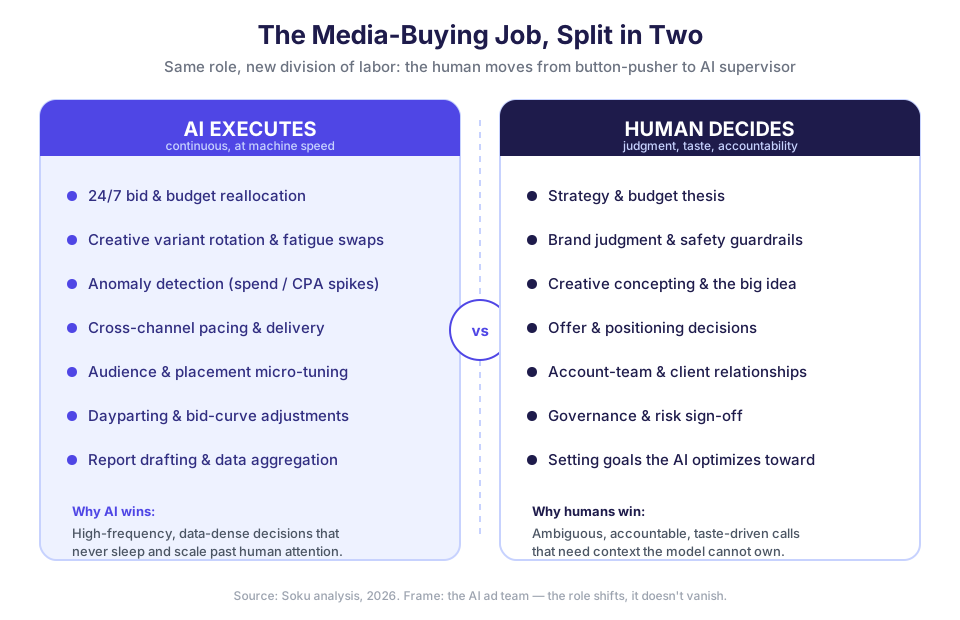
The dividing line is not "hard vs easy." It is frequency and accountability. Tasks that must happen thousands of times a day, on more signals than a person can hold in their head, flow to the machine. Tasks where someone has to stand behind an ambiguous call — to a client, to a brand, to a regulator — stay with the human. Below is the same split as a decision table, with the reason each task lands where it does.
| Media-buying task | Who owns it | Why it lands there |
|---|---|---|
| 24/7 bid & budget reallocation | AI | Re-prices auctions far faster than any person; vendors claim optimization runs every 15–60 minutes (Improvado, vendor claim) |
| Creative variant rotation & fatigue swaps | AI | Detects decay and rotates variants continuously, without waiting for a weekly review |
| Anomaly detection (spend / CPA spikes) | AI | Watches every campaign at once; flags the 2am spike a human would miss until morning |
| Cross-channel pacing & delivery | AI | Holds pacing math across Google, Meta, and more simultaneously |
| Audience & placement micro-tuning | AI | Optimizes against live conversion signal at a granularity humans can't track manually |
| Strategy & budget thesis | Human | Decides what success means and where money should go before any algorithm optimizes toward it |
| Brand judgment & safety guardrails | Human | Owns taste and the "would we actually say this" call — exactly where the 70% incident rate bites |
| Creative concepting & the big idea | Human | Originates the angle; AI rotates variants of an idea it cannot invent |
| Offer & positioning decisions | Human | Pricing, promise, and market framing are business calls, not optimization targets |
| Account-team & client relationships | Human | Trust, expectation-setting, and hard conversations don't automate |
| Governance & risk sign-off | Human | Someone must be accountable; 14% of teams having no governance owner is the warning, not the model |
Notice what this does to the role. Every "AI" row used to be a human's daily grind — logging in, pulling reports, nudging bids, swapping a tired creative. Those hours don't disappear into nothing; they get reinvested into the "Human" rows, which are higher-leverage and harder to outsource. The media buyer who spent Monday morning exporting last week's numbers now spends it deciding what the numbers should have been.
What actually changes for the human in 2026
The role doesn't shrink — it inverts. The center of gravity moves from doing the optimization to supervising the system that does the optimization. Three concrete shifts:
From execution to instruction. The skill that mattered most used to be operating the ad platforms fluently. Now it is writing a clear objective: the goal, the guardrails, the budget thesis, the brand non-negotiables. A great AI media buyer is only as good as the brief the human gives it. Setting the goals the AI optimizes toward becomes the job, not a precondition for it.
From watching dashboards to auditing the machine. With 70% of teams having hit an AI incident, the high-value human activity is not staring at performance — the AI already watches performance better. It is spot-checking the AI's decisions: did it scale the right thing, did it pause something it shouldn't have, is it drifting toward a metric that looks good and sells nothing. This is supervision, and it is genuinely hard to do well.
From task volume to judgment density. A human media buyer used to be measured by how many accounts they could juggle. As execution offloads, the measure becomes how good the decisions are — which accounts to scale, which to kill, which creative bet to make. Fewer keystrokes, heavier calls.
This is why "replacement" is the wrong word. The economics under it are stark. Vendors pitching dedicated AI media-buying platforms claim blended CPA cuts of 15–25% in the first quarter and pricing that often starts around a $50K/month minimum spend (Improvado, vendor claims worth verifying against your own results). At the same time, programmatic ad spend is projected to reach roughly $725 billion by 2026 (Improvado). More money, more automation, and more incidents flowing through the system at once means more need for someone accountable on top — not less. The supervisor role exists precisely because the stakes went up.
If you're weighing this against the alternative of hiring an agency or a full-time buyer, the math deserves its own breakdown — see our sibling post on AI media buyer cost vs an agency.
How this plays out with a real AI ad team
The cleanest way to see the split in practice is to run it. Soku is an ad-automation agent for Google and Meta — it sits on the "AI executes" side of the diagram. It handles the 24/7 work: reallocating budget, watching for spend and CPA anomalies, rotating creative variants, and keeping pacing sane across channels, then reporting back in plain language.
What it deliberately does not do is decide your strategy, invent your offer, or sign off on brand-risky creative. Those stay with you — the supervisor. In that model the human media buyer isn't competing with the agent; they're directing it. You set the objective and the guardrails, the agent executes against them continuously, and you audit what it did. That is the role shift made concrete: the agent is the buyer's hands, the human is still the head. If you want to see which tools fill the "AI executes" layer, our roundup of the best AI media buying tools compares the options.
The teams getting value in 2026 aren't the ones who handed everything to the machine, and they aren't the holdouts doing it all by hand. They're the ones who read the table above, gave the machine the execution rows, kept the judgment rows, and got disciplined about the seam in between — which, given a 6% trust rate in safeguards, is the only responsible way to run it.
FAQ
Will an AI media buyer replace human media buyers?
No — it replaces the execution layer of the job, not the role. AI now owns bid and budget reallocation, anomaly detection, variant rotation, and cross-channel pacing. Humans keep strategy, brand judgment, creative concepting, offer and positioning, relationships, and governance. With 70% of teams having hit an AI ad incident and only 6% fully trusting their safeguards (eMarketer), the human-supervisor role is becoming more necessary, not less.
What is the single biggest difference between AI and human media buyers?
Frequency and accountability. AI makes high-frequency, data-dense decisions thousands of times a day across more signals than a person can hold. Humans make the ambiguous, accountable calls — what success means, what the brand will and won't say, where the money should go — that someone has to stand behind.
Do I still need to hire a media buyer if I use AI?
Usually yes, but the job description changes. You need someone who can write a sharp objective, set guardrails, and audit the AI's decisions — a supervisor rather than a button-pusher. The hours saved on manual execution get reinvested into higher-leverage judgment. The skill shifts from operating platforms to instructing and checking the system that operates them.
Are the AI media buyer performance claims trustworthy?
Treat them as vendor claims until you verify on your own account. Platforms cite 15–25% blended CPA reductions in the first quarter and optimization every 15–60 minutes, often at a $50K/month minimum spend (Improvado). The mechanism — faster, more frequent optimization across more signals — is sound, but the magnitude depends entirely on your baseline, spend level, and how well your human supervisor sets up and audits the system.
What's the safest way to adopt AI media buying?
Split the job the way the table above does. Give the machine the execution rows, keep the judgment rows, and explicitly assign a governance owner — remember 14% of teams have none. Start by letting the AI execute against tight human-set objectives, audit its decisions before scaling its autonomy, and never delegate the brand and risk sign-off. The goal is supervised automation, not unattended automation.