 Soku AI
"AI media buyer" has gone from a pitch-deck phrase to a line item in real ad budgets. As of 2024, 60% of US ad buyers had used or planned to use AI-powered buying products, and 81.3% of senior agency professionals believe AI will shape the next decade of digital advertising. The momentum is real. So is the confusion.
The term gets stretched to cover everything from a platform's native auto-bidding to a standalone agent that logs into your ad account and makes changes on its own. Those are not the same thing, and treating them as interchangeable is how teams end up disappointed — or worse, how they end up among the 70% of marketers who hit at least one AI-related ad incident.
This guide is the map. It defines what an AI media buyer actually is, shows you the operating model under the hood (from the inside — Soku is itself an ad-automation agent), lays out the real tool landscape, gives you honest cost and ROI math, and tells you when to keep a human in the seat. Each section ends with a pointer to a deeper article so you can go straight to the question you actually have.
What is an AI media buyer?
An AI media buyer is software that takes over some or all of the repetitive, high-frequency decisions a human media buyer makes: which campaigns get budget, what bids to set, which audiences and placements to favor, which creatives to scale or pause, and when to react to performance shifts. Instead of a person logging in twice a day to nudge numbers, the system runs a continuous loop — often re-evaluating every 15 to 60 minutes.
It helps to split the category into three layers, because "AI media buyer" means something different in each:
- Platform-native automation — the optimization built into the ad platforms themselves: Meta Advantage+, Google Performance Max, The Trade Desk's Koa, Criteo Commerce Max. You are already using this if you run modern campaigns; the AI lives inside one walled garden.
- Cross-channel tools and layers — third-party software that sits on top of multiple ad accounts to bid, budget, alert, and report across channels: Smartly.io, Marin, Optmyzr, Revealbot, Madgicx, Skai, Improvado, and similar.
- AI agents — newer systems that operate an ad account more autonomously through a chat or API interface, reading data and writing changes the way a human operator would. This is the layer growing fastest, and the one most people now mean when they say "AI media buyer." (Even creative-first vendors are moving in: Creatify shipped an AI "media buyer" feature in June 2026.)
The key distinction is scope of authority. Platform automation optimizes inside its own box. A cross-channel tool gives you levers and dashboards but usually still expects a human to pull them. An AI agent is the one that can actually act — and that is where the operating model below matters most.
For the perennial "is this going to replace me?" question, we wrote a dedicated piece: "Is it replacing my media buyer?" → AI Media Buyer vs. Human Media Buyer. Short version: it replaces the manual work, not the judgment — but the role changes shape.
The state of AI media buying in 2026
Adoption is high, but it sits on top of unresolved anxiety. The same survey base that reports 60% adoption also reports that the top barriers are not cost — they are trust and operability.
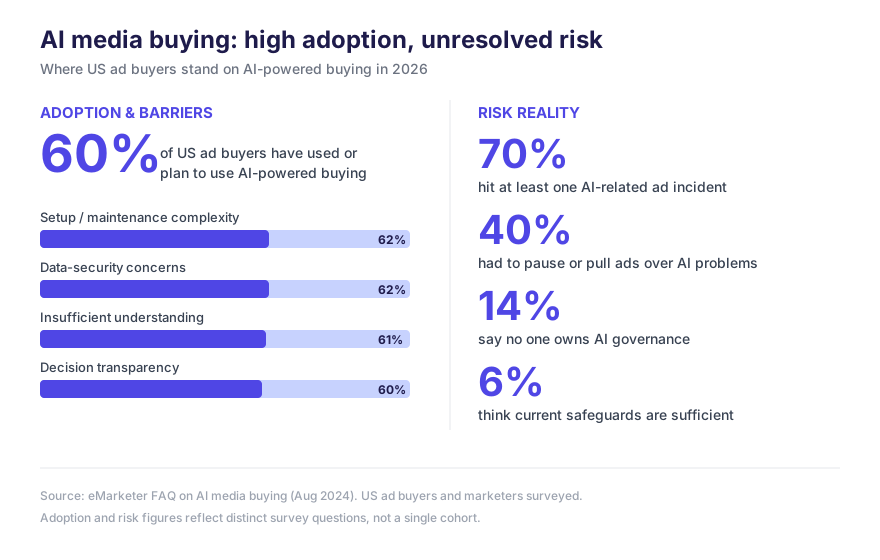
On the barrier side: 62% cite setup and maintenance complexity, 62% data-security concerns, 61% insufficient understanding of how it works, and 60% a lack of decision transparency. On the risk side, the picture is sharper still: 70% of marketers hit at least one AI-related ad incident, 40% had to pause or pull ads over AI problems, only 6% think current safeguards are sufficient, and 14% say no one owns AI governance at all.
Read those numbers together and the takeaway is not "AI media buying is dangerous." It is "AI media buying is being adopted faster than teams are building the guardrails around it." The winners in 2026 are the ones who treat governance — who can change what, with what limits, reviewed by whom — as part of the rollout, not an afterthought.
The money backs the urgency. Programmatic ad spend is climbing toward $725 billion by 2026, and the share of that spend touched by some form of automated decisioning keeps rising. The question for most teams is no longer whether to use AI in media buying, but how much authority to hand it and how to verify what it does.
How an AI media buyer actually runs: the operating model
Most articles describe AI media buyers from the outside — features, claims, logos. We can describe it from the inside, because Soku is an ad-automation agent: it connects to Google Ads and Meta Ads through their MCP interfaces and operates the account the way a buyer would. Here is what actually happens when an agent is wired to a live ad account, as a five-stage loop.
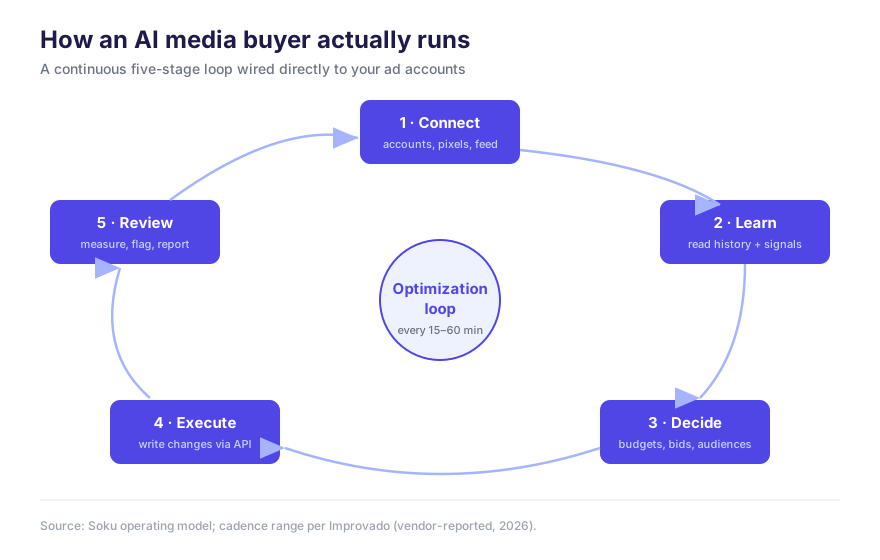
1. Connect. The agent authenticates into the ad accounts and the surrounding data — the Google Ads and Meta Ads accounts themselves, the conversion pixel or server-side events, and (for ecommerce) the product feed. This is the unglamorous, decisive step: an agent is only as good as the signal it can read and the actions it is permitted to take. Read-only access makes it an analyst; write access makes it a buyer.
2. Learn. Before touching anything, the agent reads the account's recent history — spend, conversions, CPA/ROAS by campaign, audience, device, placement, and time. It builds a working picture of what is performing, what is fatiguing, and where budget is being wasted. Good agents establish a baseline first instead of reacting to a single bad hour.
3. Decide. This is the core loop. The agent compares current performance against the goal (target CPA, target ROAS, or a spend cap) and forms candidate changes: shift budget from a stalling campaign to a winning one, raise or lower bids, narrow or broaden an audience, pause a creative that has decayed. Vendors report running these cycles every 15 to 60 minutes — far more often than a human would.
4. Execute. The agent writes the changes back through the platform APIs. This is the line that separates a true AI media buyer from a recommendation tool: it doesn't just suggest "pause Ad Set 4," it pauses Ad Set 4 — within whatever budget ceilings, change limits, and approval gates you set. Sensible deployments keep this bounded: caps on daily budget moves, a maximum bid delta, and a human approval step for anything structural.
5. Review. Every action gets measured against what it was supposed to do, logged, and rolled into a report a human can read. Did moving budget to Campaign B actually lower blended CPA, or just shift where the spend showed up? The review stage is what makes the loop trustworthy — and it is exactly the stage the 6%-trust-in-safeguards statistic tells you most tools skip.
Two honest notes from operating this way. First, the loop is only as smart as the conversion data feeding it — thin or delayed conversions make every stage noisier, and no amount of model sophistication fixes a broken pixel. Second, autonomy is a dial, not a switch. The same agent can run fully hands-off on a mature campaign and in propose-only mode on a new launch. The teams that get value treat that dial deliberately.
If you want the concrete version of this for the two biggest platforms — exactly which permissions, which guardrails, and what the first week looks like — read "Show me the setup for Meta & Google" → Automate Media Buying with AI on Meta & Google Ads.
The AI media buying tool landscape
The market splits cleanly into the three layers we named earlier. Here is how the most common names map, with the caveat that pricing moves and tiers vary — treat the figures as entry points, not quotes.
| Tool | Layer | Channels | Entry price | Best fit |
|---|---|---|---|---|
| Meta Advantage+ | Platform-native | Meta | Included | Already on Meta; want native automation |
| Google Performance Max | Platform-native | Included | Already on Google; goal-based campaigns | |
| The Trade Desk (Koa) | Platform-native | Programmatic DSP | Enterprise | Large programmatic display/CTV buys |
| Criteo Commerce Max | Platform-native | Retail/commerce | Enterprise | Retail media and commerce catalogs |
| Smartly.io | Cross-channel | Meta, Google, TikTok, more | Enterprise | Large social teams scaling creative + buying |
| Skai | Cross-channel | Search, social, retail | Enterprise | Omnichannel enterprise media teams |
| Marin | Cross-channel | Search, social | Mid-market | Search-heavy accounts wanting bid control |
| Optmyzr | Cross-channel | Search, PPC | ~$249/mo | PPC pros who want rules + scripts + audits |
| Revealbot | Cross-channel | Meta, Google, TikTok | ~$99/mo | Rule-based automation for performance teams |
| Madgicx | Cross-channel | Meta, Google | ~$44/mo | DTC teams on Meta wanting bundled automation |
| AdRoll | Cross-channel | Display, social | ~$36/mo | Retargeting-led ecommerce |
| Acquisio / Cometly | Cross-channel | Search, social | Mid-market | Bid management / attribution layers |
| Improvado | Cross-channel | Reporting + ops | Enterprise | Data pipelines and reporting at scale |
| Soku | AI agent | Google Ads, Meta Ads | See site | Teams wanting an agent that reads and acts |
A few honest gaps worth naming, because the page-one search results rarely will:
- Channel coverage is uneven. Most "cross-channel" tools are strongest on one or two platforms and thinner elsewhere. If TikTok or retail media is core to you, verify depth, not just a logo on the integrations page.
- "AI" often means rules. Several tools in the cross-channel layer are excellent rule engines with an AI label. That is genuinely useful — but it is not the same as an agent that reasons over the account.
- Effectiveness has a floor. Some vendors suggest meaningful gains only kick in above roughly $50K/month in spend; below that, the optimization signal can be too thin to beat a careful human.
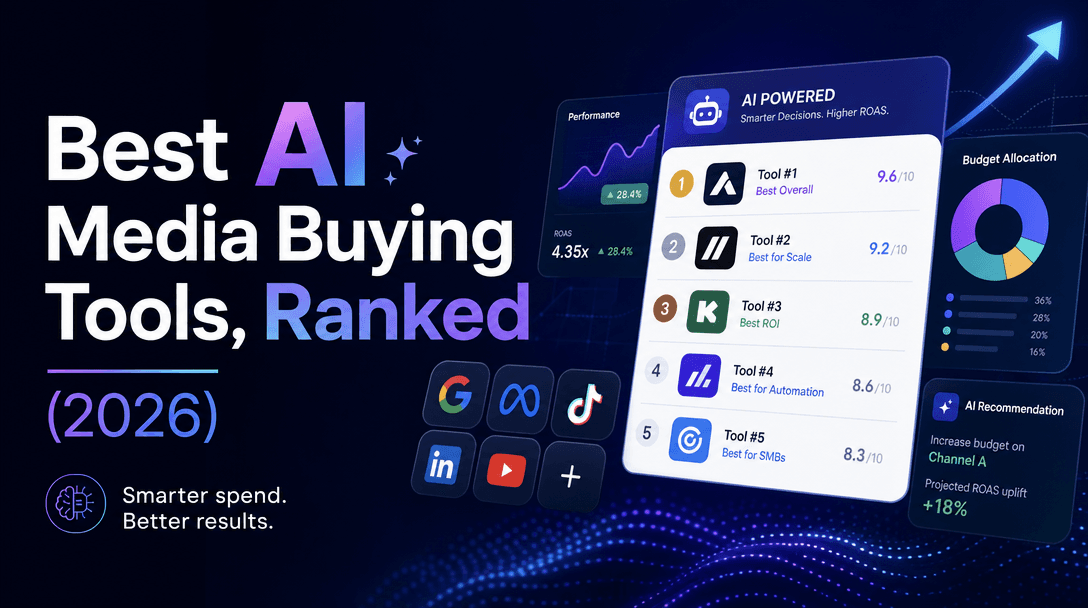
For the full head-to-head — feature-by-feature, with the comparison matrix none of the incumbents publish — go to "Which tool should I pick?" → The Best AI Media Buying Tools, Compared.
What does it cost — and what's the ROI?
Pricing spans three very different shapes. Self-serve cross-channel tools start cheap (Madgicx around $44/mo, Revealbot around $99/mo, Optmyzr around $249/mo). Enterprise platforms and agent deployments are quoted, often as a percentage of spend or a platform fee. And there is the hidden cost most calculators ignore: the time to connect, configure guardrails, and build trust before you let the system run.
On the upside, vendors claim real gains — but read them as vendor claims, not independent results. Reported figures include 15–25% blended CPA reduction in early quarters and 70–85% next-day conversion-prediction accuracy. Those are plausible on well-instrumented accounts and optimistic on thin ones. The honest framing: if an agent shaves 15% off CPA on a $50K/month account, that is $7.5K/month of efficiency against a tool cost that is usually a fraction of it — which is why the category exists. But the same agent on a $5K/month account with sparse conversions may not clear the noise floor at all.
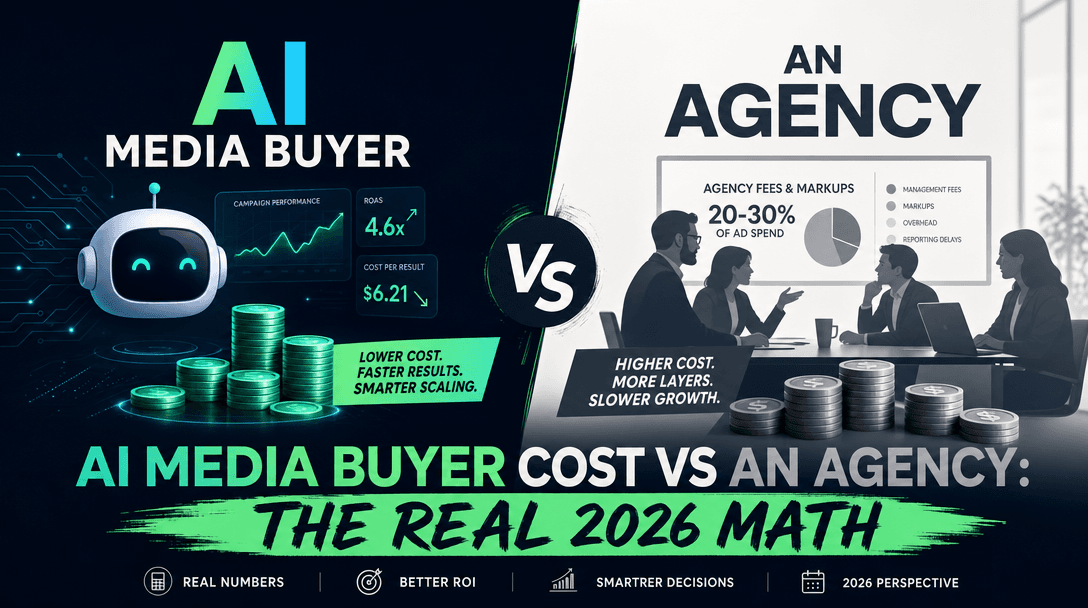
The comparison that actually decides budgets, though, is tool vs. agency. An agency layers strategy, creative, and account management onto media buying — and a retainer to match. An AI media buyer collapses the execution layer but leaves strategy and creative for you (or a leaner team) to own. We do the full payback math — retainer vs. software vs. in-house, at different spend levels — in "What does it cost vs an agency?" → AI Media Buyer Cost vs. an Agency.
Where AI media buying works best: ecommerce and DTC
The clearest fit today is ecommerce and DTC, and the reason is structural: these businesses generate dense, fast, unambiguous conversion signal (purchases, with revenue attached) and a product feed the system can optimize against. That density is exactly what the operating loop needs — it is the difference between an agent that can confidently shift budget every 30 minutes and one that is guessing.
DTC also benefits most from the creative side of the loop, because creative fatigue is the dominant failure mode on Meta. An AI media buyer that can detect a decaying creative and act is far more valuable when paired with a fast creative pipeline. If that is your world, two adjacent reads help: The Best AI Tools for Meta Ad Creatives and How to Create 100 Ad Variants with AI — the agent decides what to scale, those tools produce the assets to scale into. For ecommerce teams specifically, the Meta tools guide now separates feed-driven creative, product-photo ads, and video variants instead of lumping every design app together.
How it sits on top of Advantage+ and Performance Max
If you run paid media for an ecommerce or DTC brand, you already live inside two machines that learned to optimize without you: Meta Advantage+ Shopping Campaigns (ASC) and Google Performance Max (PMax). They ingest your product catalog, optimize toward a purchase or revenue goal, and spread delivery across placements automatically. They are good at the auction. They are not good at knowing your margin, refreshing creative before it fatigues, or pacing spend across the funnel the way a sharp buyer would. They are the engine, not the driver.
An AI media buyer is the layer above them, acting on three levers the native automation won't pull on its own:
- Product feed and ROAS targets. It keeps catalog segments and conversion-value rules aligned with your actual margin, not platform-default revenue. ASC and PMax optimize to whatever target you feed them; the AI keeps that target honest as costs move.
- Creative velocity. Catalog campaigns starve without fresh creative. The AI rotates new variants in before fatigue sets in and retires losers — the single biggest performance lever in a DTC account that platform auto-bidding cannot manufacture for you.
- Cross-channel pacing. It moves budget between Meta and Google, and between funnel stages, toward whatever is returning today — instead of the static splits a human sets once a month and forgets.
That third lever is where an agent like Soku fits a DTC operation: it connects to both Meta and Google Ads, reads ROAS across the stack, and reallocates inside your limits. The mechanism behind the vendor-claimed 15–25% blended CPA reduction and 15–60 minute optimization cycles is exactly that: more decisions, made more often, on fresher data than a human can sustain by hand. For a DTC brand running on thin contribution margin, though, the risk cuts the same way — a runaway test or a misfired audience isn't a line-item anomaly, it's a week of profit.
The DTC funnel-to-automation map
Three funnel stages, each mapped to the channel it runs on, what the AI handles daily, and what you — the owner — set and leave alone.
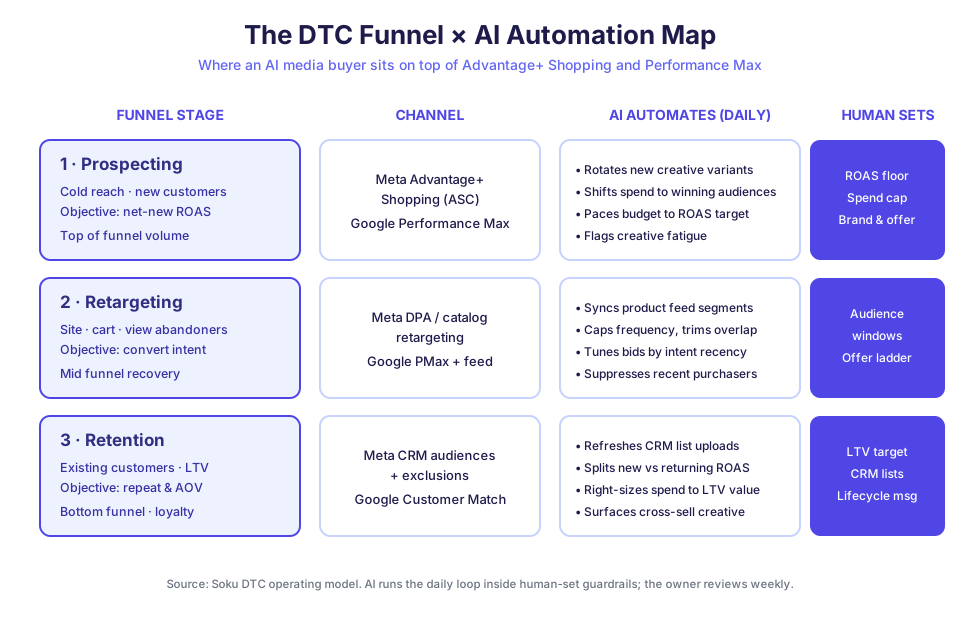
The table version, for the part you'll actually copy into your own ops doc:
| Funnel stage | Objective | Channel | What AI automates (daily) | What the human sets |
|---|---|---|---|---|
| Prospecting | Net-new customers at target ROAS | Meta Advantage+ Shopping, Google Performance Max | Rotates new creative variants, shifts spend to winning audiences, paces budget to ROAS target, flags creative fatigue | ROAS floor, spend cap, brand and offer |
| Retargeting | Convert existing intent | Meta DPA / catalog retargeting, Google PMax + feed | Syncs product-feed segments, caps frequency and trims audience overlap, tunes bids by intent recency, suppresses recent purchasers | Audience windows, offer ladder |
| Retention | Repeat purchase and higher AOV | Meta CRM audiences + exclusions, Google Customer Match | Refreshes CRM list uploads, splits new-vs-returning ROAS, right-sizes spend to LTV, surfaces cross-sell creative | LTV target, CRM lists, lifecycle messaging |
Two principles hold this together. First, the human owns the targets, the AI owns the moves. You decide a 2.5x ROAS floor and a daily cap; the AI decides which ad set gets the next dollar. Second, creative is the throughput constraint. Every stage in the map depends on fresh assets, which is why creative velocity — not bid tweaking — is where DTC accounts win or stall.
The weekly operating cadence
An AI media buyer changes who does what, when — not whether work happens. Here's a realistic week for a DTC team running with one.
What the AI does daily (unattended):
- Reads yesterday's ROAS, CPA, and spend by campaign, stage, and channel.
- Reallocates budget toward what's returning, within your caps.
- Rotates fresh creative into prospecting before fatigue, retires losers.
- Adjusts frequency and exclusions on retargeting; refreshes CRM lists on retention.
- Logs every change with a reason, and pauses anything that breaches a guardrail.
What the owner reviews weekly (30–45 minutes):
- Blended ROAS and contribution margin against target — the only number that ultimately matters.
- New-vs-returning customer split, so retention isn't quietly cannibalizing prospecting.
- The AI's change log: which moves it made, which guardrails tripped, anything it flagged for a human call.
- Creative pipeline — is there enough fresh supply for next week, or is the account about to starve?
- One strategic decision: an offer test, a new ROAS floor, a budget-ceiling change. That's the human's job, and the AI executes it.
A useful gut check: if your weekly review ever turns into re-doing the AI's daily work — manually moving budget, hand-pausing ad sets — your guardrails are too loose or your targets are wrong. Tighten the rule, not your grip. When the cadence is working, the weekly meeting is mostly you confirming the AI made the calls you would have made, and spending the saved hours on the next offer or creative concept.
Is your budget big enough yet?
The ~$50K/month effective floor is a vendor-stated minimum, and it deserves more nuance than a single line. Below it, two things break: the optimization is starved for data, and a percentage-of-spend or high flat fee eats your margin. So apply a simple rule before you buy:
| Monthly ad spend | What it usually means for an AI media buyer |
|---|---|
| Under ~$15K | Too early. Native ASC/PMax auto-bidding plus disciplined creative testing is your best ROI. An external AI layer is starved for signal. |
| ~$15K–$50K | The judgment zone. Worth it if the tool is usage- or seat-priced (not a steep % of spend) and your bottleneck is creative velocity or cross-channel pacing, not bid math. |
| $50K+ | The sweet spot. Enough conversion volume to optimize on, and the operator hours saved clearly outweigh the cost. |
If you're under the floor, the honest move is to wait — or to use an agent priced by usage rather than a percentage of spend, so a small budget isn't penalized. The deeper point: an AI media buyer is a force multiplier, not a substitute for having something to optimize. If your creative is weak or your offer is wrong, faster optimization just finds the bottom faster. Fix the inputs first.
Limitations: when to keep a human in the loop
AI media buyers are powerful where the signal is clean and the goal is well-defined. They are weakest exactly where human judgment earns its keep. Keep a person firmly in the loop when:
- Conversion data is thin, delayed, or noisy. Long sales cycles, low daily conversion counts, or a flaky pixel starve the loop. The agent will optimize toward the wrong thing with total confidence.
- The decision is strategic, not tactical. Repositioning, new-market entry, pricing changes, and brand campaigns are not 30-minute optimization problems. Hand the agent the tactics, not the strategy.
- Spend is below the effectiveness floor. Under ~$50K/month the signal is often too thin for autonomous gains to beat a careful operator.
- Governance isn't defined. With 14% of marketers saying no one owns AI governance and 40% having had to pause ads over AI problems, the single highest-ROI safeguard is deciding who can change what, with what limits, reviewed by whom before you grant write access.
- A novel event hits. Stockouts, viral moments, PR incidents, and seasonal anomalies break the patterns the agent learned from. These are exactly the moments to take the wheel.
The healthiest deployments treat the agent as a tireless operator and the human as the editor-in-chief: the agent runs the loop, the human sets the goals, the limits, and the exceptions — and reviews the log.
Where to go next
This pillar is the map; the spokes are the territory. Jump to the question you actually have:
- "Is it replacing my media buyer?" — AI media buyer vs. human media buyer: what changes, what doesn't, and how the role evolves.
- "Show me the setup for Meta & Google" — the concrete setup, permissions, and guardrails for automating media buying on Meta and Google Ads.
- "Which tool should I pick?" — the full comparison matrix of AI media buying tools, with the honest gaps.
- "What does it cost vs an agency?" — real payback math comparing an AI media buyer against an agency retainer.
Frequently asked questions
What is an AI media buyer?
Software that takes over the repetitive, high-frequency decisions of media buying — budget allocation, bidding, audience and placement choices, and creative pausing/scaling — and runs them in a continuous loop, often every 15 to 60 minutes. Depending on the tool, it either recommends changes or executes them directly through the ad platform APIs.
Is an AI media buyer the same as Performance Max or Advantage+?
Not quite. Performance Max and Advantage+ are platform-native automation that optimizes inside one ad platform. An AI media buyer in the agent sense sits across your accounts and can read and act the way a human operator would, with guardrails you define. They're complementary — many teams run an agent on top of native automation.
Will an AI media buyer replace my media buyer?
It replaces the manual execution work, not the judgment. Strategy, creative direction, governance, and handling novel events still need a human. The role shifts from button-pushing to setting goals, limits, and exceptions. The full breakdown is in our AI media buyer vs. human media buyer guide.
How much does an AI media buyer cost?
Self-serve cross-channel tools start around $36–$249/month (AdRoll, Madgicx, Revealbot, Optmyzr). Enterprise platforms and agent deployments are usually quoted, sometimes as a percentage of spend. The real comparison for most teams is tool-vs-agency — covered in our cost vs. agency guide.
Does an AI media buyer actually improve ROAS?
Vendors report 15–25% blended CPA reductions and 70–85% next-day conversion-prediction accuracy, but these are vendor claims and depend heavily on data quality and spend level. Gains are most reliable on well-instrumented accounts above roughly $50K/month and least reliable on thin, low-conversion accounts.
What's the minimum ad spend to make it worth it?
Some vendors suggest meaningful autonomous gains start around $50K/month, because the optimization loop needs enough conversion signal to beat a careful human. Below that, an AI media buyer is still useful for automation and reporting, but expect less from autonomous bidding.
Is it safe to let AI make changes to my ad account?
It can be, with guardrails. The risk is real — 70% of marketers have hit an AI-related ad incident and 40% have had to pause ads over one. Set daily budget caps, bid limits, and approval gates for structural changes; keep write access scoped; and review the action log. Treat governance as part of setup, not an afterthought.
Which platforms can an AI media buyer connect to?
It depends on the tool. Platform-native automation is single-channel; cross-channel tools and agents connect to several. Soku, for example, operates Google Ads and Meta Ads directly through their MCP interfaces. Always verify integration depth, not just whether a logo appears on the page.
Soku is an AI ad-automation agent that connects to Google Ads and Meta Ads and runs the full operating loop — read, decide, act, and report — with the guardrails you set. If you want an agent that does more than recommend, see how Soku works.