 Soku AI
"How much does an AI media buyer cost compared to an agency?" is one of the most-searched questions in paid media right now — and one of the worst-answered. Most articles list tool prices, list agency retainer ranges, and stop there. Nobody puts the two side by side with the part that actually decides the budget: the fully-loaded monthly cost of each path, including the labor you still have to pay for.
This article does the math. We build a worked cost model for a sample brand at two spend tiers — $30,000/mo and $100,000/mo — across three paths: an agency on a percentage of spend, an in-house buyer running an AI tool, and an AI agent with light human oversight. Then we frame the break-even so you can see when each one wins.
This is a spoke of our larger AI Media Buyer: The Complete 2026 Guide — start there if you want the full picture of what an AI media buyer is and how the operating loop works. If you want the role question ("is it replacing my buyer?") it lives in AI Media Buyer vs. Human Media Buyer, and the priced tools below are reviewed in depth in Best AI Media Buying Tools.
Why cost is the question nobody answers honestly
Adoption is no longer the debate. As of 2024, 60% of US ad buyers had used or planned to use AI-powered buying products, and 81.3% of senior agency professionals believe AI will shape the next decade of digital advertising. What teams actually argue about, in budget meetings, is money: is the AI path cheaper than the agency we already pay, and by how much?
The honest answer is "it depends on what you compare." A software sticker price of $99/mo looks like it crushes a $4,000/mo retainer — until you remember that someone has to operate that software, and that person costs more than the license. The only fair comparison is fully loaded: software plus the human time plus, where it applies, the percentage of spend. That is the comparison almost nobody publishes, so let's build it.
The three paths, defined
Before the numbers, here is exactly what each path includes, so the costs are comparable.
| Path | What you're buying | Who operates it | Cost shape |
|---|---|---|---|
| A. Agency | Strategy, execution, reporting, account management | The agency's team | Retainer or % of spend |
| B. In-house buyer + AI tool | A salaried buyer using a cross-channel tool | Your employee | Salary (loaded) + software license |
| C. AI agent + oversight | An agent that operates the account, plus a human reviewing it | The agent, supervised | Software subscription + part-time oversight |
Path A is the traditional default. Path B is what most "we brought it in-house" teams actually run. Path C is the newest: an agent like Soku connects to your Google Ads and Meta Ads accounts and runs the optimization loop directly, with a human checking its work rather than doing the work.
The software floor: what the tools really cost
Start with the cheapest line — the software — because it sets a floor and it's the one number everyone already knows.
The platform-native layer is free inside the ad account: Meta Advantage+ and Google Performance Max cost nothing beyond the spend itself. The cross-channel tools sit on top and carry a license. At the entry level, real published pricing runs roughly: Madgicx ~$44/mo, AdRoll from $36/mo, Revealbot ~$99/mo, and Optmyzr ~$249/mo. The enterprise tier — Smartly, Marin, Skai, Acquisio, AdStellar — is custom/quote-only, which in practice means four to five figures a month. (For the full breakdown of what each one does, see Best AI Media Buying Tools.)
So the software floor for a serious cross-channel tool is around $99–$249/mo. That's it. If software were the whole story, this article would be over. It isn't, because software doesn't operate itself.
The line everyone forgets: labor
A cross-channel tool is a cockpit, not a pilot. Optmyzr, Revealbot, and Madgicx give a buyer levers and alerts; a person still has to pull the levers, interpret the alerts, and decide what to do. That person is the expensive part.
A fully-loaded media buyer — salary plus benefits, payroll tax, software, and overhead — typically runs well into five figures a year, and the loaded monthly cost of a dedicated buyer commonly lands in the $7,000–$10,000/mo range for a full-time hire. At a $30K/mo spend you rarely need a full FTE on it, so the realistic allocation is a fraction of one. At $100K/mo, a dedicated buyer is justified.
This is the pivot of the whole comparison. The agency includes the labor in its fee. The in-house path makes you pay the labor separately on top of the tool. And the AI-agent path is the one that tries to shrink the labor line — the agent does the high-frequency operating work, and a human spends a few hours a week reviewing instead of forty hours doing.
The model: fully-loaded monthly cost at two spend tiers
Here is the worked example. Two sample brands — one spending $30,000/mo, one spending $100,000/mo — priced across all three paths. Every number below is an assumption, clearly labeled; your real costs will differ with seniority, geography, and how good a deal you negotiate. The point is the structure of the comparison, not the exact dollars.
Assumptions used:
- Agency priced as a percentage of spend — 15% at $30K (mid of the typical ~10–20% range) and 12% at $100K, reflecting the volume discount agencies offer at scale. Software is bundled into the retainer.
- In-house buyer loaded at $4,250/mo (0.5 FTE) at the $30K tier and $8,500/mo (1.0 FTE) at the $100K tier, plus an Optmyzr-class tool at ~$249/mo.
- AI agent path: agent software at $500/mo ($30K tier) to $1,000/mo ($100K tier), plus light human oversight — 0.1 FTE (~$850/mo) and 0.25 FTE (~$2,125/mo) respectively.
| Path | $30K/mo: software | $30K/mo: labor | $30K/mo: % of spend | $30K/mo TOTAL | $100K/mo TOTAL |
|---|---|---|---|---|---|
| A. Agency | included | included | $4,500 | $4,500 | $12,000 |
| B. In-house buyer + tool | $249 | $4,250 | — | $4,499 | $8,749 |
| C. AI agent + oversight | $500 | $850 | — | $1,350 | $3,125 |
And the same totals as a chart:
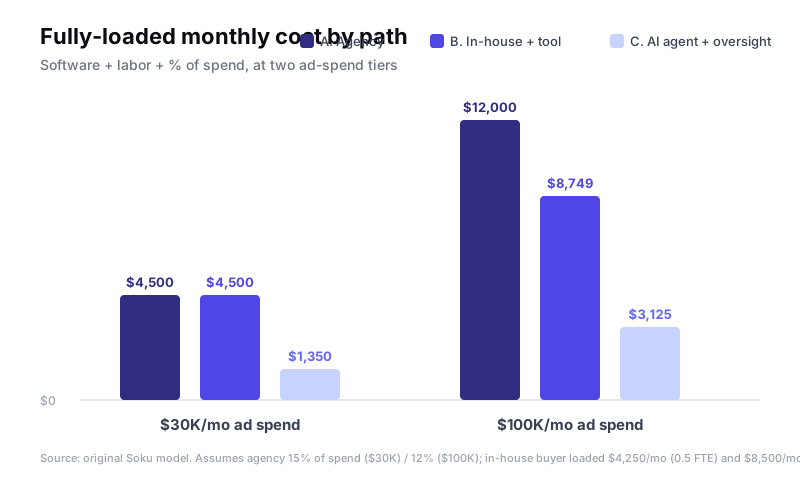
Two patterns jump out. First, the agency and in-house paths cost roughly the same at $30K but diverge at $100K — because the agency fee scales with spend while a salaried buyer's cost is fixed, so in-house gets relatively cheaper as you grow. Second, the AI-agent path is materially lower at both tiers, because it compresses the labor line rather than the software line.
The break-even: where each path actually wins
Cost per month is only half a decision. The other half is what you get back. Here's the honest break-even framing.
The AI-agent path wins on cost, speed, and always-on coverage. In the model, Path C costs roughly $3,150 less per month than the agency at $30K and roughly $8,900 less at $100K — call it $38K–$107K a year. On top of the raw saving, agents run the optimization loop every 15 to 60 minutes instead of twice a day, which is coverage no retainer buys you. Even before any performance lift, the cost gap alone is the payback.
If the AI path also lifts performance, the math compounds. Vendors claim AI can cut blended CPA by 15–25% in the first quarter (treat that as a vendor claim, not a guarantee — and note the same source suggests roughly $50K/mo minimum spend for AI to be meaningfully effective). At $100K/mo spend, even a conservative 10% efficiency gain is worth far more than the entire cost gap between paths. The fee difference becomes a rounding error next to media efficiency — which is exactly why cost-per-month should never be the only lens.
But the agency still wins on the things a model can't price. Strategy that spans channels and quarters, creative direction, negotiating rates and beta access, executive air-cover, and a relationship that absorbs the messy human parts of marketing — agencies earn their fee here, and an agent does not replace it. The honest read is that the agency premium buys judgment and accountability, not button-pushing.
So the break-even isn't a single number; it's a question of what work dominates your need:
| If your bottleneck is… | The path that wins |
|---|---|
| Day-to-day bid/budget/creative operation | C. AI agent — cheaper, faster, always-on |
| A predictable salaried operator you control | B. In-house + tool — fixed cost, scales well |
| Cross-channel strategy and senior judgment | A. Agency — pays for expertise, not clicks |
| Cost at high spend with thin internal team | C. AI agent (often with light agency strategy on top) |
The pattern most teams land on in 2026 isn't "fire the agency." It's a hybrid: keep a strategist (agency or senior in-house) for the judgment, and hand the high-frequency operating work to an agent. You pay for strategy once, not for someone to log in and nudge bids.
Where Soku fits in this model
Path C in the model — the AI agent — is the category Soku is built for. Soku connects directly to your Google Ads and Meta Ads accounts through their APIs and runs the optimization loop itself: reading performance, shifting budget, adjusting bids, pausing fatigued creative, and reporting back what it changed and why. The human in the loop reviews and sets the guardrails — daily-move caps, bid limits, approval gates for structural changes — rather than doing the repetitive work by hand.
That is what makes the labor line in the model shrink: the agent absorbs the forty-hours-a-week operating job, and your team spends a few hours reviewing. The software cost is real and visible; the labor you don't spend is where the savings actually come from. Honest caveat — an agent is excellent at operating an account and poor at boardroom strategy, so for many brands the right answer is Soku for the operating loop plus a human (or a lean agency engagement) for the strategy on top.
Frequently asked questions
Is an AI media buyer always cheaper than an agency?
On fully-loaded monthly cost, usually yes — in our model the AI-agent path is materially lower at both $30K and $100K in spend, mainly because it compresses the labor line rather than the software line. But "cheaper per month" isn't the same as "better value." An agency buys strategy and accountability an agent doesn't, so the right comparison weighs cost against what each path actually does.
What does the software alone cost?
Entry-level cross-channel tools run roughly $36–$249/mo (AdRoll, Madgicx, Revealbot, Optmyzr), with enterprise platforms like Smartly, Marin, and Skai quote-only. Platform-native automation (Meta Advantage+, Google PMax) is free inside the ad account. The full tool breakdown is in Best AI Media Buying Tools.
Why do you include labor when the tool is so cheap?
Because a cross-channel tool is a cockpit, not a pilot — it gives a buyer levers, but a person still has to pull them. A fully-loaded media buyer commonly costs $7,000–$10,000/mo for a full-time hire, which dwarfs the license. Any cost comparison that leaves labor out is comparing a tool price to a full service, which is not a fair fight.
Is there a minimum ad spend where AI makes sense?
One vendor source suggests roughly $50K/mo minimum spend for AI to be meaningfully effective, and our model shows the cost advantage growing with spend. Below ~$20K/mo, the savings are real but smaller in absolute dollars, and platform-native automation plus a few hours of human time is often enough on its own.
Can I use both an agency and an AI agent?
Yes, and many teams do. The common 2026 pattern is a hybrid: a strategist (agency or senior in-house) owns cross-channel strategy and creative direction, while an agent like Soku runs the day-to-day operating loop. You pay for judgment once instead of paying someone to push buttons full-time. For how the loop itself works, see the complete AI media buyer guide.
Are these numbers a real quote?
No. Every figure in the model is a clearly-labeled assumption built to show the structure of the comparison. Agency rates, salaries, and software prices vary widely by market, seniority, and negotiation. Plug in your own numbers — the framework holds even when the dollars change.