 Soku AI
On July 9, 2026, Google introduced AI transparency labels for ads — a "How this ad was made" panel inside My Ad Center that tells people whether the ad in front of them was created or edited with AI. It rolls out globally across Search, YouTube, and Discover, and it's the first Google ad-disclosure requirement to reach beyond election ads since the 2023 political-ad policy.
If you run ads by hand, this is a checkbox you'll learn to tick. If you generate ad creative with AI at any scale — a design tool, an image model, or an ad-automation agent — it's a workflow change, because you are now responsible for a disclosure Google will not verify for you. And the timing is not an accident: the policy lands three weeks before the EU AI Act's transparency duties become enforceable.
This is the operating guide for the second group. What Google actually shipped, who owns the label, where it applies, and how an AI-driven ad team should handle it so disclosure is automatic on your side instead of an afterthought.
What Google actually launched
There are two moving parts, and it helps to keep them separate.
The user-facing panel. A "How this ad was made" section now appears in My Ad Center, reachable from the three-dot menu or info icon on an ad. It states whether an ad was created or edited using AI. It's live across Search, YouTube, and Discover. Based on local requirements, the label may also appear directly on the ad rather than only inside the panel.
The advertiser-facing control. The mechanism you operate is the AI label setting, which — per Google's advertising policy update — launches gradually throughout July across Google Ads, Display & Video 360, Campaign Manager 360, Merchant Center, and Ads Editor. You either add labels directly to your creatives or flip this setting to declare that a creative contains AI-generated or AI-modified content.
The distinction that matters: the panel is what viewers see; the setting is what you're accountable for.
The two tracks: automatic vs. self-attested
How a given ad earns its label depends entirely on which tools made it.
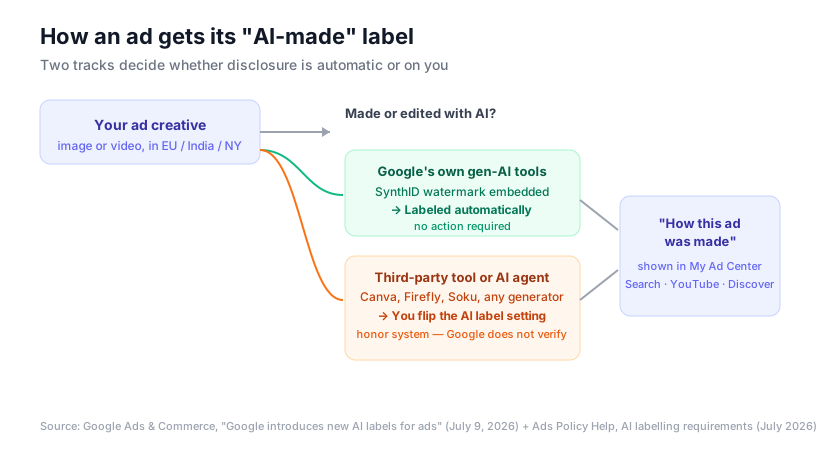
Track A — Google's own generative AI tools. If you built the creative with Google's gen-AI advertising features, the disclosure is added automatically. Google embeds SynthID, an imperceptible watermark, in outputs from its own tools, so the platform already knows the asset is AI-made. No action required.
Track B — third-party tools and AI agents. If the creative came from anything else — Canva, Adobe Firefly, Midjourney, an image model, or an autonomous ad agent — Google has no watermark to read. The label depends on you ticking the box, and Google has said it will not check whether that box is ticked truthfully. It's an honor system.
For anyone running AI at scale in their creative pipeline, Track B is the whole story. The label is only as accurate as your own process, which means the reliable move is to make attestation a step in the pipeline, not a memory test at upload time.
Where and when it applies
Three constraints keep this from being a blanket global mandate today:
- Content type: the requirement targets image and video ad creatives that were generated or modified using AI. AI-assisted copy or bidding is not the trigger; synthetic or altered visuals are.
- Regions: disclosure is required where AI-transparency regulation exists — Google names the European Union, India, and New York. Elsewhere, labeling is available but not mandated.
- Rollout: the AI label setting arrives gradually through July 2026 across the five products above, so if you don't see it in a given account yet, it's still propagating.
Election advertisers are handled separately and always have been: they select the "Altered or synthetic content" checkbox in campaign settings, per the 2023 synthetic-media policy.
One caveat Google states plainly and you should internalize: using the AI label setting does not guarantee compliance with any specific regulation. The setting is a tool, not a legal shield.
The compliance clock
The reason to solve this now rather than in Q4 is a date on the calendar.
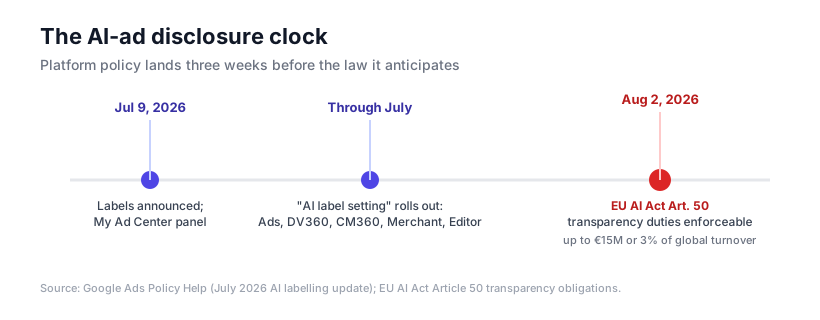
The EU AI Act's Article 50 transparency obligations become enforceable on August 2, 2026 — roughly three weeks after Google's announcement. Article 50 requires that AI-generated or manipulated content be disclosed to the people who see it, and penalties for transparency violations can reach €15 million or 3% of global annual turnover. Google's platform-level label is, in effect, the ad ecosystem getting ahead of the law it anticipates. India and New York have their own transparency rules driving the regional scope.
So the honor system is temporary in spirit even if it's lax in enforcement today. The advertisers who wire disclosure into their process now are simply building the audit trail everyone will be expected to have.
The operating model for AI ad teams
If your creative is machine-generated, you're permanently in Track B. Here's the model that keeps you clean without slowing production.
1. Treat "AI-made" as metadata that travels with the asset. The moment a creative is generated, tag it. Whether that's a naming convention, a column in your asset library, or a field your generation pipeline writes, the label decision should be made at creation, when you actually know the answer — not reconstructed weeks later by whoever happens to upload it.
2. Default the AI label setting on for AI-heavy accounts. If the overwhelming majority of your visuals are AI-generated or AI-edited, flipping the account-level setting on is far safer than per-creative recall. Over-disclosure carries no penalty; under-disclosure carries policy risk. When in doubt, label.
3. Draw the "modified" line explicitly. The policy covers content "generated or modified" with AI, and "modified" is where teams get sloppy. An AI background swap, a generative fill, an AI upscale, or an AI-relit product shot all count. Write down what your team treats as disclosable so two people make the same call.
4. Keep a generation log. Which tool produced which asset, when, for which campaign. You don't need it for Google today, but it's exactly what an EU AI Act audit — or an internal legal review — will ask for. This is the durable infrastructure; the checkbox is just today's expression of it.
5. If an autonomous agent runs your ads, disclosure is a launch-gate, not a report. An agent that generates creative and pushes it live has to carry the attestation through to the platform automatically. The failure mode is an agent that ships AI creative with the label setting untouched. Bake it in as a precondition of publishing, so a campaign can't go live mis-labeled.
The questions Google's announcement doesn't answer
Two things advertisers keep asking that the policy is quiet on.
Does an "AI-made" label hurt performance? There's no public data yet — the feature is days old. The honest answer is: don't assume, measure. If you're worried the disclosure suppresses click-through, run it as a real test — hold creative, audience, and placement constant and compare labeled AI creative against your non-AI control, the same way you'd test any creative variable. The plausible outcome is negligible impact, but it's a measurable question, not a reason to under-disclose.
What if Google labels something incorrectly? Auto-labeling keys off SynthID and your setting, so a false positive is unlikely for non-Google tools (there's no watermark to misread). The bigger risk is the reverse — an asset that should be labeled slips through because the setting was off. That's another argument for defaulting the setting on and catching it at the source rather than disputing a label after the fact.
How Soku fits
Soku is an AI ad-automation agent — it generates ad creative and can push campaigns live — which puts it squarely in Track B. That's precisely why the operating model above matters more than the checkbox: when generation and deployment happen in one workflow, the disclosure has to ride along with the asset automatically, or it doesn't happen at all.
The teams that will handle this well aren't the ones who memorize a policy page. They're the ones who treat "was this made with AI?" as a fact recorded at creation and carried to the platform — so labeling is a property of the pipeline, not a manual step someone remembers. If you're already generating creative at volume — say you're producing dozens of ad variants with AI — that discipline is the difference between compliant-by-default and exposed.
FAQ
Do I have to label AI-generated ad copy? No. The requirement targets image and video creatives generated or modified with AI. AI-written headlines or descriptions aren't the trigger under this policy.
Is the AI label setting required everywhere? No. It's required where transparency regulation exists — the EU, India, and New York per Google. Elsewhere it's optional but available.
If I use Google's own AI tools, do I still flip the setting? No. Assets from Google's generative tools are labeled automatically via SynthID. The setting is for AI content made outside Google's tools.
Does ticking the box make me EU AI Act compliant? No. Google states explicitly that using the AI label setting doesn't guarantee compliance with any specific regulation. It's one signal, not a legal safe harbor.
When can I access it? The AI label setting rolls out gradually through July 2026 across Google Ads, Display & Video 360, Campaign Manager 360, Merchant Center, and Ads Editor. If it's not in your account yet, it's still propagating.