 Soku AI
On July 9, 2026, OpenAI announced that GPT-5.6 is now the preferred model in Microsoft 365 Copilot — powering Word, Excel, PowerPoint, Chat, and Cowork. For the general strategy of running GPT-5.6 inside an ad workflow, start with our GPT-5.6 Sol model-routing guide. This post is narrower. It answers one question the launch coverage skips: when the model that a few hundred million knowledge workers use by default is the same model class your ad-automation agent runs, what actually changes for an ad team?
Short answer: the model layer just got standardized for you. The workflow layer did not.
What actually shipped
GPT-5.6 is not a single model. It is a family of three — Sol (flagship), Terra (enterprise), and Luna (high-volume) — covering different points on the reasoning-versus-cost curve. Microsoft is routing that family into its productivity suite so Copilot can, in OpenAI's framing, deliver "more useful work from every token" with "stronger performance per dollar and on-demand capability for the most complex tasks."
In practice the pitch is workflow-shaped, not benchmark-shaped: draft and refine documents in Word with fewer rounds of prompting, run deeper analysis in Excel while spending fewer tokens, and hand agentic multi-step work to a model with enough reasoning to carry it further before a human steps back in.
Why "preferred in Copilot" is different from another model launch
Most model releases are opt-in. This one is a default. Being the preferred model inside Microsoft 365 Copilot puts GPT-5.6 in front of the single largest installed base of workplace software on earth — which is exactly why the announcement reads as much like a partnership statement as a product one.
Context matters here. The news landed amid reports of tension between Microsoft and OpenAI, after Bloomberg reported Microsoft was leaning on its own in-house MAI models to cut costs in apps like Word and Excel. Calling GPT-5.6 the "preferred model" reaffirms that OpenAI's technology stays central to Copilot — without erasing the fact that Microsoft is also hedging with its own models underneath.
For marketers, the corporate drama is a footnote. The signal that matters: the frontier reasoning tier is now a default in the tools your team already lives in. That resets the baseline of what a "normal" AI assist looks like — and it raises the bar for anything that calls itself ad automation.
What it means operationally for ad teams
Here is the part the news write-ups miss, and where we can speak first-hand: Soku is an ad-automation agent, and it runs on GPT-5.6 model tiers. So the "what does a Copilot-standard GPT-5.6 mean operationally" question is not abstract for us — it is our routing table.
The instinct after a launch like this is to send everything to the flagship. That is how a model upgrade turns into a cost spike. The tier that OpenAI ships exists precisely so you do not: reserve flagship-class reasoning for the few jobs with high ambiguity, many tools, and irreversible consequences, and push the high-volume, reversible, repeatable work down to a cheaper tier.
When you actually meter an ad agent, the distribution inverts spend intuition:
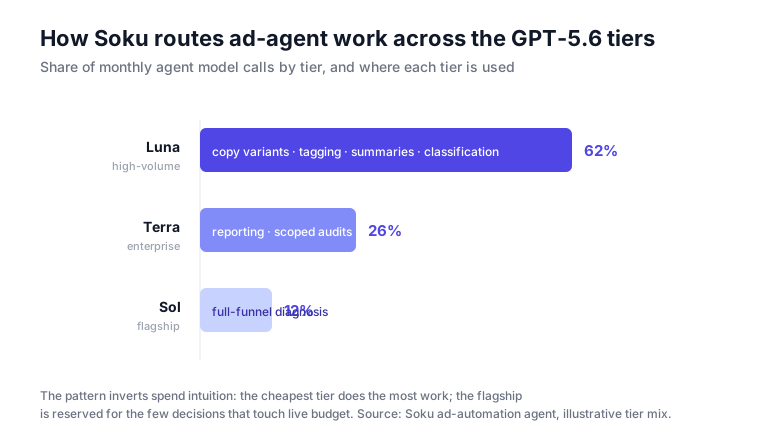
The high-volume tier does the most work — generating copy variants, tagging entities, summarizing search terms, classifying creative — because that is where the token volume lives. The enterprise tier handles scoped audits and reporting. The flagship tier is a thin slice at the top, spent only on full-funnel diagnosis where the model has to reconcile Meta, Google, GA4, and Shopify evidence before it recommends touching live budget. A Copilot-standard GPT-5.6 does not change that shape. It just means the same reasoning ceiling your agent reaches for is now the ambient default your team feels in Excel — so the gap you have to justify is no longer "is the model good enough," it is "does the workflow around it actually do the job."
Copilot gives you the model, not the loop
This is the distinction ad teams should hold onto. Copilot is assistive and in-document: the human sits in Word or Excel, GPT-5.6 helps them draft the brief, model the budget, or build the review deck, and the human still leaves the document to open Ads Manager, read the numbers, push the change, and remember what they did.
An ad-automation agent is a different shape entirely.
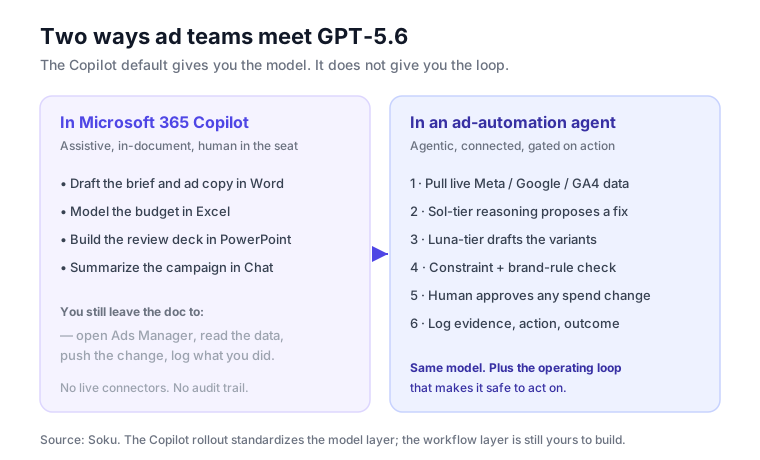
Same model class, but wrapped in a loop the document assistant does not have: live connectors to the ad platforms, tiered routing so the flagship is spent sparingly, a constraint and brand-rule check, a human approval gate on anything that moves spend, and an evidence log of every recommendation and its outcome. That loop — not the model — is what makes it safe to let AI act on a campaign instead of just draft a paragraph about one. If you want to build that first workflow without letting a model touch live spend, start read-only: let the agent pull the data and draft recommendations, and keep every write behind human approval.
So which tier, for which job?
The Copilot rollout makes the tier question louder, because now everyone has a mental model of "GPT-5.6" from their Office apps and assumes one setting fits everything. It does not. The right approach is a routing policy, not a favorite model — and the tradeoffs (planning depth, tool reliability, speed, cost, approval needs) are exactly what we rank in GPT-5.6 Sol vs GPT-5.5, Gemini, and Claude for ad workflows. The one-line version: match the tier to the blast radius of the task.

The take
Making GPT-5.6 the default in Microsoft 365 Copilot is a distribution event more than a capability event. The capability was already available to anyone building on the API — including ad-automation agents like Soku. What changed is that the frontier reasoning tier is now the baseline expectation of every marketer who opens Excel.
The teams that win from this are not the ones who switch every prompt to the flagship. They are the ones who treat the model as standardized infrastructure and put their effort into the loop that Copilot does not ship: connected data, tiered routing, approval gates, and an audit trail. The model got commoditized this week. The operating system around it is still the differentiator.
FAQ
What did OpenAI announce about GPT-5.6 and Microsoft 365 Copilot?
On July 9, 2026, OpenAI said GPT-5.6 is now the preferred model in Microsoft 365 Copilot, powering Word, Excel, PowerPoint, Chat, and Cowork. GPT-5.6 ships as three tiers — Sol, Terra, and Luna — spanning flagship, enterprise, and high-volume use.
Does GPT-5.6 in Copilot help with running ads?
Indirectly. Copilot is an in-document assistant: it helps draft briefs, model budgets, and build decks. It does not connect to your ad platforms or act on campaigns. Running ads through AI means pairing the same GPT-5.6 model class with an agent that has live connectors, approval gates, and logging.
Should ad teams route every task to the flagship GPT-5.6 tier?
No. Reserve the flagship (Sol) tier for high-ambiguity, multi-tool, spend-impacting decisions like full-funnel audits. Send high-volume copy generation, tagging, and summaries to a cheaper tier. In practice the cheapest tier handles the majority of agent calls.
How does Soku use the GPT-5.6 tiers?
Soku routes work by blast radius: flagship reasoning for diagnosis that touches budget, mid tier for scoped audits and reporting, and the high-volume tier for the bulk of copy, tagging, and classification — all inside a loop with connectors, brand-rule checks, human approval on spend changes, and an evidence log.