 Soku AI
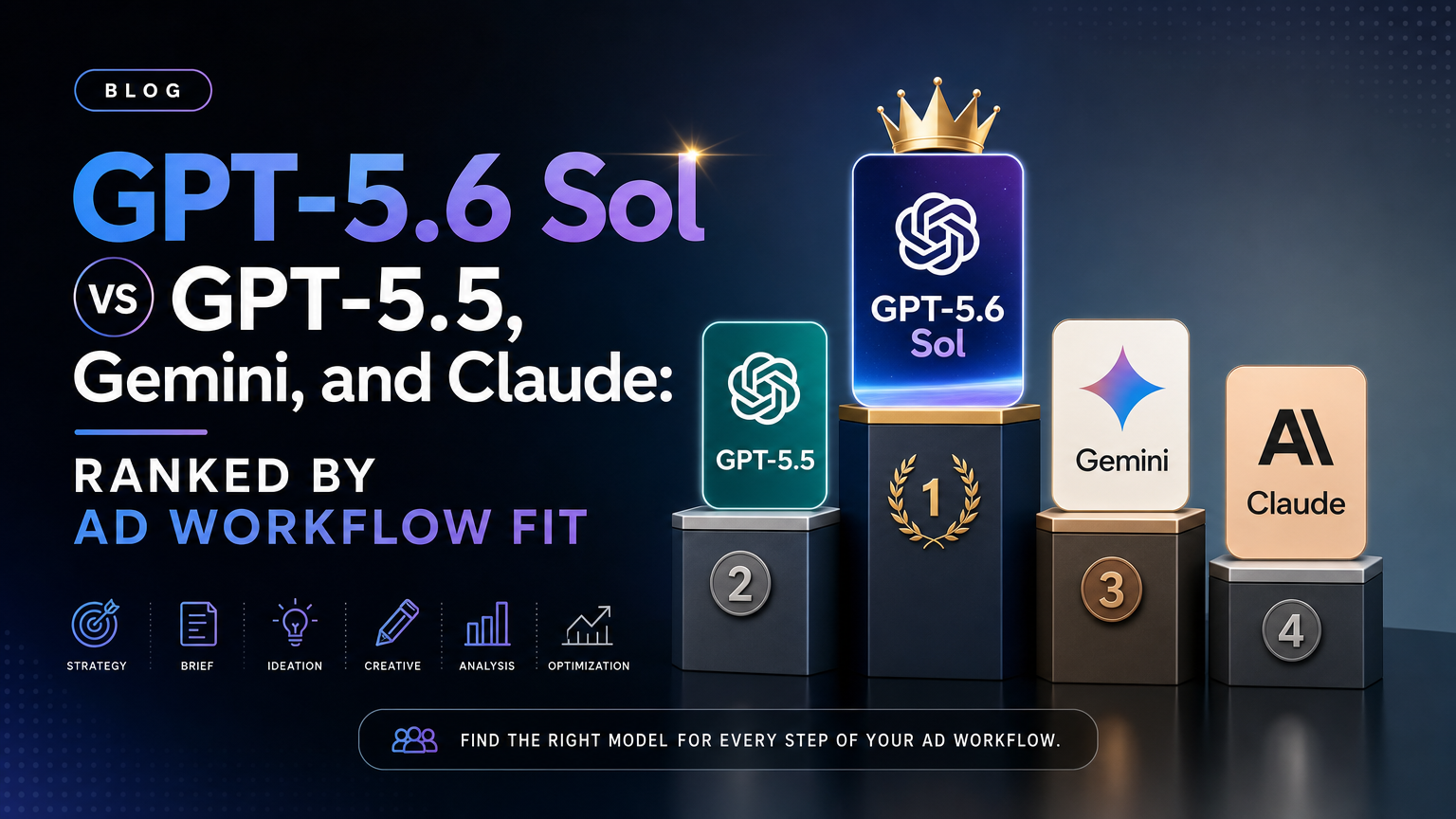
The wrong way to compare GPT-5.6 Sol is to ask which model is "best." Ad teams do not need one model. They need a routing policy that sends the right work to the right model tier.
OpenAI's GPT-5.6 Sol preview is not just another model-release headline for marketers. The useful question is narrower: which parts of an ad team's workflow are now worth routing to a more capable, more expensive reasoning model, and which parts should stay on cheaper fast models?
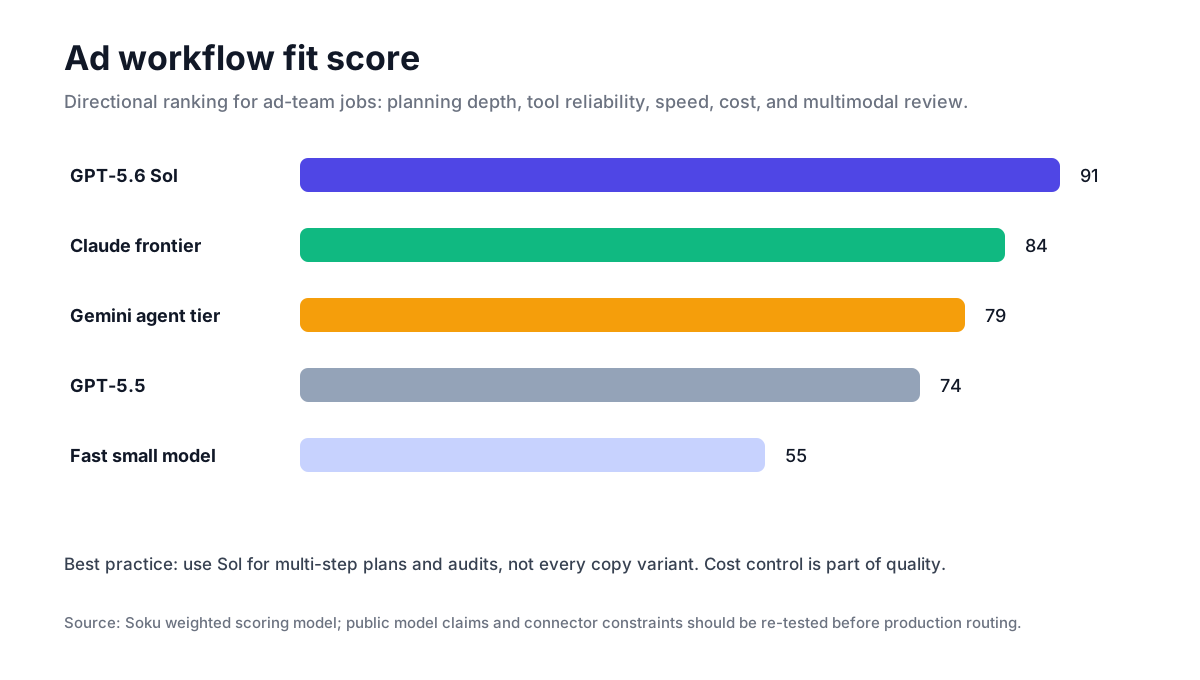
This page ranks the alternatives by ad workflow fit - planning depth, tool reliability, speed, cost, and multimodal or browser-agent work - and then shows how to wire the winning tier into a Meta and Google Ads workflow without letting a preview model touch live spend.
The scoring model
We scored each model class against five ad-team jobs:
| Criterion | Weight | Why it matters |
|---|---|---|
| Long-horizon planning | 30% | Campaign diagnosis and account planning are multi-step |
| Tool-use reliability | 25% | Ad agents depend on connectors and evidence |
| Cost control | 20% | Daily operations can burn tokens fast |
| Speed | 15% | Reporting and triage need low latency |
| Multimodal or UI work | 10% | Creative review and browser QA matter, but not for every task |
This is not a universal benchmark. It is a Soku operating score for marketing teams.
Ranking by job
| Model tier | Best ad-team job | Avoid using it for |
|---|---|---|
| GPT-5.6 Sol | Multi-channel diagnosis, launch planning, scenario trees | High-volume copy variants |
| Claude frontier tier | Long documents, structured analysis, nuanced strategy | Repetitive tagging or summaries |
| Gemini agent tier | Browser-agent inspection, visual QA, Google ecosystem workflows | Budget decisions without structured data |
| GPT-5.5 | General strategy, content, campaign briefs | Complex autonomous tool loops |
| Fast small model | Classification, extraction, variant generation, routing | Ambiguous account strategy |
The pattern is clear: GPT-5.6 Sol should sit near the top of the planning stack, not at the bottom of every workflow.
GPT-5.6 Sol vs GPT-5.5
Use GPT-5.6 Sol when the task has multiple tools, multiple constraints, and a real chance of bad action. A full account audit qualifies. A single landing-page description does not.
GPT-5.5 remains a good default for:
- first-pass campaign briefs
- ad-copy variants
- landing-page rewrite suggestions
- competitor summaries
- weekly performance narratives
The upgrade threshold is evidence depth. If the model must hold Meta, Google, GA4, Shopify, creative metadata, and change history in one chain of reasoning, route upward.
GPT-5.6 Sol vs Claude
Claude-style frontier models remain strong for long-document synthesis, structured reasoning, and nuanced planning. For marketing teams, the decision often comes down to integration and workflow reliability rather than raw prose quality.
Choose GPT-5.6 Sol when the Soku workflow is already OpenAI-routed or when the task benefits from OpenAI tool/runtime compatibility.
Choose Claude when the task is document-heavy, policy-heavy, or already sits inside a Claude-connected research workflow.
In practice, Soku should not make this a brand debate. It should route by task type and measure outcomes.
GPT-5.6 Sol vs Gemini
Gemini's strongest marketing role is not always text. It is visual and UI-bound work: browser inspection, screenshot reasoning, landing-page QA, ad preview review, and Google ecosystem tasks. Our Gemini computer-use guide for AI ad ops covers that lane.
GPT-5.6 Sol is the better default for abstract campaign strategy and multi-channel reasoning. Gemini is a stronger candidate when the workflow needs to look at a page, inspect a UI, or operate inside Google's tool surfaces.
The Soku routing policy
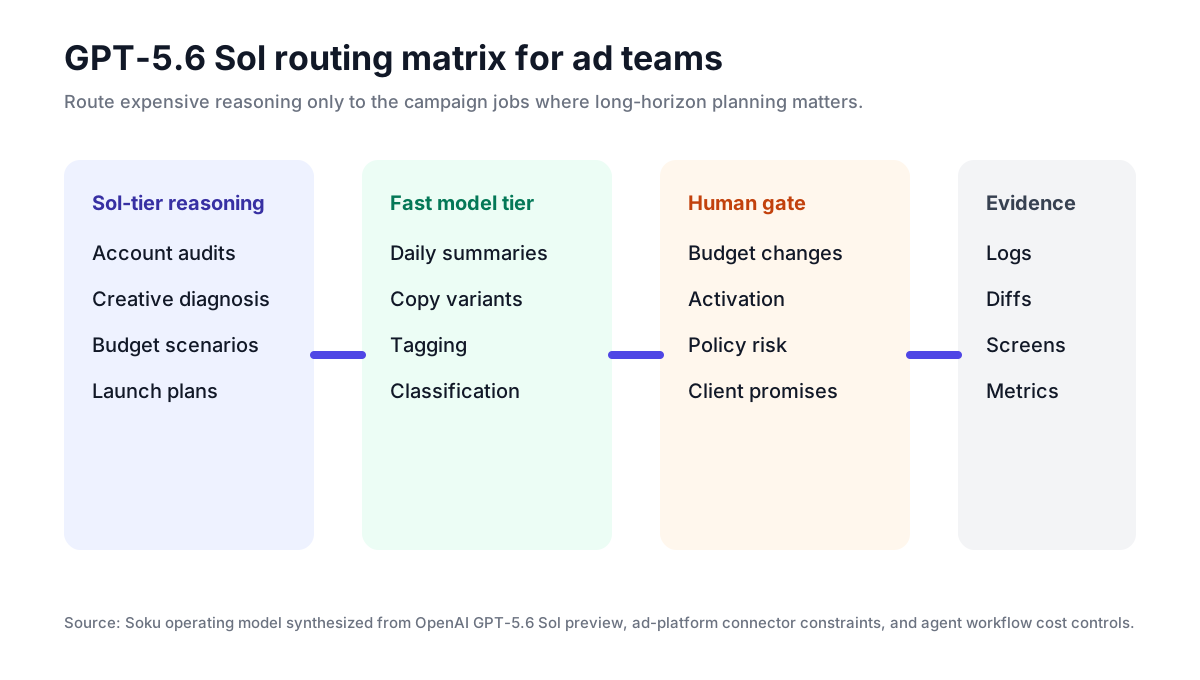
A production ad-agent stack should route like this:
| Workflow | Recommended tier |
|---|---|
| Daily account summary | Fast model or GPT-5.5 |
| Creative batch generation | Fast model |
| Creative fatigue diagnosis | GPT-5.6 Sol or Claude frontier |
| Google landing-page QA | Gemini computer-use tier |
| Budget scenario plan | GPT-5.6 Sol |
| Final action brief | GPT-5.6 Sol plus human approval |
The economic logic matters. If every micro-task goes to a frontier model, the cost curve breaks. If every strategic task goes to a cheap model, the recommendations get shallow. Routing is the product decision.
How to test the routing
Run the same account diagnosis through two tiers:
- Give each model the same 14-day account package.
- Ask for causes, confidence, missing data, and next actions.
- Blind-review recommendations with a media buyer.
- Score for evidence quality, false causality, action specificity, and safety.
- Track whether approved recommendations improved after the next measurement window.
That is a better benchmark than a public leaderboard. It tests the work your team actually does.
What actually changes for ad teams
The core change is not better copy. Better copy is table stakes. The harder jobs are multi-step campaign work:
| Job | Why Sol-class reasoning helps | Why it still needs a gate |
|---|---|---|
| Full-funnel account audit | The model must reconcile Meta, Google, GA4, Shopify, and landing-page evidence | It can overstate causality when tracking is incomplete |
| Creative fatigue diagnosis | It has to connect spend, frequency, hooks, format, audience, and landing-page fit | It cannot replace creative approval or policy review |
| Budget scenario planning | It must reason over constraints, targets, pacing, and attribution delay | Spend changes need human approval |
| Launch planning | It can turn a messy brief into tasks, assets, naming, QA, and measurement | Activation should not be automatic |
| Experiment design | It can structure hypotheses and holdouts | Business risk belongs to the operator |
For Soku, the model is not the product by itself. The product is the loop around it: connected data, tool access, evidence logs, approval gates, and a memory of what was tried before.
The upgrade rule, in two prompts
The practical routing rule is simple:
Use GPT-5.6 Sol when the work has high ambiguity, multiple tools, irreversible consequences, or a long chain of dependent steps.
Use a cheaper model when the work is repeatable, isolated, reversible, or high-volume.
That means GPT-5.6 is a strong fit for a prompt like:
Audit this week's Meta and Google Ads performance for the ecommerce brand, identify the top three budget or creative risks, compare each finding against GA4 revenue and Shopify orders, and draft a proposed action plan with evidence and confidence levels.It is a poor fit for:
Write 40 headline variants for this product.The second task is useful, but it is volume work. Run it on a fast model, then let Sol review the shortlist against the account objective.
Setup: start with a bounded read-only diagnosis
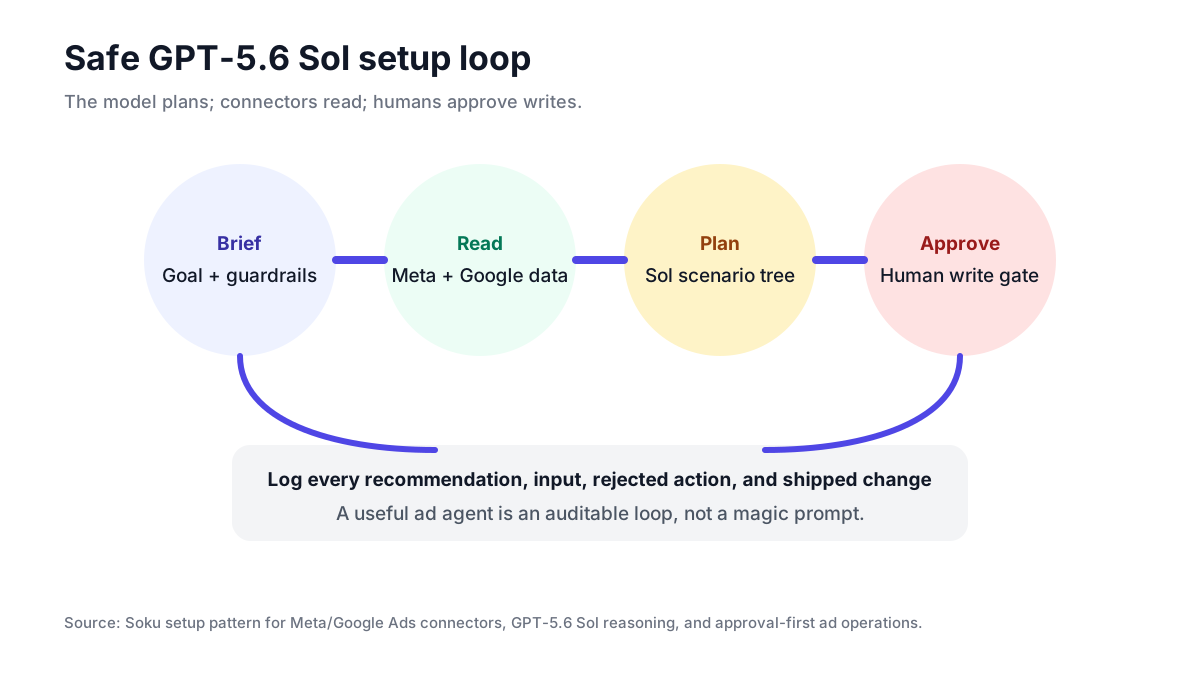
Picking the tier is the easy half. GPT-5.6 Sol is useful for ad teams only if it is wired into a safe operating loop, and a stronger reasoning model does not automatically make a safer ad agent. The application around it still owns credentials, connector scopes, approval gates, logging, and rollback.
Start with a read-only diagnosis:
Review the last 14 days of Meta and Google Ads performance for this brand. Identify the top three risks, cite the metrics behind each finding, separate creative problems from budget problems, and propose next actions. Do not modify campaigns.That task is intentionally bounded. It asks the model to reason, not operate. The first production test should produce an evidence-backed recommendation, not an API mutation.
Separate data access from write access
Give the model read access first. Meta Ads, Google Ads, GA4, Shopify, Search Console, and internal creative metadata should be available as structured context through Soku or connector tools. Write actions should sit behind a separate approval layer.
The distinction matters:
| Capability | First 30 days | Later |
|---|---|---|
| Read performance | Allowed | Allowed |
| Summarize account risks | Allowed | Allowed |
| Draft changes | Allowed | Allowed |
| Change budgets | Blocked | Approval required |
| Launch campaigns | Blocked | Approval required |
| Pause ads | Blocked | Approval required |
| Edit targeting | Blocked | Approval required |
This is the same operating posture we recommend for Meta Ads AI Connectors and Google Ads MCP: read first, write later, approve always.
Build the context package
Do not paste a dashboard screenshot into GPT-5.6 and ask for strategy. Build a context package:
| Input | Why it matters |
|---|---|
| Campaign structure | The model needs to know which campaigns serve which jobs |
| Spend, CPA, ROAS, CTR, CVR | Core performance signals |
| Creative metadata | Hooks, formats, concepts, upload dates, fatigue windows |
| Landing-page URLs | Conversion problems often live off-platform |
| GA4 and Shopify revenue | Platform-reported ROAS is not enough |
| Guardrails | Target CPA, minimum ROAS, max daily spend, forbidden actions |
| Change history | The model needs to know what changed before the metric moved |
The original element here is the context package, not the prompt. Most failed ad-agent demos fail because the prompt is asked to compensate for missing account context. This is also what makes a model comparison meaningful: two tiers only differ in a way you can measure when both are handed the same evidence.
Use a two-pass prompt
Run diagnosis and action planning separately.
First pass:
Given the attached account data, identify the strongest three explanations for the performance change. For each, cite the evidence, confidence level, and missing data. Do not propose actions yet.Second pass:
Now propose actions for the confirmed causes only. Separate no-risk monitoring, low-risk creative work, and approval-required account changes. For every account change, include the exact object, expected impact, risk, and rollback.This prevents the model from jumping straight from "CPA rose" to "cut budget." In paid media, premature action is often more expensive than slow analysis.
Log every recommendation
A production setup should log:
- input data window
- connector sources used
- model name and routing decision
- recommendations
- evidence citations
- confidence
- human approval or rejection
- action taken
- outcome after the next measurement window
Without this log, the team cannot learn whether GPT-5.6 improved decisions. With the log, the model becomes part of a measurable operating system, and the routing policy above becomes an evidence-backed choice instead of a preference.
Keep the first deployment boring
The first month should not include autonomous edits. A safe rollout looks like this:
| Week | Workflow | Allowed action |
|---|---|---|
| 1 | Daily cross-channel summary | Read only |
| 2 | Creative fatigue diagnosis | Read only |
| 3 | Budget scenario planning | Draft only |
| 4 | Human-approved change briefs | Approval required |
Only after the recommendations are consistently useful should the team add low-risk writes, and even then the write should be explicit and reversible.
Where Soku uses the model
The strongest Sol workflow is a planner-inspector loop:
- Soku pulls structured performance data from Meta, Google, TikTok, GA4, Shopify, and Search Console.
- GPT-5.6 Sol reasons over the evidence and proposes a diagnosis.
- A cheaper model generates variant copy or asset ideas from the approved strategy.
- Soku checks platform constraints and brand rules.
- A human approves any budget, bid, launch, or audience change.
- Soku logs the recommendation, evidence, action, and outcome.
This avoids two common failures. The first is using a frontier model as an expensive autocomplete engine. The second is letting an agent make spend-impacting changes without enough evidence.
The practical win is not that GPT-5.6 can "run ads." The win is that it can produce a better campaign plan from connected evidence, and Soku can turn that plan into reviewed, measurable work. For a practical dry run, see our GPT-5.6 Sol ad automation test. For what the Copilot rollout means once the model becomes a workplace default, read GPT-5.6 in Microsoft 365 Copilot: what it means for AI ad teams.
The demand signal is early but real
DataForSEO shows gpt 5.6 at 1,300 US monthly searches, low competition, and a high estimated CPC. The long-tail phrases that matter to marketers - gpt-5.6 marketing, gpt-5.6 ad automation, gpt-5.6 setup, and gpt-5.6 alternatives - still show no stable volume.
Read that as a caution about consensus. There is no settled answer yet on which model belongs in which ad workflow, which is exactly why a borrowed ranking is worth less than a routing test run on your own account.
The original Soku take
The best model-routing strategy for ad teams is not a leaderboard. It is a control system.
The model should be allowed to think deeply, but not allowed to act broadly. It should have access to the evidence needed to make a recommendation, but every recommendation should carry confidence, source links, and a concrete rollback plan.
That is the real GPT-5.6 change for marketers: a frontier model makes long-horizon campaign reasoning more credible. It does not remove the need for guardrails. It makes the guardrails more valuable, because the recommendations become strong enough that teams will be tempted to act on them.
FAQ
What is GPT-5.6 Sol?
GPT-5.6 Sol is OpenAI's previewed next-generation model. For marketers, the relevant question is how it performs on long, tool-heavy campaign workflows, not whether it can write a better tagline.
Is GPT-5.6 Sol better than Claude for marketing?
Not universally. It may be better for some tool-heavy Soku workflows; Claude may be better for some document-heavy strategy work. Route by task and measure outcomes.
Should Gemini handle all Google Ads work?
No. Gemini is compelling for browser and visual inspection. Structured Google Ads performance analysis should still use clean connector data.
What is the cheapest safe setup?
Use a fast model for extraction and variants, GPT-5.5 for routine summaries, and GPT-5.6 Sol only for planning, diagnosis, and approval briefs.
Do I need Meta and Google write permissions to test GPT-5.6?
No. Start with read-only account data and draft recommendations. Budget, bid, activation, targeting, and deletion should require human approval, and not in the first deployment.
What should I test first?
Creative fatigue diagnosis is the best first test because it requires cross-channel reasoning but does not require an immediate spend change.