 Soku AI
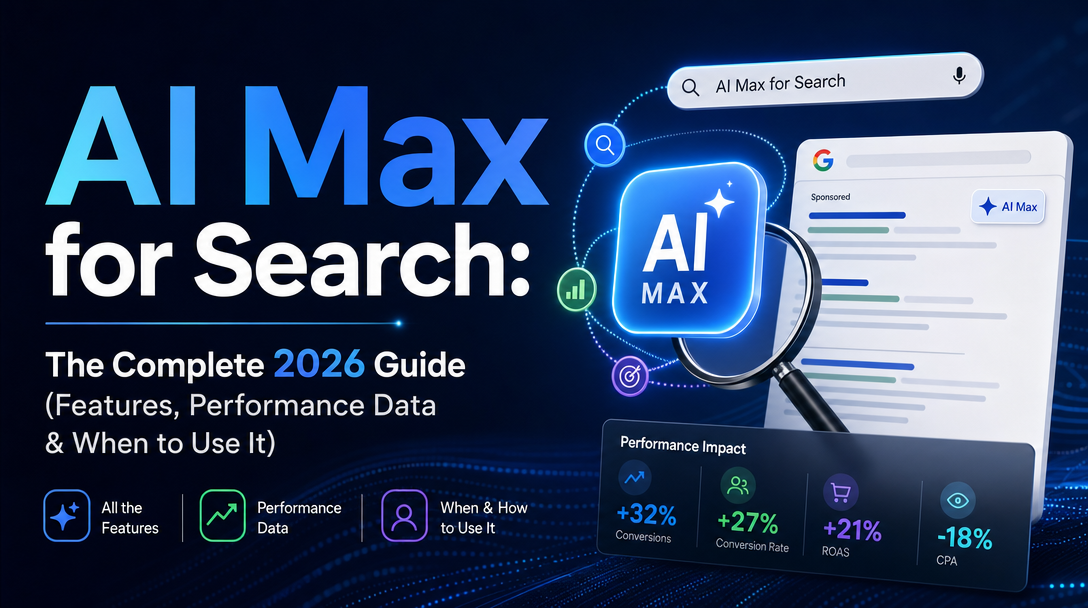
AI Max for Search is now the default for new Google Search campaigns, and Google is migrating Dynamic Search Ads onto it by February 2027. If you run paid search, AI Max is no longer optional to understand — it's the surface your campaigns are moving to whether you opt in or not.
But "the default" doesn't mean "the right setting for every account." Independent tests have shown AI Max performance ranging from strong to more than twice the cost per conversion of traditional match types. The job for an ad team in 2026 isn't to resist AI Max or to flip it on everywhere — it's to know exactly what it does, where it wins, and how to control it.
This guide covers the full picture: what AI Max is, how it compares to Performance Max and standard Search, the real performance data, the settings that matter, and a decision framework for when to use it. For the deep dive on any one part, we link to the focused articles in this cluster.
What AI Max for Search actually is
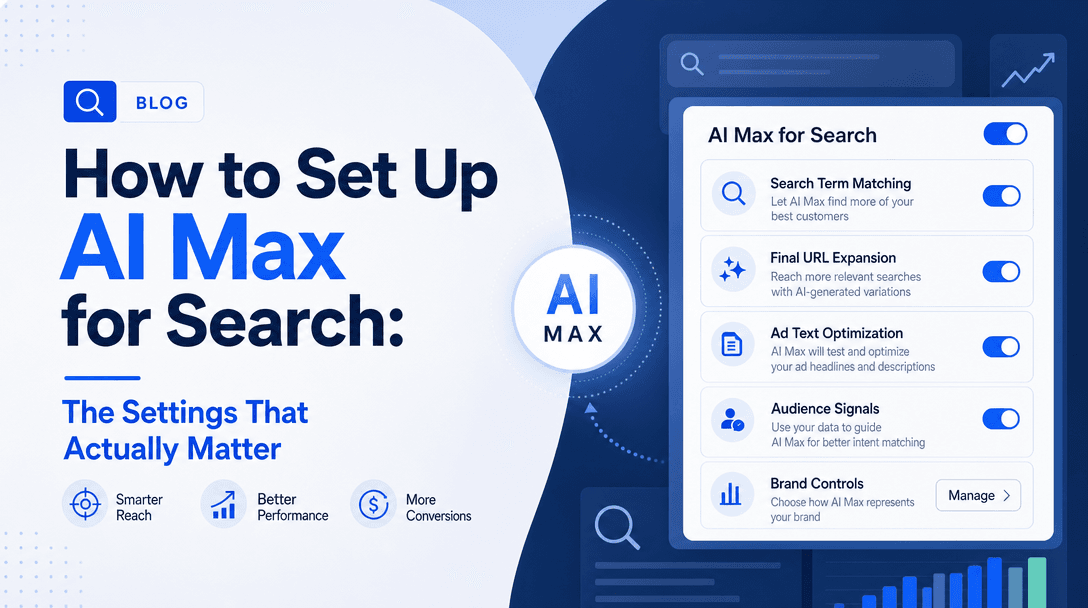
AI Max for Search is a feature suite layered onto Search campaigns — not a separate campaign type. When you enable it, three things turn on (all on by default):
- Search term matching — Google expands beyond your keywords to match relevant queries it predicts will convert, using broad-match-style intent modeling plus landing-page signals. This is the DSA-like capability that lets it find queries you never added.
- Text customization — Google rewrites and generates headlines and descriptions dynamically to match the query and landing page, rather than serving only the exact ad text you wrote.
- Final URL expansion — Google can send traffic to the most relevant page on your site for a given query, not just the final URL you set.
Underneath, AI Max combines your landing-page content, real-time intent signals, your existing ad copy, and audience data to decide what to show and where to send the click. In plain terms: it takes the dynamic, query-matching logic that powered Dynamic Search Ads and pushes it further toward automation, with the manual levers either removed or defaulted on.
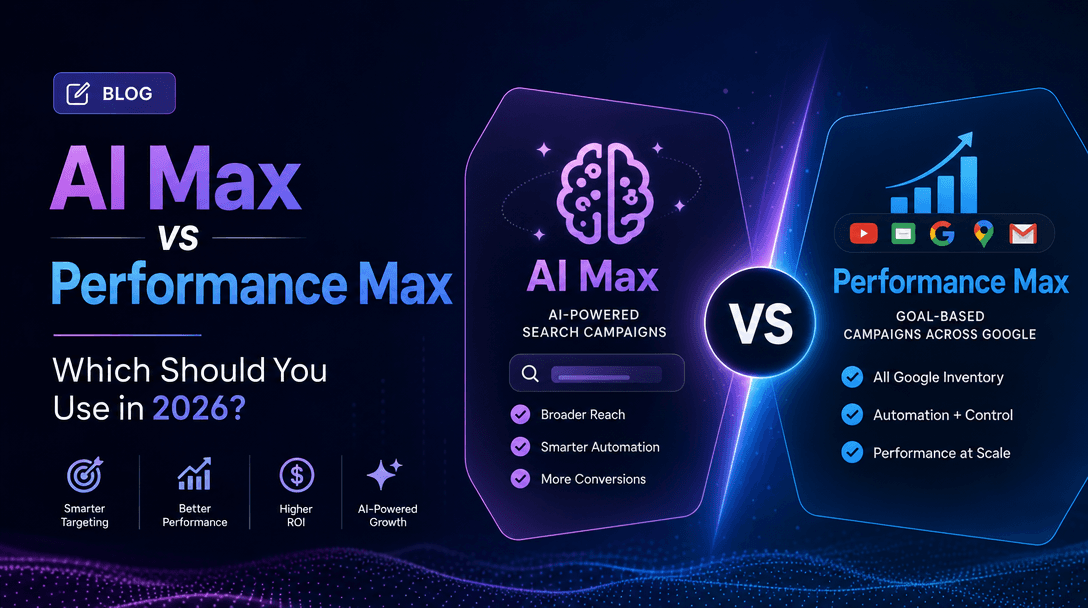
AI Max vs Performance Max vs standard Search
The single most common question is how AI Max relates to Performance Max. They are not the same thing, and conflating them leads to bad structure decisions. (For the full breakdown and a decision flowchart, see AI Max vs Performance Max: which should you use in 2026?)
| Standard Search | AI Max for Search | Performance Max | |
|---|---|---|---|
| What it is | Campaign type | Feature layer on Search | Campaign type |
| Channels | Search only | Search only | All Google inventory |
| Targeting | Your keywords + match types | Keywords + AI query expansion | Goal-based, no keywords |
| Ad text | You write it | AI customizes/generates | AI assembles from assets |
| Control | Highest | Medium | Lowest |
| Best when | You need precision and negatives | Strong Search hit a ceiling | You want total Google reach |
The practical read:
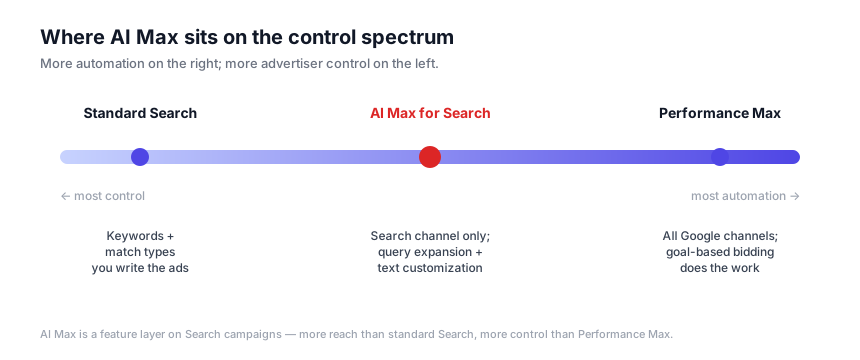
- Standard Search gives you keyword-level control, negative-keyword management, and intent precision. Best when those matter — regulated industries, tight brand control, lean budgets.
- AI Max for Search keeps you inside the Search channel and your campaign structure, but loosens the boundaries to capture incremental queries. Best when you have strong Search campaigns that have plateaued and want to test query expansion with some guardrails still in place.
- Performance Max is a different bet entirely: spread budget across all of Google (Search, Display, YouTube, Gmail, Discover, Maps) with bidding doing the heavy lifting. It gives you the least control and the most reach. PMax does not give you keyword-level control, negative-keyword management, or intent precision — so it complements dedicated Search rather than replacing it. (See our take on Performance Max creative and feed strategy.)
Many mature accounts run standard Search + AI Max experiments + PMax together, monitoring cross-campaign overlap. That's viable if you have the budget and the monitoring discipline to keep them from cannibalizing each other.
The performance reality — what the data shows
Here's where ad teams need to stay clear-eyed. AI Max is powerful, but its results in independent testing have been uneven, which is exactly why advertisers pushed Google to delay the forced migration.
In a widely cited November 2025 test, analyst Xavier Mantica measured AI Max cost per conversion at $100.37 versus $43.97 for phrase match — more than double. Other independent tests reported roughly 35% lower ROAS for AI Max against traditional match types. Tellingly, Google itself revised its headline claim down from "14% more conversions" to 7%.
This does not make AI Max a bad product. It makes it an uneven one: query expansion and text customization can unlock genuine incremental conversions on some accounts and query mixes, while burning budget on loose matches on others. The variance is the point — and the reason to test on your own data before committing your whole account.
The settings that actually matter
If you turn AI Max on, these are the controls that keep it from running away (for the full step-by-step order, see how to set up AI Max for Search):
- Brand exclusions and negative keywords — query expansion means AI Max will reach for adjacent queries; negatives are how you keep it on-intent. Audit them before enabling.
- Final URL expansion controls — you can restrict which pages AI Max is allowed to send traffic to. Lock this down if parts of your site shouldn't receive paid traffic.
- Text customization — review the headlines and descriptions Google generates; pin the ones that protect brand voice and compliance.
- Locations of interest / audience signals — feed AI Max the strongest first-party and audience signals you have; it leans on them heavily.
- Reporting on search terms — check the new query surface weekly. Expanded matching is only safe if you're watching what it actually matches.
A framework for when to use AI Max
Don't enable it everywhere, and don't avoid it on principle. Decide per campaign:
- Turn it on (as an experiment) when a Search campaign is strong but plateaued, your negatives and brand controls are solid, and you can monitor search terms weekly.
- Hold off when you're in a regulated/brand-sensitive vertical, your budget is too small to absorb learning-phase variance, or you don't have the bandwidth to police expanded matching.
- Always test side-by-side rather than switching wholesale — duplicate the campaign, split traffic, and judge on your own CPA and ROAS, not Google's headline numbers.
The DSA migration makes this urgent
This isn't a someday decision. Google is retiring Dynamic Search Ads and migrating them onto AI Max: new DSA creation ends January 2027 and remaining DSAs auto-migrate starting February 2027. The delay from September 2026 bought a testing runway — but only if you use it. The full timeline and action plan are in our companion piece: Google delays the DSA → AI Max automigration to February 2027 — what ad teams should do now.
Honest limitations — what AI Max still can't do
- It can't replace keyword-level precision. If your business depends on tight intent control, AI Max trades that away for reach.
- It can't fix a weak landing page or feed. Query expansion sends more varied traffic; if the page doesn't convert that traffic, you just pay more.
- It isn't consistent across accounts. The same settings that lift one account inflate CPA on another. There is no universal "correct" configuration — only what your data shows.
- It reduces transparency. With text customization and URL expansion on, you have less direct insight into the exact ad/query/page combination that drove a conversion.
How Soku fits
The recurring theme above is test on your own data, weekly, across every campaign — which is operationally heavy to do by hand. That's the gap an ad-automation agent fills.
Soku connects to your Google Ads account through the Google Ads MCP and can run AI Max vs. standard Search experiments, pull the side-by-side CPA and ROAS on your own account, watch the expanded search-term surface for off-intent matches, and flag which campaigns are safe to migrate early versus which need the full runway to February 2027. Instead of a one-off audit, you get a continuous read on where AI Max actually earns its place.
Where to go next
- AI Max vs Performance Max → Which should you use in 2026? — the focused comparison and decision guide.
- Turning AI Max on safely → How to set up AI Max for Search — the settings to configure, in order, before you enable it.
- The migration timeline and action plan → Google delays the DSA → AI Max automigration to February 2027
- Connecting Google Ads to an AI agent → Google Ads MCP guide
- Creative and feed strategy for the automated era → Performance Max creatives & the feed algorithm
FAQ
Is AI Max a campaign type? No. It's a feature suite you enable on Search campaigns. Performance Max is the separate, all-channel campaign type.
Is AI Max the same as broad match? No, but it's related. AI Max uses broad-match-style intent modeling plus landing-page signals and text customization. It's broader than broad match alone.
Will my DSA campaigns become AI Max automatically? Yes — new DSA creation ends January 2027 and remaining DSAs auto-migrate to AI Max or Performance Max starting February 2027.
Should I just trust Google's defaults? Test first. Independent data shows AI Max performance varies widely; validate on your own CPA and ROAS before committing budget.
Can I run AI Max and Performance Max together? Yes, many accounts run standard Search, AI Max experiments, and PMax together — provided you monitor cross-campaign overlap so they don't cannibalize.
Sources: Google Ads Help — AI Max for Search FAQ, Search Engine Land, PPC Land.