 Soku AI
Leonardo AI Pricing (2026): Tokens, Plans and API Costs
Leonardo AI pricing read from leonardo.ai on 2026-10-14: Essential $12, Premium $30, Ultimate $60 a month ($10, $24, $48 billed yearly), Team from $24 a seat, pay-as-you-go API with $5 credit, and a table converting tokens into finished ad variants.
Prices and limits last verified against the vendor on 2026-10-14.
Every number in the plan tables below was read off Leonardo's own pricing page on 2026-10-14, logged out. The page blocks plain automated fetches, so we read it three ways: rendered from a US vantage through a browser-rendering reader, through a second crawler, and in a desktop browser where we flipped the billing toggle to see both monthly and yearly prices. All three showed the same monthly figures. Supporting sources, read the same day:
- Leonardo's help center articles on Tokens, Token Usage, Top-up Tokens and Nano Banana
- The API page, the Pricing & Plans FAQ and the Pay-As-You-Go guide in Leonardo's developer docs
- Leonardo's Terms of Service, last updated January 19, 2026
The token-to-variant table and every cost-per-variant figure are ours. Leonardo meters tokens, not ads, so the question an ad team asks ("how many finished creatives does $30 buy?") needs assumptions Leonardo doesn't make for you. We label every one. If you're comparing tools rather than budgeting for Leonardo, the ranked options are on Leonardo AI alternatives.
The one idea that makes Leonardo's pricing readable: a plan buys tokens, and models spend them at very different rates. Leonardo's own models keep running in relaxed mode after the tokens run out on Premium and Ultimate. Third-party models such as Nano Banana, GPT Image and Veo spend tokens every time, on every plan.
Leonardo AI Individual Plans and Prices (Last Updated 2026-10-14)
| Free | Essential | Premium | Ultimate | |
|---|---|---|---|---|
| Billed monthly | $0 | $12 / month | $30 / month | $60 / month |
| Billed yearly | — | $10 / month | $24 / month | $48 / month |
| Yearly total (our arithmetic) | — | $120 | $288 | $576 |
| Fast Tokens | 150 / day | 8,500 / month | 25,000 / month | 60,000 / month |
| Rollover token bank capacity | — (Token Bank 150) | 25,500 | 75,000 | 180,000 |
| Top-up Tokens | No | Yes | Yes | Yes |
| Creations | Public | Private | Private | Private |
| Quality settings | Basic | Enhanced | Enhanced | Enhanced |
| Personal AI models | — | 10 | 20 | 50 |
| Concurrent generations | — | 2 | 3 | 6 |
| Generation queue | — | 5 | 10 | 20 |
| Unlimited relaxed images | No | No | Yes, selected first-party models | Yes, selected first-party models |
| Unlimited relaxed video | No | No | No | Yes, selected models |
| Blueprints concurrency / queue | 1 / 5 | 2 / 5 | 3 / 10 | 6 / 20 |
Read from leonardo.ai/pricing on 2026-10-14. Prices in USD, excluding tax. The monthly view is the page's default; we switched to "Pay Yearly" in a browser to read the yearly prices.
The relaxed-image models named in the comparison table are Lucid Origin, Lucid Realism, Phoenix 1.0, Phoenix 0.9, FLUX Dev and FLUX Schnell. Ultimate's relaxed video is listed for MiniMax H3 (480p, Accelerated or Turbo), Motion 1.0, Motion 2.0 and Motion 2.0 Fast; the page's footnote also names Hailuo 2.3, Hailuo 2.3 Fast and Wan 2.6, and says concurrency and queuing "may be slowed from time to time based on demand."
Leonardo AI Team Plans
| Starter | Growth | Custom | |
|---|---|---|---|
| Price per seat | $24 / month | $48 / month | Contact sales |
| Shown for 3 seats | $72 / month | $144 / month | — |
| Fast Tokens per seat | 25,000 | 60,000 | Custom |
| Shared tokens at 3 seats | 75,000 | 180,000 | — |
| Bank capacity at 3 seats | 225,000 | 540,000 | — |
| Relaxed image and video, selected models | Unlimited | Unlimited | Included |
| Private team generations | Yes | Yes | Included |
| Train AI models using team tokens | Not ticked | Yes | Included |
| Max simultaneous generations / queue | 6 / 20 | 6 / 20 | Custom |
Read from the Team tab of leonardo.ai/pricing on 2026-10-14. The seat selector starts at three and wouldn't go lower in our check; adding a fourth Starter seat showed $96 and 100,000 shared tokens. The Team prices didn't change when we switched the billing toggle, and the page doesn't show a separate yearly team price.
Two Team rules from the help center matter for budgeting. Team plans can't buy Top-up Tokens; you add seats instead, with the charge and token allocation pro-rated to your renewal date. And a team's tokens are a shared pool, so one heavy video user can drain everyone's month.
Leonardo AI API Pricing
Leonardo's API is billed separately from the app, in dollars rather than tokens.
| Pay As You Go | API Custom | |
|---|---|---|
| Price | No monthly fee; pay per generation | Contact sales |
| Starting credit | $5 free API credit for new API accounts | — |
| Top-ups | Manual or automatic (threshold and amount you set) | — |
| Credit expiry | Doesn't expire | — |
| Concurrency | Up to 10 concurrent generations | Custom limits |
| Extras | remove.bg background-removal APIs | Model-based discounts, dedicated support |
From the API tab of leonardo.ai/pricing, the API page and the Pricing & Plans FAQ, 2026-10-14.
What we could not get: per-model API prices. Leonardo doesn't print a per-model dollar rate card on its public pages. Its docs point to a pricing calculator inside the logged-in app and a calculator API endpoint, and say each generation response now includes a cost object with the amount charged. We didn't create an account for this page, so we can't quote what a Nano Banana or GPT Image call costs through Leonardo's API. Leonardo's help center also warns that API credits and app tokens "are not directly comparable," so don't convert one into the other.
The docs add a few useful rules: self-serve users get no discounts by default; per the legacy API FAQ, failed API generations are refunded and the balance can briefly go negative, with the shortfall deducted from the next top-up; and the move from old monthly API subscriptions to pay-as-you-go is optional for existing customers, who keep their converted balance.
What the Plan Table Doesn't Say Out Loud
1. "Up to 20% off" means 17% on Essential. Yearly billing takes Essential from $12 to $10 a month, Premium from $30 to $24 and Ultimate from $60 to $48. Leonardo's Terms say subscriptions auto-renew for the same period and that cancellation takes effect at the end of the current period, so a yearly plan is a year's commitment.
2. Relaxed is unlimited only for Leonardo's own models. The pricing FAQ is direct: third-party models "always run at normal speed and always consume tokens," and it lists GPT-Image-1, Flux.1 Kontext, Ideogram, Nano Banana, Nano Banana Pro, Seedream 4.0 and 4.5, Veo 3 and 3.1, Kling, Sora 2 and LTX-2 among them. Flow State is excluded too. Relaxed generation also can't be switched on by hand; it starts only once every token is gone.
3. Unused tokens roll over, up to three months' worth. The Rollover Bank holds 25,500, 75,000 or 180,000 tokens depending on plan. Top-up Tokens sit outside that cap and never expire, but they only work while you're subscribed. Leonardo's help articles disagree on whether rollover or monthly Fast Tokens are spent first, but all of them say top-ups are spent last.
4. Free is public, and the Terms are stricter than the FAQ. Free generations are public. The pricing FAQ says free users get a royalty-free licence for commercial use; the Terms of Service (section 8.7) say that for free subscribers, ownership of the output "will vest in us upon creation." Paid subscribers own their content and can keep it private. Public content on any plan can be used by Leonardo, including for training models.
5. Prices exclude tax. The FAQ says tax is added at checkout through Stripe where it applies.
6. Top-up pack prices aren't public. The help center describes small, medium and large Top-up Token packs bought inside the app, without listing prices. We couldn't verify them logged out.
What Each Action Costs in Tokens
Leonardo publishes fewer token prices than you'd want. The pricing FAQ says "a single token doesn't correspond to a specific image size or a specific action," and the help center says you'll see the cost "generally on the button itself" before generating. These are the per-action costs Leonardo states in public, as of 2026-10-14:
| Action | Tokens | Source |
|---|---|---|
| Nano Banana image (Gemini 2.5 Flash Image), any generation | 40 per image; extra reference images free | Nano Banana article |
| Default image, 768 × 768 | 1 per image (4 for four) | Token Usage |
| Upscalers | 5 | Token Usage |
| Remove background | 2 | Token Usage |
| Alchemy V2 | 16 per image (26 for four) | Token Usage |
The Token Usage table is dated August 25, 2026, but mostly describes Leonardo's older pipeline features; current models such as Lucid Origin, GPT Image or Seedream aren't on it. Third-party trackers publish per-model token costs, but we couldn't confirm them on a Leonardo page, so we don't use them.
That's enough to price one well-documented workflow: ad statics on Nano Banana. It's a fair choice for ads, because it's a strong editing model and Leonardo states its price plainly.
Tokens to Ad Variants: The Conversion Table
This is the table Leonardo doesn't publish. It converts each plan's monthly Fast Tokens into finished Nano Banana ad statics under two workflows. The token costs come from Leonardo; the workflows are our assumptions. Change them to match how your team works.
Assumptions, stated plainly:
- A. Lean static (assumption): one batch of four Nano Banana images at 40 tokens each, ship the best one. 4 × 40 = 160 tokens per finished image.
- B. Static in three placements (assumption): one batch of four candidates (160), two Nano Banana edit passes to reframe the winner to two more aspect ratios, such as 1:1 to 4:5 and 9:16 (2 × 40 = 80), and three upscales (3 × 5 = 15). 255 tokens per variant. We assume an edit pass costs the same 40 tokens as a generation, which matches the help center's "all Nano Banana generations cost 40 tokens," and that the 5-token upscaler price still applies.
- Free: 150 tokens a day over 30.4 days is about 4,560 tokens a month. A 160-token batch does not fit in one day, but finished images persist, so a batch can be spread over two days. That is why the Free row is not zero. It assumes Nano Banana is available on the Free plan, which Leonardo's pricing page does not state.
- Fast Tokens only: no rollover, no top-ups, no relaxed generation. Real creative work rarely ships the first batch, so read these as ceilings.
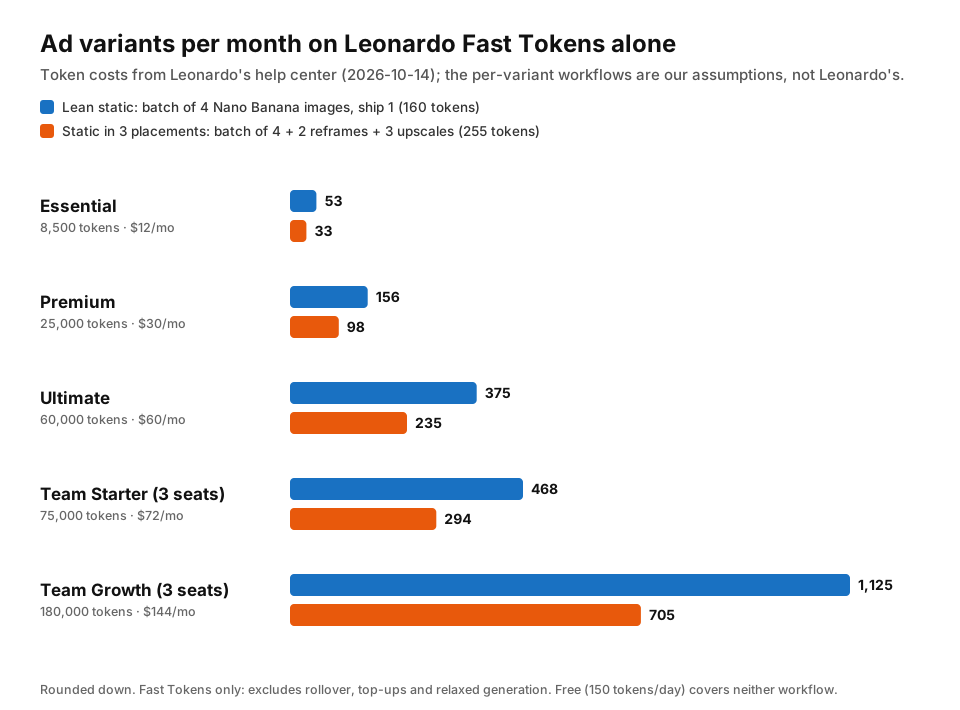
| Plan | Fast Tokens / month | Nano Banana images | A. Lean statics | B. Statics in 3 placements |
|---|---|---|---|---|
| Free | 150 / day | 3 a day | about 28 (batches spread across days) | about 17 |
| Essential | 8,500 | 212 | 53 | 33 |
| Premium | 25,000 | 625 | 156 | 98 |
| Ultimate | 60,000 | 1,500 | 375 | 235 |
| Team Starter, 3 seats | 75,000 | 1,875 | 468 | 294 |
| Team Growth, 3 seats | 180,000 | 4,500 | 1,125 | 705 |
Rounded down to whole variants. Our arithmetic on Leonardo's published token costs, 2026-10-14.
What that works out to per finished variant (scenario B):
| Plan | Monthly billing | Yearly billing | Cost per token (monthly) | One Nano Banana image (monthly) |
|---|---|---|---|---|
| Essential | $0.36 | $0.30 | $0.0014 | $0.056 |
| Premium | $0.31 | $0.24 | $0.0012 | $0.048 |
| Ultimate | $0.26 | $0.20 | $0.0010 | $0.040 |
| Team Starter, 3 seats | $0.24 | — | $0.00096 | $0.038 |
| Team Growth, 3 seats | $0.20 | — | $0.0008 | $0.032 |
Plan price ÷ scenario B variants a month. Assumes you use every Fast Token; unused tokens roll into the bank rather than vanish, up to the cap.
What the arithmetic says:
- Through Leonardo, Nano Banana costs about what Google charges. Google's Gemini API pricing lists Gemini 2.5 Flash Image at $0.039 per image on 2026-10-14. On Leonardo it's $0.032 to $0.056 of plan tokens. You pay a little more on Essential, a little less on Ultimate yearly or Team Growth, and in return you get Leonardo's interface, gallery and the rest of the model shelf.
- Essential is a trial for ad work. 33 finished three-placement statics a month, no relaxed fallback, and two concurrent generations.
- Premium's real value is relaxed mode, if you can stay first-party. If Lucid Origin or Phoenix suits your look, Premium keeps generating after the tokens are gone. If your ads need Nano Banana, GPT Image or Ideogram, Premium is simply 25,000 tokens.
- Team plans are the cheapest tokens on the page. Growth at three seats costs $0.0008 a token, the same as Ultimate billed yearly, but with no top-ups available.
- Video changes everything. Leonardo doesn't publish video token costs on a public page; the help center only says Veo 3 models are limited to paid plans "due to the token cost." Price a few clips in the app before you commit to a plan for video ads.
Which Plan Ad Teams Actually Need
- Testing Leonardo for ads: Free, knowing that generations are public and, under the Terms, owned by Leonardo. 150 tokens a day covers three Nano Banana images.
- A solo marketer making a few dozen statics a month: Essential, billed monthly until you know your volume. Private generations start here.
- A brand whose look works on Leonardo's own models: Premium. Unlimited relaxed images on Lucid and Phoenix are the reason to pay $30.
- Heavy third-party model use or video: Ultimate, or Team Growth if more than one person needs access. Budget for tokens, not relaxed mode, because third-party models never go relaxed.
- Generating from code: the pay-as-you-go API, with the $5 starting credit to price your real requests in the calculator first.
Leonardo stops at the image. If you also need each winner resized to every placement and launched on Meta, Google and TikTok, compare Soku's AI ad generator, which turns a product URL or photos into image and video ads, and the other options on our Leonardo AI alternatives page.
Related Reading
- Leonardo AI alternatives for ad creative: ranked by reason for leaving, including a same-brief cost comparison across nine tools and models.
- Leonardo AI review for marketers: Leonardo scored on nine ad tasks, with what we could and couldn't test.
- Midjourney pricing: the same plan-to-variant conversion for Midjourney's GPU hours.
Frequently Asked Questions
How much does Leonardo AI cost per month in 2026?
Leonardo's pricing page on 2026-10-14 lists four individual plans: Free at $0 with 150 Fast Tokens a day, Essential at $12 a month with 8,500 Fast Tokens, Premium at $30 with 25,000 and Ultimate at $60 with 60,000. Billed yearly, Essential is $10 a month, Premium $24 and Ultimate $48. Team plans are $24 a seat (Starter) or $48 a seat (Growth), shown as $72 and $144 a month for three seats. Prices exclude tax.
How much do you save with Leonardo AI annual billing?
The page advertises up to 20% off for paying yearly. In our check on 2026-10-14, Essential dropped from $12 to $10 a month (about 17% off), Premium from $30 to $24 and Ultimate from $60 to $48 (20% off each). That's $120, $288 and $576 a year by our arithmetic. The Team prices didn't change when we switched the billing toggle.
How many images do Leonardo AI tokens get you?
It depends on the model, because Leonardo says a token doesn't correspond to a specific image or action. Its help center lists Nano Banana at 40 tokens per image, and the older feature table lists a default 768 by 768 image at 1 token. At 40 tokens, Essential's 8,500 monthly tokens cover 212 Nano Banana images, Premium's 25,000 cover 625 and Ultimate's 60,000 cover 1,500. Finished ad variants come out lower once you count candidates, reframes and upscales; the conversion table on this page shows how much lower.
Is Leonardo AI unlimited?
Only in relaxed mode, and only for some models. Premium includes unlimited relaxed image generation on Leonardo's own models such as Lucid Origin, Lucid Realism, Phoenix, FLUX Dev and FLUX Schnell, and Ultimate adds relaxed video on Motion and a few other models. Relaxed generation only starts once your tokens run out and runs at lower priority. Third-party models such as GPT Image, Ideogram, Nano Banana, Seedream, Veo, Kling and Sora always consume tokens on every plan.
How much does the Leonardo AI API cost?
The Leonardo API is pay-as-you-go: no monthly fee, a $5 free starting credit for new API accounts, automatic top-ups, credit that doesn't expire and up to 10 concurrent generations. Per-model dollar rates aren't printed on the public pages; they're in a pricing calculator inside the logged-in app, and each API response includes a cost object. API Custom plans add model-based discounts and higher concurrency through sales.
What are Leonardo AI Top-up Tokens and what do they cost?
Top-up Tokens are one-time token packs for paid individual plans. Leonardo's help center says they never expire, are used after your Fast and Rollover tokens, and only work while you hold an active subscription. They can't be bought on Team plans, where you add seats instead. The pack prices are shown inside the app, not on the public pricing page, so we couldn't verify them for this page.
Can I use Leonardo AI images commercially on the free plan?
Leonardo's pricing FAQ says free users get a non-exclusive, royalty-free licence to use their generations commercially, while Leonardo holds rights to them. Its Terms of Service, last updated January 19, 2026, go further: for free subscribers, ownership of the output vests in Leonardo, and free generations are public. On paid plans, ownership vests in you and you can keep generations private. For ad work, a paid plan is the safer footing.
See also the best Leonardo AI alternatives and our hands-on Leonardo AI review.