 Soku AI
Midjourney Pricing (2026): Which Plan Ad Teams Actually Need
Midjourney pricing read from Midjourney's own plan docs on 2026-10-08: Basic $10, Standard $30, Pro $60, Mega $120 a month (20% off annually), Fast GPU hours, Relax, Stealth, concurrency, the $1M-revenue rule, and a table converting Fast hours into finished ad variants.
Prices and limits last verified against the vendor on 2026-10-08.
Every number in the plan table below was read off Midjourney's own documentation on 2026-10-08. Midjourney publishes its plans in a help-center article rather than on a marketing pricing page, so that article is the primary source. Sources:
- Comparing Midjourney Plans for prices, Fast and Relax time, Stealth, concurrency and usage rights
- GPU Speed (Fast, Relax, Turbo) for the GPU-minute cost of each job type
- Video for video batch costs, resolution and length
- Purchasing Extra Fast Time for top-up rules
- Terms of Service, version effective May 27, 2026, for ownership and the revenue rule
The variant-conversion table and the cost-per-variant figures are ours. Midjourney meters GPU time, not ads; the question an ad team actually asks ("how many finished creatives does $30 buy?") needs assumptions Midjourney doesn't make for you, and we label every one.
The one idea that makes Midjourney's pricing readable: you aren't buying images, you're buying GPU minutes. Midjourney's own analogy is a cell phone data plan. A cheap SD grid costs 0.8 minutes; an HD batch of four videos costs 26. The same plan can mean a thousand images or seven video ads.
The Midjourney Plans
| Basic | Standard | Pro | Mega | |
|---|---|---|---|---|
| Monthly price | $10 | $30 | $60 | $120 |
| Annual price | $96 ($8/mo) | $288 ($24/mo) | $576 ($48/mo) | $1,152 ($96/mo) |
| Fast GPU time | 3.3 hr/mo (200 min) | 15 hr/mo | 30 hr/mo | 60 hr/mo |
| Relax GPU time | None | Unlimited images | Unlimited images and SD video | Unlimited images and SD video |
| Video resolution | SD | SD and HD | SD and HD | SD and HD |
| Extra Fast GPU time | $4/hr | $4/hr | $4/hr | $4/hr |
| Stealth mode | No | No | Yes | Yes |
| Max concurrent image prompts | 3 Fast | 3 Fast or Relax | 12 Fast or 3 Relax | 12 Fast or 3 Relax |
| Max concurrent video prompts | 1 Fast | 3 Fast | 6 Fast or 3 Relax | 12 Fast or 3 Relax |
| Max repeat / permutation size | 4 jobs | 10 jobs | 40 jobs | 40 jobs |
| Max queued jobs | 10 | 10 | 10 (3 Relax videos) | 10 (3 Relax videos) |
| Work solo in Discord DMs | Yes | Yes | Yes | Yes |
| Usage rights | General Commercial Terms | General Commercial Terms | General Commercial Terms | General Commercial Terms |
| Companies over $1M gross revenue | Not permitted | Not permitted | Required tier (or Mega) | Required tier (or Pro) |
Read from Comparing Midjourney Plans on 2026-10-08. Prices in USD as published. The last row restates the plan page's footnote, quoted in full below.
Midjourney's plan-page footnote on usage rights, verbatim:
"If you have subscribed at any point, you are free to use your images/videos in just about any way you want. You must purchase the Pro or Mega plan if you are a company making more than $1,000,000 USD in gross revenue per year."
The Terms of Service (effective May 27, 2026) say the same thing in ownership language: "If you are a company or any employee of a company with more than $1,000,000 USD a year in revenue, you must be subscribed to a 'Pro' or 'Mega' plan to own Your Assets." Note the "or any employee" wording: on our reading, an employee of a large company working on a personal Basic or Standard plan doesn't meet it.
What the Table Doesn't Say Out Loud
1. Annual is 20% off, paid upfront. Midjourney says "You can get a 20% discount on your subscription by committing to an annual plan, where the full year fee is paid upfront." The Terms say you can cancel at any time and won't be charged after the current subscription period ends; read Midjourney's billing help on refunds before paying a year upfront.
2. Fast time doesn't roll over. The GPU speed article: "Each time your subscription renews, your Fast time is reset... any unused time doesn't carry over to the next month." Purchased top-up hours behave differently: they expire 60 days after purchase and only work while you hold an active subscription.
3. Relax is unlimited, not instant. Relax jobs "wait in line to be processed as GPUs free up," with waits Midjourney puts at 0 to 30 minutes, longer for heavy Relax users. For a designer exploring concepts overnight, that's free volume. For a media buyer who needs ten variants before a 2 pm launch, it isn't a plan feature to count on.
4. Turbo isn't an option on the current models. Turbo mode spends Fast time at double the rate for up to four times the speed, but Midjourney's docs say it is not supported in V8.1, and the version comparison chart lists it as unavailable for V8.1 and V8.2, the current default.
5. Stealth is the privacy line, and it sits at $60. Below Pro, Midjourney's Terms say "By default, Your Content is publicly viewable and remixable." For unreleased product shots or a campaign before launch, that's the real reason many brand teams end up on Pro regardless of how many GPU hours they need.
6. Concurrency is where Pro pulls away from Standard. Standard runs 3 image prompts at once; Pro and Mega run 12 in Fast mode. Repeat and permutation jobs, the features that let one prompt fan out into many variations of a headline or color, max out at 10 jobs on Standard and 40 on Pro and Mega. For bulk variant work, Pro's advantage is throughput, not just hours.
What Each Job Costs in GPU Time
Midjourney publishes approximate GPU costs per job type. These are the inputs to everything that follows.
| Job | Approximate GPU cost |
|---|---|
| SD image prompt (a set of four images) | 0.8 min |
| HD image prompt (2048px, V8.1 and later) | 1.3 min |
| Variation | Less than 1 min |
| Creative or Subtle upscale | 2 min |
| Edit model SD prompt | 1 min |
| Edit model HD prompt | 2.3 min |
| Omni Reference prompt (V7) | 2 min |
| SD video, batch of 4 / 2 / 1 | 8 / 4 / 2 min |
| HD video, batch of 4 / 2 / 1 | 26 / 13 / 7 min |
| Video extension (+4 seconds) | Same as the initial video generation |
From GPU Speed and Video, 2026-10-08. "A set of four images" per prompt is from Midjourney's Getting Started Guide. Midjourney calls all of these approximate; upscaling, nonstandard aspect ratios and older model versions can cost more.
Two details matter for ad work. First, Midjourney videos start at 5 seconds and extend in 4-second steps to a 21-second maximum, at 480p (SD) or 720p (HD); a 13- or 17-second cut takes two or three extensions, each billed like a new generation. Second, Midjourney's version notes say inpainting and outpainting on HD images downscale the result to SD, so a reframed HD master needs another upscale to get back to 2048px.
Fast Hours to Ad Variants: The Conversion Table
This is the table Midjourney doesn't publish. It converts each plan's Fast time into finished ad assets under three workflows. The GPU costs come from Midjourney; the workflows are our assumptions. Change them to match how your team actually works.
Assumptions, stated plainly:
- A. Lean static (assumption): one SD prompt produces a usable image in its set of four, then one Creative or Subtle upscale. 0.8 + 2 = 2.8 GPU-min per finished image.
- B. Static shipped in three placements (assumption): three SD prompts of exploration (12 candidates), one Edit model pass to fix a detail or text, two Edit model passes to reframe the winner to two more aspect ratios (for example 1:1 to 4:5 and 9:16), and three upscales for the three finals. 3 × 0.8 + 1 + 2 × 1 + 3 × 2 = 11.4 GPU-min per variant. We assume each reframe is one Edit model SD job; Midjourney doesn't publish a separate price for an outpaint.
- C. Five-second SD video ad (assumption): one SD image prompt for the first frame, then the default batch of four SD videos. 0.8 + 8 = 8.8 GPU-min. Using a batch of one instead (2 min) would quadruple the count but give you one take.
- D. Five-second HD video ad (assumption): one SD image prompt plus a batch of four HD videos. 0.8 + 26 = 26.8 GPU-min. Basic can't generate HD video.
- Every scenario uses Fast time only, ignores rejected jobs, and assumes the first round produces something usable. Real creative work rarely does, so read these as ceilings.
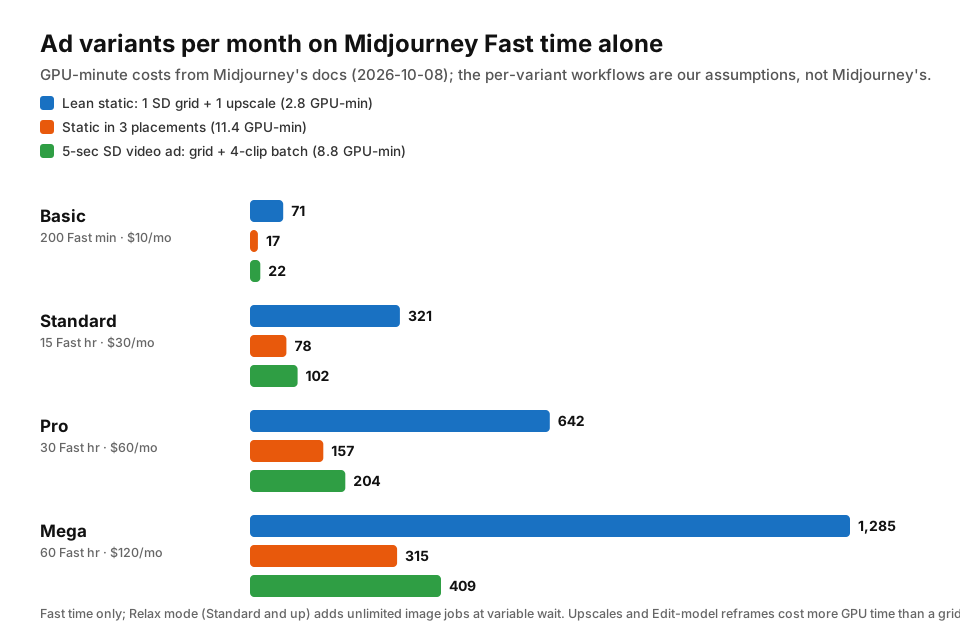
| Plan | Fast GPU min | SD prompts (×4 images) | A. Lean statics | B. Statics in 3 placements | C. SD video ads | D. HD video ads |
|---|---|---|---|---|---|---|
| Basic | 200 | 250 | 71 | 17 | 22 | Not available |
| Standard | 900 | 1,125 | 321 | 78 | 102 | 33 |
| Pro | 1,800 | 2,250 | 642 | 157 | 204 | 67 |
| Mega | 3,600 | 4,500 | 1,285 | 315 | 409 | 134 |
Rounded down to whole variants. Our arithmetic on Midjourney's published GPU costs, 2026-10-08.
What that works out to per finished variant (scenario B):
| Plan | Monthly price per variant | Annual price per variant | At $4/hr top-up rates |
|---|---|---|---|
| Basic | $0.59 | $0.47 | $0.76 |
| Standard | $0.38 | $0.31 | $0.76 |
| Pro | $0.38 | $0.31 | $0.76 |
| Mega | $0.38 | $0.30 | $0.76 |
Plan price ÷ scenario B variants per month. The top-up column is $4 per GPU hour × 11.4 minutes. It ignores Relax time, which is why the subscription rows look cheaper per variant than top-ups.
What the arithmetic says:
- GPU time is cheap; your hours aren't. Even the heavy three-placement workflow comes out under 40 cents of Fast time per variant on Standard and above. The real cost of a Midjourney-based ad workflow is the person prompting, picking, fixing text, reframing, exporting, naming and uploading each asset, none of which the plan prices.
- Upscales and reframes, not generations, eat the budget. In scenario B, the three SD exploration prompts cost 2.4 minutes; the upscales and Edit passes cost 9. If you can ship SD output (1024 × 1024 for a square image in V8.2) on placements that don't need more, you cut the bill by more than half.
- Video is where plan size starts to matter. HD video costs 26 minutes a batch. A Standard plan's 15 hours make about 33 HD video ads, before any extensions. Pro and Mega can push SD video into Relax; Standard can't.
- Basic is a trial, not an ad plan. 200 minutes, no Relax, no Stealth, and it isn't permitted for companies over $1M in revenue.
Which Plan Ad Teams Actually Need
- Solo marketer or small brand under $1M revenue, statics only: Standard. Unlimited Relax images absorb exploration, 15 Fast hours cover finishing, and HD video is available if you need a few clips. Your work will be publicly visible on Midjourney's site, so don't put unreleased products in it.
- Any company over $1M in gross revenue: Pro at minimum. This isn't a GPU decision; Midjourney's Terms make Pro or Mega the condition of owning your Assets. Pro also brings Stealth.
- Agencies and in-house teams producing variants in volume: Pro, for 12 concurrent Fast image jobs and 40-job permutations, then Mega only when the Fast hours themselves run out. Mega doubles the hours and video concurrency but adds no new feature over Pro.
- Video-first paid social: price your HD batches first. If you need more than a few dozen HD clips a month, Mega's 60 hours or $4/hr top-ups are the realistic path, and SD-only Relax video won't meet most placement specs.
- Teams that need to automate generation: no plan. Midjourney's Terms say "You may not use automated tools to access, interact with, or generate Assets through the Services," and its Community Guidelines say it "does not provide an API," apart from rare explicitly granted exceptions. See the Midjourney review for what that means in practice, and Midjourney alternatives for tools with public APIs.
Related Reading
- Midjourney alternatives for ad creative — ranked by reason for leaving: API access, text rendering, brand consistency and resize-to-placement.
- Midjourney review for advertisers — a documented-capability evaluation of text, references, editor, video, Stealth and the automation ban.
- GPT Image 2 vs Nano Banana 2 vs Seedream 5.0 Pro — how API-available image models perform on real ad briefs.
See also the best Midjourney alternatives and our hands-on Midjourney review.