 Soku AI
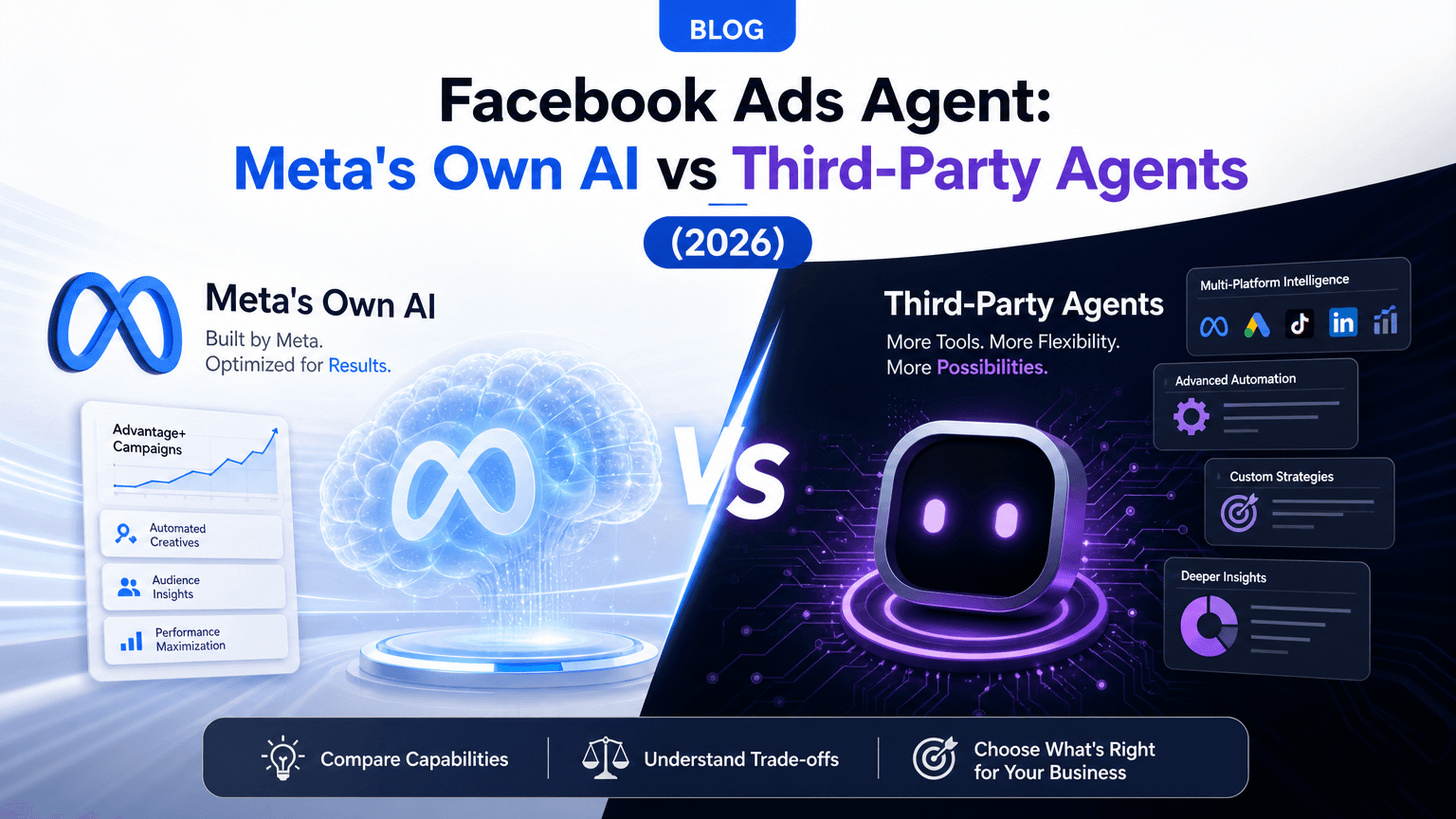
Since Meta shipped its official Ads MCP on April 29, 2026, "which MCP server should I connect?" has a new default answer — but not always. We'll rank the field two ways: first by setup time (the metric everyone leads with), then by what actually matters, with a weighted score that flips the order. The second ranking is the one to act on.
For the full overview of the official server, setup, and how it all fits together, see Meta Ads MCP: The Complete Guide.
Ranked by setup time
Setup-time estimates and capabilities below are drawn from Scalemate's comparison; the scoring and judgment that follow are ours.
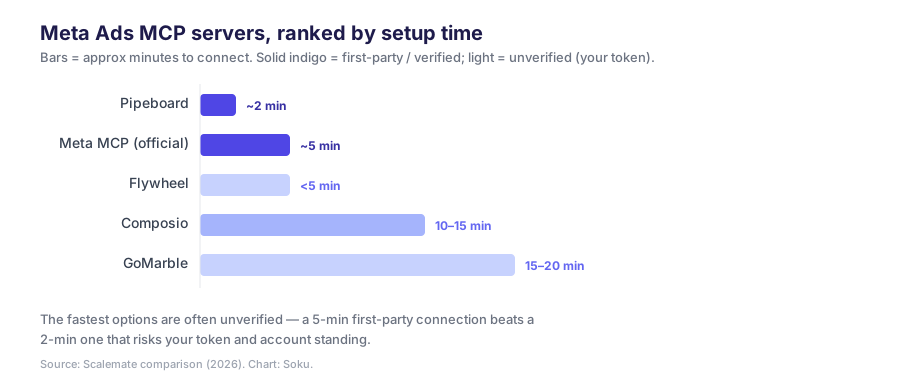
| Rank | Server | Setup time | Auth | Cost | Cross-platform | Verified? |
|---|---|---|---|---|---|---|
| 1 | Pipeboard | <2 min | Remote URL paste | Free tier + paid | Meta + Google | Verified 3rd-party |
| 2 | Meta Ads MCP (official) | ~5 min | Meta Business OAuth | Free (beta) | Meta only | First-party |
| 2 | Flywheel | <5 min | Remote config | Free | Meta + Google | Unverified |
| 4 | Composio | 10–15 min | Account + config | Paid trial | Meta (+200 integrations) | 3rd-party |
| 5 | GoMarble | 15–20 min | Local install + your API creds | Free (MIT, open source) | Meta only | Unverified |
| — | Soku (agent layer) | ~2 min connect | Meta Business OAuth (managed) | Free tier + paid | Meta + Google + more | First-party agent |
(Soku is not a raw MCP server — it's the agent layer that sits on top of one, adding account-to-brand routing and a human gate on every write. It's in the table because it's where multi-brand, write-safe teams actually land; the connector ranking below scores the raw MCP servers.)
Why setup time is the wrong headline metric
You connect a Meta Ads MCP once. Saving three minutes at setup is irrelevant the day after; what you live with is the auth model, the ban risk, and how well it fits an agent workflow. The fastest options are often the riskiest — they're unverified, running on your personal access token, firing unlimited API calls unless you add rate limiting yourself (Scalemate). That's the exact pattern that got agency accounts restricted before the official launch.
Re-ranked by what actually matters
So here's our weighting — what we'd optimize for if we were standing up an agent against Meta Ads today. Setup time is only 10% of it:
| Factor | Weight | Why |
|---|---|---|
| Account safety (verified / first-party) | 35% | A ban wipes out the whole workflow; nothing else matters if you lose the account |
| Tool coverage (read + write depth) | 25% | A reporting-only connector can't run the act half of the loop |
| Agent fit (multi-account, gated writes) | 20% | Agencies need account-to-brand routing and human approval |
| Cost / longevity | 10% | Free + first-party won't disappear or rug a price |
| Setup time | 10% | A one-time cost; matters least |
Score each option 1–5 on the first four factors and the order changes:
| Server | Safety | Coverage | Agent fit | Cost | Setup | Weighted |
|---|---|---|---|---|---|---|
| Meta MCP (official) | 5 | 5 | 3 | 5 | 4 | 4.55 |
| Pipeboard | 4 | 3 | 4 | 4 | 5 | 3.85 |
| Composio | 3 | 4 | 4 | 3 | 2 | 3.35 |
| GoMarble | 2 | 4 | 3 | 5 | 1 | 2.90 |
| Flywheel | 2 | 3 | 3 | 4 | 4 | 2.85 |
The official server wins once safety and coverage carry their real weight — the 3 minutes Pipeboard saves can't outrun first-party verification and the full 29-tool read+write set. Pipeboard stays the pick when you genuinely need Meta and Google in one connector.
Verified vs. unverified: the split that overrides speed
- First-party / verified (safe from ban risk): the official Meta MCP runs on Meta's own credentials; Pipeboard operates as a verified third party with scoped permissions.
- Unverified (credential-based risk): Flywheel and GoMarble require your personal token and leave throttling to you.
If you take one thing from this post: a 5-minute first-party connection beats a 2-minute one that puts your token and account standing on the line.
Pick by profile
- Solo buyer, one Meta account: the official MCP — free, zero config, no ban risk. (Setup steps →)
- Meta + Google in one connector, fastest start: Pipeboard (<2 min, verified, both platforms).
- Developer who wants to read the source: GoMarble (open-source; accept the setup cost and self-throttling).
- Workflow chaining across many tools: Composio (Meta as one of 200+ integrations).
- Agency running many brands / clients: none of the raw connectors solve account-to-brand routing — that's the agent layer. Soku wraps the official connector with per-brand account mapping and a human gate on every write (more below).
Where the agent layer fits
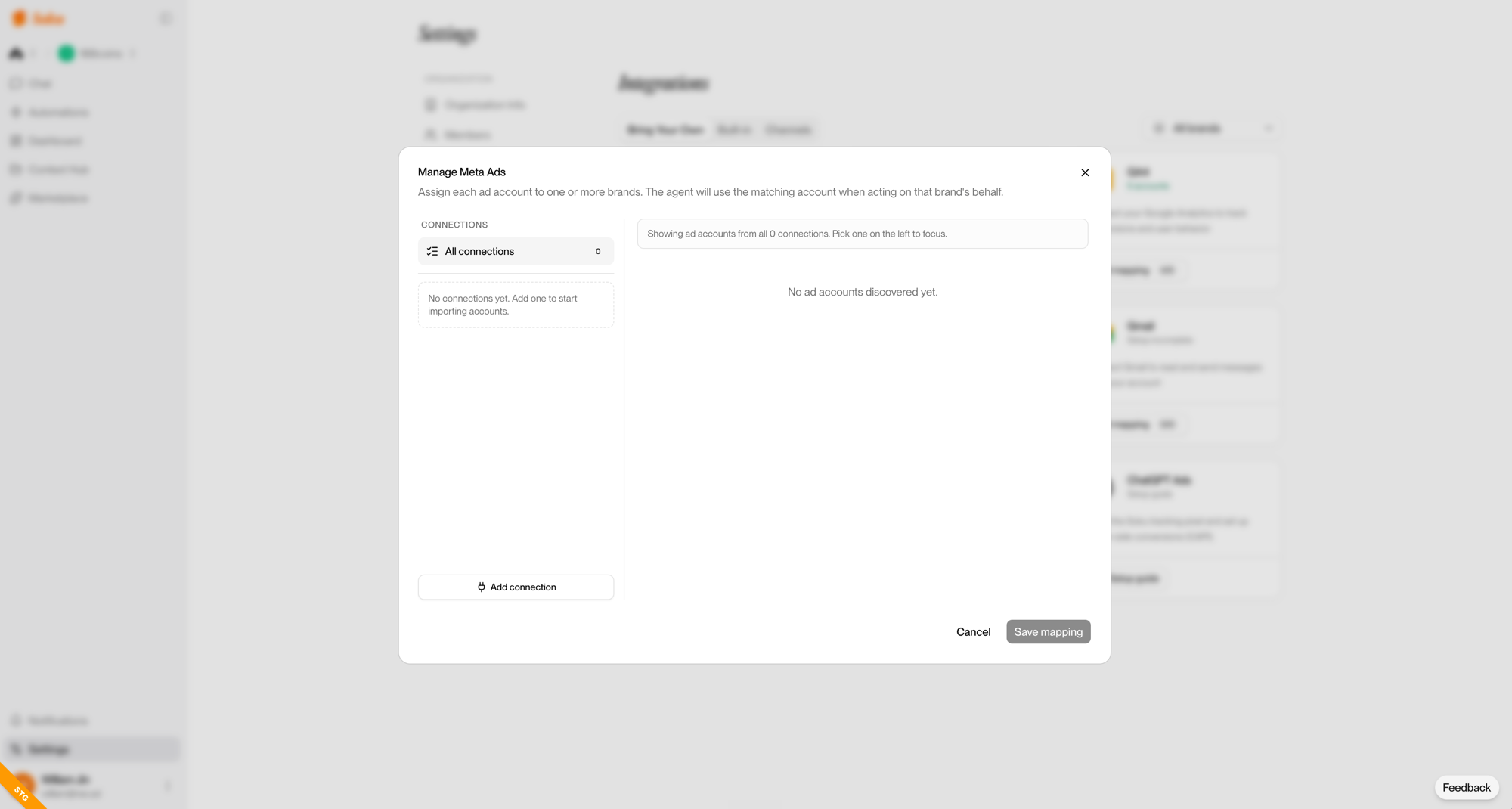
A connector gives an assistant the Meta verbs; it doesn't decide which account belongs to which client, keep a human gate on spend, or run unattended safely. That's the layer above the MCP — and it's exactly the "agent fit" axis the raw connectors score low on. In Soku you connect Meta once and map each ad account to one or more brands, so one agent operates a whole client roster without ever pointing the wrong account at the wrong brand:
More on that model in What Meta's Official MCP Means for AI Ad Teams, and to connect through Claude specifically see How to Connect Claude to Meta Ads.
FAQ
What's the fastest Meta Ads MCP to set up?
Pipeboard (<2 minutes, remote URL paste). But the official Meta MCP (~5 minutes) is first-party and ban-proof, which scores higher on every axis that outlasts day one.
Is the official Meta MCP better than third-party connectors?
On our weighted score, yes (4.55 vs 3.85 for the runner-up) — free, OAuth, no ban risk, full read+write. Third-party connectors still win for Meta + Google in one connection (Pipeboard) or open-source transparency (GoMarble).
Why are some "free" connectors riskier?
Unverified connectors (Flywheel, GoMarble) use your personal access token and fire unthrottled API calls unless you add limits — the pattern behind past account restrictions.
Which should an agency use?
A verified/first-party connector, plus an agent layer on top for account-to-brand routing and human approval gates — raw connectors don't handle multi-brand.