 Soku AI

Creative is the part of a Google Ads audit where most reports go soft. Structure and search terms produce hard numbers; creative sections tend to produce adjectives — "ads feel stale," "copy could be stronger." Adjectives do not survive contact with a budget meeting.
But there is a rigorous version of a creative audit, built on a simple boundary: audit structure and measurable decay, not taste. Whether a headline is compelling is opinion; whether an ad group has one disapproved RSA and no backup, whether an RSA has 4 headlines when the system can use 15, whether an ad's CPC has risen 30% while its frequency climbed past 4 — those are facts, pulled from the API, scored against thresholds.
That boundary is a hard rule in how Soku's AI agent audits creative: it never speculates about whether copy is "good" — it audits counts, coverage, policy status, strength ratings, and decay signals, and leaves creative judgment to the humans who own the brand. This guide covers both halves of the discipline — the structural checks for Google Search and PMax, and the fatigue-detection chain — with the exact thresholds. It is part of our step-by-step series on auditing a Google Ads account with an AI agent.
Part 1 — The structural audit: does Google have enough to work with?
Modern Google Ads creative is combinatorial. You supply assets — headlines, descriptions, images, videos — and the system assembles ads per auction. So the first audit question is not "are the ads good?" but "have we supplied enough raw material, and is any of it broken?" Each check below produces a PASS / WARN / FAIL verdict with severity.
Check 1 — Disapproved ads. The audit starts with policy status because a disapproved ad is a zero, not a discount. Zero disapproved RSAs passes; one or two warns; three or more fails — and any disapproved RSA that is the only ad in its ad group is an automatic high-severity fail, because that ad group has silently stopped serving. Findings are grouped by policy topic (trademark, misleading claims, restricted content) so related violations get fixed in one batch instead of one at a time.
Check 2 — RSA count per ad group. At least 2 enabled RSAs per ad group passes; exactly 1 warns; an active ad group with 0 fails. With a single RSA there is no intra-ad-group competition — Google rotates between RSAs and shifts serve toward the stronger one over time, and one ad means nothing to rotate toward.
Check 3 — Headline coverage. 8+ unique headlines per RSA passes, with 12–15 the ideal range; 3–7 warns; fewer than 3 fails. Headlines are the combinatorial fuel — a 3-headline RSA offers the system almost nothing to test. Coverage also has a quality dimension the count alone misses: headlines should span distinct angles (feature, benefit, urgency, proof), because ten rephrasings of one sentence are one headline wearing ten hats.
Check 4 — Ad Strength, read honestly. Every RSA carries Google's Poor / Average / Good / Excellent rating. Any Poor fails the check; any Average warns. But an honest audit is careful about what this rating is. Google reports that advertisers improving Ad Strength from Poor to Excellent see 15% more conversions on average. Independent research is far cooler: an Optmyzr study across roughly 20,000 accounts found no strong relationship between Ad Strength and actual performance — the higher-strength RSA in an ad group won more impressions only 56.8% of the time, and their follow-up work argues Ad Strength measures asset completeness and variety, not ad quality.
The audit therefore treats Ad Strength as a completeness signal, not a performance grade: a Poor rating reliably means assets are missing, too few, or too similar — which is worth fixing — while chasing Excellent for its own sake is cargo-culting. The genuinely useful API field is action_items, which states per RSA what Google thinks is missing ("add more headlines," "make headlines more unique"); the agent reports those specifics rather than just the label, and cross-references the account's recommendations feed sorted by projected impact.
Check 5 — Extensions (assets). Sitelinks and callouts: 4+ of each per campaign passes, 1–3 warns, zero fails — plus at least one structured snippet set, and image assets enabled on Search. Missing extensions shrink your eligible ad formats and real estate; they are also the fastest fixes in the entire audit, minutes of work with no downside.
Check 6 — PMax asset group health. For accounts running Performance Max (skipped cleanly when not), per asset group: 20+ images passes (5–19 warns, fewer than 5 fails); 5+ logos; 5+ native videos with all three aspect ratios (16:9, 1:1, 9:16) present; and at least 2 asset groups per campaign. The native-video check has teeth: an asset group with zero uploaded videos gets flagged even if Google auto-generated videos from your images, because auto-generated video consistently underperforms native. PMax campaigns should also carry campaign-level negative keywords — without them there is no query-level control at all (the search terms audit covers where negatives belong).
One reporting rule threads through all six checks: UNVERIFIED is not FAIL. When an API call cannot retrieve a field, the agent marks the check unverified and says what to look at manually — it never counts a data-retrieval failure as an account failure. Audit scores inflated by missing data are how reports lose credibility.
Part 2 — The fatigue audit: is the creative wearing out?
Structure asks whether you gave the system enough material. Fatigue asks whether the material still works. Fatigue analysis matters most on audience-driven placements (Demand Gen, video, and paid social — Soku runs the same rubric on Meta accounts), and the discipline transfers: fatigue is a chain of evidence, not a single metric.
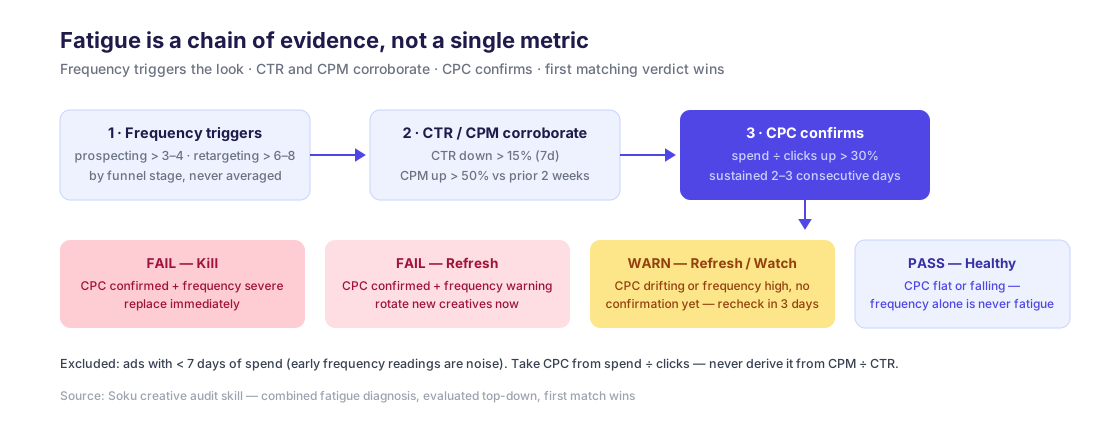
The mistake almost everyone makes is treating one number — usually frequency — as a verdict. High frequency with stable performance is just efficient reach. The agent's rubric separates three roles:
- Frequency triggers the look. For prospecting (cold) audiences: under 3 is healthy, 3–4 is a warning, above 4 is severe. For retargeting (warm) audiences: under 6 healthy, 6–8 warning, above 8 severe.
- CTR and CPM corroborate. CTR declining more than 15% week-over-week, or CPM rising more than 50% versus the prior two weeks for 2–3 consecutive days — the pattern of an audience that has seen the ad and stopped responding, forcing the system to pay more for worse attention.
- CPC confirms. Cost per click rising more than 30% versus the prior two weeks, sustained over consecutive days, is the confirmation — proof that attention actually got more expensive, not just noisier.
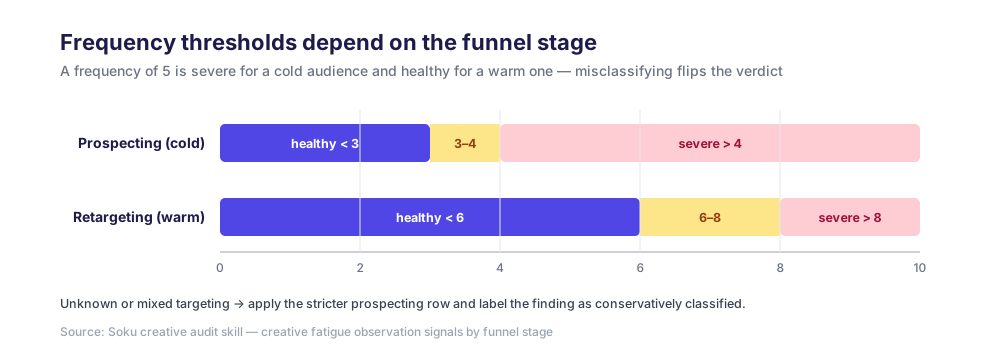
The prospecting/retargeting split is not pedantry — a frequency of 5 is severe for a cold audience and completely healthy for a warm one, so misclassifying the audience flips the verdict. When the funnel stage cannot be determined, the agent applies the stricter prospecting thresholds and labels the finding as conservatively classified, rather than guessing.
The signals combine into one decision table, evaluated top-down, first match wins:
| Evidence | Verdict | Action |
|---|---|---|
| CPC confirmed rising + frequency severe | FAIL | Kill — the creative is exhausted; replace it |
| CPC confirmed rising + frequency at warning | FAIL | Refresh now — confirmed fatigue at lower saturation |
| CPC drifting up + (CTR down > 15% or CPM up > 50%) | WARN | Refresh soon — one to two weeks of life left |
| Frequency at warning/severe but CPC flat | WARN | Watch — recheck in 3 days; saturation without damage yet |
| Everything else | PASS | Healthy — frequency alone is never fatigue |
Two implementation notes that decide whether this chain produces sense or nonsense:
- Trend comparisons need daily data. The 2–3-day-versus-prior-two-weeks comparisons require daily insight buckets; a single 30-day aggregate cannot show a recent CPM spike. The agent pulls daily series for exactly this reason.
- Take CPC directly from spend / clicks. Deriving CPC from CPM and CTR is a classic unit trap: the correct identity is CPC = CPM / (CTR × 1000) with CTR as a ratio, and the naive CPM / CTR division overstates CPC by orders of magnitude — which triggers false Kill verdicts on healthy ads.
Two companion checks round out the fatigue picture. Spend concentration: when one ad captures more than 80% of its ad set's spend, testing has effectively stopped — if that ad then fatigues, there is no proven successor, so the finding is to re-test alternatives before the incumbent dies. Newly launched ads are excluded: anything under 7 days of spend is outside fatigue analysis entirely, because early frequency readings are meaningless and flagging them teaches teams to ignore the audit.
And the refresh discipline itself: rotate at least two new creatives into a fatigued ad set, keep the winning format, change the hook and visual — and do not pause the fatigued ad until the replacements have proven themselves. Pausing the only working ad on the day you launch untested replacements converts a fatigue problem into a revenue problem.
Running the creative audit with an AI agent
Assembled, the audit is: policy status, RSA counts, headline coverage, Ad Strength action items, extension coverage, and PMax asset health on the structural side; frequency-CTR-CPM-CPC chains per ad on the fatigue side — every ad, not a sample, with each finding carrying its evidence and a PASS / WARN / FAIL verdict. Manually that is an afternoon of UI archaeology per account; Soku's agent runs it in minutes as a read-only skill — it never pauses, edits, or creates ads; it produces the fix list and humans act on it. Connect an account through the Google Ads integration and ask for a creative audit, or build the same pulls yourself via the Google Ads MCP guide.
Creative findings rarely travel alone: a below-average expected-CTR component in the Quality Score audit is frequently the same problem as thin headline coverage here, and weak conversion on healthy clicks often belongs to the landing page rather than the ad. For the full eight-step audit surface, start from the step-by-step Google Ads audit guide.
FAQ
Should I optimize every RSA to Excellent Ad Strength?
Fix Poor and Average ratings by addressing their action items — those reliably indicate missing or redundant assets. But do not chase Excellent as a KPI: independent data shows the rating is about asset completeness, not performance. Judge ads on conversions and cost, not the label.
Does creative fatigue apply to Search ads?
Far less. Search ads are shown against intent, not pushed at an audience, so frequency-driven fatigue is mostly an audience-placement phenomenon (Demand Gen, video, social). On Search, "fatigue" usually shows up instead as gradual CTR erosion against competitors refreshing their copy — caught by the CTR corroboration signal, not the frequency trigger.
How many creatives should be live per ad group or ad set?
On Search: at least 2 RSAs per ad group, each with 8–15 distinct headlines. On audience placements: at least 2–3 creatives with genuinely different hooks, watched via the spend-concentration check so one incumbent does not silently absorb all delivery.
How often should the creative audit run?
Structural checks: monthly, and after any campaign build or policy email. Fatigue checks: weekly on audience-driven placements — fatigue develops on a weekly timescale, and the Watch verdicts explicitly ask for a 3-day recheck.
Can the agent write new ads too?
Generating creative is a separate job from auditing it — deliberately. The audit is read-only and evidence-based; generation is a creative workflow with its own approval loop. Keeping them separate means the audit's verdicts stay uncontaminated by the agent grading its own homework.