 Soku AI

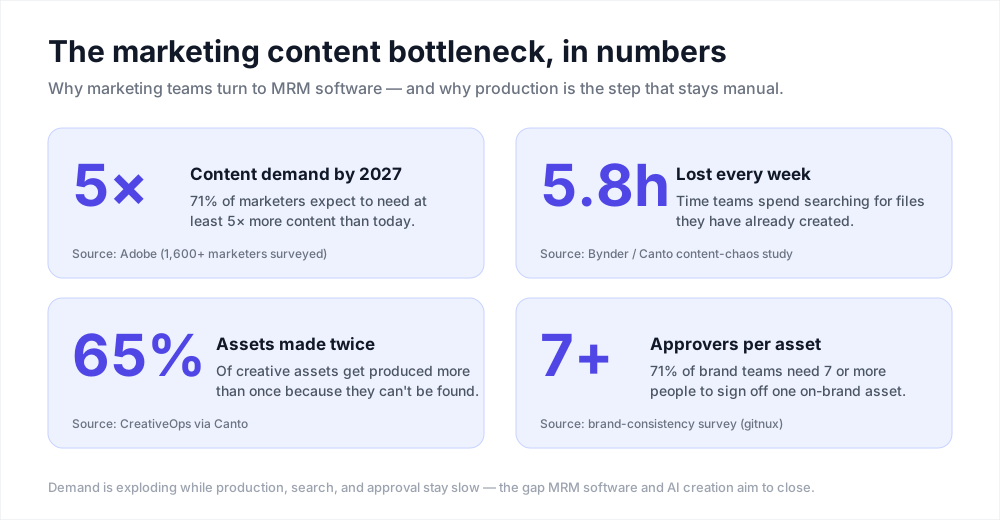
Marketing teams are being asked to produce more than ever — and most of the machinery around them was not built for the volume. 71% of marketers expect to need at least 5× more content by 2027, while the average marketing team still loses 5.8 hours a week just searching for files it already created. Somewhere between the campaign plan and the published ad, work piles up: assets get recreated, approvals stall, and budgets blur.
Marketing resource management (MRM) software is the category built to fix that — a single system to plan, budget, produce, govern, and measure marketing work. This guide explains what MRM software actually does, how it differs from the tools it's often confused with, the leading platforms by team size, and — the part most buyer's guides skip — where the 2026 shift to AI creative production fits into the picture.
What is marketing resource management software?
Marketing resource management is the practice of planning, allocating, and tracking everything that powers marketing operations — people, budgets, assets, and workflows. MRM software brings all of that into one platform, what Gartner historically described as helping organizations "plan, budget, execute and measure the impact of marketing initiatives, content, campaigns and resources."
In practice, MRM platforms manage four kinds of resources:
- People — team capacity, utilization, and skills across projects.
- Budgets — campaign spend, cost allocation, and ROI tracking (the "marketing resource planning," or MRP, layer).
- Assets — images, video, templates, and brand files, with version control and search.
- Workflows — intake requests, production schedules, review cycles, and approvals.
Think of it as the system of record for marketing operations: the place where a campaign goes from a line in a budget to a planned project to an approved, on-brand asset that ships. Most full MRM suites bundle planning and budgeting, project management, content production, workflow automation, digital asset management (DAM), and reporting into one stack.
MRM vs. DAM vs. project management: clearing up the confusion
MRM gets conflated with two adjacent categories. The distinction matters when you're choosing what to buy.
- MRM vs. DAM. A digital asset management system manages what you create — centralized storage, versioning, and distribution of finished assets. MRM manages how you create it — the planning, budgeting, and workflow around the work. As Bynder puts it, "DAM manages what you create; MRM manages how you create it." Many teams run both, and most enterprise MRM suites include a DAM module.
- MRM vs. project management. Tools like Asana, monday.com, and Wrike handle tasks and collaboration, but lack the marketing-specific campaign planning and budget tracking that MRM adds. Smaller teams often start in a PM tool and outgrow it.
- MRM vs. work management. Work management covers how work gets coordinated — timelines, approvals, collaboration. MRM is a superset that layers planning, budgeting, and brand governance on top.
A quick gut check: if your problem is "I can't find the asset," you may need a DAM. If it's "I can't see what we're spending or where work is stuck," you need MRM.
The MRM market in 2026
MRM is a mature but quietly growing category. Analyst estimates of its size vary — Grand View Research puts the 2024 market at $4.91B growing ~12.4% a year, while Fortune Business Insights estimates $5.61B in 2025 rising to $6.31B in 2026 at a 12.57% CAGR. The consensus is a roughly $5–6B market growing at a low-double-digit clip, explicitly driven by data-driven marketing and AI.
One credibility note worth knowing before you read older "best MRM" lists: Gartner ran a Magic Quadrant for MRM from 2001 until 2017, then retired it and reframed the space. Forrester picked it up with MRM Waves in 2018 and 2020, and Gartner today publishes a Magic Quadrant for Marketing Work Management Platforms instead. If a vendor is citing a "Gartner MRM Magic Quadrant," it's dated.
Core capabilities to compare
When you evaluate MRM software, you're really comparing seven capability areas. Use these as your scorecard:
- Planning & budgeting (MRP) — allocate people, time, and money; track spend and ROI.
- Workflow & approval automation — routing, proofing, review cycles, sign-offs.
- Digital asset management — storage, versioning, search, distribution.
- Brand governance — guideline enforcement, templates, rights and compliance.
- Project & resource management — tasks, capacity, calendars.
- Reporting & analytics — campaign performance and utilization dashboards.
- Integrations — Creative Cloud, CMS/DXP, and the rest of your martech stack.
That last point is not a footnote. The martech landscape has exploded from 150 solutions in 2011 to more than 15,000 in 2025 — an MRM that doesn't integrate cleanly just becomes one more silo.

The best marketing resource management software in 2026
There's no single "best" MRM — the right tool depends heavily on team size and whether you already live inside a particular ecosystem. Here are the leading options, with an honest read on each.
Adobe Workfront — best for Adobe-stack enterprises
The enterprise default for teams already on Adobe Experience Cloud. Adobe acquired Workfront for $1.5B in 2020 and integrated it tightly with Creative Cloud and AEM Assets. Strength: deep Adobe integration, request intake, and proofing at scale. Limitation: opaque pricing, and most of its value assumes you own the broader Adobe stack. Best for: 500–2,000+ user organizations standardized on Adobe.
Aprimo — best for large brands needing AI-rich DAM + MRM
A legacy enterprise MRM and DAM platform built for very large brands. Aprimo was named a Leader in the 2025 Gartner Magic Quadrant for DAM, with AI auto-tagging and semantic search. Strength: depth in workflow and AI-powered asset operations. Limitation: dated UI and heavy implementation — the full suite runs roughly $75,000–$300,000+ a year with 6–12 month rollouts. Best for: 500+ user enterprises that can absorb the cost.
Wrike — best mid-market MRM
A credible mid-market option with proofing, request intake, custom workflows, and real-time analytics. Strength: flexible campaign planning without enterprise-suite overhead. Limitation: ownership churn (Citrix acquired it for $2.25B in 2021, later spun into Cloud Software Group) has slowed its roadmap. Best for: 25–500 user marketing teams.
Bynder & Brandfolder — best for DAM-first teams
Both are DAM-led platforms with MRM-adjacent modules. Bynder targets enterprise brand governance (SMB contracts around $33,000/yr, enterprise around $125,000/yr); Brandfolder, owned by Smartsheet, pairs intuitive asset organization with Smartsheet's work management (median spend around $34,000/yr). Best for: teams whose primary pain is asset sprawl rather than budgeting.
Lytho — best for in-house creative teams
The product of the inMotionNow + Lytho merger, focused on creative operations. Best for: in-house creative departments that are the bottleneck in their content pipeline, typically 25–100 users.
Asana & monday.com — best for small teams starting out
Work-management tools frequently used as lightweight MRM. Strength: fast to adopt, inexpensive. Limitation: no native budgeting/MRP or deep brand governance. Best for: under-25-user teams not yet ready for a full MRM.
Optimizely (Welcome) & Uptempo (Allocadia) — specialists
Optimizely's Welcome (formerly NewsCred) is a content marketing platform strongest when paired with Optimizely's DXP. Uptempo (the rebranded Allocadia) is MRP-first — marketing planning, budgeting, and spend management for CMOs who need plan-to-spend visibility more than DAM or workflow.
MRM software compared
| Platform | Best for | Strength | Pricing (directional) |
|---|---|---|---|
| Adobe Workfront | Adobe-stack enterprises | Deep Adobe integration, scale | Enterprise, contact sales |
| Aprimo | Large brands, AI-rich DAM | Workflow + AI asset ops | ~$75K–$300K+/yr |
| Wrike | Mid-market | Flexible campaign workflows | Per-user tiers |
| Bynder | DAM-first enterprise | Brand governance | ~$33K–$125K/yr |
| Brandfolder | DAM + Smartsheet teams | Asset organization | ~$34K/yr median |
| Lytho | In-house creative ops | Creative bottleneck relief | Mid-market |
| Asana / monday.com | Small teams | Easy, affordable | ~$50–$100/user/mo |
| Uptempo | CMO budgeting | Planning & spend | Enterprise |
The 2026 shift: AI and the content supply chain
The biggest change in this category isn't a new vendor — it's where AI is being inserted. The industry term of art is the content supply chain: the end-to-end process of planning, creating, managing, activating, and measuring content. Adobe, Aprimo, and others now frame MRM through this lens, and AI is reshaping every stage:
- AI content and creative generation — generative writing, image, and video, with 50% of senior executives reporting faster ideation and production.
- Automated metadata for DAM — AI auto-tagging and visual search that make assets findable the moment they're uploaded.
- Agentic workflows — a shift from static, linear routing toward systems where humans guide strategy and AI agents orchestrate execution.
Here's the gap that exposes. MRM and content-supply-chain platforms are excellent at orchestrating the process — planning, governance, approval, reporting. But the actual production of high-volume, on-brand, channel-specific ad creative remains the manual bottleneck. It's why 47% of marketers say a single piece of content involves 51–200 people, and why so many assets get made twice. The workflow makes the bottleneck visible; it doesn't make the creative.
Where an AI creative engine fits
This is where it's worth being precise about tools like Soku AI. Soku is not an MRM. It doesn't own your marketing budget, your master calendar, or your brand-asset library — and it shouldn't pretend to. It's the AI creative-production layer that plugs into the stack an MRM governs.
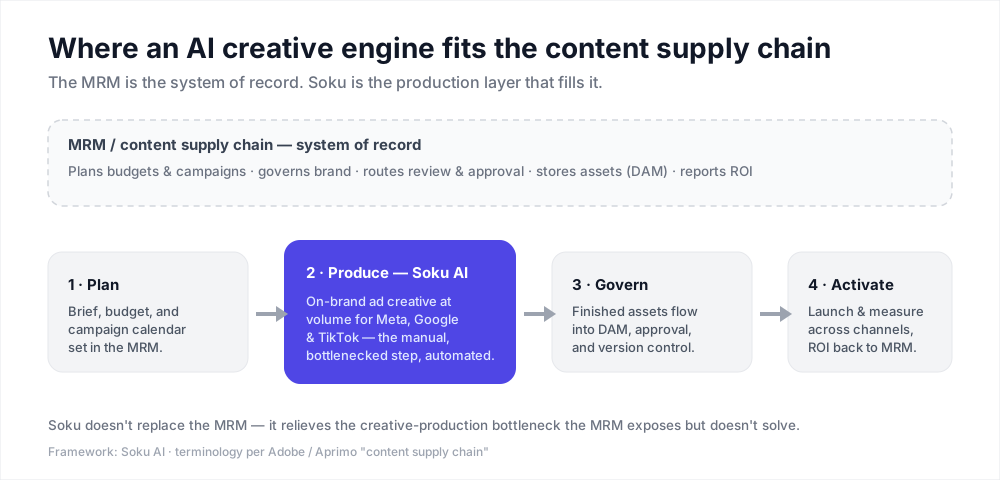
In a modern stack, the division of labor looks like this:
- The MRM plans and governs — budgets, calendar, brand rules, approval routing, and ROI reporting stay in the system of record.
- Soku produces the creative — it generates on-brand ad-creative variants at volume for Meta, Google, and TikTok, attacking the upstream cause of the bottleneck: not enough on-brand variations produced fast enough.
- Finished assets flow back into governance — Soku's output moves into the DAM and approval flow the MRM controls, so version control, sign-off, and reporting stay where they belong.
The point isn't to replace your MRM — it's to fill it. As content demand climbs toward 5×, the constraint shifts from managing the work to producing enough of it. An AI creative engine is how the content supply chain keeps up without adding headcount for every new channel and variant.
How to choose
A practical decision path:
- Under ~25 marketing users: start with a work-management tool (Asana, Wrike Team) and a DAM only if asset sprawl is real. Full MRM is likely overkill.
- 25–100 users with a creative bottleneck: look at Wrike or Lytho; add an AI creative engine to relieve production volume.
- 100–500 users: Wrike Business, Bynder MRM, or Welcome, depending on whether your pain is workflow, assets, or content planning.
- 500+ users on Adobe: Workfront is the path of least resistance. Otherwise, evaluate Aprimo.
- Across all sizes: if your real constraint is producing enough on-brand creative — not coordinating it — pair whatever MRM you choose with an AI creative layer rather than buying a bigger suite.
Buy MRM when spreadsheets and a project tool stop scaling — when asset sprawl, multi-week approvals, brand drift, or budget blind spots start costing real money. (Brand inconsistency and compliance gaps alone run around $1.4M a year on average.) But match the tool to the bottleneck. Many teams buy a bigger MRM hoping it will produce more content, when the missing piece is a production engine, not another system of record.
Frequently asked questions
What is MRM software?
Marketing resource management software centralizes marketing planning, budgeting, workflows, approvals, asset management, and reporting in one platform — managing people, budgets, assets, and workflows as a single system of record.
What's the difference between MRM and DAM?
DAM manages what you create — storage, versioning, and distribution of finished assets. MRM manages how you create it — planning, budgeting, and workflow. MRM is broader, and many teams run both; most MRM suites include a DAM module.
MRM vs. project management — aren't they the same?
No. Project and work-management tools handle tasks and collaboration but lack the marketing-specific campaign planning and budget tracking MRM adds. Small teams often start in a PM tool and graduate to MRM as they scale.
Do you need MRM software?
It pays off once asset sprawl, slow multi-stakeholder approvals, brand inconsistency, or budget-visibility gaps appear — i.e., when a spreadsheet and a project tool stop scaling. Smaller teams can start with Asana or Wrike.
What's the best MRM software for small teams?
Under ~25 marketing users, Asana Marketing or Wrike Team are practical starting points; entry-level MRM runs roughly $50–$100 per user per month. Add a DAM or AI creative engine as specific pains emerge.
How much does MRM software cost?
A wide range: basic tools around $50–$100 per user per month for small teams; mid-market suites in the low-thousands per month; enterprise platforms like Aprimo at $75,000–$300,000+ a year with multi-month implementations.
Is the Gartner Magic Quadrant for MRM still published?
No. Gartner ran an MRM Magic Quadrant from 2001 to 2017, then retired it; the successor is the Magic Quadrant for Marketing Work Management Platforms. Forrester published MRM Waves in 2018 and 2020.
Does AI replace MRM software?
No — AI is being embedded into MRM (auto-tagging, generative creation, agentic routing) rather than replacing it. The system-of-record role persists; AI accelerates findability and, with tools like Soku, the production of on-brand creative that MRM workflows depend on.