 Soku AI
If you run marketing for a brand in 2026, "AI marketing agency" has probably landed in your inbox a dozen times — usually attached to a promise that sounds too good to be true: the same campaigns, 50–80% cheaper, launched in days instead of months. This guide is written for the person who has to decide whether that promise is real, and whether to act on it.
This is the pillar for our AI-marketing-agency cluster. It targets the head term "ai marketing agency" and gives you the full map: what the model is, what these agencies actually do, how they differ from a traditional shop, what they cost, and how to choose one — or decide you shouldn't hire one at all. Where a question deserves a full treatment, we send you to a dedicated deep dive:
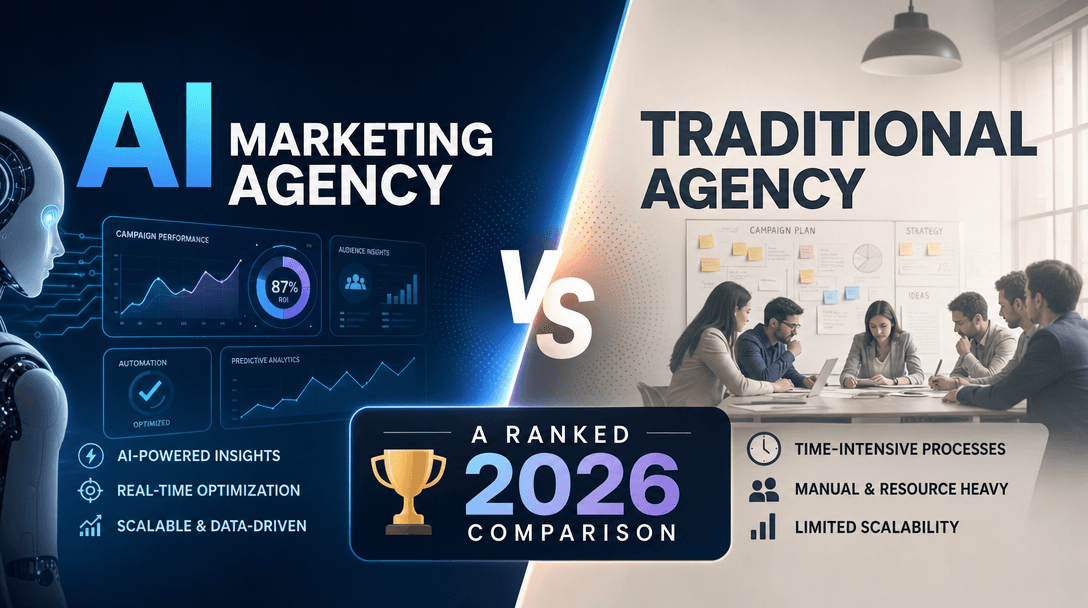
- For the side-by-side trade-offs, see AI Marketing Agency vs Traditional Agency (ranked by speed, cost, transparency, and scope).
- For real 2026 numbers, see How Much Does an AI Marketing Agency Cost? (retainer vs performance vs hybrid).
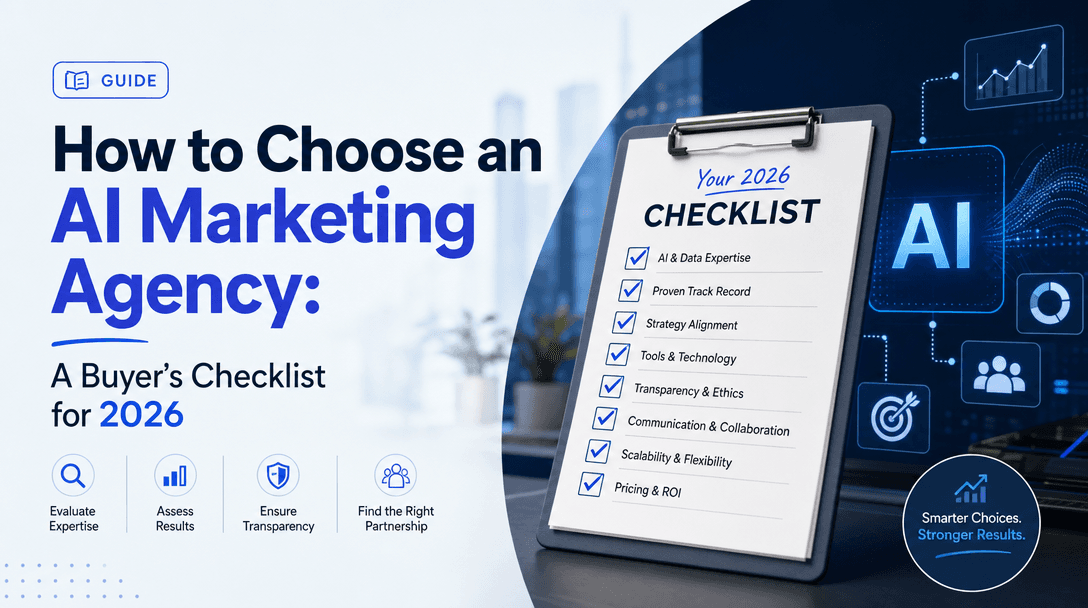
- For a vetting framework, see How to Choose an AI Marketing Agency (a weighted buyer's checklist).
One disclosure up front: Soku is an AI ad-automation agent, so we describe the operating model from the inside. We've tried to keep the analysis honest — including where an AI agency is the wrong call.
What is an AI marketing agency?
An AI marketing agency is a marketing service where AI agents — not just humans using AI tools — do the bulk of the execution: planning campaigns, generating creative, launching and adjusting ads, and reporting. A human still owns strategy and sign-off, but the day-to-day operating work runs on software.
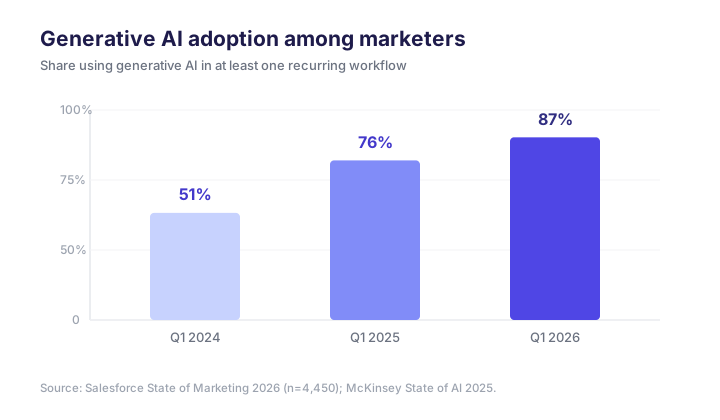
That distinction matters, because almost every agency now "uses AI." 87% of marketers use generative AI in at least one recurring workflow, up from 51% just two years earlier, per Salesforce's State of Marketing 2026 survey of 4,450 marketers. A traditional agency with a ChatGPT subscription is not an AI marketing agency. The label only means something when AI is the operating system of the delivery — when adding a client costs mostly software and a few hours of human review, not another full-time hire.
The category exists because the underlying capability crossed a threshold. McKinsey's State of AI found 88% of organizations now report regular AI use in at least one business function, with marketing and sales among the functions where AI is most often deployed. The tools got good enough that a small team plus agents can now produce what used to require a floor of specialists.
What an AI marketing agency actually does
The service surface looks similar to a normal agency — the difference is who (or what) does the work and how often. Typical scope:
- Paid media — building, launching, and continuously optimizing campaigns across Google, Meta, TikTok, and emerging surfaces like ChatGPT Ads.
- Creative production — generating and testing dozens of ad variants (copy, images, video cuts) instead of shipping two and hoping.
- SEO and GEO content — producing and updating pages at volume, increasingly optimized for AI answer engines (generative engine optimization), not just Google.
- Analytics and reporting — always-on dashboards and anomaly detection rather than a monthly PDF.
- Lifecycle and CRM — automated segmentation, personalization, and response.
The tell is cadence. A human media buyer reviews accounts once or twice a day. An agent can run the optimization loop every 15 to 60 minutes, around the clock — coverage no retainer full of humans can match. That's also why AI agencies can profitably serve smaller accounts: the marginal cost of another client is close to the cost of the software.

The four types you'll actually encounter
"AI marketing agency" is a label four very different things wear. Knowing which one you're talking to prevents most bad fits:
- AI-native full-service agency — built from the ground up around agents, offering paid media, creative, content, and analytics as a managed service. Agents do the execution; a lean human team owns strategy. This is the category in its purest form and where the cost and speed advantages are largest.
- AI point solution — a specialist that does one thing with AI extremely well (creative generation, or paid-social optimization, or SEO/GEO content) rather than the whole funnel. Great when you have a specific gap; not a full agency replacement.
- Traditional agency with AI bolted on — an established shop that has added AI tools to a human-led delivery model. Legitimate, but priced and paced like a traditional agency, because it still is one. The tell, again, is how much runs autonomously versus how much is a human using a tool.
- Self-serve AI platform — software you (or your team) operate directly, with little or no managed service. The cheapest option and the most control, if you have someone to run it. This is closer to hiring a tool than an agency.
Most confusion in this market comes from a type-3 or type-4 vendor marketing itself with type-1 language. The questions in our how to choose guide are designed to place a vendor in the right box quickly.
Why the category is growing now
This isn't hype cresting — it's capability catching up to demand. Generative AI moved from novelty to a mainstream marketing category tracked as its own market in the space of two years, and consumer adoption of AI is now steering how marketing is planned and bought. When the tools became good enough to run a campaign end to end, a service model built around them became viable — and cheaper than the labor-heavy alternative. The AI marketing agency is the packaging of that shift for brands that don't want to build the capability themselves.
The operating model (this is the real difference)
Strip away the marketing language and an AI marketing agency runs a continuous loop. Understanding it is the single most useful thing a buyer can do, because it tells you exactly what you're paying for and where the human still matters.
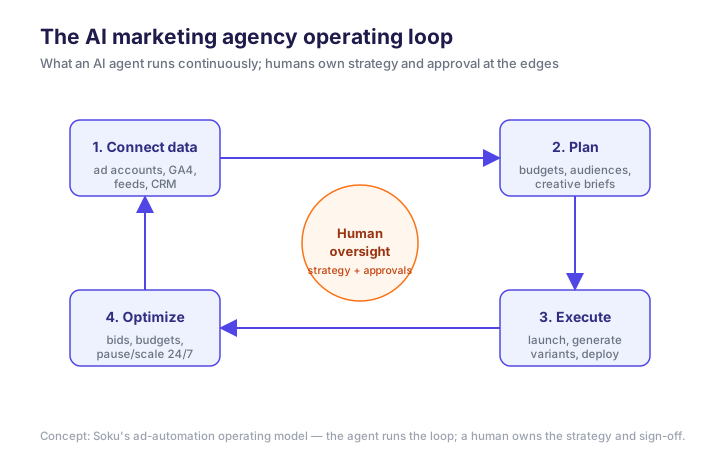
- Connect — the agent is wired into your ad accounts, analytics (GA4), product feeds, and CRM. This is the foundation; a disconnected agent is just a chatbot.
- Plan — it proposes budgets, audiences, and creative briefs against your goals.
- Execute — it launches campaigns, generates creative variants, and deploys them.
- Optimize — it monitors performance and adjusts bids, budgets, and creative continuously, pausing losers and scaling winners.
The human sits in the middle, not in the loop: setting strategy, defining guardrails, and approving anything consequential. This is why the model scales with software instead of headcount — and why "how much of the work is automated versus human" is a question you should ask every agency directly (our how to choose guide turns that into a scorecard).
It's also why the incumbent economics break. McKinsey notes most organizations are still piloting rather than scaling AI — roughly a third have begun to scale — so an agency that has genuinely operationalized agents is still, in 2026, an early mover with a real cost edge.
How AI agencies differ from traditional agencies
Three differences do most of the work. We rank them in full in the vs traditional agency comparison; here's the summary.
| Dimension | Traditional agency | AI marketing agency |
|---|---|---|
| Speed | Campaigns in weeks | Launches in hours to days |
| Cost | $15k–$50k/mo typical | $2k–$8k/mo typical |
| Coverage | Business hours, twice-daily checks | 24/7, 15–60 min loop |
| Scales by | Hiring people | Adding software capacity |
| Best at | Brand, strategy, one-off big ideas | Production-heavy, always-on execution |
The nuance most vendor pages skip: AI agencies run roughly 30–60% cheaper on production-heavy work — content, paid-media management, reporting, first-draft creative — but cost about the same, or more, on strategy, brand, and category-defining work, where human judgment is the product. If your need is mostly the former, the math is decisive. If it's the latter, it isn't.
What does an AI marketing agency cost?
Pricing spans a wide range because "AI marketing agency" covers everything from a $500/mo automation tool with a dashboard to a $50k/mo custom deployment. The honest ranges, by business size:
| Business size | Typical monthly cost | What you get |
|---|---|---|
| Startup / small business | $500 – $2,000 | Basic automation, AI SEO, templated agents |
| Small–mid | $2,000 – $10,000 | Dedicated manager, custom content, multi-channel |
| Mid-market | $10,000 – $50,000 | Custom model tuning, advanced data pipelines |
| Enterprise | $50,000+ | Fully custom, dedicated deployments |
Digital marketing agency retainers commonly fall between $5,000 and $50,000 per month; most mid-market AI engagements land in the $5,000–$25,000 range. Three billing models exist — flat retainer, performance (a percentage of spend or results), and hybrid — and platform/token fees are often billed separately from the strategy fee. We break all of this down with worked examples in How Much Does an AI Marketing Agency Cost?.
When to hire an AI agency vs build in-house vs keep a traditional agency
This is the decision the head term is really asking about. A simple way to reason about it:
- Hire an AI marketing agency when your work is execution-heavy and always-on — paid media, creative volume, content at scale — and you want that running for a fraction of a traditional retainer without recruiting a team. This is the sweet spot.
- Build in-house (with agents) when marketing is core to your moat, you have the volume to justify owning the loop, and you want the institutional knowledge to stay with you. Many teams pair a senior strategist with an agent and skip the agency entirely. The full cost model for this path is in AI Media Buyer Cost vs an Agency.
- Keep a traditional agency when your next quarter hinges on brand, positioning, a category-defining campaign, or crisis work — the judgment-heavy, one-off things AI is weakest at.
- Do both — the most common 2026 pattern. A strategist (in-house or agency) owns direction and taste; an agent like Soku runs the daily operating loop. You pay for judgment once instead of paying people to push buttons full-time.
A quick gut check: if you can write down the rules for a task, an agent can probably run it cheaper and more consistently than a human. If the task is "have good taste" or "read the room," keep the human.
Honest limitations
AI marketing agencies are not magic, and the failure modes are predictable. Salesforce found 84% of marketers admit to still running generic campaigns despite high AI adoption — automation amplifies whatever strategy you feed it, including a bad one. Data quality is the usual bottleneck: an agent connected to siloed, messy data optimizes toward the wrong signal fast. And on strategy, brand voice, and novel creative with no playbook, a good human still wins. Treat vendor efficiency claims — "5x faster, 40% cheaper" — as claims, not guarantees, and ask to see them measured on a real account.
There's also an adoption gap worth naming. High usage is not the same as high effectiveness: McKinsey's finding that most organizations are still piloting rather than scaling AI applies to agencies too. A vendor can be genuinely using agents and still be early in operationalizing them — which is fine, as long as you can see the results on accounts like yours rather than taking the capability on faith. The failure that hurts buyers most isn't the agency that admits it's still maturing; it's the one that promises full autonomy it can't demonstrate. That's why the vetting step (below) matters more here than in most software purchases.
Where Soku fits
Soku is the operating loop in that middle diagram, delivered as an agent rather than a team. It connects to your Google, Meta, and TikTok accounts plus GA4 and your product feed, plans and launches campaigns, generates and tests creative variants, and runs the optimization loop continuously — with you owning strategy and approvals. It's the in-house-agent path and the "do both" path at the same time: the execution engine that lets a lean team (or a strategist) operate like a full agency without the retainer. If you're comparing tools rather than agencies, our marketing agency software and agencies pages go deeper on the platform.
Where to go next
This pillar is the map. For the full treatment of each decision, follow the deep dives:
- Weighing AI against your current shop? → AI Marketing Agency vs Traditional Agency — a ranked comparison across speed, cost, transparency, and scope.
- Building a budget? → How Much Does an AI Marketing Agency Cost? — retainer vs performance vs hybrid, with real numbers.
- Shortlisting vendors? → How to Choose an AI Marketing Agency — a weighted checklist and the red flags that should end a conversation.
- Considering in-house instead? → AI Media Buyer Cost vs an Agency — the worked math on building the loop yourself.
Frequently asked questions
Is an AI marketing agency the same as a marketing agency that uses AI tools?
No. Nearly every agency now uses AI tools. An AI marketing agency is one where agents run the execution and the cost structure scales with software, not headcount. Ask what share of the work is automated versus human — the answer separates the two.
Are AI marketing agencies actually cheaper?
On production-heavy work — paid media, content, reporting, first-draft creative — typically 30–60% cheaper than a traditional agency. On strategy, brand, and one-off creative, they cost about the same or more. Match the model to the work.
Can an AI agency replace my whole marketing team?
Usually not, and you shouldn't want it to. The durable pattern is a human owning strategy and taste while an agent runs the daily loop. It replaces button-pushing, not judgment.
What does an AI marketing agency cost per month?
Anywhere from $500/mo for small-business automation to $50,000+/mo for enterprise deployments, with most mid-market engagements at $5,000–$25,000. See the full cost breakdown.
How do I know if one is legit?
The green flags: it names the models and platforms it runs, shows the automated-vs-human split, separates platform fees from its strategy fee, lets you keep account and data ownership, and shows real tracked results. Our how to choose guide turns this into a scorecard.