 Soku AI

Search for "AI marketing cloud" and you will find two very different things wearing the same name. One is a category of enterprise software — the marketing clouds from Salesforce, Adobe, and a handful of challengers — that orchestrate messages to customers you already have. The other is a vague marketing buzzword that vendors staple onto any product with a prediction in it.
This guide is about the first thing, told honestly. We will define what an AI marketing cloud actually does, walk through the platforms that matter in 2026 with their real strengths and weaknesses, and then make an argument that the marketing-cloud category does not want you to hear: the cloud is the orchestration layer, not the creative engine. It is exceptional at deciding when and how to deliver a message to a known person. It does almost nothing to manufacture the creative that wins a new one. That gap is the whole reason a tool like Soku exists, and we'll be specific about where the line sits.
What an "AI marketing cloud" actually is
A marketing cloud is a suite — not a single tool — that unifies customer data, message orchestration, and analytics across channels (email, SMS, push, in-app, web, sometimes ads) on top of one shared customer profile. The "AI" layer that every vendor now bolts on does four jobs reliably:
- Optimization — send-time, channel, and frequency decisions made per user instead of per campaign.
- Prediction — churn risk, lifetime value, and next-best-action scores for every profile.
- Personalization — message-level content variation, dynamic blocks, subject-line and copy assistance.
- Orchestration agents — the 2026 addition: autonomous "agents" that build journeys, adjust segments, and resolve routine campaign decisions without a human wiring each step.
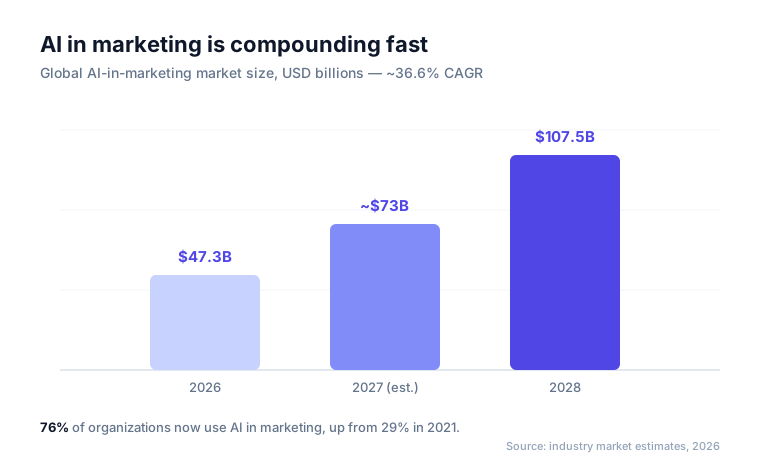
Here is the important framing. The AI-in-marketing market is compounding fast — independent estimates put it around $47 billion in 2026 and climbing past $100 billion by 2028, and worldwide adoption has jumped to roughly 76%, up from 29% in 2021. When a capability grows that fast, it stops being a differentiator and becomes an expectation. That is exactly what happened to the marketing cloud's AI features in 2026: agentic journey optimization, predictive scoring, and message-level personalization are now table stakes on every enterprise tier. Choosing between clouds is no longer "who has AI." Everyone has AI. It is "who has the right data model, channel coverage, and price for your business."
The AI marketing cloud platforms that matter in 2026
We've ranked these by how broad and enterprise-grade the cloud is, not by which is "best" — best depends entirely on your stack, your channels, and your budget. Each entry covers what it does well, where it falls short, and who it fits.
Salesforce Marketing Cloud (Einstein + Agentforce)
The default enterprise choice if you already live in Salesforce CRM. Einstein covers send-time optimization, engagement scoring, and copy insights; Agentforce, matured through 2026, adds autonomous agents for large-scale campaign personalization and journey building.
- Strengths: Deepest CRM integration on the market, high-volume email at scale, and the broadest partner ecosystem. If your sales and service data already lives in Salesforce, the unified profile is hard to beat.
- Weaknesses: Fully activating the AI features takes significant configuration — often dedicated Salesforce technical resources. Total cost of ownership is the highest in this list once implementation and admin time are counted.
- Best for: Large B2B and B2C enterprises already standardized on Salesforce that need governance, scale, and deep CRM ties.
Adobe Experience Cloud (Journey Optimizer + AJO)
Adobe competes most directly with Salesforce at the enterprise level, and in 2026 its AI updates added agentic journey optimization and brand-safe content generation that plug into the wider Adobe creative and analytics stack.
- Strengths: Best-in-class for content-heavy, design-led organizations; Journey Optimizer is winning net-new enterprise deals against Salesforce. Tight integration with Adobe Analytics and the creative tools.
- Weaknesses: Complexity and price rival Salesforce. The full value only appears if you're committed to the broader Adobe ecosystem; piecemeal adoption underdelivers.
- Best for: Enterprises with mature content operations that already use Adobe Analytics and creative tooling.
Braze (BrazeAI)
The mobile-first, real-time challenger. BrazeAI includes intelligent send-time optimization, predictive churn scores, AI content recommendations, and automated A/B variant selection — and crucially, it's accessible to marketers without a data-science team.
- Strengths: Processes every user event the moment it happens, so campaigns trigger on live behavior with no data-sync lag. Generally wins on cost for mid-market use cases versus Salesforce.
- Weaknesses: Lighter on classic CRM/sales-cloud depth than Salesforce. Strongest when mobile and cross-channel engagement is the core use case, less so for complex B2B sales motions.
- Best for: Mobile-first consumer brands needing real-time, cross-channel lifecycle engagement.
HubSpot (Breeze)
HubSpot's Breeze AI brings agents and copilots to the mid-market all-in-one CRM. It's the friendliest to set up and the most generous to smaller teams.
- Strengths: Fastest time-to-value, unified CRM + marketing + service, excellent onboarding. Breeze agents handle content, prospecting, and routine workflow automation without specialist help.
- Weaknesses: Less powerful than Salesforce or Adobe at very high volume and complex enterprise governance. Costs escalate as contact tiers and add-ons stack up.
- Best for: SMB and mid-market teams that want one platform for CRM, marketing, and service with minimal setup.
Klaviyo (K:AI)
Not a full "marketing cloud" in the Salesforce sense, but the category-defining B2C CRM for e-commerce — and increasingly cloud-like with its K:AI marketing and customer agents.
- Strengths: Purpose-built for e-commerce, deep Shopify integration, predictive analytics (LTV, churn, next order), and native SMS/WhatsApp sharing the same data as email. Pricing scales by profile count, not feature tier.
- Weaknesses: Focused on retention and e-commerce; not designed for complex B2B journeys or enterprise governance.
- Best for: DTC and e-commerce brands that want retention automation tied directly to store data.

Side-by-side comparison
| Platform | AI layer | Best fit | Real-time | Setup effort | Relative cost |
|---|---|---|---|---|---|
| Salesforce Marketing Cloud | Einstein + Agentforce | Enterprise, Salesforce-native | Good | High | $$$$ |
| Adobe Experience Cloud | Journey Optimizer (AJO) | Content-led enterprise | Good | High | $$$$ |
| Braze | BrazeAI | Mobile-first, mid-market | Excellent | Medium | $$$ |
| HubSpot | Breeze | SMB / mid-market all-in-one | Good | Low | $$ |
| Klaviyo | K:AI | E-commerce retention | Good | Low | $$ |
The honest read: at the enterprise tier, the AI capabilities have converged. You are really choosing a data model and a channel posture — Salesforce for CRM depth, Adobe for content depth, Braze for real-time mobile, HubSpot for simplicity, Klaviyo for e-commerce. The AI is comparable; the fit is not.
The job no marketing cloud actually does
Now the argument. Every platform above is built to answer one question extraordinarily well: given a person already in my database, what message do I send them, when, and on which channel? That is orchestration. It is the retention and lifecycle half of marketing, and AI has made it genuinely better.
But notice what's missing. A marketing cloud assumes the customer is already there. It optimizes the delivery of messages to known people. It does not manufacture the creative that acquires new people — the ad concepts, the variant generation, the performance creative that runs on paid social and search to reach someone who has never heard of you. That is a different job, upstream of the cloud, and the marketing clouds barely touch it.
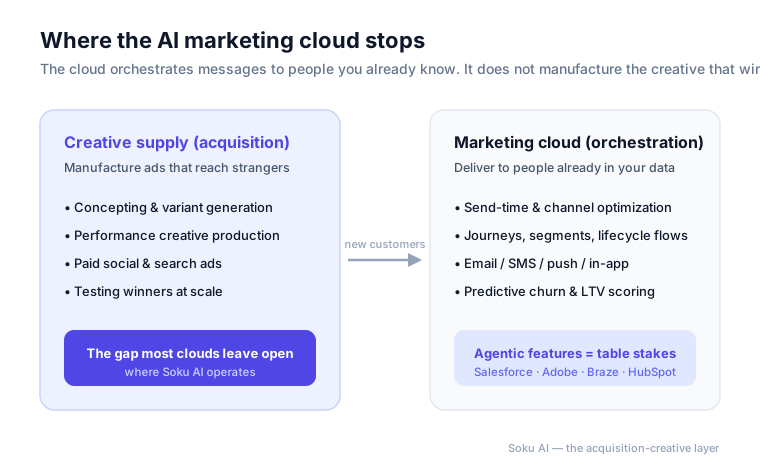
This is not a knock on the clouds — it's a boundary. Salesforce, Adobe, and Braze are world-class at the right-hand side of that diagram. But the left-hand side — the acquisition-creative supply chain — is exactly where most teams still bleed time and money. You can have the most sophisticated journey optimizer in the world and still be hand-building ad creative in a design tool, exporting it, uploading it to Meta, and waiting a week to learn which version worked.
That's the gap Soku AI fills, and we list it here honestly: not as a marketing cloud, but as the layer in front of one. Soku generates ad creative, tests variants, and optimizes audiences and placements across Meta, Google, and TikTok — then the winners and the customers they bring in flow into your marketing cloud, where Salesforce or Braze or Klaviyo takes over the lifecycle. The cloud orchestrates; Soku supplies the creative that gives it someone to orchestrate.
If your acquisition creative is the bottleneck — and for most growth teams in 2026 it is — no amount of marketing-cloud AI fixes it, because that's not the job the cloud was built to do.
How to choose your AI marketing cloud
Skip the feature checklist; the AI features are largely equivalent now. Decide on these four axes instead:
- Where does your customer data already live? If it's Salesforce CRM, Marketing Cloud's unified profile is worth the implementation tax. If it's a Shopify store, Klaviyo. Don't fight gravity.
- What's your primary channel? Mobile-first and real-time → Braze. Content- and design-led → Adobe. Email + e-commerce → Klaviyo. Mixed mid-market → HubSpot.
- What's your true total cost of ownership? Add implementation, admin headcount, and add-on tiers — not just the sticker price. Salesforce and Adobe are powerful but expensive to run; HubSpot and Klaviyo are cheaper to operate.
- Who maintains it? If you don't have technical marketing-ops resources, favor Braze, HubSpot, or Klaviyo over Salesforce or Adobe.
And one axis the cloud vendors won't put on their comparison page: is your bottleneck delivery or supply? If you struggle to get the right message to existing customers, buy a marketing cloud. If you struggle to produce enough good acquisition creative to feed the funnel, a marketing cloud won't help — you need a creative engine in front of it.
Frequently asked questions
What is an AI marketing cloud?
It's an enterprise software suite that unifies customer data, cross-channel message orchestration, and analytics, with an AI layer that handles send-time optimization, predictive scoring, message personalization, and (in 2026) autonomous orchestration agents. Salesforce Marketing Cloud, Adobe Experience Cloud, and Braze are leading examples.
Is "AI marketing cloud" the same as marketing automation?
Marketing automation is one piece of it. A marketing cloud is broader — it adds a unified customer data layer, more channels, deeper analytics, and (now) agentic AI on top of the trigger-and-flow automation that defined the earlier category.
Which AI marketing cloud is best?
There is no single best. At the enterprise tier the AI features have converged, so the right choice depends on where your data lives, your primary channel, your total cost of ownership, and who maintains it. Salesforce suits Salesforce-native enterprises, Adobe suits content-led ones, Braze suits mobile-first brands, HubSpot suits the mid-market, and Klaviyo suits e-commerce.
Are the AI features actually different between platforms?
Less than the marketing implies. Send-time optimization, predictive churn/LTV scoring, message-level personalization, and orchestration agents are table stakes on enterprise tiers in 2026. The meaningful differences are data model, channel coverage, real-time processing, setup effort, and price.
Does a marketing cloud create ad creative?
Not really. Marketing clouds orchestrate messages to people already in your database — the retention and lifecycle side. They don't manufacture the acquisition creative (ad concepts and variants for paid social and search) that brings new customers in. That's a separate, upstream job handled by a creative engine like Soku AI, whose output then feeds the cloud.
How much does an AI marketing cloud cost?
It varies widely. HubSpot and Klaviyo start in the low hundreds per month for smaller teams; Salesforce Marketing Cloud and Adobe Experience Cloud run into five and six figures annually once implementation, admin, and add-ons are counted. Always evaluate total cost of ownership, not the sticker price.
The takeaway
The AI marketing cloud is real, mature, and increasingly undifferentiated on AI alone. In 2026 you're not choosing intelligence — every cloud has it — you're choosing a data model, a channel posture, and a price you can sustain. Pick the one that matches where your customers already live.
But know the boundary. The cloud is the orchestration layer. It delivers brilliantly to the customers you have; it does not produce the creative that earns the customers you don't. If acquisition creative is your bottleneck, the highest-leverage move isn't a bigger marketing cloud — it's putting a creative engine in front of the one you already run.