
 Soku AI
Seedance vs Kling (2026): Seedance 2.5 vs Kling 4.0 for Ad Video, Tested
Seedance vs Kling for ad video, verified 2026-10-26. We ran the same three ad prompts through Seedance 2.5 and Kling 4.0 on fal, including a product-still consistency test. Seedance kept the label readable in 8 of 8 frames. Kling spelled the brand right and cost $0.157/s against $0.473/s. Real billed cost per clip and per usable second.
Prices and feature claims last verified against both vendors' own published pages on 2026-10-26.
Most "Seedance vs Kling" pages compare Seedance 2.0 with Kling 3.0, and none of the top results we read had run Kling 4.0. That matters, because both lines have moved on. ByteDance released Seedance 2.5 on July 31, 2026. Kuaishou says Kling 4.0 launched on October 15, 2026, and fal put it on its API the next day. Both now generate up to 30 seconds in one pass, both generate audio, and both take product references. They are still priced very differently.
So we ran our own test. On 2026-10-26 we sent the same three ad prompts to Seedance 2.5 and Kling 4.0 on fal. One prompt animates a product still, to test product consistency. One is a UGC line of dialogue. One is a can-and-ice shot with a printed brand name and a timed headline. We looked at the frames ourselves, transcribed the audio, and pulled the actual billed cost from fal's usage API. Every price on this page was read from the vendor's or reseller's own page on the same day.
Neither model is ours. Soku is an AI advertising agent that runs some Seedance and Kling tiers, so there is a short note on that at the end, after the comparison.
The Short Answer
- Product still to video: Seedance 2.5. Given the same packshot and prompt, it did every action we asked for and kept the brand name readable in 8 of 8 sampled frames. Kling 4.0 never picked the bottle up and covered the name with a thumb in 7 of 8.
- Printed brand names in text-to-video: Kling 4.0. It spelled our made-up brand VOLTA correctly. Seedance 2.5 printed VOLCA.
- Timed headlines: Kling 4.0. It put "ZERO SUGAR" in the final second, as asked. Seedance showed it at about 2.2 seconds of 4.
- UGC dialogue: a tie. Both said the scripted line word for word. Seedance's take looked more like phone footage. Kling's looked like a polished beauty ad.
- Price: Kling 4.0, by about 3x. On fal, Kling 4.0 is $0.157 per second at 720p. Seedance 2.5 is $0.473. In our test both models produced 8 usable seconds out of 12, so the cost per usable second was $0.24 for Kling and $0.70 for Seedance.
The Two Model Families Right Now
Both vendors sell several tiers at once, and resellers carry most of them. This is what was listed on 2026-10-26.
| Seedance (ByteDance Seed) | Kling (Kuaishou) | |
|---|---|---|
| Newest flagship | Seedance 2.5, released July 31, 2026 (TechNode) | Kling 4.0, launched October 15, 2026 (Kuaishou release) |
| Still sold | Seedance 2.0, 2.0 Fast, 2.0 Mini, 1.5 Pro | Kling 3.0, 3.0 Turbo, 3.0 Omni, 3.0 4K, 2.6 |
| Not yet on general API | No Seedance 2.5 Fast or Mini tier is listed on fal | Kling 4.0 Flash (limited early access since September 28). Kling's own API lists Kling 4.0 as "coming soon" |
| Where developers buy it | BytePlus ModelArk, resellers such as fal | Kling's API, resellers such as fal |
| Where creators use it | Dreamina and CapCut (international), Jimeng and Doubao (China) | klingai.com |
One oddity worth knowing: on 2026-10-26, Kling's own developer pricing page said "Kling 4.0 API access is not yet available" and showed its prices as preview only. fal, though, had published kling/v4/text-to-video, image-to-video, reference-to-video and video-to-video/edit on October 16, and all three of our Kling jobs ran on them without trouble. If you need Kling 4.0 through an API today, a reseller is the route that works.
Specs Side By Side
From each model's fal API schema and the vendors' own pages, read 2026-10-26.
| Seedance 2.5 | Kling 4.0 | |
|---|---|---|
| Clip length per generation | 4 to 30 s, or "auto" (fal schema) | 3 to 30 s (fal schema) |
| Longer than 30 s | ByteDance says you can extend twice (Seed) | Multi-shot prompts add up to the 30 s total per job |
| Resolution | 480p, 720p, 1080p on fal | 720p, 1080p on fal. Kuaishou says Kling 4.0 outputs up to 10-bit HDR and "will also support" 4K and 21:9 |
| Aspect ratios | 21:9, 16:9, 4:3, 1:1, 3:4, 9:16 | 16:9, 9:16, 1:1, 21:9 |
| Modes on fal | Text, image (first and last frame), reference-to-video, video editing and extension | Text, image (start and end frame), reference-to-video, video editing |
| References | Up to 30 images, 10 videos and 10 audio files, 50 files total | On fal: up to 10 images, 5 videos and 7 "elements" (characters or objects, some with a voice). Kuaishou's own figure: up to 15 reference assets and 10 keyframes |
| Multi-shot | Through the prompt | Explicit per-shot prompts (multi_prompt), each with its own duration |
| Audio | generate_audio switch, on by default, same price either way | No switch on fal; every clip we generated had an audio track |
| Cheap preview | draft mode renders 480p and can be completed at 1080p within seven days | None listed on fal |
On paper, Seedance 2.5 is the more flexible tool for reference-heavy work. It takes five times as many reference images, and it is the only one of the two that takes reference audio. Kling 4.0's selling points are its named elements, which let you pin a character or product and refer to it by name, and its explicit shot list. For ad work that means Seedance suits "here are 20 brand assets, make a spot". Kling suits "shot 1 is the hook, shot 2 is the packshot".
Prices, Verified 2026-10-26
On fal (the same route for both)
| Model | 480p | 720p | 1080p | Billing |
|---|---|---|---|---|
| Seedance 2.5 | ~$0.2205/s | ~$0.4730/s | ~$1.164/s | $0.0214 per 1,000 tokens (480p and 720p), ~$0.0234 at 1080p. Video inputs ×0.6 |
| Seedance 2.0 Fast | $0.2419/s | $0.0112 per 1,000 tokens | ||
| Seedance 2.0 Mini | ~$0.0721/s | ~$0.1547/s | $0.007 per 1,000 tokens | |
| Kling 4.0 | $0.157/s | $0.235/s | Per second. With video references, $0.094/s (720p) on input plus output length | |
| Kling 3.0 Turbo Pro | $0.14/s | Per second | ||
| Kling 3.0 Pro | $0.112/s without audio, $0.168/s with audio | |||
| Kling 3.0 4K | $0.42/s, audio on or off |
Sources: fal's model pages for Seedance 2.5, Kling 4.0 and the other listed endpoints. fal notes that Seedance's per-second figures are approximations for 16:9. The token formula, (height × width × seconds × 24) / 1024, is the actual bill. A 9:16 clip at 720p has the same pixel area, so it costs the same.
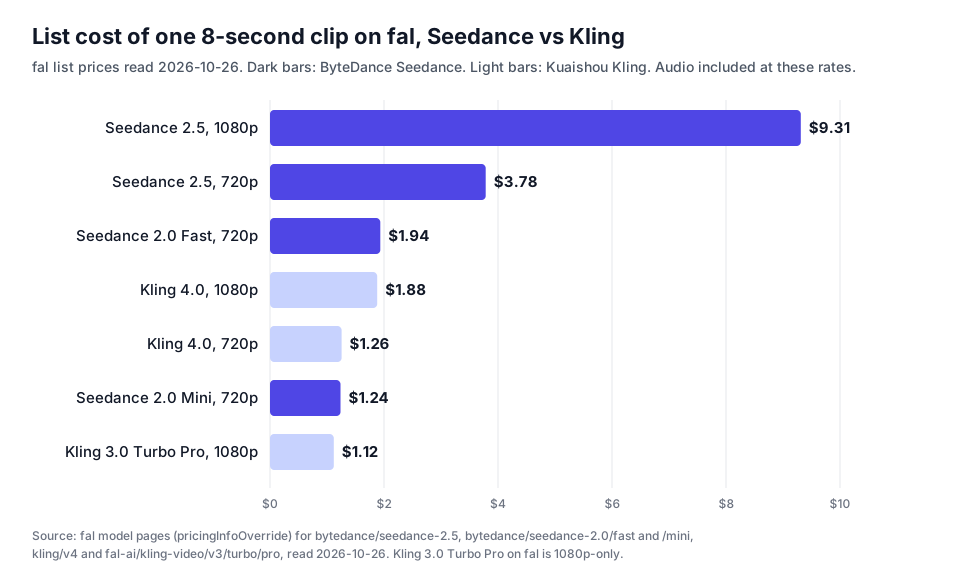
The number that matters most: at 1080p, Seedance 2.5 costs about 5x what Kling 4.0 costs ($1.164 against $0.235 per second). At 720p the gap is 3x. Seedance's cheaper 2.0 Mini tier costs about the same as Kling 4.0 at 720p.
Buying direct
- Kling. Kling's API pricing page sells prepaid units at $0.14 per video unit (list). Kling 4.0 is listed at 1.0 unit per second at 720p and 1.5 at 1080p, which is $0.14 and $0.21 per second. That is about 11% below fal, but the page says the Kling 4.0 API is not live yet and the prices are a preview. Kling 3.0 Turbo with native audio is 0.8 units at 720p ($0.112/s) and 1.0 at 1080p ($0.14/s). Kling's consumer membership page did not render plan prices to our reader on 2026-10-26, so we do not quote subscription prices here.
- Seedance. BytePlus sells Seedance 2.5 in token bundles: $32 for 5 million tokens, $64 for 10 million and $640 for 100 million, each valid for three months, at 480p or 720p. BytePlus says 5 million tokens buys roughly 120 to 500 seconds of 480p video, depending on the input mode. That is about $0.06 to $0.27 per 480p second, against fal's $0.2205. If you will spend the bundle within three months, buying direct is cheaper. BytePlus does not publish a per-second rate, so we can't give a like-for-like 720p figure.
Our Test: Three Ad Prompts, Seedance 2.5 vs Kling 4.0
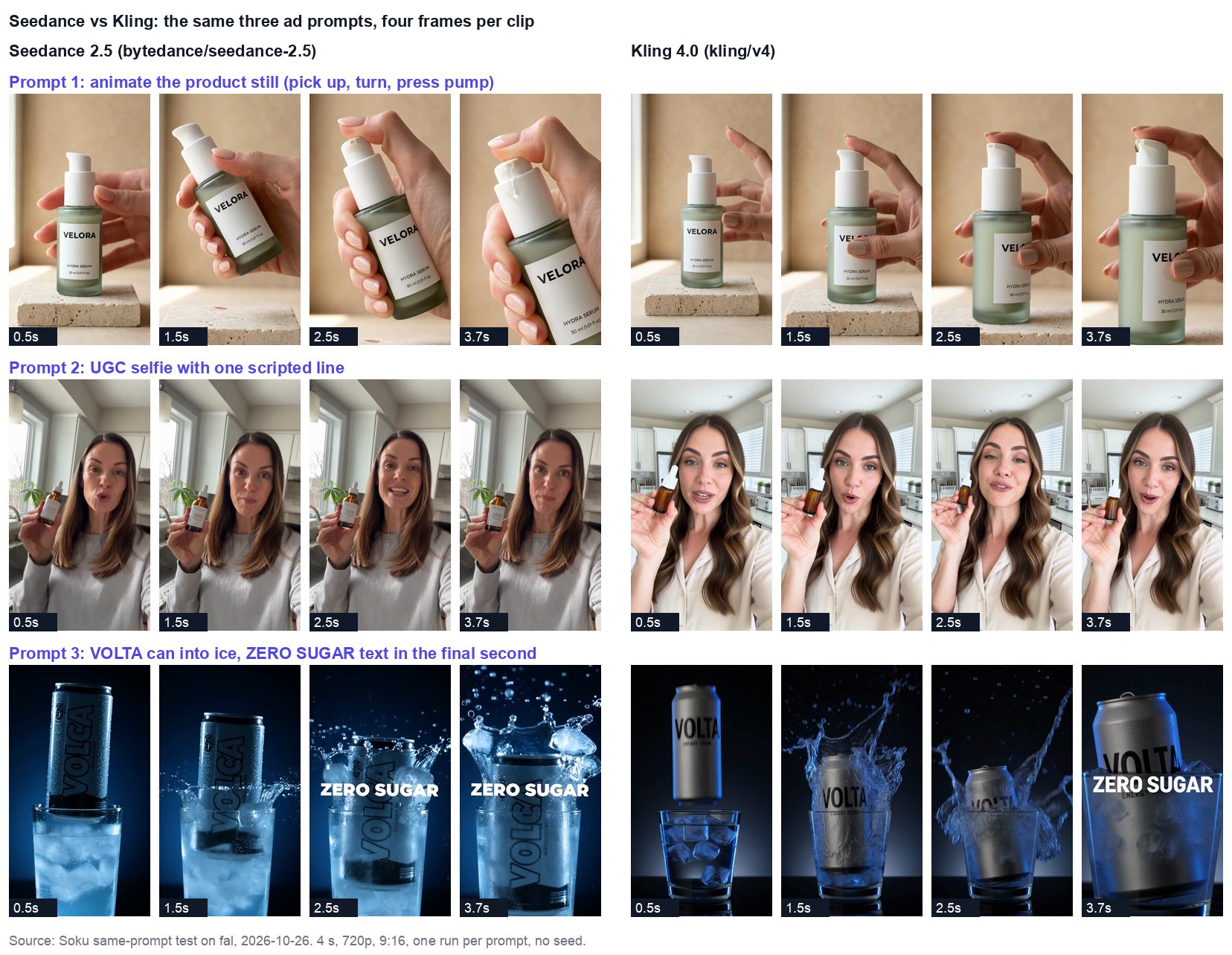
Setup. Three prompts, each written the way an ad team would write it and each aimed at a known weak spot. Each ran once on Seedance 2.5 and once on Kling 4.0 through fal on 2026-10-26. Settings: 4 seconds, 720p, 9:16, no seed, no negative prompt. Seedance had audio on, and Kling 4.0 has no audio switch. All six jobs were submitted at the same moment.
- Product consistency (image-to-video). We made one product still: a sage-green VELORA HYDRA SERUM 30 ml bottle on a travertine block. We generated it once with Nano Banana 2 for $0.08, and both models got the identical file. Prompt: a hand enters from the right, picks the bottle up, turns it toward the camera and presses the pump once, a drop of serum forms on the nozzle, slow push-in, "keep the label readable: VELORA, HYDRA SERUM". Endpoints:
bytedance/seedance-2.5/image-to-videoandkling/v4/image-to-video. - UGC dialogue (text-to-video). A woman in her late twenties films a selfie in a bright kitchen, holds up an amber serum bottle and says: "Two weeks of this every morning, and my skin finally feels calm."
- Printed brand name, liquid and a timed headline (text-to-video). A cold can with VOLTA printed on it drops into a glass of ice, with a slow-motion splash, blue rim light, and "ZERO SUGAR" appearing in the final second. VELORA and VOLTA are made-up brands, so neither model could have seen them before.
Product consistency, scored frame by frame
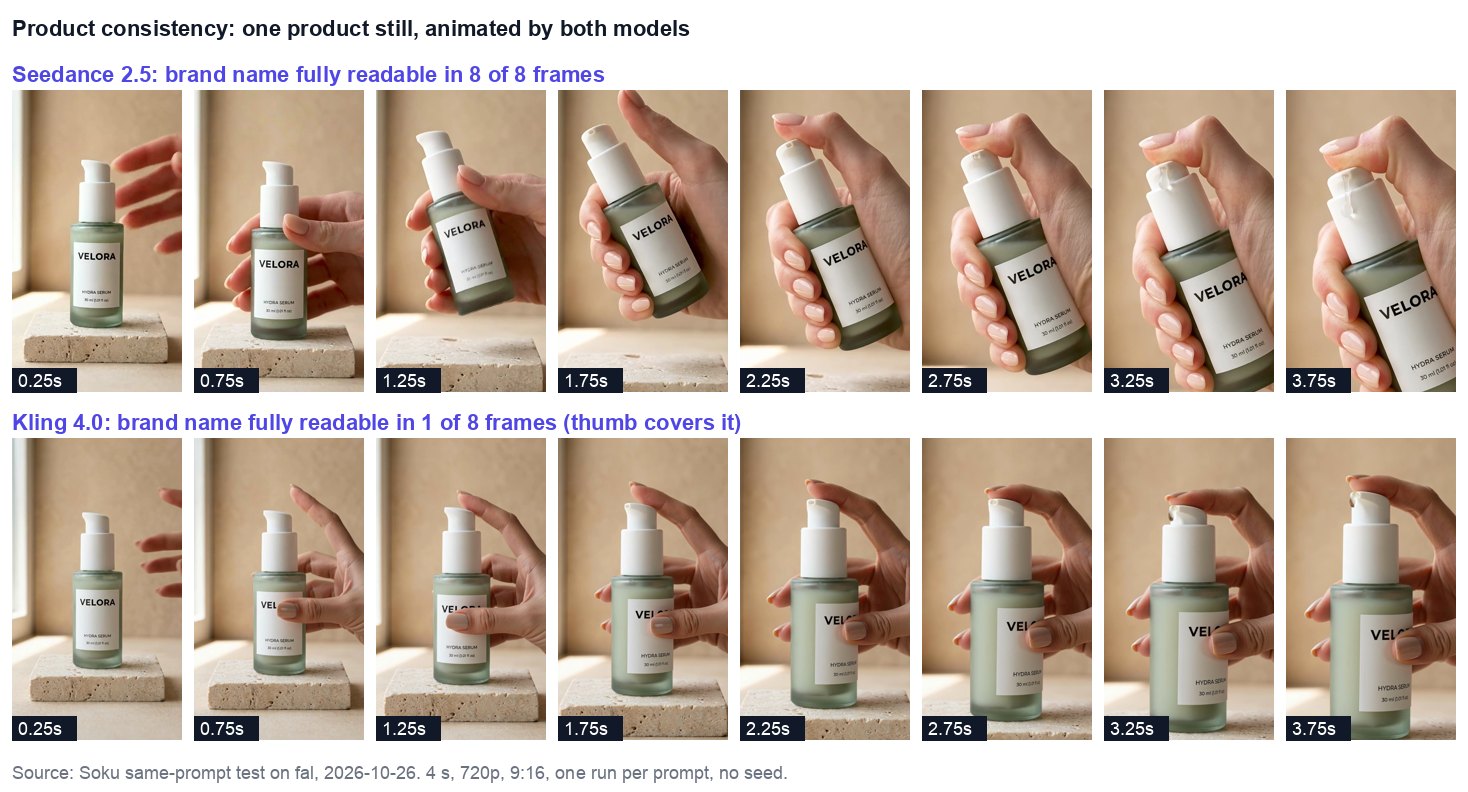
For the image-to-video prompt we sampled 8 frames at half-second intervals, from 0.25 s to 3.75 s, and checked three things in each one. Is the brand name fully visible and spelled correctly? Does the bottle's shape and glass colour still match the input still? Did the requested action happen?
| Check (8 frames) | Seedance 2.5 | Kling 4.0 |
|---|---|---|
| Brand name fully readable and correct | 8 of 8 | 1 of 8 (partly covered by a thumb in the other 7, never misspelled where visible) |
| "HYDRA SERUM 30 ml" line intact | 8 of 8 (cropped by the frame edge in the last one as the camera pushes in) | 8 of 8 |
| Glass colour matches the still | Stable throughout | Turns noticeably paler and milkier from about 1.8 s |
| Hand picks up and turns the bottle | Yes | No. The bottle never leaves the stone |
| Pump pressed, drop of serum | Yes, though the serum runs down the side of the pump rather than beading on the nozzle | Yes, with a bead on the nozzle |
| Slow push-in | Yes | Yes |
This was the clearest result of the test. Seedance 2.5 treated the packshot as something to preserve. Kling 4.0 treated it as a starting frame. Kling kept the label's lettering intact, but an ad where a thumb covers the brand name for three and a half seconds is not usable. You can probably fix it with a stronger prompt, or with Kling's elements reference instead of a plain start frame. We didn't test that, because we gave both models the same input.
What each did on all three prompts
Scores are 1 to 5, our judgement from the frames and audio. "Ad-ready" means: could this clip go into a paid-social concept test after at most a trim, without regenerating?
| Prompt | Seedance 2.5 | Kling 4.0 |
|---|---|---|
| 1. Product still to video | Adherence 5, product fidelity 5, motion 4. Ad-ready: yes | Adherence 2, product fidelity 2, motion 4. Ad-ready: no (label covered) |
| 2. UGC dialogue | Line word for word. Convincing phone-camera look with window glare. The woman reads older than the late twenties we asked for. The bottle gained a label of illegible pseudo-text. Adherence 4, fidelity 3, motion 4. Ad-ready: yes for a concept test | Line word for word. Polished beauty-ad lighting rather than phone footage. Plain amber bottle with no invented text. Adherence 5, fidelity 4, motion 4. Ad-ready: yes |
| 3. Printed brand, splash, headline | One continuous shot with a convincing crown splash and ice. The can reads "VOLCA". "ZERO SUGAR" appears at about 2.2 s, not in the final second. Adherence 3, fidelity 1, motion 4. Ad-ready: no | The can reads "VOLTA", plus an "ENERGY DRINK" line we didn't ask for. It cuts hard at 3.0 s to a tighter end card with "ZERO SUGAR" in the final second. The splash seems to empty the glass, and after the cut the glass holds ice and no liquid. Adherence 4, fidelity 5, motion 3. Ad-ready: yes |
Two patterns are worth more than the scores.
Text printed on a product is still a coin toss without a reference. Kling got VOLTA right and Seedance did not, but in our Veo test both Veo tiers misspelled a made-up brand on a bottle too. When Seedance had the label to copy from (prompt 1), it was flawless. If your product has a wordmark, give the model a picture of it, or add the name as an edit overlay. Do not trust text-to-video to print it.
Kling 4.0 edits like an ad editor, for better and worse. Without being asked, it cut from the splash to a packshot end card for the final second. That is a sensible ad structure, and it is how it landed the headline on time. It also means continuity breaks at the cut. Seedance held one continuous take in all three clips. If you need a single unbroken shot from Kling, its multi_prompt field is how you control the shot list.
Audio
Both models returned audio on all three clips. A Whisper (small) transcription of prompt 2 returned the scripted line exactly for both: "Two weeks of this every morning and my skin finally feels calm." On the clips without dialogue, Whisper returned only filler such as "Thank you." That is a known Whisper artefact on music and ambience, not speech the models generated, but we did not check every clip by ear. Kling's mix was louder on every prompt: its mean volume was -21.5, -25.0 and -18.8 dB, against Seedance's -30.1, -27.5 and -23.8 dB. Expect to normalise levels if you cut the two together.
Latency, real cost and cost per usable second
| Seedance 2.5 | Kling 4.0 | |
|---|---|---|
| fal request IDs (prompts 1, 2, 3) | 01a17589-b37d-7110-85e0-74bb3a31b279, 01a17589-b384-7360-a094-141810072a96, 01a17589-b389-7b72-994a-ecc4ad1ea368 | 01a17589-b38e-7aa2-a3d0-825c1a7c86c8, 01a17589-b399-7233-b24a-af549c3de78a, 01a17589-b395-7590-b37f-a1b9742cc53f |
| fal-reported inference time (prompts 1, 2, 3) | 374.8 s, 137.2 s, 224.3 s | 247.8 s, 175.7 s, 187.5 s |
| Wall clock, submit to result (5 s polling) | 382 s, 142 s, 230 s | 253 s, 177 s, 189 s |
| Output | 24 fps, about 4.06 to 4.09 s, 720×1280 (716×1284 for image-to-video) | 24 fps, 4.04 s, 720×1280 (716×1280 for image-to-video) |
| Seconds generated | 12 | 12 |
| Actual billed cost (fal usage API) | $5.60 (261,686 tokens at $0.0214 per 1,000) | $1.88 (12 s at $0.157) |
| Cost per 4 s clip | about $1.87 | $0.63 |
| Usable seconds (our judgement) | 8: prompts 1 and 2 | 8: prompts 2 and 3 |
| Cost per usable second | $0.70 | $0.24 |
Three things to take from this:
- Both models are slow on fal right now. The median job took about 3 to 4 minutes for 4 seconds of video. Seedance's image-to-video job took over six minutes. Plan batch runs, not live iteration, or use Seedance's
draftmode for previews. - Each model failed one prompt, so the usable rates came out the same. That leaves price as the tie-breaker, and on price Kling 4.0 wins by roughly 3x. Our full test, including the $0.08 product still, cost $7.56.
- The prompt mix decides the winner. If your work is mostly packshot-to-motion, Seedance's discard rate would likely be lower than Kling's and the gap would narrow. If it is mostly text-to-video hooks with printed branding, the gap would widen. This is one run per prompt per model. Treat it as a method you can repeat on your own products, not a benchmark.
Which One To Choose
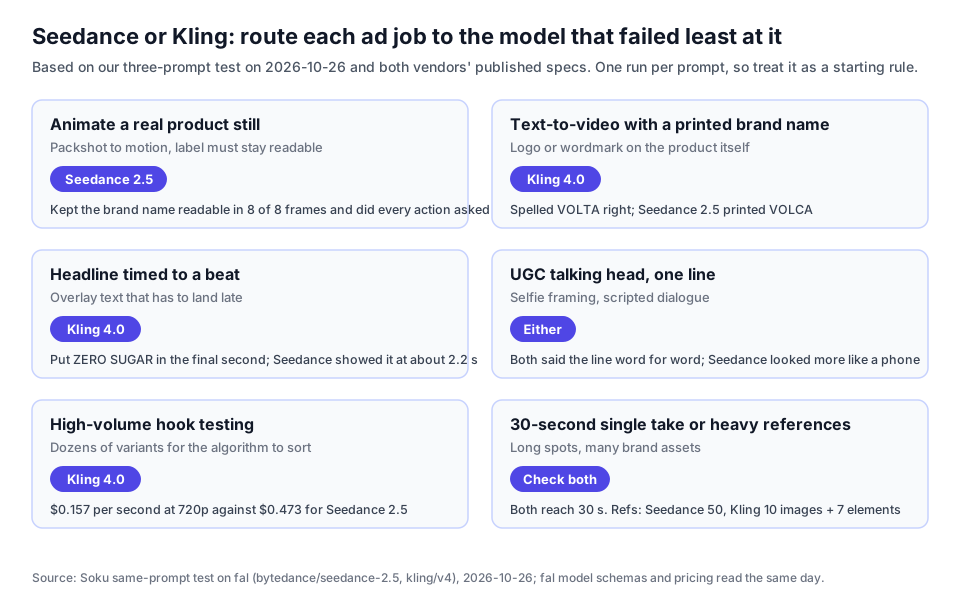
You animate existing product photography (ecommerce, DTC, catalogue ads). Start with Seedance 2.5 image-to-video. In our test it was the only one of the two that kept the packshot intact. It is the expensive option, so prototype at 480p ($0.2205/s on fal) or in draft mode, then render the winner at 720p or 1080p.
You make dozens of text-to-video hook variants for the algorithm to sort. Start with Kling 4.0 at 720p. At $0.157 per second on fal, a 6-second hook costs $0.94, against $2.84 on Seedance 2.5. In our run it was also the better of the two at printed branding and timed overlays. If you want Seedance's look at a similar price, Seedance 2.0 Mini ($0.1547/s at 720p) is the like-for-like tier. We didn't test it here.
You run creator-style UGC ads. Either model will say a scripted line correctly. Pick on look. In our run, Seedance looked more like a real phone recording, and Kling looked like a lit beauty shoot. Both added or changed details on the product, so swap in your real product with a reference image before anything ships.
You need a 15 to 30-second single spot. Both now generate up to 30 seconds per job. Seedance 2.5 takes far more reference material (50 files against Kling's 10 images, 5 videos and 7 elements), and Kling 4.0 gives you an explicit shot list. At 720p a 30-second render costs about $14 on Seedance 2.5 and $4.71 on Kling 4.0 on fal, so test the concept short first.
You need 1080p or higher. Kling 4.0 at 1080p ($0.235/s) costs a fifth of Seedance 2.5 at 1080p ($1.164/s). For 4K today, Kling 3.0 4K is listed on fal at $0.42/s. Kuaishou says Kling 4.0 supports 4K too, but fal did not offer a 4K option for it on 2026-10-26.
You need an API you can rely on this quarter. Seedance 2.5 is generally available on BytePlus ModelArk and fal. Kling 4.0 is live on fal but not yet on Kling's own API (Kuaishou says developer API access is coming "soon"), so if you need a direct contract with Kuaishou, build on Kling 3.0 for now and plan the switch.
For the platform question rather than the model question, see Higgsfield vs Kling. Higgsfield resells Kling and Seedance under one credit meter, and that page covers when that is worth paying for. For finished ad tools built on top of these models, see the best AI video ad generators.
Where Soku Fits
Since we build in this space: Soku is an AI advertising agent, not a video model, and it does not make Seedance or Kling. This is what it runs, from its code:
- The Seedance video generator runs Seedance 2.0 Mini text-to-video (
bytedance/seedance-2.0/mini/text-to-video) on fal, at 480p or 720p and 4 to 15 seconds. It does not run Seedance 2.5. That is a deliberate cost choice: 2.5 costs about three times as much per second. - The Seedance 2.5 page runs Seedance 2.5 itself (
bytedance/seedance-2.5text-to-video, and reference-to-video when you attach references), at 480p or 720p and 4 to 15 seconds. - The Kling 3 page runs Kling 3.0 Turbo Pro text-to-video (
fal-ai/kling-video/v3/turbo/pro/text-to-video), at 1080p only and 3 to 15 seconds, priced from fal's $0.14-per-second list rate. No Soku surface runs Kling 4.0 yet. - In the Creatives canvas, Seedance 2.0 Mini is the default engine for a fresh clip. Seedance 2.5, Seedance 2.0 Fast and Kling 3 are among the video engines you can pick. Kling 3 and Seedance 2.0 Fast run text-to-video only there.
- Where Soku differs from a raw model API is the step after the clip. It can put creatives into campaigns on the ad platforms it connects to and report how they perform, which is how you find out which of your Seedance or Kling variants actually sells. It does not make either model better or cheaper than buying it from fal, BytePlus or Kling directly.
Sources
Read on 2026-10-26 unless noted:
- ByteDance Seed, Seedance 2.5 model page (30-second storytelling, extensions, editing): <https://seed.bytedance.com/en/seedance2_5>
- BytePlus, Dreamina Seedance 2.5 product and token bundle pricing: <https://www.byteplus.com/en/product/seedance>
- TechNode, "ByteDance launches Seedance 2.5 video-generation model" (2026-07-31; reference limits, rollout): <https://technode.com/2026/07/31/bytedance-launches-seedance-2-5-video-generation-model/>
- Kuaishou, Kling 4.0 launch release (2026-10-19; launch date, 30-second generation, Omni Reference, HDR, 4K, API plans), via Bernama-GLOBE NEWSWIRE: <https://mrem.bernama.com/viewsm.php?idm=55628> and <https://bernama.com/en/press/news.php?id=2622471>
- Kling API pricing (Kling 4.0 preview rates, Kling 3.0 rates, unit price): <https://kling.ai/dev/pricing>
- fal, Seedance 2.5 text-to-video (pricing, token formula, schema): <https://fal.ai/models/bytedance/seedance-2.5/text-to-video>
- fal, Seedance 2.5 image-to-video and reference-to-video: <https://fal.ai/models/bytedance/seedance-2.5/image-to-video>, <https://fal.ai/models/bytedance/seedance-2.5/reference-to-video>
- fal, Seedance 2.0 Fast and Mini text-to-video: <https://fal.ai/models/bytedance/seedance-2.0/fast/text-to-video>, <https://fal.ai/models/bytedance/seedance-2.0/mini/text-to-video>
- fal, Kling 4.0 text-to-video, image-to-video and reference-to-video (pricing, schema): <https://fal.ai/models/kling/v4/text-to-video>, <https://fal.ai/models/kling/v4/image-to-video>, <https://fal.ai/models/kling/v4/reference-to-video>
- fal, Kling 3.0 Turbo Pro, Kling 3.0 Pro and Kling 3.0 4K: <https://fal.ai/models/fal-ai/kling-video/v3/turbo/pro/text-to-video>, <https://fal.ai/models/fal-ai/kling-video/v3/pro/text-to-video>, <https://fal.ai/models/fal-ai/kling-video/v3/4k/text-to-video>
- fal, "What is Kling 4.0?" (Kling 4.0 Flash early access, 4K and HDR status): <https://fal.ai/learn/tools/what-is-kling-4-0>
Comparing something else? Browse all competitor breakdowns.