
 Soku AI
Sora vs Veo (2026): Which AI Video Model Is Better for Ads Now That Sora Is Shut Down?
Sora vs Veo for ad creative, verified 2026-10-21. OpenAI shut the Sora app on April 26, 2026 and the Sora 2 API on September 24, 2026. Veo 3.1 costs $0.40/s with audio, or $0.10/s on Fast, and has its own retirement dates. Includes specs, last published Sora prices, and a same-prompt Veo 3.1 test with cost per usable second.
Prices and feature claims last verified against both vendors' own published pages on 2026-10-21.
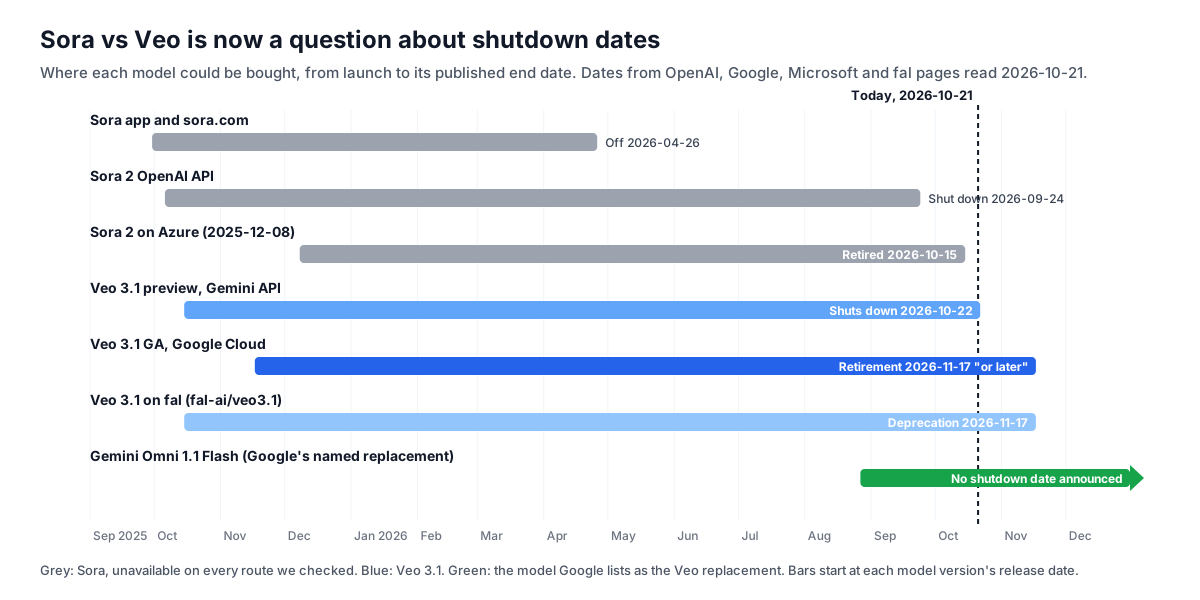
Most "Sora vs Veo" articles compare two models you can buy. In October 2026 you can't. OpenAI shut down the Sora app on April 26, 2026 and the Sora 2 API on September 24, 2026. Microsoft retired the last listed Azure version of Sora 2 on October 15, 2026, and fal's Sora 2 endpoint now returns a 404. So the head-to-head question has changed. It is no longer "which one is better". It is "what did Sora give you, what does Veo give you today, and how long will Veo itself be around?"
This page answers those three questions using only the vendors' own pages, read on 2026-10-21. For the Sora side we use its specs and the last prices OpenAI published (an archived OpenAI pricing page from February 2026). For the Veo side we use today's Google and fal pages. We also ran three ad prompts through Veo 3.1 and Veo 3.1 Fast on fal to measure cost per usable second. We planned to run the same prompts on Sora 2, but no live endpoint was left to run them on.
Neither model is ours. We build an AI advertising agent that happens to run Veo 3.1, so there is a short section on that at the end, after the comparison.
The Short Answer
- For ads you make today, Veo wins by default. Sora 2 is not sold on any route we checked: OpenAI's app, OpenAI's API, Azure, and fal.
- Veo 3.1 has a clock running too. Google's Gemini API preview models for Veo 3.1 shut down on October 22, 2026, with Gemini Omni 1.1 Flash named as the replacement. The GA model on Google Cloud lists a retirement date of November 17, 2026 "or later", and fal lists its main Veo 3.1 endpoint for deprecation on November 17, 2026.
- On price, Veo 3.1 Fast now matches what sora-2 used to cost. Both are $0.10 per second at 720p with audio, Veo on Google's list and Sora on OpenAI's last published list. Standard Veo 3.1 is $0.40 per second. That is above sora-2-pro's $0.30 at 720p and below its $0.50 at the larger size.
- In our same-prompt test, neither Veo tier spelled a product name correctly on the bottle, but both rendered the overlay headline correctly. Both delivered a short line of dialogue word for word. Standard Veo 3.1 handled the water physics better, and on this sample it cost $0.64 per usable second against $0.45 for Fast.
What Happened To Sora
Sora 2 launched on September 30, 2025 as a social iOS app with a new video-and-audio model. API snapshots followed (the first is dated sora-2-2025-10-06). Six months later, on March 24, 2026, OpenAI said it would discontinue Sora. Reuters, Bloomberg and VentureBeat covered the announcement that day. An OpenAI spokesperson told VentureBeat the company had decided "to discontinue Sora in the consumer app and API," and that the Sora research team would focus on world simulation for robotics.
The dates that matter, from OpenAI's own pages:
| Event | Date | Source |
|---|---|---|
| Sora 2 and the Sora app launch | 2025-09-30 | OpenAI, "Sora 2 is here" |
| Discontinuation announced; developers notified | 2026-03-24 | OpenAI API deprecations page |
| Sora web and app experiences discontinued | 2026-04-26 | OpenAI Help Center |
Videos API, sora-2, sora-2-pro and all snapshots shut down | 2026-09-24 | OpenAI API deprecations page |
Azure OpenAI sora-2 (2025-12-08) retired | 2026-10-15 | Microsoft Foundry model retirement schedule |
OpenAI's deprecations table lists the replacement for every Sora model as "---". Its API reference now carries a banner: "The Sora 2 models and Videos API were shut down on September 24, 2026 and are no longer available. No one-to-one replacement API is available." The current OpenAI API pricing page has no video section at all.
If you made ads in Sora, the help center says you can export past content from sora.chatgpt.com/sunset, and that data is permanently deleted after any final export window. Do that first.
Veo's Own Clock
Veo is the model still standing, but you should not treat it as a stable foundation either. Read on 2026-10-21:
- Gemini API (Google AI Studio keys). The deprecations page lists
veo-3.1-generate-preview,veo-3.1-fast-generate-previewandveo-3.1-lite-generate-previewwith a shutdown date of October 22, 2026. The recommended replacement for all three isgemini-omni-1.1-flash. The Gemini API Veo guide still usesveo-3.1-generate-previewin its code samples, so code copied from it stops working tomorrow. - Google Cloud (Vertex AI, now documented as Gemini Enterprise Agent Platform). The Veo 3.1 model page lists
veo-3.1-generate-001andveo-3.1-fast-generate-001as GA, released November 17, 2025, with a retirement date of "November 17, 2026 or later". Veo 3.1 Lite (veo-3.1-lite-generate-001) is listed as Preview. The same Gemini API deprecations page points users of older Veo 3.0 and 2.0 models either to Omni 1.1 Flash or to these GA models on Google Cloud. - fal. The
fal-ai/veo3.1model page carries the line "This endpoint will be deprecated on November 17, 2026." We ran our test on it on October 21, and it worked normally.
So Veo 3.1 is the only one of the two you can buy today. On Google's and fal's own published dates, it has roughly four weeks left on its most common routes. Google's own forward path is Gemini Omni Flash. We compared that model against Veo 3.1 and Seedance for ad work in our four-way test, and covered it on its own in the Gemini Omni Flash guide.
Specs Side By Side
This is what each model offered through its API, from the vendors' documentation. Sora 2 is described as it was when it was sold.
| Sora 2 / Sora 2 Pro (OpenAI API, retired) | Veo 3.1 (Gemini API and Google Cloud) | |
|---|---|---|
| Clip lengths | 4, 8 or 12 seconds (default 4) | 4, 6 or 8 seconds. On the Gemini API, 1080p, 4K and reference images require 8 seconds |
| Sizes and ratios | 720x1280, 1280x720; Pro also priced at 1024x1792 and 1792x1024 | 9:16 and 16:9; 720p and 1080p on every tier, 4K on standard Veo 3.1; Lite stops at 1080p |
| Audio | Synced dialogue and sound effects, included in the per-second price | Native dialogue, sound effects and ambience. Google prices audio-on and silent separately |
| Image input | One input image used as the first frame; must match the output size | Image-to-video, first and last frame interpolation, and up to 3 reference images of a person, character or product |
| Making it longer | Remix of a completed video. The API reference also lists an extensions endpoint (4 to 20 seconds per segment) | Extension of 7 seconds at a time, up to 20 times, for Veo-generated videos up to 141 seconds (Gemini API) |
| People | Real people and public figures could not be generated; input images with human faces were rejected | Text-to-video allows people; image-to-video and reference images are limited to adults; EU, UK, CH and MENA are limited to adults on every mode |
| Other content rules | Only content suitable for under-18 audiences; copyrighted characters and music rejected | Safety filters and memorization checks; blocked generations are not charged |
| Provenance | Visible watermark on all outputs at launch, plus C2PA metadata | SynthID invisible watermark, verifiable on Google's SynthID platform |
| Outputs per request | 1 per job (the create call has no count parameter) | 1 on the Gemini API; up to 4 per prompt on Google Cloud |
| Stated latency | OpenAI's model page rated Sora 2's speed "Slow" | Minimum 11 seconds, maximum 6 minutes at peak (Gemini API) |
Four of these rows mattered most for ad work.
Clip length. Sora's 12-second option covered a whole short-form spot in one generation. Veo's single generation stops at 8 seconds, so a 12 to 15-second ad means extending or editing clips together. For hook-first social ads that is often fine, because the first two or three seconds do most of the work. For a single-shot spot, it adds a step.
Faces in input images. Sora 2's API rejected input images that contained human faces. That ruled out the most common UGC-ad workflow: animating a still of a real creator or model you have rights to. Veo 3.1 accepts adult faces in image-to-video and reference images. For brands that run creator-led ads, this alone made Veo the more usable API even before Sora was shut down.
Product references. Veo 3.1 takes up to three reference images of a product and is documented to preserve its appearance. Sora 2 took one first-frame image. Our test below is text-only and shows why references matter: without them, Veo misspelled the product name on the bottle every time.
Watermarking. Sora put a visible watermark on outputs at launch. Veo uses an invisible SynthID watermark. For paid placements a visible mark is a practical problem. An invisible one is not, though it still lets anyone with a SynthID checker identify the clip as AI-generated, so plan your AI-content disclosure as if it will be detected.
Prices, Verified 2026-10-21
Veo 3.1 (live)
From Google's Gemini API pricing page and the Google Cloud generative AI pricing page, read 2026-10-21. Both list the same audio-on rates. Google Cloud's table labels the unit "1 count"; the Gemini API labels it "per second".
| Tier | With audio, 720p | With audio, 1080p | With audio, 4K | Silent, 720p (Google Cloud) |
|---|---|---|---|---|
| Veo 3.1 | $0.40/s | $0.40/s | $0.60/s | $0.20/s |
| Veo 3.1 Fast | $0.10/s | $0.12/s | $0.30/s | $0.08/s |
| Veo 3.1 Lite (Preview on Google Cloud) | $0.05/s | $0.08/s | Not supported | $0.03/s |
From fal's fal-ai/veo3.1 model page, read 2026-10-21: standard is $0.20 per second silent or $0.40 with audio at 720p or 1080p, and $0.40 or $0.60 at 4K. Fast is $0.10 silent or $0.15 with audio at 720p or 1080p, and $0.30 or $0.35 at 4K. fal notes that Lite is available on Google's own platforms and not on fal. Our fal usage record for the test below billed exactly these rates: $0.40 per second on fal-ai/veo3.1 and $0.15 per second on fal-ai/veo3.1/fast.
The gap that matters: Veo 3.1 Fast with audio is $0.10 a second from Google and $0.15 from fal. If you generate at volume and can work with Google's APIs directly, that is a third off your bill.
Sora 2 (historical, no longer sold)
OpenAI's current pricing page lists no video model. The last version we could read is an archived copy of platform.openai.com/docs/pricing captured on 2026-02-07:
| Model | Size | Price per second (audio included) |
|---|---|---|
sora-2 | 720x1280 or 1280x720 | $0.10 |
sora-2-pro | 720x1280 or 1280x720 | $0.30 |
sora-2-pro | 1024x1792 or 1792x1024 | $0.50 |
What one clip costs
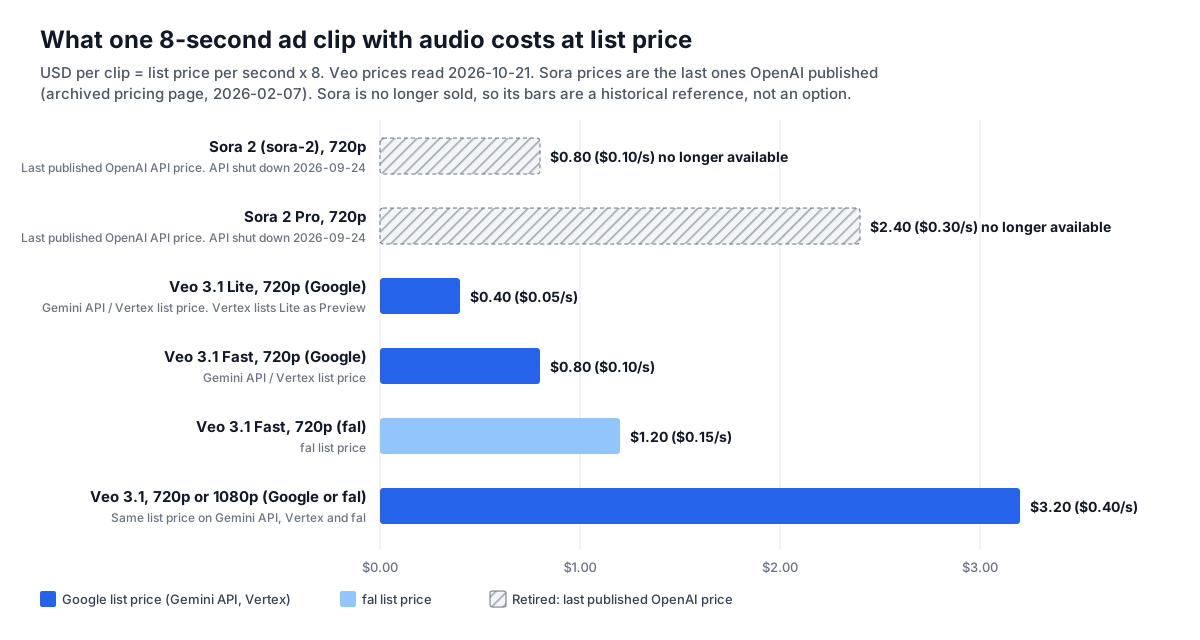
Our arithmetic on the list prices above, for one clip with audio:
| Clip | Sora 2 (retired) | Sora 2 Pro 720p (retired) | Veo 3.1 Lite (Google) | Veo 3.1 Fast (Google) | Veo 3.1 Fast (fal) | Veo 3.1 (Google or fal) |
|---|---|---|---|---|---|---|
| 4 s, 720p | $0.40 | $1.20 | $0.20 | $0.40 | $0.60 | $1.60 |
| 8 s, 720p | $0.80 | $2.40 | $0.40 | $0.80 | $1.20 | $3.20 |
| 12 s | $1.20 (one clip) | $3.60 (one clip) | Needs an extension | Needs an extension | Needs an extension | Needs an extension |
| Test matrix: 10 hooks x 2 ratios x 8 s | $16 | $48 | $8 | $16 | $24 | $64 |
On list price, Veo 3.1 Fast from Google costs exactly what sora-2 did, and Lite costs half. Standard Veo 3.1 is 4× the old sora-2 rate and 1.33× sora-2-pro at 720p. Whether that premium is worth it depends on how many clips you throw away, which is what the test below tries to measure.
Our Test: Three Ad Prompts, Veo 3.1 vs Veo 3.1 Fast
We planned to render the same ad prompts in Sora 2 and Veo 3.1. On 2026-10-21 there was no Sora 2 endpoint left to call. OpenAI's API is shut down, Azure's last Sora 2 version was retired on October 15, and fal's fal-ai/sora-2/text-to-video page returns a 404, and fal's schema endpoint for it returns nothing. So we ran the prompts through the two Veo 3.1 tiers you would actually choose between today, and we report Sora only on its documented specs above.
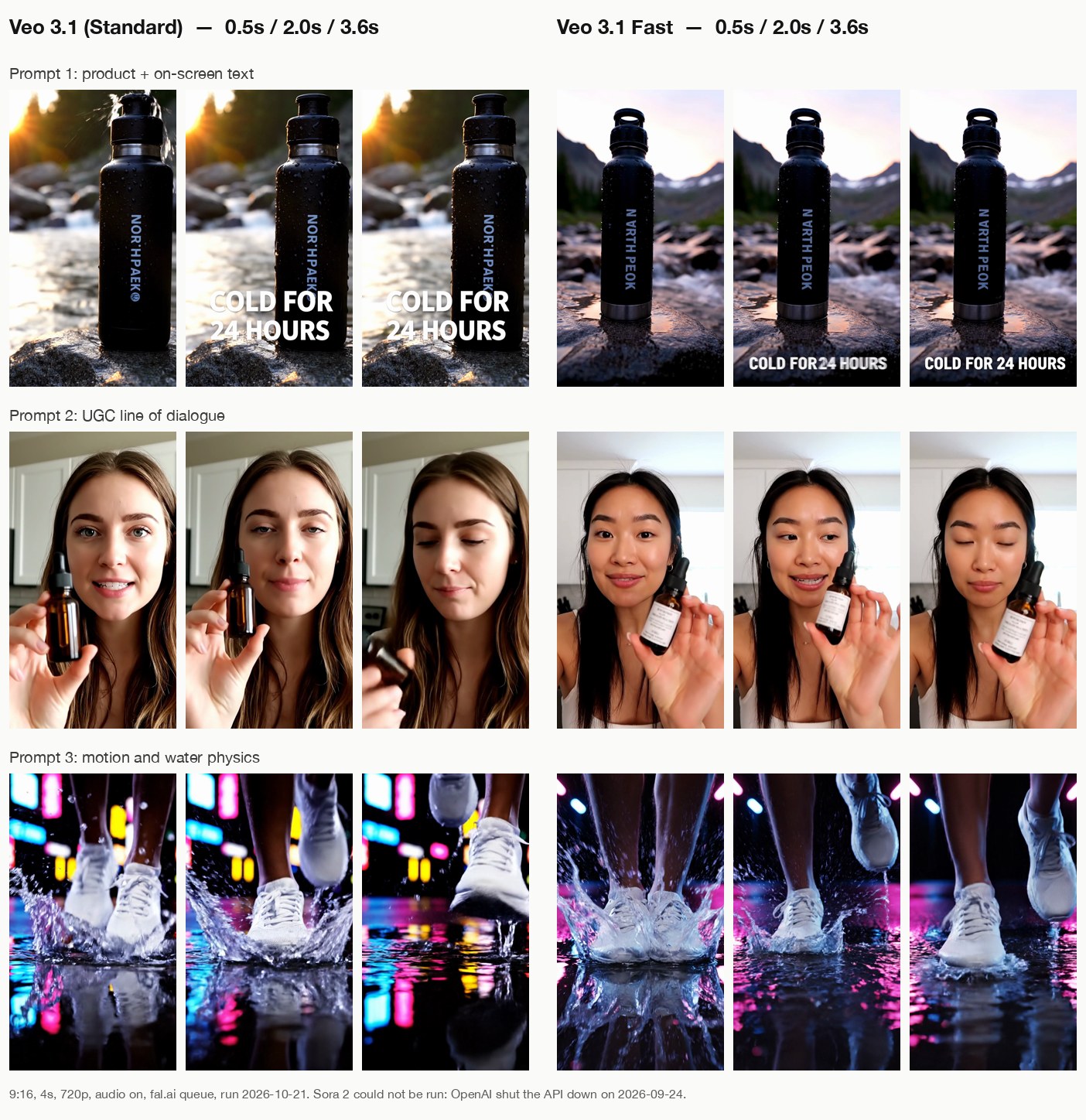
Setup. Three prompts written the way an ad team would write them, each aimed at a known weak spot: text on a product and an on-screen headline, a line of UGC dialogue, and fast motion with water. Each ran once on fal-ai/veo3.1 and once on fal-ai/veo3.1/fast at 9:16, 4 seconds, 720p, audio on, no seed, no negative prompt, no reference images. Six jobs, submitted to fal's queue on 2026-10-21. We read the frames ourselves and transcribed the audio with Whisper.
The prompts:
- Product + text: a matte black insulated water bottle with the word NORTHPEAK on it, on a wet rock by a mountain stream at sunrise, slow push-in, and the on-screen text "COLD FOR 24 HOURS" in the final second. NORTHPEAK is a made-up brand, chosen so neither model could have seen it.
- UGC dialogue: a selfie-style video of a woman in a kitchen holding up an amber serum bottle and saying, "Two weeks of this every morning, and my skin finally feels calm."
- Motion: a low close-up of white running shoes splashing through a puddle on a neon-lit street at night, slow-motion spray, the runner continuing out of frame, with footsteps and an electronic beat.
What each did
| Prompt | Veo 3.1 (standard) | Veo 3.1 Fast |
|---|---|---|
| 1. Product + on-screen text | Strong look: backlit sunrise, droplets, a plausible splash. The label reads "NOR'HPAEK", not NORTHPEAK. "COLD FOR 24 HOURS" is spelled correctly, but it appears by about 1.6 s, not in the final second, and sits over the bottle. Ambient audio only. | Flatter dusk light, cleaner composition. The label reads "NARTH PEOK", with one letter mirrored. The overlay first renders as "COLD FOR24 HOURS", then settles to the correct "COLD FOR 24 HOURS" by about 2.5 s. |
| 2. UGC dialogue | The line was transcribed word for word, and in the frames we checked her mouth moves through it. Believable selfie framing and window light. In the last half-second she lowers the bottle out of frame with some motion blur. | The line was also transcribed word for word, with similar delivery. The bottle gains a printed label with illegible pseudo-text, which nobody asked for. Framing is steady throughout. |
| 3. Motion and water | Convincing splashes and neon reflections. The runner runs in place rather than leaving the frame, and the "street" reads as a studio set with bokeh. | Same in-place running and studio feel. Water hangs from the soles in rope-like strands in several frames, the most visible physics error in the test. |
On text, there is a pattern. Both tiers rendered the large overlay headline correctly, and both misspelled the small brand name printed on the product. A headline that floats over the shot is easy. Lettering that has to wrap around a curved object is not. In practice, if your product has a logo, give Veo a reference image of it, or add the brand name and price as an edit overlay after generation. Do not trust text-to-video to print it.
On audio, both tiers delivered the scripted line exactly within a 4-second clip. On the clips without dialogue, Whisper returned only filler such as "Thanks for watching", a known Whisper artefact on music and ambience. We read that as transcription noise, but we did not check every clip by ear. Loudness did differ: the water-and-music clip came out loud on both (about -8 to -10 dB mean volume), while the stream ambience sat around -30 dB.
Latency and cost per usable second
| Veo 3.1 (standard) | Veo 3.1 Fast | |
|---|---|---|
| fal request IDs | 01a15bcf-4e44-7e12-92f0-3f42d1215143, 01a15bcf-54c6-7ba2-91c4-7c5955d53364, 01a15bcf-5b4b-7160-b739-27c8610e6c84 | 01a15bcf-519a-7742-9337-fd67033ab7e1, 01a15bcf-5814-7a92-8589-5157672c8e33, 01a15bcf-5e85-7d42-a3d3-eef3caed1b6d |
| fal-reported inference time (prompts 1, 2, 3) | 52.9 s, 54.1 s, 53.8 s | 57.9 s, 47.2 s, 63.4 s |
| Wall clock from submit to result (10 s polling) | 71 s, 74 s, 63 s | 59 s, 60 s, 86 s |
| Seconds generated | 12 | 12 |
| Actual billed cost (fal usage API) | $4.80 | $1.80 |
| Usable seconds (our judgement, trims allowed) | 7.5: prompt 2 trimmed to 3.5 s, prompt 3 in full | 4.0: prompt 2 in full |
| Cost per usable second | $0.64 | $0.45 |
How we judged "usable": could the clip go into a paid-social concept test after a trim, without regenerating? Prompt 1 failed on both tiers because a misspelled brand name on the product is not shippable. Prompt 3 on Fast failed because of the water strands. Prompt 2 on Fast passed for a concept test, but the invented label text would have to go before it ran for a real brand. These are judgement calls on a sample of three, and the numbers would move with a different sample, so treat them as an illustration of the method, not a benchmark.
Two observations hold despite the small sample:
- Fast was not faster on fal in this run. Its median inference time (57.9 s) was slightly above standard's (53.8 s). On fal, the reason to pick Fast is price, not turnaround.
- Standard's lower discard rate narrowed the price gap, but did not close it. At list price, standard costs 2.7× Fast on fal. Per usable second it cost 1.4× in our run. If you are making a few hero clips, standard's better physics is cheap insurance. If you are making forty hook variants for an algorithm to sort, Fast's price wins, and even more so at Google's $0.10 rate.
For comparison, sora-2's last published price was $0.10 per second. Without a discard rate we can't compute its cost per usable second, and we will not guess one.
Which One To Choose
The real choice in October 2026 is between the routes that are still open, so this section is about which Veo tier to pick, or whether to skip Veo altogether.
You were using Sora 2 (the $0.10/s tier) for quick concepts and social drafts. Move to Veo 3.1 Fast at the same $0.10 per second from Google (or $0.15 on fal). You lose single 12-second clips and gain 9:16 and 16:9 at up to 1080p, adult faces in image-to-video, and product reference images.
You were using Sora 2 Pro for polished marketing footage. Move to standard Veo 3.1. At 720p it costs more per second than sora-2-pro ($0.40 against $0.30), and less than sora-2-pro's large size ($0.50) while offering 1080p and 4K.
You run UGC or creator-led ads. Veo 3.1 was the better fit even before the shutdown, because Sora 2's API rejected input images with human faces. Use Veo's image-to-video or reference images with footage you have the rights to.
Your product has a logo or label that must be legible. Neither tier got our made-up brand name right from text alone. Use reference images, or generate the shot without text and add the lettering in an edit.
You are starting a new pipeline today. Read the dates first. The Gemini API preview IDs end on October 22, 2026. Google Cloud's GA models and fal's main endpoint list November 17, 2026. If you need something that lasts beyond the next few weeks, evaluate Gemini Omni 1.1 Flash, which Google names as the replacement and which has no announced shutdown date, against Veo 3.1 on Google Cloud. Our Omni Flash vs Veo vs Seedance test is the place to start. For a list of finished ad tools built on top of these models, see the best AI video ad generators.
You want the cheapest clips for volume testing. Neither Sora nor standard Veo was ever the cheapest option. Veo 3.1 Lite on Google ($0.05 per second with audio) and Seedance models on fal sit below both.
Where Soku Fits
Since we build in this space: Soku is an AI advertising agent, not a video model, and it does not make or resell Sora. Here is what it actually runs, from its code:
- Veo 3.1 is available on the Veo 3.1 model page and as a text-to-video engine in the Creatives canvas. Both call fal's
fal-ai/veo3.1endpoint at 4, 6 or 8 seconds (default 4), 720p or 1080p, in 9:16 or 16:9 (default 9:16), with audio always on. Soku prices it in credits from fal's $0.40-per-second with-audio list price. Because it runs on that fal endpoint, it is also subject to fal's November 17, 2026 deprecation notice. What Soku runs under the Veo name after that date depends on what fal and Google ship. - The /tools/sora generator does not run Sora. Its generator calls ByteDance's Seedance 2.0 Mini text-to-video (
bytedance/seedance-2.0/mini/text-to-video) on fal. Searchers who land on it get a Seedance clip, not an OpenAI one. - Where Soku does differ from a raw model API is the step after the clip: it can put creatives into campaigns on the ad platforms it connects to and report on how they perform. That is useful when you are testing many Veo variants. It does not make Veo itself any better or cheaper than buying it from Google or fal directly.
Sources
Read on 2026-10-21 unless noted:
- OpenAI Help Center, "What to know about the Sora discontinuation": <https://help.openai.com/en/articles/20001152-what-to-know-about-the-sora-discontinuation>
- OpenAI API deprecations (Sora 2 and Videos API entry dated 2026-03-24): <https://developers.openai.com/api/docs/deprecations>
- OpenAI API reference, Create video (shutdown banner; seconds and size values): <https://developers.openai.com/api/reference/resources/videos/methods/create>
- OpenAI API pricing, current (no video section): <https://platform.openai.com/docs/pricing>
- OpenAI API pricing, archived 2026-02-07 (Sora 2 per-second prices): <http://web.archive.org/web/20260207123851/https://platform.openai.com/docs/pricing>
- OpenAI video generation guide, archived 2026-01-04 (guardrails, input reference, remix): <http://web.archive.org/web/20260104144957/https://platform.openai.com/docs/guides/video-generation>
- OpenAI, "Sora 2 is here" and "Launching Sora responsibly" (watermark and C2PA): <https://openai.com/index/sora-2/>, <https://openai.com/index/launching-sora-responsibly/>
- Microsoft Foundry model retirement schedule (Azure
sora-2): <https://learn.microsoft.com/en-us/azure/foundry/openai/concepts/model-retirement-schedule> - Reuters and VentureBeat coverage of the March 24, 2026 announcement: <https://www.reuters.com/technology/openai-set-discontinue-sora-video-platform-app-wsj-reports-2026-03-24/>, <https://venturebeat.com/technology/openai-is-shutting-down-sora-its-powerful-ai-video-app>
- Google Gemini API pricing (Veo 3.1, Gemini Omni Flash): <https://ai.google.dev/gemini-api/docs/pricing>
- Google Gemini API Veo guide (durations, references, extension, limitations): <https://ai.google.dev/gemini-api/docs/veo>
- Google Gemini API deprecations (Veo and Omni Flash models): <https://ai.google.dev/gemini-api/docs/deprecations>
- Google Cloud Veo 3.1 model page (GA versions, retirement date): <https://docs.cloud.google.com/gemini-enterprise-agent-platform/models/veo/3-1-generate>
- Google Cloud generative AI pricing (Veo table): <https://cloud.google.com/vertex-ai/generative-ai/pricing>
- fal Veo 3.1 model page (pricing, deprecation notice): <https://fal.ai/models/fal-ai/veo3.1>
- fal Sora 2 text-to-video page (returns 404): <https://fal.ai/models/fal-ai/sora-2/text-to-video>
Comparing something else? Browse all competitor breakdowns.