 Soku AI
Most Snapchat ad accounts are quietly losing money for a reason that has nothing to do with bidding, budgets, or targeting. They are running creative that was never built for Snapchat. A 16:9 spot trimmed from a YouTube cut, a Meta static resized to fit, a TikTok export with the wrong safe zones — uploaded, launched, and left to underperform.
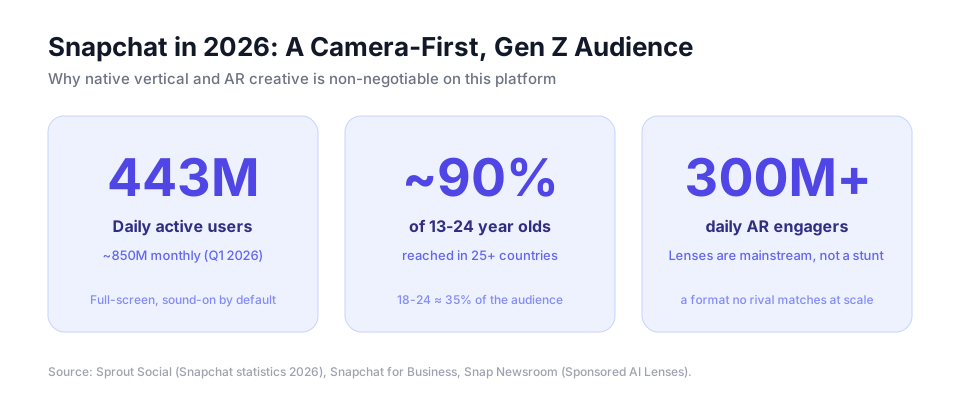
Here is the thesis of this guide: Snapchat creative fails when brands repurpose horizontal or Meta assets, and AI is the only practical way to produce native vertical, AR-first variants at the velocity Snapchat's young, fast-scrolling audience demands. Snapchat reaches roughly 90% of 13-to-24-year-olds in over 25 countries (Snapchat for Business) — an audience that swipes faster, expects sound-on, and rewards camera-native AR over polished broadcast spots. You cannot win that audience with leftovers from another platform.
This is a practical playbook: the platform realities that make Snapchat different, the formats that matter, the creative rules that move metrics, and an AI-powered workflow for producing winning variants at scale.
Why Snapchat Creative Is Its Own Discipline
Snapchat is not a smaller version of Meta or a Stories-only TikTok. It is a camera-first product whose entire surface assumes vertical, full-screen, sound-on attention.
The audience makes the stakes clear. Snapchat reported roughly 443 million daily active users and around 850 million monthly active users in Q1 2026 (Sprout Social), with 18-to-24-year-olds making up about 35% of the audience and 25-to-34-year-olds the next largest cohort. More importantly for advertisers, the platform reaches roughly 90% of all 13-to-24-year-olds across 25-plus countries. If your buyer is Gen Z or younger Millennial, this is not an optional channel.
And this audience lives in the camera. Snap reports that over 300 million Snapchatters engage with augmented reality every single day (Snap Newsroom). AR is not a gimmick bolted onto Snapchat — it is a core behavior. An ad strategy that ignores Lenses is leaving the platform's most distinctive surface untouched.
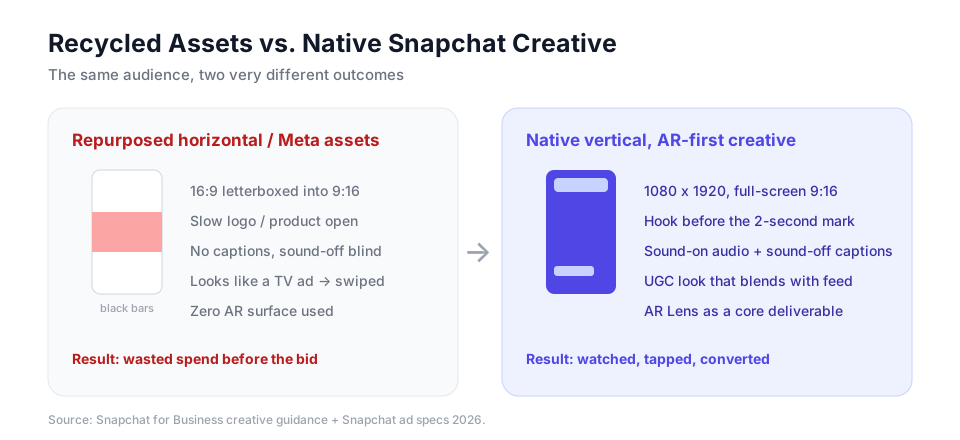
The technical implication of all this is unforgiving. Snapchat creative is 1080 x 1920px, 9:16, full-screen (Snapchat ad specs). A horizontal asset letterboxed into that frame wastes two-thirds of the screen on black bars. A Meta-native static designed for a 4:5 feed slot loses its composition. The medium itself punishes recycled assets before a single dollar of spend is wasted on a bad bid.
The Snapchat Ad Formats That Matter
Before talking creative, you need to know the canvas. Snapchat's core formats each demand a different creative approach.
- Single Image or Video Ads (Snap Ads): The workhorse — full-screen vertical video or image that appears between content like Stories and Shows, with a swipe-up action. Snap notes these are most effective when short; under 10 seconds tends to outperform.
- Story Ads: A tappable series of 3-20 image or video frames in a single placement, ideal for a brand narrative or a multi-product walkthrough.
- Collection Ads: A hero video or image with four tappable product tiles, built for commerce. Paired with Dynamic Ads, the tiles auto-populate from your product catalog — a format Snap has credited with strong revenue growth.
- Commercials: Non-skippable for up to 6 seconds (and up to 3 minutes total), appearing within Snap's curated content. This is your guaranteed-attention format, so the first 6 seconds have to earn the rest.
- Spotlight Ads: Ads inside Snapchat's TikTok-style scrollable UGC feed — one of the faster-growing impression surfaces, where native text, stickers, and a fast visual hook are mandatory to blend in.
- AR Lenses and Filters: Interactive camera experiences where the user becomes part of the ad. This is the format no other major platform can match at Snapchat's scale.
The pattern across all of them is the same: vertical, full-screen, fast, and camera-native. None of these formats reward a repurposed horizontal asset, and several of them (AR Lenses, Collection, Spotlight) have no clean equivalent on Meta at all.
The Creative Rules That Actually Move Metrics
Snapchat's creative best practices are remarkably consistent across the platform's own guidance and independent benchmarks. Four rules do most of the work.
1. Win the first two seconds
Snapchatters swipe fast. Snap's creative guidance is explicit: establish your brand moment before the two-second mark and open with dynamic footage, not a static logo or a slow product pan (Snapchat ad specs guidance). On Spotlight, the most successful ads land a visual hook in the first half-second. There is no warm-up. The opening frame is the ad.
2. Design for sound-on, caption for sound-off
Snapchat is a sound-on environment by default — audio should land in the first 1-2 seconds. But many users still browse muted, so bold text overlays and captions are non-negotiable. The winning creative works both ways: it hits with audio and it still communicates the message on mute.
3. Make ads that don't look like ads
The single most repeated rule: Snapchat ads work best when they fit Snapchat's look and feel. UGC-style, creator-shot, lo-fi content consistently beats polished broadcast production — the same lesson that defines winning TikTok creative. A spot that screams "TV commercial" gets swiped. A clip that looks like it came from a friend gets watched.
4. Use AR as a format, not a stunt
Branded AR Lenses average meaningful interactive playtime and drive lift in purchase intent because the user is holding the brand, not just viewing it. With 300M+ daily AR users, a Lens is a mainstream creative format on this platform — treat it as a core deliverable, not a one-off activation.
Where AI Changes the Game
Here is the tension. Snapchat demands native vertical video, captions, multiple format variants, and AR Lenses — and it demands them fresh, because a fast-scrolling young audience burns through creative quickly. Producing that volume by hand is slow and expensive. This is exactly the gap AI closes.
Snapchat itself is leaning into generative AI. The platform launched Sponsored AI Lenses, an ad format built on Snap's proprietary generative AI that lets Snapchatters insert themselves into branded AI-generated visuals — Snap says brands using the format can access 25-45% more impressions in a single day (Snap Newsroom). Snap's own creator tooling now includes AI image-to-video generation in Lens Studio, and the company has stated it will keep investing in AI tools that let teams of any size produce premium ad creative. The platform is signaling, loudly, that AI-native creative is the future of the surface.
AI helps Snapchat advertisers in three concrete places:
- Volume creative generation. Turn one core concept into dozens of native vertical variants — different hooks, captions, pacing, and CTAs — without a full reshoot. AI video ad generators make 9:16 the default output rather than an afterthought, so you are no longer cropping landscape footage into a phone-shaped hole.
- Localization at scale. Snapchat's reach spans dozens of markets. AI lets you swap voiceover, on-screen text, and captions per language and culture without rebuilding the edit each time — critical for a platform whose strongest audiences span North America, Europe, the Middle East, and beyond.
- Variant testing velocity. The fast-decay nature of Gen Z attention means you need to test constantly and refresh winners before they fatigue. The discipline of producing 100+ ad variants with AI is what keeps a Snapchat account from going stale — feeding the algorithm a steady stream of fresh, native creative to find and scale the next winner.
The 86% of buyers who already use or plan to use generative AI for video advertising aren't doing it for novelty — they're doing it because manual production can't keep pace with the variant volume modern platforms reward.
A Concrete Snapchat AI Creative Workflow
Here is a repeatable loop that turns the principles above into a system.
- Start from the angle, not the asset. Identify the message that resonates with your Snapchat audience — a problem, a moment, a transformation. Do not start from an existing horizontal cut.
- Generate native vertical variants. Use AI video tooling to produce 8-15 9:16 cuts of the angle, each with a distinct first-two-seconds hook and caption treatment. Build for sound-on and sound-off in every variant.
- Add at least one AR-first concept. Spin up a branded Lens or Filter idea — increasingly achievable with AI-assisted Lens tooling — so you are testing the platform's most native format, not just video.
- Map variants to formats. Route short punchy cuts to Snap Ads and Spotlight, a multi-frame narrative to Story Ads, and catalog-driven cuts to Collection/Dynamic Ads. One angle, many format-native expressions.
- Launch, read the data, refresh fast. Kill underperformers early, identify the winning hook pattern, and feed that pattern back into the next AI generation batch before the winner fatigues.
This loop is only sustainable with AI doing the heavy lifting on production. The strategic judgment — the angle, the format mapping, the read on what's winning — is where the human stays in the loop.
AI Ad Creative for Snapchat Games
Mobile games are the single biggest advertiser category on Snapchat's audience profile, and game creative behaves differently enough from brand creative to deserve its own rules. Start with the correction that most guides get wrong.
Snapchat does not publish a playable ad format. As of 2026-07-31, Snapchat's own ad formats page names seven formats — Sponsored Snaps, Single Image or Video, Story Ads, Collection Ads, Commercials, AR Lenses and AR Filters. There is no playable, no interactive end card and no dedicated game unit on that list. If you have read otherwise, that source is describing a different platform or a format Snapchat does not document publicly. Plan around the seven formats that exist.
That constraint is the whole strategy. Because you cannot let someone play the game inside the ad, the creative has to do the job a playable normally does: prove the core loop is fun, in a few seconds, without interaction.
The four rules that differ for games
1. Show gameplay, not cinematics. The most common failure in game creative is a rendered trailer with no footage of the actual game. Users are deciding whether the moment-to-moment loop looks satisfying. A cinematic answers a question nobody asked.
2. The first second must contain a decision. Not a logo, not a title card, not a slow reveal. Show the board state, the fail state, or the choice — the thing that makes a viewer think I would have done that differently. That reaction is what a playable buys, and it is reproducible in linear video.
3. Fail states outperform success states. Near-misses and deliberately wrong moves consistently hold attention better than flawless play, because a competent-looking run gives the viewer nothing to correct. This is the single most transferable trick from playable design into non-playable formats.
4. AR Lenses are the format most under-used by game advertisers. A Lens is the closest Snapchat gets to interactivity, and it maps naturally onto a game's characters, skins or mechanics — the user becomes the character rather than watching it. It is more production work than a video variant, which is exactly why most competitors skip it. On a camera-first platform, that is where the differentiation is.
Where AI actually helps here
Game creative is a volume problem with a narrow brief, which is the shape AI handles best:
- Hook permutation at scale. One gameplay capture, twenty opening seconds — different fail states, different UI callouts, different first-line copy. The footage is fixed; the hook is the variable, and the hook is what decides the outcome.
- Localisation without re-shooting. Games ship globally on day one. Generated voiceover and on-screen copy in a dozen languages against the same capture is a genuine cost collapse, not a marginal saving.
- Format fan-out. The same core capture has to become a 6-second non-skippable Commercial, a longer Single Video, and a Story Ad sequence. Those are different edits of one asset, and cutting them by hand is where creative teams lose their week.
What AI does not do is tell you which of the twenty hooks to fund. That is a measurement question, and it is the reason game UA teams end up with hundreds of variants and no ranking.
How Soku Fits
The hardest part of this workflow isn't generating creative — it's knowing which angle to generate more of, and how Snapchat performance compares to where else you're spending.
Soku analyzes your Snapchat ad performance alongside Meta, Google, and TikTok from a single conversation, so a winning hook on one platform becomes a tested hypothesis on another. Instead of treating Snapchat as a siloed channel run on recycled assets, Soku surfaces the creative angles that actually convert for your audience, flags creative fatigue before it drags down ROAS, and helps you decide where the next batch of native vertical variants should go. Connect your account through the Snapchat Ads integration to bring Snapchat into the same cross-platform view as the rest of your spend.
The Bottom Line
Snapchat rewards advertisers who treat it as its own discipline: vertical, full-screen, sound-on, AR-native creative built for an audience that decides in two seconds whether to watch or swipe. Repurposed horizontal and Meta assets don't just underperform — they signal to a young, camera-fluent audience that you don't understand their platform.
AI is what makes native-first achievable at scale. It collapses the cost of producing dozens of vertical variants, localizing across markets, and even building AR experiences — turning Snapchat's high creative bar from a barrier into an advantage for the brands willing to clear it. The brands that win on Snapchat in 2026 won't be the ones with the biggest budgets. They'll be the ones producing the most native, most tested, most fresh creative — at a velocity only AI makes possible.