 Soku AI
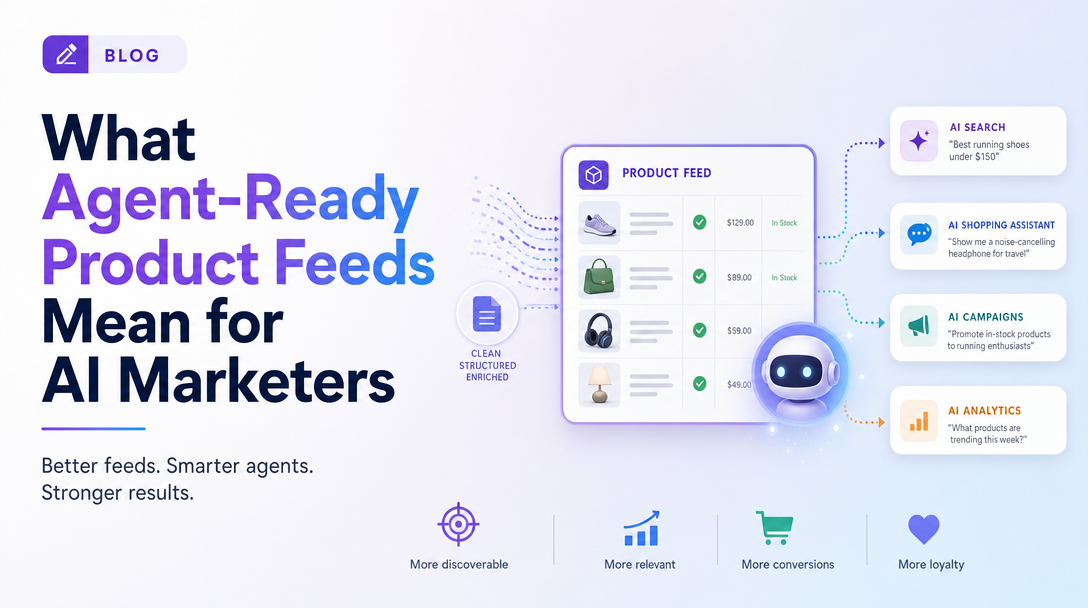
If you manage marketing for an ecommerce brand, a new kind of customer has started shopping your catalog — and it will never look at your site. It is an AI shopping agent, dispatched by a person who typed "find me a lightweight rain jacket under $150 with good reviews" into ChatGPT, Gemini, or Perplexity. The agent does not browse. It reads structured data, compares it against every competitor's structured data, and returns a shortlist. Whether you make that shortlist depends on one thing: whether your product feed is agent-ready.
This is the explainer. What agent-ready means, the four signals that decide it, why the old "SEO plus nice photos" playbook does not carry over, and why this lands on the marketing team's desk rather than IT's. For the complete overview of the channels, setup, and tooling, see the pillar: Agent-Ready Product Feeds: The 2026 Playbook for Selling to AI Buyers.
The definition, without the jargon
Agent-ready product data is structured, machine-parsable, real-time product information that an AI agent can directly query, interpret, and act on — to recommend and to sell your product.
The load-bearing words are machine-parsable and real-time. Most product data was built for a human browsing a website: it lives inside JavaScript-rendered templates, leans on photography to convey what the product is, and describes things in the language of persuasion. An agent cannot use any of that. It needs literal fields it can read without rendering a page, and it needs them to be true right now, because it may complete a purchase seconds after reading them.
The gap between "renders nicely for a human" and "an agent can consume it" is where most brands lose. Roughly 60% of ecommerce catalogs carry missing identifiers, inconsistent attributes, or stale inventory — the exact defects that make an agent quietly skip you in favor of a competitor whose data is clean.
The four signals of agent-readiness
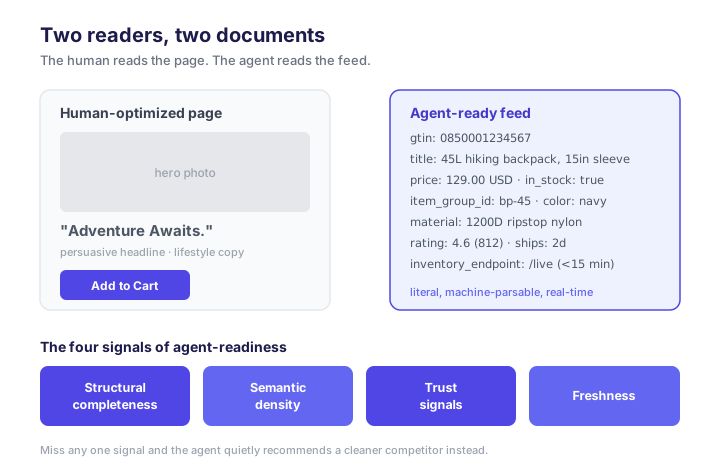
We audit every catalog against four signals. If you take one thing from this post, take this frame.
1. Structural completeness
An agent needs enough machine-readable fields to answer three questions without guessing: what is this, what does it cost, is it available? That means the core attributes are populated on every record — title, description, price, sale price, availability, GTIN, brand, category (in a real taxonomy), condition, shipping weight and dimensions, return policy, and image URLs.
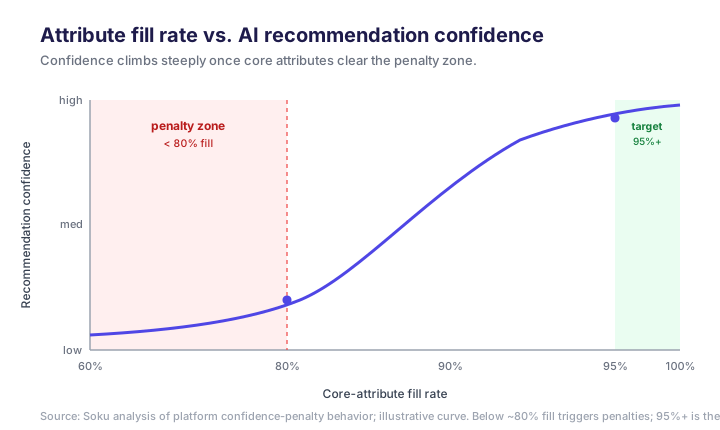
The working benchmark from platform behavior is a 95%+ fill rate on those core attributes. Drop below roughly 80% and platforms start applying confidence penalties — you are still in the catalog, but you are down-ranked in the recommendation set. Completeness is not glamorous, but it is the single biggest lever most brands have left untouched.
2. Semantic density
This is where marketers can add the most value, and where "SEO brain" actively hurts. An agent matches a shopper's natural-language query against the literal facts in your data, not against adjectives. Consider two descriptions of the same bag:
- Low density: "Premium quality backpack, perfect for all your adventures."
- High density: "45-liter technical hiking backpack with a padded 15-inch laptop sleeve, hydration-bladder compatible, hip-belt load distribution, 1,200-denier ripstop nylon."
The first is invisible to a query like "hiking backpack that fits a 15-inch laptop." The second is a direct hit. The rule we use: every description carries at least five machine-parseable facts — explicit dimensions, weight or capacity with units, material composition with percentages, and at least one concrete use case. Cut the superlatives; they are noise to the reader that matters now.
3. Trust signals
Agents are engineered to be cautious on a shopper's behalf, so they lean on trust signals: GTINs, verified reviews, accurate shipping data, and — critically — consistency between your on-page Schema.org markup and your submitted feed. When those disagree, the agent treats it as a quality failure.
GTINs are the sharpest signal. Products without them are excluded from Google's trust-based layers (Performance Max and Gemini recommendations) and get reduced confidence from ChatGPT's commerce engine. For genuinely GTIN-less products (handmade, private-label), the correct move is to set identifier_exists: false — not to leave the field blank, which reads as a defect.
4. Freshness
An agent that recommends your product and then discovers at checkout that it is out of stock has burned the shopper's trust — and the platform's. So platforms track merchant data reliability over time, and merchants with frequent out-of-stock or price mismatches get down-ranked in future recommendation rounds even after they fix the data. The guidance from the OpenAI and universal-commerce specs points to a 15-minute maximum lag for price and availability, with real-time API sync for high-velocity SKUs. Freshness is the one signal you cannot fake with a one-time cleanup.
Why the old playbook does not carry over
For a decade, ecommerce marketing meant winning the human: rank in Google's blue links, write persuasive copy, run retargeting. Agent-ready commerce breaks each of those assumptions.
- Ranking is against data, not pages. The agent does not read your blog post about "the best rain jackets." It reads feeds and executes against APIs. A detailed article will not lift your ChatGPT shopping rank the way a complete, accurate feed will. This is the commerce edge of the broader shift we cover in generative engine optimization and GEO vs SEO.
- Persuasion moves to facts. The agent is immune to your headline. It is persuaded by specificity: the fact that the jacket is 3-layer, 20K waterproof, weighs 310 grams, and has 4.6 stars across 800 reviews.
- The feed is the funnel. Discovery, comparison, and conversion increasingly happen inside the AI interface, off your site entirely. If your feed is thin, you are not "lower in the funnel" — you are absent from it.
Why this is a marketing problem, not an IT ticket
It is tempting to file "fix the feed" under engineering and move on. That is the mistake. Three of the four signals are marketing decisions in disguise:
- Semantic density is copywriting — deciding which facts matter to which buyer and stating them in parse-able form is a positioning and messaging job.
- Trust signals are merchandising — which products get reviews surfaced, how the catalog is structured, what taxonomy you claim.
- Channel coverage is media strategy — the same clean feed that wins organic AI placement is what makes your paid catalog campaigns (Advantage+, Performance Max, ChatGPT Ads) perform, because those are feed-driven too.
Only freshness is purely a plumbing problem. The rest is the marketing team's leverage — which is exactly why an AI shopping agent reading a thin feed is a marketing failure, not an IT one.
What to do next
Once you understand the four signals, the natural next questions are how do I set this up and which approach is worth it. Those are the next two spokes:
- Build it: Agent-Ready Product Feeds: A Hands-On Setup Guide for Meta and Google Ads — the exact operating sequence for the two channels most teams start with.
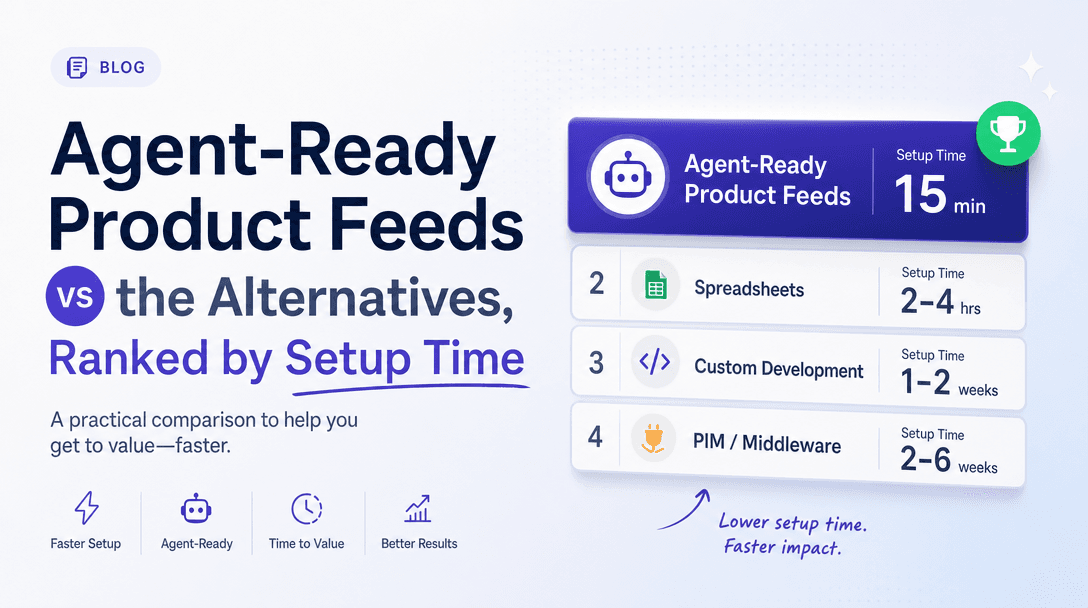
- Choose an approach: Agent-Ready Product Feeds vs the Alternatives, Ranked by Setup Time — a weighted ranking so you pick with data.
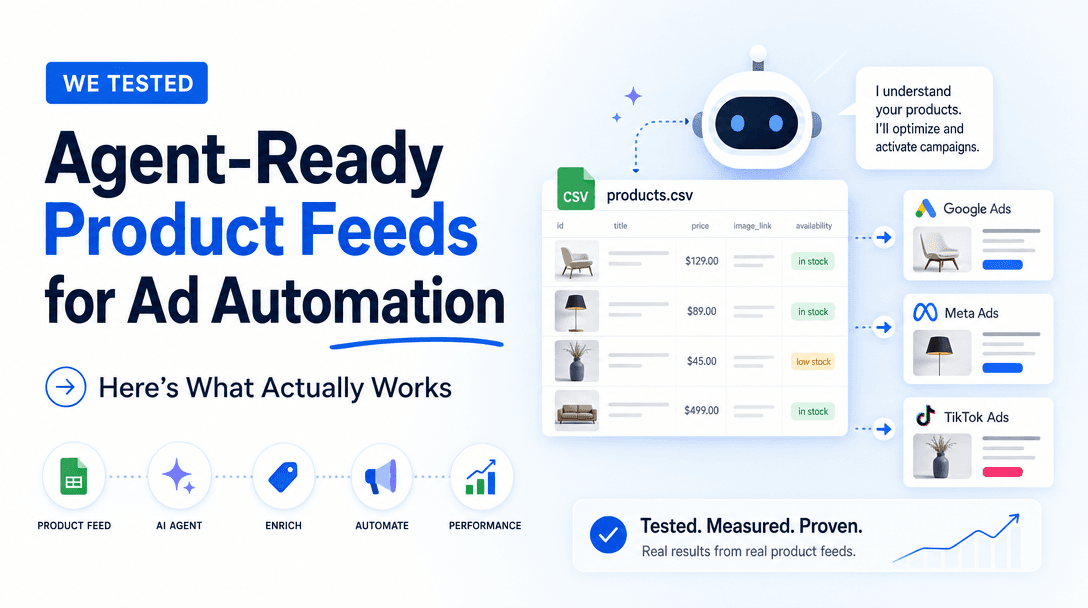
- See it tested: We Tested Agent-Ready Product Feeds for Ad Automation — what actually worked when we ran a catalog through the pipeline.
For the full picture, return to the pillar: Agent-Ready Product Feeds: The 2026 Playbook for Selling to AI Buyers.
FAQ
Is "agent-ready" just a rebrand of feed optimization?
No — it is feed optimization plus the AI-channel specs, a structured-data layer consistent with the feed, and a much tighter freshness bar. Clean Google Shopping data is the floor, not the ceiling.
Do agents really ignore my website?
When acting as a shopper, yes — they consume structured product data and complete actions against APIs. Your site still matters for humans who click through, but the agent's decision is made on the feed.
What is the fastest win?
Fix identifiers and fill rate first. Getting core attributes to 95%+ and setting identifier_exists correctly moves you out of the penalty zone faster than any copy rewrite.
Who should own this internally?
Marketing, with engineering support for the freshness pipeline. The signals that decide your placement — density, trust, coverage — are marketing calls.