
 Soku AI
Runway vs Kling (2026): AI Video for Marketers, Priced Per Usable Clip
Runway vs Kling, verified 2026-10-27. Runway now resells Kling 4.0 inside its plans, so we priced the same Kling clip on six storefronts and ran three ad prompts through Kling 4.0 and Kling 3.0 Turbo. Cost per usable 1080p clip ran from $0.64 to $3.40 depending on where you buy it.
Prices and feature claims last verified against both vendors' own published pages on 2026-10-27.
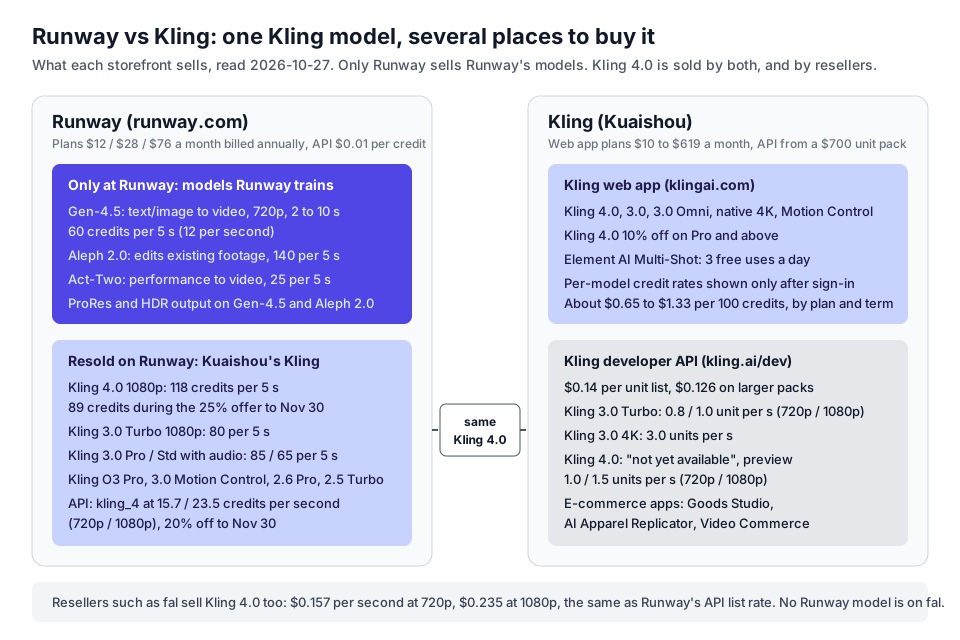
Searching "Runway vs Kling" assumes two rival model makers. As of 2026-10-27, Runway also sells Kling. Its pricing page lists Kling 4.0 next to its own Gen-4.5, at 118 credits per 5-second 1080p clip. Below it are rows for Kling 3.0 Pro, Std, Turbo and Motion Control, Kling O3 Pro, Kling 2.6 Pro and two Kling 2.5 Turbo tiers. Runway's developer API sells Kling 4.0 too. Kuaishou, which makes Kling, still sells all of these itself, through the klingai.com app and a developer API. Resellers such as fal sell them as well.
That changes the question a marketer actually has to answer. It is no longer "which company makes the better video model". There are three questions:
- Do you need anything only Runway makes? That means Gen-4.5, Aleph 2.0 (video-to-video editing) or Act-Two.
- Which Kling tier earns its price for ad work? Kling 4.0 costs 1.7 times as much per second as Kling 3.0 Turbo at 1080p on fal.
- Where is a usable Kling clip cheapest? Runway's app, Runway's API, Kling's app, Kling's API or a reseller.
We answered the second and third questions with our own test. On 2026-10-27 we ran the same three ad prompts through Kling 4.0 and Kling 3.0 Turbo Pro at 1080p on fal, looked at every clip, and decided which were usable. Then we priced each usable clip on every storefront where we could read a price that day. We could not run Runway's own Gen-4.5 without spending a Runway account's credits, and it is not on fal. So Gen-4.5 is compared on its published spec and price only, and we make no quality claim about it. Neither product is ours. Soku appears in a short note at the end.
Runway also has a new domain. runwayml.com now redirects to runway.com, and all Runway prices here were read there.
The Short Answer
- Want Gen-4.5, Aleph 2.0 or Act-Two? You need Runway. Kuaishou doesn't sell them and neither does fal. Gen-4.5 is also the cheapest video model on Runway's rate table per 5 seconds (60 credits), but it is 720p and up to 10 seconds.
- Want Kling 4.0 and already pay for Runway Max? Buy it on Runway. At Max's annual rate a 5-second 1080p clip costs about $0.94, or about $0.71 during Runway's 25% offer to November 30. That beat every other price we could verify.
- On Runway Standard or Pro, Runway is the expensive way to buy Kling. On Standard billed annually, the same clip works out to about $2.27. fal charges $1.175 per clip with no plan.
- For volume hook testing, Kling 3.0 Turbo is the better buy. In our test it delivered 3 usable clips out of 3 at $0.70 each on fal. Kling 4.0 delivered 2 full usable clips out of 3, at $1.175 each. That made it 2.5 times as expensive per usable clip and 1.9 times per usable second.
- Buy Kling direct if you want Kling's own apps or API. Kling's web app has Element AI Multi-Shot and e-commerce tools such as Goods Studio and AI Apparel Replicator. Its API is cheapest per unit at volume. Kling 4.0 was still "not yet available" on Kling's own API on 2026-10-27, though.
What Runway Sells Next To Kling
Runway's consumer rate table, read 2026-10-27 with every "View more" row expanded, splits into Runway's own models and third-party ones. Credits are per clip at the stated length.
| Runway's own | Credits | Resold Kling on Runway | Credits |
|---|---|---|---|
| Gen-4.5 | 60 per 5 s | Kling 4.0, 1080p | 118 per 5 s (89 to Nov 30) |
| Aleph 2.0 (edit video) | 140 per 5 s | Kling 3.0 Pro, with audio | 85 per 5 s |
| Gen-4 Aleph | 75 per 5 s | Kling 3.0 Std, with audio | 65 per 5 s |
| Gen-4 Video | 60 per 5 s | Kling 3.0 Turbo, 1080p | 80 per 5 s |
| Gen-4 Video Turbo | 25 per 5 s | Kling 3.0 Motion Control, 1080p | 85 per 5 s |
| Act-Two | 25 per 5 s | Kling O3 Pro | 85 per 5 s |
| Kling 2.6 Pro | 125 per 5 s | ||
| Kling 2.5 Turbo Pro, 1080p / Turbo | 75 / 50 per 5 s |
The same table also lists Seedance 2.0 Pro, Fast and Mini, Veo 3.1 and Veo 3, WAN 2.6, HappyHorse 1.0 and two Grok Imagine tiers. The app table has only one Kling 4.0 row, at 1080p. Runway's developer API also sells kling_4 at 720p.
Two details from Runway's API pricing page matter if you are comparing Kling prices:
- Runway's Kling 4.0 API list price is the same as fal's. It charges 15.7 credits per second at 720p and 23.5 at 1080p, at $0.01 a credit. That is $0.157 and $0.235 per second, the same as fal's Kling 4.0 listing. Through November 30, 2026 UTC, Runway takes 20% off. Its worked example is a 5-second 720p clip at 64 credits instead of 79.
- Runway's API has no Kling 3.0 Turbo. It lists
kling3.0_standard,kling3.0_pro,kling3.0_4k, three Kling O3 tiers andkling2.5_turbo_pro. Turbo is only in the app.
The app rate and the API rate for Kling 4.0 at 1080p are almost identical: 118 credits per 5 seconds in the app against 117.5 on the API, rounded up to 118. The difference between the two is the price of a credit, and that depends on your plan.
Runway Gen-4.5 vs Kling 4.0: The Spec Sheet
These are the two flagship models, one from each company. The figures come from the request schemas in Runway's API reference and from Kling's own pages, read 2026-10-27.
| Runway Gen-4.5 | Kling 4.0 | |
|---|---|---|
| Who makes it | Runway | Kuaishou |
| Where you can buy it | Runway app and Runway API only | Kling app, Runway app and API, resellers such as fal. Kling's own API: "not yet available" |
| Clip length | 2 to 10 s, integer | 3 to 30 s |
| Output size | 1280:720, 720:1280, 1104:832, 960:960, 832:1104, 1584:672 | 720p or 1080p (auto_720p / auto_1080p on Runway's API). fal offers 16:9, 9:16, 1:1, 21:9 |
| Inputs | Text, plus an optional first-frame image | Text, frames, image and video references, or an edit of a source video |
| Audio | No audio field in the API request | Included, with no toggle (Runway: "Kling 4.0 includes audio and has no audio toggle") |
| Pro formats | ProRes and PNG sequences (+5 credits/s), 10-bit and HDR profiles (+20 credits/s) | None listed |
| Runway app price | 60 credits per 5 s | 118 per 5 s at 1080p (89 to Nov 30) |
| Runway API price | 12 credits/s ($0.12) | 15.7 / 23.5 credits/s at 720p / 1080p |
Kling's membership page describes Kling 4.0 as supporting "dynamic motions, Omni reference, native 30s-generation and multiple keyframes". Runway's model list calls Gen-4.5 "Runway's state-of-the-art text to video and image to video model". Those are the vendors' words, not our findings.
For an ad team, the spec sheet is mostly about length and resolution. Gen-4.5 is a short-clip, 720p-class model, which suits 6 to 10-second hook variants that will be cropped and compressed by a feed anyway. If you need one 15 to 30-second spot in a single pass, or native 1080p, the spec points to Kling 4.0. If you finish in a grading suite, Gen-4.5's ProRes and HDR outputs are something Runway sells and Kling doesn't list.
The Prices, Verified 2026-10-27
Runway plans
| Plan | Monthly | Billed annually | Credits | Price per credit (annual) | Notes from the plan card |
|---|---|---|---|---|---|
| Free | $0 | $0 | 125, one time | — | "A selection of generative creative models", 5GB |
| Standard | $15 | $12/mo | 625/mo | $0.0192 | All AI video and image models, 5 parallel generations, no watermarks, 4K upscaling |
| Pro | $35 | $28/mo | 2,250/mo | $0.0124 | 15 parallel, 1 Brand Kit, 1 voice clone, top-ups, Runway MCP, unlimited 4K upscaling |
| Max | $95 | $76/mo | 9,500/mo | $0.0080 | 20 parallel, credits roll over 1 month, 3 Brand Kits, HDR, ProRes, early access |
| Team | $69/seat | $55/seat | 165,600/yr for 2 seats | about $0.0080 | 2 to 9 members, shared pool, API access, SSO, legal indemnification |
| API | Pay as you go | — | — | $0.01 | Per-second rates published per model |
Every paid card lists "Generate, test and publish ads with Runway Ads" and an "agentic creative collaborator", both marked New. We did not test either. Runway's FAQ says Standard and Pro credits reset within 24 hours of the billing date, Max rolls up to one month over, and purchased top-ups never expire, with a 1,000-credit minimum.
Kling web app plans
Kling's membership page was running introductory discounts with a countdown timer when we read it, so the list price, the first-period price and the renewal price all differ. These are all three, as displayed:
| Plan | Monthly list | Monthly, as offered | Yearly, as offered | Credits/month | Kling 4.0 |
|---|---|---|---|---|---|
| Basic | $0 | — | — | Not stated logged out | — |
| Standard | $10 | $6.99 first month, then $8.80 | $79.20/yr (list $120) | 660 | No discount listed |
| Pro | $37 | $25.99 first month, then $32.56 | $293.04/yr (list $444) | 3,000 | 10% off |
| Premier | $207 | $135 first month, then $181.99 | $1,490 first year, then $1,639.99 (list $2,484) | 18,000 (8K to 38K options) | 10% off |
| Ultra+ | $619 | $402 first month, then $544.99 | $4,457 first year, then $4,902.99 (list $7,428) | 57,000 | 10% off |
Paid plans list 1080p and 4K video generation, watermark removal and commercial use of generated content. Kling's own "price per 100 credits" figures ran from $1.06 (Standard, first month) down to $0.65 (Ultra+, first year). At renewal prices they work out to about $1.33 per 100 on Standard monthly and $0.72 per 100 on Ultra+ yearly.
What we could not verify: how many credits Kling 4.0 uses per second in Kling's web app. The generator is behind a sign-in, and the logged-out pricing page lists plans but not per-model rates. Third-party sites quote rates that disagree by more than 4x, so we do not repeat any of them. Without that number we can't price a Kling 4.0 clip in Kling's own app.
Kling developer API
Kling's API pricing sells prepaid packs: $700 for 5,000 units ($0.14 a unit) or $2,100 for 15,000. Larger packs from $3,780 for 30,000 units get 10% off ($0.126 a unit). All packs are valid 180 days with no rollover. The page says these packs "are not compatible with Kling 4.0 or Kling 4.0 Flash" and that "Kling 4.0 API access is not yet available". It shows Kling 4.0 at a preview rate of 1.0 unit per second at 720p and 1.5 at 1080p. Kling 3.0 Turbo with native audio is 0.8 and 1.0 unit per second, and Kling 3.0 is 3.0 units per second at 4K.
fal
From fal's model catalogue, read 2026-10-27: Kling 4.0 is $0.157 per second at 720p and $0.235 at 1080p, with video-reference and edit modes at $0.094 and $0.141 per second on input plus output length. Kling 3.0 Turbo Pro is $0.14 per second at 1080p. Kling 3.0 Pro is $0.112 per second without audio and $0.168 with it, and Kling 3.0 4K is $0.42. fal lists no Runway model.
Our Test: Kling 4.0 vs Kling 3.0 Turbo, Same Prompts
Why these two tiers. Both are sold on Runway at 1080p, both are sold by Kuaishou, and both are on fal. Kling 3.0 Turbo is the cheap tier and Kling 4.0 is the new flagship. If you buy Kling through Runway, the choice between these two rows has more effect on your bill than the choice of storefront.
Why not Gen-4.5. It is sold only by Runway. Running it would have meant spending credits from a Runway account. For a comparison of this kind we would rather say we didn't test it than generate a sample we couldn't repeat on the same terms. Its spec and price are above. Its usable rate is unknown.
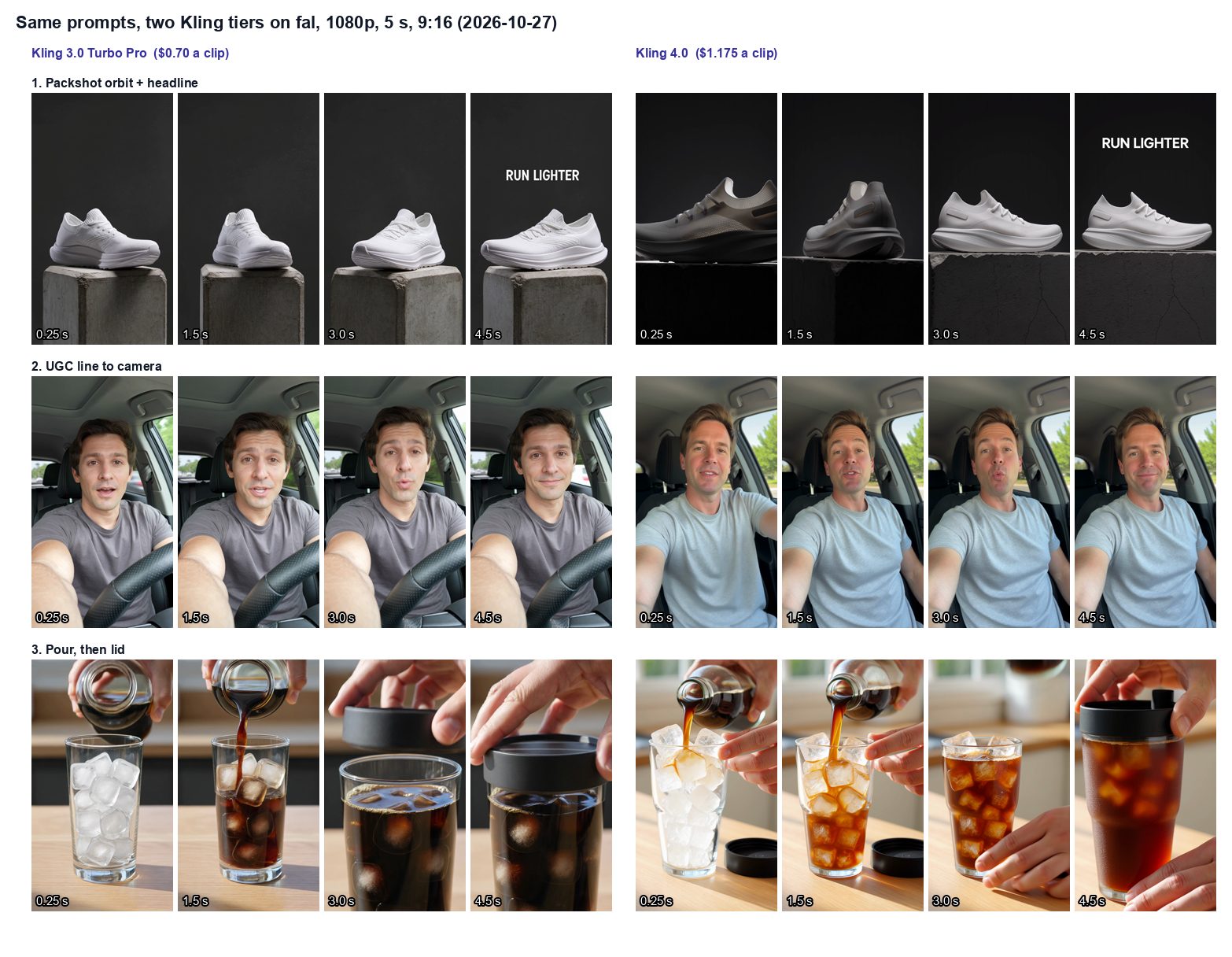
Setup. On 2026-10-27 we submitted all six jobs to fal within five seconds of each other. Every job was 1080p, 5 seconds and 9:16, with no seed and no negative prompt. Kling 4.0 ran on kling/v4/text-to-video with resolution: 1080p. Kling 3.0 Turbo ran on fal-ai/kling-video/v3/turbo/pro/text-to-video, which is 1080p only. The three prompts were written the way an ad brief would be, and each aims at a different failure:
- Packshot orbit and timed headline. A white knit running shoe on a concrete plinth. The camera makes a slow 180-degree orbit, with a hard rim light, and "RUN LIGHTER" appears in the final second. Tests product consistency through motion, and text timing.
- UGC line to camera. A man in his mid-thirties films a selfie in a parked car and says: "I cancelled three subscriptions after one week with this app." Tests lip sync and the spoken line.
- Pour, then lid. Two hands pour dark cold brew from a glass bottle into a tumbler full of ice, then press a matte black lid on. Tests hands, liquid and a two-step action.
What each tier did
We looked at every clip at 2 frames per second and transcribed the UGC audio with Whisper (small). "Usable" means the clip could go into a paid-social concept test after at most a trim, without regenerating.
| Prompt | Kling 3.0 Turbo Pro | Kling 4.0 |
|---|---|---|
| 1. Packshot orbit + headline | The shoe turns on the plinth rather than the camera orbiting, but the shoe stays the same white shoe in every frame. "RUN LIGHTER" spelled correctly, appearing at about 4.0 s, inside the final second as asked. Rim light is soft. Usable. | A real camera orbit round the back of the shoe, with better light. But the shoe changes: for the first 1.5 to 2 seconds it reads grey-beige with a dark sole, then it becomes a white shoe with a white sole. "RUN LIGHTER" spelled correctly but on screen from about 3.5 s, earlier than asked. Not usable as generated. About 3 seconds are salvageable as a trimmed end card. |
| 2. UGC line to camera | Line delivered word for word (Whisper: "I cancelled three subscriptions after one week with this app."). Arm held out, steering wheel in frame, convincing. Usable. | Line delivered word for word. Warmer daylight and more natural framing. Mixed louder (see below). Usable. |
| 3. Pour, then lid | Clean pour with ice movement. Hard cut at about 3 s to a close-up of the lid going onto a taller, straight-sided vessel. The ice turns soft and blurry after the cut. Usable for a concept test if you accept the cut. | Clean pour, and the lid is on the counter from the first frame, which sets up the second action nicely. The coffee is amber, not the dark cold brew we asked for. Also cuts at about 3 s to a different, taller tumbler. Usable on the same terms. |
Three observations matter more than the per-clip verdicts:
Kling 4.0 followed camera directions more literally. We asked for a camera orbit. Kling 4.0 moved the camera. Kling 3.0 Turbo turned the product instead. For a lot of ads that difference is invisible. For a hero shot where the set and light should move with the camera, it isn't.
Kling 4.0 was the one that changed the product. A shoe whose sole changes colour two seconds into an ad is a rejection, whatever the camera does. One run on one prompt is not a pattern. But it is exactly the failure that costs an ad team a regeneration, and it is why "usable" and "generated" are different numbers.
Both tiers cut on their own. On the pour prompt, both models ended the continuous shot at about 3 seconds and cut to a close-up of the lid on a differently shaped vessel. That reads as an edit, and most viewers won't notice in a feed. But if you need one unbroken take, ask for it explicitly or use the multi-shot field to control the shot list.
Audio and latency
All six clips came back with an audio track. Kling 4.0's mix was louder on every prompt, with mean volume of -19.5, -20.3 and -22.9 dB against Kling 3.0 Turbo's -25.6, -23.5 and -24.3 dB. Normalise levels before you cut the two into the same edit.
Kling 3.0 Turbo was much faster. Its fal-reported inference times were 61, 77 and 77 seconds, and the full round trip from submit to result was 67 to 83 seconds. Kling 4.0 took 257, 197 and 257 seconds of inference, with 198 to 266 seconds wall clock. That is about three minutes slower per clip. When you are iterating on a hook, that delay matters as much as the price.
Real billed cost and cost per usable clip
| Kling 3.0 Turbo Pro | Kling 4.0 (1080p) | |
|---|---|---|
| fal request IDs (prompts 1, 2, 3) | 01a17ab3-d3aa-7223-9031-64e430c36a7d, 01a17ab3-d761-70a2-9644-8185a9bea82b, 01a17ab3-daf6-70c3-b0c6-75406c09acd5 | 01a17ab3-c8d6-7401-adf0-ffdbb68322fc, 01a17ab3-cc67-72c1-84ce-0eab48615f90, 01a17ab3-d010-74c0-a807-8cdc8f5f5ddb |
| Output | 1080×1920, 24 fps, 5.04 s, with audio | 1080×1920, 24 fps, 5.04 s, with audio |
| Actual billed cost (fal usage API) | $2.10 (15 s at $0.14) | $3.53 (15 s at 1080p, billed as 22.45 units at $0.157) |
| Usable clips | 3 of 3 | 2 of 3 |
| Usable seconds (our judgement) | 15 | 13 (5 + 5 + about 3 trimmed) |
| Cost per usable clip | $0.70 | $1.76 |
| Cost per usable second | $0.14 | $0.27 |
The whole test cost $5.63. Kling 4.0's per-second list price is 1.7 times Kling 3.0 Turbo's at 1080p on fal. One discarded clip widened that to 2.5 times per usable clip. Run a different prompt mix and the gap will move. If your ads lean on long single takes, multi-shot sequences or 15 to 30-second spots, Kling 4.0 can do things the 15-second Turbo tier can't, and the comparison changes.
Same Usable Clip, Six Storefronts
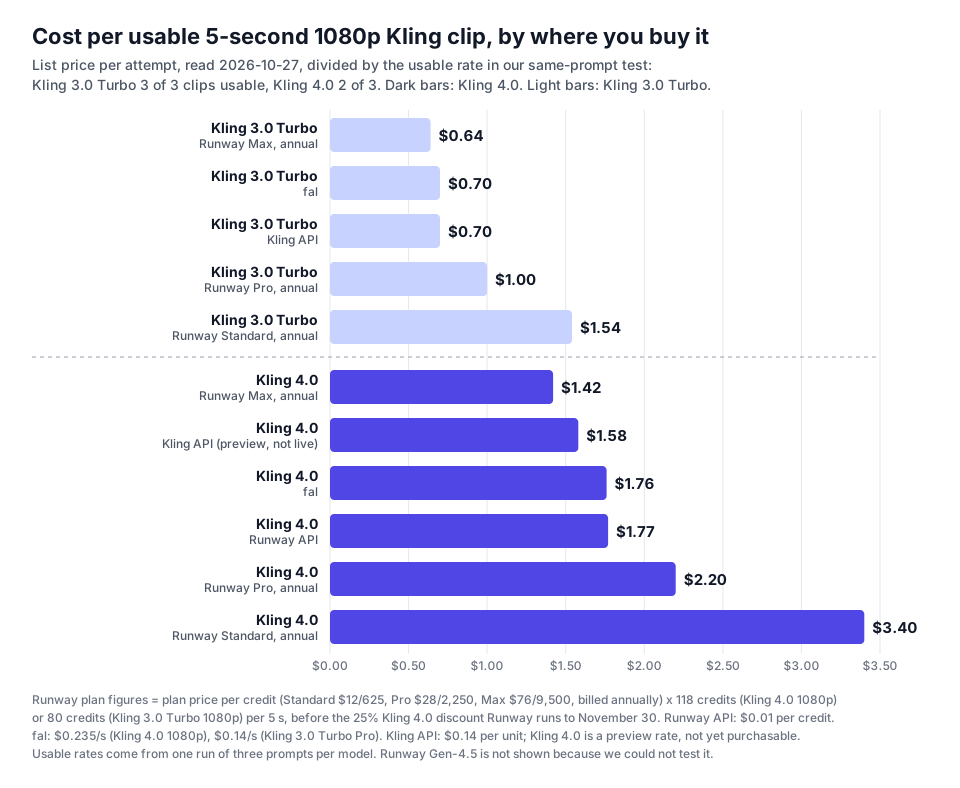
Now apply those usable rates to each place you can buy the two tiers. Per-attempt prices are list prices read 2026-10-27, for a 5-second 1080p clip. Runway plan prices are the plan's price per credit times Runway's credit rate. They assume you use every credit you pay for.
| Where you buy it | Kling 3.0 Turbo, per attempt | Kling 3.0 Turbo, per usable clip | Kling 4.0, per attempt | Kling 4.0, per usable clip |
|---|---|---|---|---|
| Runway Max, annual ($0.0080/credit) | $0.64 (80 cr) | $0.64 | $0.94 (118 cr) | $1.42 |
| Runway Max, annual, during the 25% offer | — | — | $0.71 (89 cr) | $1.07 |
| Kling API ($0.14/unit) | $0.70 (1.0 unit/s) | $0.70 | $1.05 (preview, not purchasable) | $1.58 |
| fal | $0.70 | $0.70 | $1.175 | $1.76 |
| Runway API ($0.01/credit) | Not offered | — | $1.18 (118 cr); $0.95 to Nov 30 | $1.77; $1.43 to Nov 30 |
| Runway Pro, annual ($0.0124/credit) | $1.00 | $1.00 | $1.47 | $2.20 |
| Runway Standard, annual ($0.0192/credit) | $1.54 | $1.54 | $2.27 | $3.40 |
| Kling web app | Not verifiable logged out | — | Not verifiable logged out | — |
What that table says:
- The plan you are on moves the price more than the storefront does. The same Kling 4.0 clip costs 2.4 times as much on Runway Standard as on Runway Max. Runway's credit price falls from $0.0192 to $0.0080 between those plans. Its per-model credit rates do not change.
- Runway Max is the cheapest verified way to buy Kling, if you would use Max anyway. At $76 a month you are buying 9,500 credits whether you spend them or not. Max rolls one month of unused credits forward. Standard and Pro reset.
- Below Max, a pay-as-you-go reseller is cheaper than a Runway plan for Kling. On fal, or on Kling's own API for Kling 3.0, a Kling clip costs the same whether you make one or a thousand. But Kling's API asks for $700 up front.
What $76 buys
A month of Runway Max at the annual price, against $76 spent on fal:
| Spend $76 on | Kling 3.0 Turbo 1080p, 5 s | Kling 4.0 1080p, 5 s | Gen-4.5, 5 s |
|---|---|---|---|
| Runway Max (9,500 credits) | 118 attempts, about 118 usable | 80 attempts (106 during the offer), about 53 usable (71) | 158 attempts, usable rate untested |
| fal | 108 attempts, about 108 usable | 64 attempts, about 43 usable | Not available |
Usable counts apply our test's rates, 3 of 3 for Turbo and 2 of 3 for Kling 4.0. Treat them as a rough guide, not a forecast.
Where Each One Is Stronger For Ad Work
Runway is stronger as one place to make and finish ads. One credit balance covers Gen-4.5, Aleph 2.0 editing, Kling, Seedance, Veo and audio. Pro and above add Brand Kits and voice clones, Max adds HDR and ProRes, and Team adds a shared credit pool, SSO and legal indemnification. Runway also publishes exact per-model rates for both the app and the API, so you can budget before you generate. Its weakness for Kling buyers is the entry plans. On Standard, Kling costs about twice what a reseller charges.
Kling is stronger if you are committed to Kling. Kuaishou's app has features Runway's rate table doesn't list: Element AI Multi-Shot, with three free uses a day on paid plans. Runway's app table has no 4K Kling row, though its API does sell kling3.0_4k. Its API also offers e-commerce apps such as Goods Studio, AI Apparel Replicator and Video Commerce, priced per second. On packs of 30,000 units or more ($0.126 a unit), its API is the cheapest per-second Kling 3.0 Turbo we found, at $0.126 a second at 1080p, just under Runway Max's $0.128. Its weaknesses for a buyer today are that the app's per-model credit rates are hidden until you sign in, the plan pages run layered promotions, and Kling 4.0 is not yet on its own API.
Neither one tells you which clip worked. Runway's plan cards now promise to "generate, test and publish ads", and Kling's plans are sold on output volume. Both bill you for generations. Neither pricing page describes reading back which creative earned its spend in Meta or Google Ads. That answer still comes from your ad account.
Which One To Choose
You want Gen-4.5's look, Aleph 2.0 edits on existing footage, or ProRes and HDR delivery. Choose Runway. Nobody else sells these. Start on Pro if you need MCP or top-ups, or Max if you will use 9,500 credits a month.
You already pay for Runway Max or Team. Buy Kling through Runway. At about $0.0080 a credit, Kling 4.0 1080p is about $0.94 a clip, and $0.71 until November 30. Kling 3.0 Turbo is $0.64. That beats every per-clip price we could verify elsewhere.
You make dozens of short text-to-video hooks a week and only want Kling. Use Kling 3.0 Turbo through fal or Kling's API, or through Runway if you are already on Max. In our test it cost $0.70 per usable clip against $1.76 for Kling 4.0, and it returned results about three minutes sooner.
You need 15 to 30-second single spots, video references or edits of source footage. Use Kling 4.0. Gen-4.5 stops at 10 seconds, and Kling 3.0 Turbo at 15. Pick the cheapest storefront you can actually buy from. Today that is Runway Max, then fal or Runway's API. Kling's own API will be an option once Kling 4.0 is live there.
You are on a budget under $20 a month. Runway Standard ($12 annual) gets you 625 credits, enough for about five Kling 4.0 clips or ten Gen-4.5 clips. Kling Standard ($10 list) gets you 660 Kling credits, but we can't tell you how many Kling 4.0 seconds that buys. If you only want Kling, pay-as-you-go on a reseller has no monthly floor.
For more on the models themselves, see our Kling 3 model page and the Runway AI page. Our Seedance vs Kling test compares Kling 4.0 with ByteDance's Seedance 2.5, and Runway vs Higgsfield prices the third-party engines Runway shares with Higgsfield.
Where Soku Fits
Since we build in this space: Soku is an AI advertising agent, not a video model, and it does not make or resell Runway or Kling plans. This is what it runs, from its code:
- The Kling 3 page runs Kling 3.0 Turbo Pro, the same tier we tested here:
fal-ai/kling-video/v3/turbo/pro/text-to-videoon fal, 1080p only, 3 to 15 seconds, in 16:9, 9:16 or 1:1. Its price is set from fal's $0.14-per-second rate. The Creatives canvas offers the same Kling 3 engine for text-to-video. No Soku surface runs Kling 4.0. - Soku does not run any Runway model and has no Runway integration. The generator on the Runway AI page runs MiniMax H3 (
minimax/h3/text-to-video) and names that engine. Runway is listed as a requested integration on Soku's integrations page. - Where Soku differs is the step after the clip. It connects to ad accounts, can create Meta campaigns, ad sets and ads from your creatives, and reads back their performance. That is how you find out which Kling variant earned its spend. It does not make Kling cheaper or better than buying it from Runway, Kuaishou or fal.
Sources
Read on 2026-10-27:
- Runway pricing: plans, Team plan, and the per-model credit table with "View more" expanded (runwayml.com now redirects here): <https://runway.com/pricing>
- Runway developer API pricing (kling_4, Kling 3.0 and O3 rates, Gen-4.5, discount rules): <https://docs.dev.runwayml.com/guides/pricing/>
- Runway API model list and API reference (Gen-4.5 and kling_4 request schemas: durations, ratios, inputs): <https://docs.dev.runwayml.com/guides/models/>, <https://docs.dev.runwayml.com/api/>
- Kling web app membership plans (monthly and yearly tabs, Kling 4.0 discount, plan benefits): <https://app.klingai.com/global/membership/membership-plan>
- Kling developer API pricing (unit packs, Kling 4.0 preview rates, Kling 3.0 rates, e-commerce solutions): <https://kling.ai/dev/pricing>
- fal model catalogue for Kling (Kling 4.0, 3.0 Turbo, 3.0 Pro, 3.0 4K prices): <https://fal.ai/models?keywords=kling>, <https://fal.ai/models/kling/v4/text-to-video>, <https://fal.ai/models/fal-ai/kling-video/v3/turbo/pro/text-to-video>
- Our test: six fal jobs (request IDs above), billed cost from fal's usage API, frames sampled at 2 per second, UGC audio transcribed with Whisper (small), loudness measured with ffmpeg volumedetect.
Comparing something else? Browse all competitor breakdowns.