Soku AI
All tools

AI hook generator

Win the scroll in the first three seconds.

A free AI hook generator for video ads that writes both halves of the opening: the line people read and the frame they see. Describe your product, and Soku writes text hooks across different angles, plans the first three seconds for the best ones, and builds the opening shot.

Text + visual hooksTikTok, Reels, Shorts

The hooks are written inside Soku, not on this page. Fill this in and it becomes your first message to Soku’s AI after sign-up.

Where will it run?

What do you need?

Nothing is generated on this page. After you sign up, this message is waiting in a new Soku chat — review it, then send.

  • Text hooks labelled by angle
  • First-3-second shot plan per hook
  • Written for sound-off viewing
  • Opening shot generated in Soku

Three deliberate steps

01

Describe the product and the angle

Tell Soku what you sell, who it is for and where the ad runs. The more specific the claim — "refills cost a third of a new bottle", not "eco-friendly" — the less generic the hooks.

02

Get hooks, then the opening shot

Soku’s chat agent writes a batch of text hooks across different angles, then plans the first three seconds for the strongest ones: the opening frame, what moves, and the line on screen.

03

Build it, run it, read the hook rate

Generate the opening seconds as a vertical video in Soku, attach them to an ad, and — once Meta or TikTok is connected — compare hook rate and hold rate per ad to see which opening actually held people.

Hook playbook

Six text hooks and five opening shots that hold up

These are the patterns Soku draws on when you brief it. Use them by hand if you prefer — the point is to test several angles, not to polish one line. TikTok’s creative best practices ask for the content proposition in the first 3 seconds, the hook in the first 6, and on-screen text at 5–10 words per second.

Text hooks — the first line

Call out the person
“If you sit at a desk past 3pm, your back already knows this.”
Lead with the result
“I stopped paying for bottled cleaner in March.”
Name the objection
“Posture correctors look ridiculous. This one you can’t see.”
Open a loop
“The cheapest part of my skincare routine is the one that worked.”
Contrast
“$80 at the salon. $11 at home. Same result.”
Proof first
“Day 1 vs day 30 — same light, same angle.”

Visual hooks — the first frame

Mid-action start
Cut in with the hand already pouring, peeling, spraying. No establishing shot — the motion is the hook.
Split-screen before/after
Both states in frame one, so the claim is proven before anyone reads the caption.
Problem close-up
Open on the stain, the tangle, the error message. The viewer recognises their problem before they see your product.
Face to camera, mid-sentence
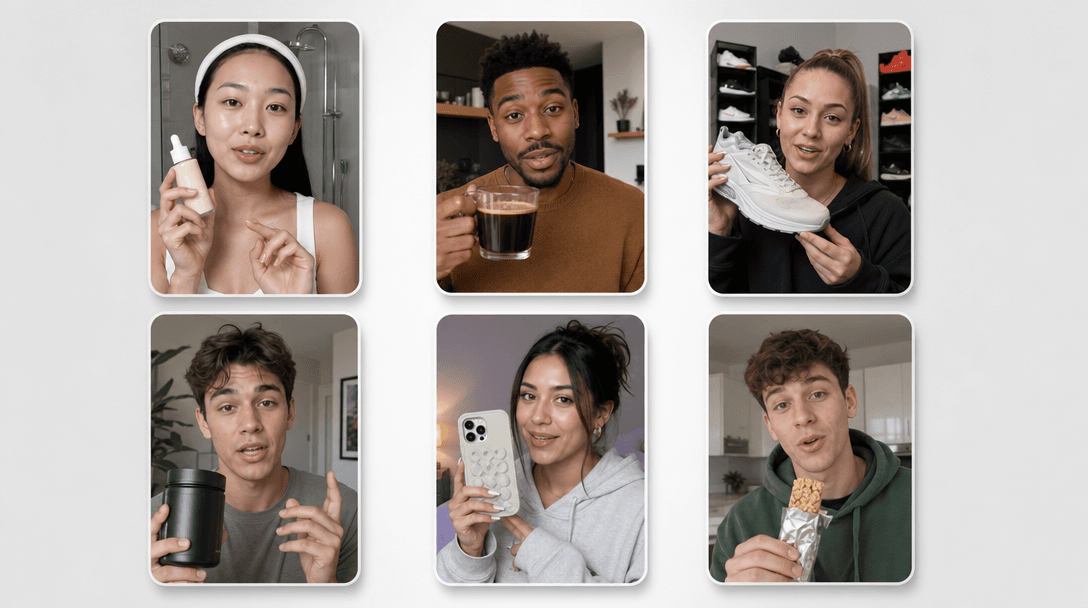
A person already talking reads as content, not as an ad. Put the line on screen too for muted viewers.
Unexpected object or scale
Something in the wrong place or at the wrong size. Use it only if the next shot pays it off — otherwise hold rate drops.

Platform note: TikTok, Reels and Shorts are 9:16 and keep their captions and buttons over the bottom and right edges — keep the opening line in the upper-middle of the frame. Feed placements on Facebook and Instagram are usually 4:5 or 1:1, so plan a crop that keeps the subject in frame.

Why Soku

A hook is a line and a frame, not just a line

Most hook generators hand you a list of sentences. On TikTok, Reels and Shorts the viewer decides on what they see before they read anything, so the line and the opening frame have to be written together.

Text and visual from one brief

The same conversation that writes the hook plans the shot it opens on, so the first frame shows what the first line promises instead of a logo card and a voiceover catching up.

Built, not just written

Inside Soku the opening plan feeds creative generation: the shot, on-screen text and captions come back as a 9:16 video you can drop into an ad, rather than a document someone still has to film.

Grounded in what is already running

Ask Soku to break down competitor ads first and the hooks start from the openings, offers and angles actually in market — not from a generic list of "you won’t believe" templates.

Judged by your own numbers

Connect Meta or TikTok and Soku reads hook rate (video plays ÷ impressions) and hold rate per ad, so the next batch of hooks is written against what held your audience, not someone else’s benchmark.

Use cases

Who reaches for this, and when

Performance marketers

Refresh a tired ad by changing only the opening

When an ad’s hook rate slides but the body still converts, the cheapest test is a new first three seconds on the same edit. Brief Soku with the winning ad’s angle and get five new openings to swap in.

DTC and app founders

Know what to film before you pick up a phone

A list of hooks is not a shot list. Getting the opening frame, the motion and the on-screen line for each hook turns “make a TikTok” into three specific shots you can record in one sitting.

Agencies and UGC buyers

Brief creators with hooks that are already tested angles

Hand a creator three labelled openings — problem, result, objection — instead of “be authentic”. Each one maps to a separate ad, so the test tells you which angle won rather than which creator.

Questions before you run it

Does the AI hook generator run on this page?
No. This page takes your brief and carries it through sign-up; the hooks are written by Soku’s chat agent inside the product, and the opening shot is generated there too. After you sign up, a new chat opens with your brief already filled in as the first message — you review it and press send.
Is the AI hook generator free?
You can start on Soku’s free plan with no credit card, which is enough to brief the chat agent and get text hooks and opening-shot plans back. Generating the opening seconds as video uses credits on a paid plan — Creator, at $19/month, is where most people start.
What makes a good hook for a video ad?
It shows the product or the problem immediately, makes one specific claim, and works with the sound off. TikTok’s own creative guidance asks advertisers to introduce the content proposition in the first 3 seconds and to prioritise the hook in the first 6. In practice that means no logo intro, the subject in frame on the first cut, and on-screen text that carries the line for people watching muted.
What is the difference between a text hook and a visual hook?
A text hook is the opening line — spoken, written on screen, or both. A visual hook is what the first frame and first movement show: a before/after, a hand mid-action, an unexpected object, a face reacting. Viewers judge the frame before they read the line, so the two need to agree. Soku writes them together for that reason.
How do I know which hook is working?
Run each opening as its own ad on the same body and compare hook rate — the share of impressions that turned into video plays — alongside hold rate, how many of those viewers stayed to 75%. With Meta or TikTok connected, Soku reads both per ad. Judge at the ad level, and give each version enough impressions before you call it.

Ten hooks, three openings, one brief.

Write the brief once. Soku writes the hooks in chat on the free plan, builds the opening seconds on a paid plan, and — with your ad account connected — shows you which one held.

Write my hook brief