Soku AI
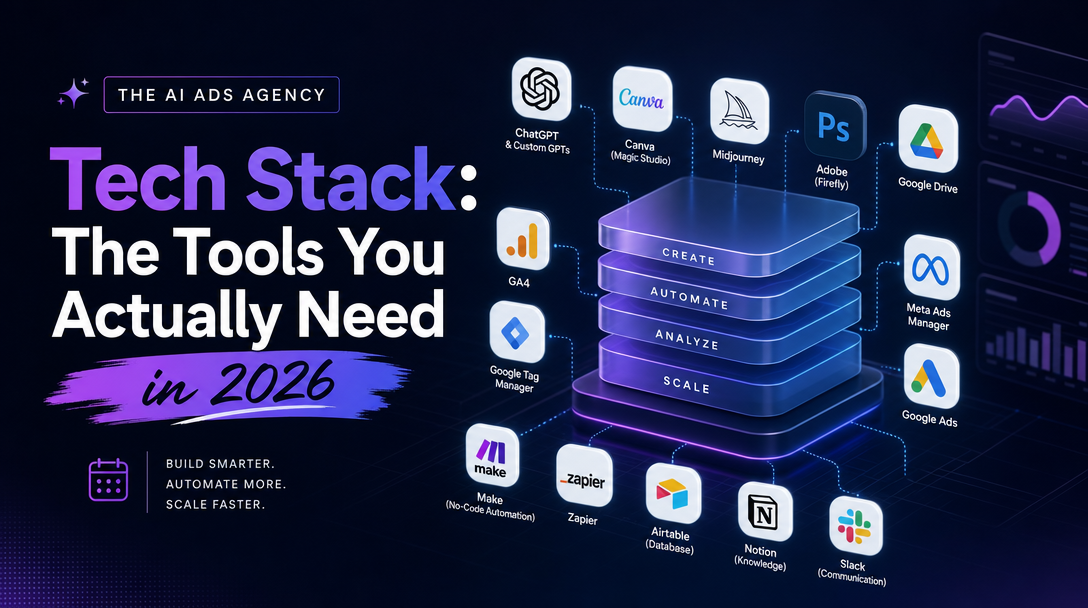
Most "agency tech stack" lists are arms races. They name forty tools across ten categories and quietly assume you'll hire a person to babysit each one. That math worked when software assisted humans. It stopped working the moment software started doing the work — and in 2026, the execution layer of a paid-media agency is software that an AI agent drives.
So this guide does the opposite of a long list. It defines the smallest stack that can actually run client ad accounts, organized into four layers, and for each layer it tells you what it does, what to look for, real tools by name, and the specific place an AI agent replaces a seat. The thesis, which is the same one that runs through our pillar: a small stack tied together by an agent beats twelve disconnected tools. For the complete overview, see How to Start an AI Ads Agency.
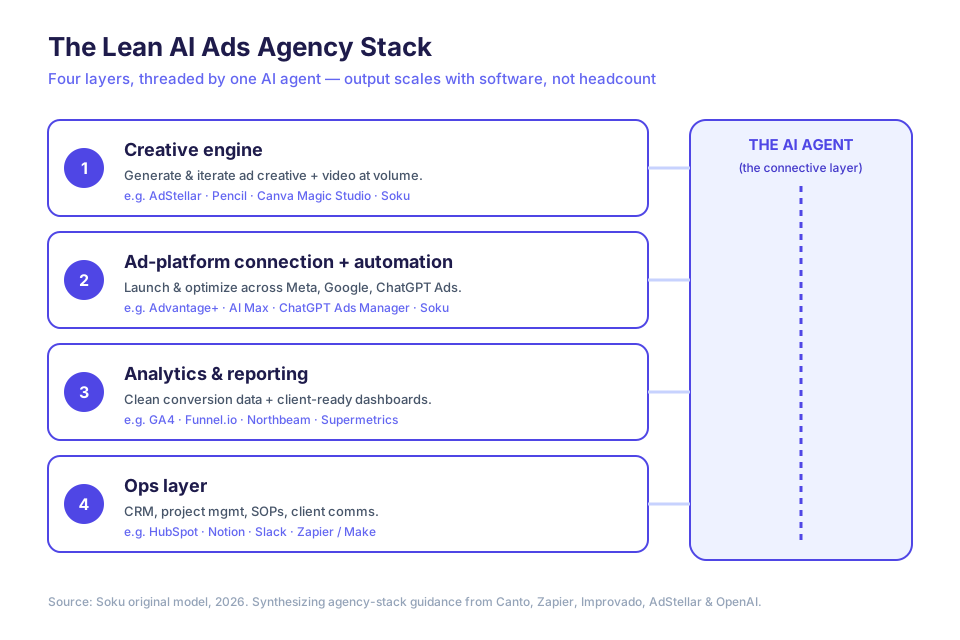
The four layers (and what the lists get wrong)
Walk through the popular 2026 stack guides — Zapier's 17 best AI marketing tools, Canto's marketing stack guide, Improvado's analyst toolkit — and take the union of everything they name. You get the same six-to-ten buckets every time: AI assistant, content/visual, SEO, social, analytics, CRM, project management, automation glue.
Two things are consistently missing for a paid-media agency specifically:
- The ChatGPT Ads platform. OpenAI launched ads inside ChatGPT in February 2026 and opened a self-serve Ads Manager in May. It is now a third major buying surface next to Meta and Google, and most stack lists predate it.
- The agent layer. The lists treat AI as a feature inside each tool — a copywriter in your creative tool, a copilot in your CRM. They never name the connective layer: the agent that reads across all four buckets and actually executes the loop. That's the layer that turns "fewer, better-connected tools" from a slogan into margin.
Collapse the union into the four layers an ads agency truly runs on, and you get this.
| Layer | What it does | What to look for | Example tools | Where the AI agent replaces a seat |
|---|---|---|---|---|
| 1. Creative engine | Generate and iterate ad creative + video at volume | Brief- or URL-to-creative, video, brand/legal guardrails, variant testing | AdStellar, Pencil, Canva Magic Studio, Soku | The junior designer cranking out static + video variants |
| 2. Platform + automation | Launch and optimize across Meta, Google, ChatGPT Ads | Native API access, cross-platform launch, budget/bid automation, change logs | Meta Advantage+, Google AI Max, ChatGPT Ads Manager, Soku | The media buyer building campaigns and pushing bid changes |
| 3. Analytics & reporting | Clean conversion data + client-ready dashboards | Multi-source aggregation, conversion modeling, natural-language querying | GA4, Funnel.io, Northbeam, Supermetrics | The analyst pulling numbers and writing the weekly report |
| 4. Ops layer | CRM, project mgmt, SOPs, client comms | AI-native (not bolt-on), workflow automation, simple for a small team | HubSpot, Notion, Slack, Zapier / Make | The account coordinator chasing status and updates |
The rest of this guide is one section per layer.
Layer 1 — The creative engine
What it does. Turns a brief, a URL, or a product feed into ad creative — statics, carousels, and increasingly video — at the volume modern platforms demand. Meta's own 2026 Advantage+ guidance pushes accounts toward many creative variants tested in agentic refresh loops, and AdStellar's benchmark roundup reports AI-generated, agent-refreshed variants outperforming static creative on ROAS. Volume is no longer optional; it's the input the platforms optimize on.
What to look for. Brief-to-creative and video in one place; brand and legal guardrails (Pencil's whole pitch is that every asset is checked against brand rules); and a workflow that produces variants, not one hero asset. For deeper picks, see our roundup of the best AI tools for Meta ad creatives.
Example tools. Canva's Magic Studio for design-first teams, Pencil for guardrail-heavy enterprise/agency work, AdStellar for full-stack Meta creative, and Soku for agencies that want generation wired straight into launch.
Where the agent replaces a seat. This is the junior designer. Instead of briefing one person who produces a handful of variants per day, the agent generates and tags a batch, the human approves the on-brand ones, and rejects feed back as constraints. One reviewer covers the output of what used to be a small creative pod.
Layer 2 — Ad-platform connection + automation
What it does. Connects to the buying surfaces and runs the campaigns: build structure, launch, and optimize across Meta, Google, and now ChatGPT Ads. The platforms have themselves gone AI-native — Meta Advantage+ automates targeting and creative selection, Google AI Max rewrites and routes search ads — so this layer is less about manual knob-turning and more about orchestrating three native autopilots from one place.
What to look for. Genuine API access to each platform (not screenshot scraping); cross-platform launch from one brief; budget and bid automation with rules you can audit; and a clean change log, because when an agent is making changes you need to see what it did. ChatGPT Ads is the new requirement here — if your stack can't touch it, you're blind to a third of the auction.
Example tools. The platforms' native managers (Meta Ads Manager + Advantage+, Google Ads + AI Max, the ChatGPT Ads Manager), plus an automation layer on top. Fully autonomous platforms like Ryze exist; the agency-friendly version is an agent that proposes changes and lets you keep approval rights. Soku sits in this layer, connecting the three platforms and driving the launch/optimize loop.
Where the agent replaces a seat. This is the media buyer's execution work — building ad sets, duplicating winners, shifting budget, pausing losers. The agent runs the mechanical loop continuously; the human sets strategy and guardrails. For the platform-specific motion, see How to Start a ChatGPT Ads Agency.
Layer 3 — Analytics & reporting
What it does. Two jobs that lists often conflate: get clean conversion data (so optimization is aimed at the right outcome), and produce client-ready reporting (so the relationship survives the first slow month). Improvado and Cometly's analytics roundup both stress that the bottleneck in 2026 is rarely dashboards — it's trustworthy, deduplicated conversion data feeding both the platforms and the client deck.
What to look for. Multi-source aggregation (Funnel.io and Supermetrics specialize here), conversion modeling that survives privacy loss (Northbeam's media-mix modeling for DTC), and natural-language querying so a non-analyst can ask "why did CPA jump on Tuesday." On ChatGPT Ads specifically, conversion tracking is its own discipline — see ChatGPT Ads Conversion Tracking with User Objects.
Example tools. GA4 as the spine, Funnel.io or Supermetrics for aggregation, Northbeam for attribution/MMM, and a natural-language layer on top.
Where the agent replaces a seat. This is the analyst who spends Monday pulling numbers and Friday writing the report. The agent assembles the data, flags the anomalies, drafts the narrative, and the human edits for judgment and tone. The weekly report stops being a person's whole morning.
Layer 4 — The ops layer
What it does. Everything that isn't ads but without which the agency doesn't function: CRM and pipeline, project management, SOPs, and client communication. This is the layer most likely to bloat, because every tool list adds three more apps here.
What to look for. AI-native rather than bolt-on (HubSpot's Breeze and Salesforce Einstein now execute multi-step tasks), not just suggest), real workflow automation (Zapier or Make as the glue), and — crucially for a small team — simplicity. A two-person agency does not need an enterprise PM suite. For the project-management slice specifically, see our guide to ad agency project management software.
Example tools. HubSpot for AI-native CRM, Notion for SOPs and lightweight PM, Slack for comms, Zapier or Make to connect the rest.
Where the agent replaces a seat. This is the coordinator chasing status and drafting client updates. With the other three layers feeding it, the agent can compose the "here's what happened this week" message from real data and route it for a human send — collapsing account-management overhead.
The honest version of the thesis
Add it up and a complete, defensible 2026 ads-agency stack is roughly: one creative engine, the three native ad platforms plus an automation layer, one analytics spine, and a small ops kit — not the twelve-to-twenty tools the listicles imply. The compression doesn't come from buying a magic all-in-one; it comes from the agent layer threading the four buckets together so output scales with software instead of headcount.
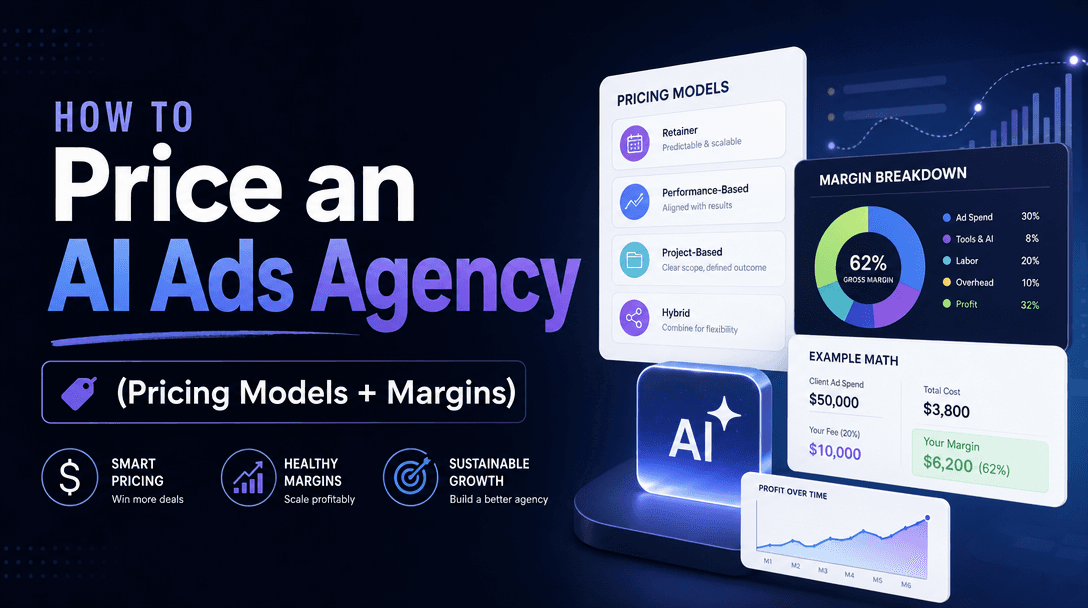
That's also the honest limit. The agent doesn't remove the human — it removes the seat per layer. You still need someone setting strategy, holding brand and legal judgment, and owning the client relationship. What changes is the ratio: one operator can now run the work that used to need a creative, a buyer, an analyst, and a coordinator. That ratio is the entire economic argument for an AI ads agency, and it's why how you charge has to change too — see How to Price an AI Ads Agency.
Pick the smallest tool that covers each of the four layers, make sure one of them can touch ChatGPT Ads, and put an agent across all four. That stack — not a longer one — is the one you actually need.
Two adjacent categories get pitched into this stack and mostly do not belong in it at agency scale: marketing resource management software for briefs, assets and approvals, and marketing automation software for lifecycle and CRM. Both are real categories with real buyers — they just sit outside the four layers above, and buying either one first is the most common way an agency stack gets expensive without getting faster.
Soku is the agent layer in this model: it generates creative, launches and optimizes across Meta, Google, and ChatGPT Ads, and assembles the reporting — so a small team runs the work of a much larger one. Listed here as one option among the honest tools above, not the only one.