 Soku AI
Two things changed in the last 18 months, and together they make 2026 the first year you can credibly run an ads agency with almost no team. First, the ad platforms themselves became AI-native: Meta's Advantage+ now automates targeting and creative selection, Google's AI Max rewrites and routes your search ads, and OpenAI launched ChatGPT Ads — an entirely new ad surface with its own Ads Manager. Second, the execution layer — building creative, launching campaigns, reading the data, writing the report — moved from "a person does it" to "an AI agent does it, a person checks it."
Most of the guides you'll find on "how to start an AI ads agency" miss this. They were written for a generic AI automation agency — chatbots, workflow glue, a Notion dashboard — and they stop exactly where the hard part begins: the unit economics of selling paid media, the actual ad platforms you run on, and what you can honestly charge. This playbook is the opposite. It assumes you want to run performance ads for real clients, and it gives you the operating model, the stack, the pricing, and the first-client motion — then routes you to a deep-dive guide for each.
What an AI ads agency actually is (and isn't)
An AI ads agency sells one outcome: more performance per dollar of ad spend, delivered faster than a human team could. You are not selling "AI." Clients do not care that you use AI — they care that their cost per acquisition drops, their creative stops fatiguing, and they stop waiting two weeks for a new batch of ads. AI is how you deliver; the deliverable is still media performance.
That distinction matters because it sets you apart from the flood of generalist "AI agencies." A useful way to see the difference:
| Generic AI automation agency | AI ads agency | |
|---|---|---|
| Core deliverable | Chatbots, internal workflows, automations | Campaign performance (ROAS, CPA, CTR) |
| Who the buyer is | Ops / IT / founder | Head of growth / performance marketer |
| What "good" looks like | Time saved | Revenue and pipeline |
| Where AI does the work | Connecting apps | Creative, launch, optimization, reporting |
| How you're paid | Setup fee + small retainer | Retainer and/or % of ad spend |
The buyer for an ads agency already has a budget line — they're already spending on ads — so you're reallocating spend, not creating a new one. That's a much easier sale, and it's why the commercial intent here is so high: the keyword "ai advertising agency" carries a cost-per-click north of $25, a signal that the people searching it are buyers, not browsers.
Why now: the platform shift you're building on
The reason a one-person agency is suddenly viable is that the ad platforms did half the work for you, and an AI agent can do the other half. Three shifts to understand before you position your agency:
- Meta Advantage+ collapsed targeting and placement into a single automated objective. The lever that used to take a skilled media buyer — audience construction — is increasingly the platform's job. The remaining edge is creative volume and quality.
- Google AI Max for Search ads expands matching, generates assets, and routes queries automatically. Again, the manual knobs shrink; creative and feed quality grow in importance.
- ChatGPT Ads (ads.openai.com) is a brand-new surface. New surfaces are where small, fast operators win, because there's no incumbent agency relationship to displace and the playbook isn't written yet. We cover how to actually operate on it in the cluster below.
The throughline: as platforms automate the buying, the durable agency skill becomes producing and managing a high volume of good creative, wired to clean conversion data. That is exactly the work an AI agent is now good at.
The operating model that changes your margins
Here's the thesis the rest of this guide is built on. In a traditional agency, output scales with headcount: every five or so clients, you hire another media buyer, another designer, another analyst. Margins stay thin because labor is your cost of goods. In an AI-agent agency, the execution work runs on software, so output scales with tooling, not hires — and the founder's time goes to strategy, QA, and client relationships, the things that actually can't be automated.
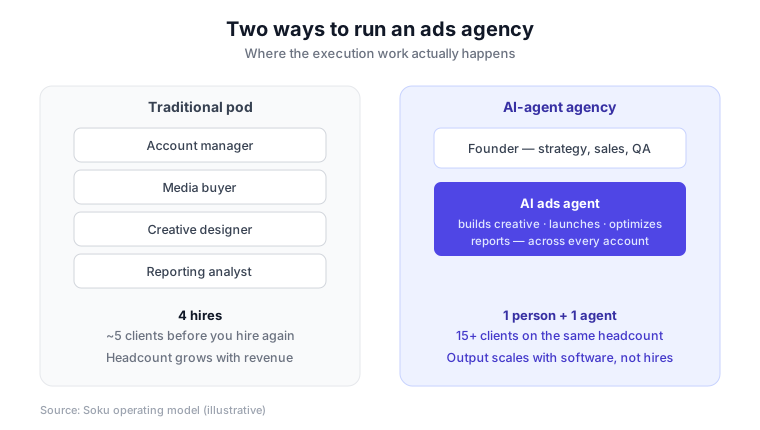
The economic consequence is the whole reason to start now. Run the same $3,000/month retainer through both models and the difference isn't in the revenue line — it's in what you keep:
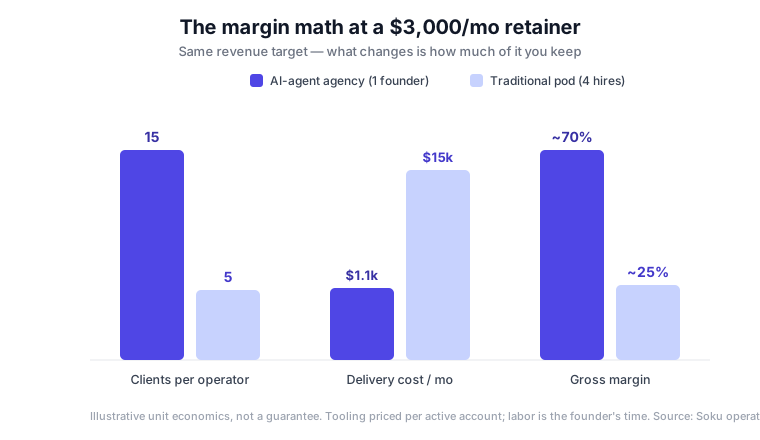
These numbers are illustrative, not a promise — your real margins depend on niche, spend levels, and how much you automate. But the shape is robust: when the marginal cost of serving one more client is mostly software, your gross margin and your client-per-operator count both go up sharply. That's the lever. Everything below is how to pull it.
The 6-step playbook
Step 1 — Pick a niche where ad budgets already exist
The single most common reason new agencies fail is weak positioning: "we do AI marketing solutions" is vague and unsellable. Choose a niche along one of three axes — industry (DTC beauty, local home services, B2B SaaS), service (paid social creative, Google Shopping, full-funnel performance), or problem ("we kill creative fatigue for ecommerce brands spending $50k+/month"). The best beginner niche is one where businesses already spend on ads, where the problem repeats every month, and where you can describe the outcome in one sentence.
Pick a niche where the math is obvious. Automating a task that saves a business $100/month justifies a $20 fee. Managing $50,000/month in ad spend and lifting ROAS 20% creates $10,000 of monthly value — which makes a $2,000–$4,000 retainer an easy yes. Anchor on spend levels high enough that your fee is a rounding error against the value you create.
Step 2 — Define one sharp offer
Resist the urge to offer everything. One starter offer, clearly scoped, beats a menu. The common structures:
- Done-for-you (DFY): you run the ads end to end. Highest price, highest trust required.
- Done-with-you (DWY): you build and optimize; the client's team executes parts. Lower delivery load.
- Audit + strategy: a fixed-fee diagnostic that doubles as a paid sales call into a retainer.
- Creative-as-a-service: you produce the high-volume creative the platforms now demand, and the client runs the buys.
For a first offer, "audit + strategy" as a low-friction entry that converts into a DFY retainer is the cleanest path. It lets a skeptical buyer test you on a small, fixed scope before committing.
Step 3 — Build a lean AI stack
You need four layers: a creative engine (generate and iterate ad creative at volume), an ad-platform connection (launch and optimize across Meta, Google, ChatGPT Ads), an analytics layer (clean conversion data and reporting), and a thin ops layer (CRM, SOPs, client comms). The mistake is buying twelve disconnected tools; the win is a small stack where the agent layer ties creative, launch, and reporting together. We break down exactly which tools, and where an agent like Soku replaces a seat, in the AI ads agency tech stack guide.
Step 4 — Price for value, not hours
This is the question every other guide dodges. Three workable models: a flat retainer ($1,500–$5,000/month for SMB, more for higher spend), a percentage of ad spend (10–20%, aligns you with scale but caps you to their budget), or a hybrid (base retainer + performance bonus). Because your delivery cost is largely software, you can price below a traditional agency and still keep a far higher margin — a genuine wedge when you're winning your first accounts. The full framework, with real numbers and when to use each model, is in how to price an AI ads agency.
Step 5 — Land your first clients
You don't need a sales team; you need sharp positioning and proof. The motion that works for a new agency: publish a few pieces of genuinely useful content in your niche (an audit teardown, a creative breakdown), run focused outbound to a tight list of brands that obviously spend on ads, and de-risk the first engagement with a small paid audit. Your first ten clients come from being specific and credible, not from volume spam. The step-by-step version, including outreach templates and the audit-to-retainer flow, is in how to get your first clients for an AI ads agency.
Step 6 — Stand up your ad platforms
The platforms are where the work actually happens, and each has a 2026-specific setup. ChatGPT Ads is the newest and least-documented, which makes it the biggest opportunity. Start with the operator's setup guide — how to start a ChatGPT ads agency — then wire up the two pieces that most affect performance: creating campaigns from product feeds and conversion tracking with user objects, the latter being how you make sure the optimization is fed accurate data.
Your first 90 days
Most guides hand you a list of steps but no sequence. Here's a realistic phased plan — the goal of the first quarter is one paying client and a repeatable delivery system, not a full roster.
| Phase | Focus | Concrete output |
|---|---|---|
| Days 1–30 | Positioning + stack | One-sentence niche statement, one offer, a working creative-to-launch-to-report stack, two sample audits done for free as proof |
| Days 31–60 | First sales motion | Tight outbound list of 40–60 brands that obviously run ads, 5–10 paid audits delivered, first DFY retainer signed |
| Days 61–90 | Deliver + systematize | First client live and reporting weekly, SOPs written down so the agent runs the same playbook per account, second client in pipeline |
The trap is spending all 90 days on "setup" — a website, a logo, a perfect stack — and never talking to a buyer. Reverse it: a rough stack and two real audits beat a polished brand and zero conversations.
Common mistakes that sink new AI ads agencies
- Serving everyone. "We do AI marketing" is unsellable. Pick one niche and one outcome.
- Selling AI instead of results. Lead with the CPA you'll lower, not the model you use.
- Underpricing to your cost, not the client's value. Your software cost is low — that's your margin, not a reason to charge $300/month.
- Buying a bloated stack. Twelve disconnected tools is worse than four that an agent ties together.
- Skipping conversion tracking. Optimization is only as good as the data feeding it — wire up conversion tracking before you scale spend.
- Promising a number you haven't earned. Don't quote a ROAS before you've seen the account.
What you should never promise
Honesty is part of the moat — overpromising is how agencies lose accounts in month three. Don't promise a specific ROAS before you've seen the account; don't promise that "AI" will fix a bad product or a broken offer; and don't hide that you use automation — frame it as how you deliver speed and consistency. AI handles volume, iteration, and pattern-spotting; it does not replace strategic judgment, brand taste, or the uncomfortable conversation when a client's creative is the problem. Set the expectation that you bring the judgment and the agent brings the throughput.

How Soku fits
Soku is an AI ads agent — the execution layer this model assumes. It connects to the ad platforms, generates and iterates creative, launches and optimizes campaigns, and produces the client-ready reporting, across every account you run, from one workspace. In the operating model above, Soku is the box doing the work that used to be four hires; you stay the strategist, the QA, and the face the client trusts. That's what makes the one-founder-fifteen-clients math real rather than aspirational — and it's free to start, so your first retainer is close to pure margin.
Where to go next
This pillar is the map. Each deep dive below is the territory — read them in roughly this order as you build:
- How to start a ChatGPT ads agency in 2026 — the step-by-step setup for operating on OpenAI's new ad surface, the highest-opportunity platform right now.
- The AI ads agency tech stack — the four-layer stack and exactly which tools (and which seats an agent replaces).
- How to price an AI ads agency — retainer vs. percentage vs. hybrid, with real numbers and margin math.
- How to get your first clients — positioning, outbound, and the paid-audit-to-retainer motion.
- Create ChatGPT Ads campaigns from product feeds — ingesting your catalog and building feed-driven campaigns.
- ChatGPT Ads conversion tracking with user objects — the conversion-matching setup that decides whether your optimization works.
FAQ
Do I need ad-buying experience to start an AI ads agency?
It helps, but the bar dropped. As platforms automate targeting and bidding, the durable skills are creative judgment, offer strategy, and reading data — and an agent handles the mechanical execution. Start in a niche you understand commercially, and let the platform plus the agent cover the buying mechanics while you build the track record.
How much does it cost to start?
Far less than a traditional agency, because you're not hiring. Your real costs are your tooling stack and your time. Several core tools (including Soku) are free to start, so you can land and deliver a first retainer before you spend much at all.
What should I charge my first client?
For SMB accounts, a $1,500–$3,000/month retainer is a defensible starting range; tie it to the value of their ad spend, not to your hours. If they spend $50k/month, your fee is a small fraction of the budget you're improving. See the pricing guide for the full framework.
Is ChatGPT Ads worth building on this early?
Yes — that's precisely why. Early on a new surface means no incumbent agency to displace and an unwritten playbook you can own. Start with the ChatGPT ads agency setup guide.
How is this different from a generic "AI automation agency"?
An automation agency sells time savings on internal workflows. An AI ads agency sells media performance to a buyer who already has an ad budget. The deliverable, the buyer, and the metric of success are all different — and the ads buyer is far easier to sell because the budget already exists.