 Soku AI
In January 2026, OpenAI began testing ads inside ChatGPT, and by spring it had shipped an Ads Manager Beta that lets businesses register as advertisers, set budgets and bids, upload creative, launch campaigns, and read performance — all in one portal. That is the whole opportunity in one sentence: a brand-new paid-media surface, owned by the company that already has hundreds of millions of weekly users, with almost no agencies running it yet. If you have ever wished you could go back to 2007 and start a Facebook Ads shop, this is the closest analog you will get.
This guide is the operator's version of how to start a ChatGPT Ads agency: the prerequisites, how to structure the agency, the campaign workflow, how an AI agent does the actual execution, how to price the offer, and the honest limits of building on a beta. For the complete overview of the broader category, see How to Start an AI Ads Agency; this post is the ChatGPT-specific spoke.
What ChatGPT Ads is, and why being early matters
ChatGPT Ads are placements that appear inside ChatGPT conversations, served when a user's intent maps to an advertiser's offer. OpenAI's Ads Manager Beta is the control plane for buying them. Per OpenAI's own help center, it currently supports the core workflow you'd expect from a maturing platform: advertiser registration, billing, access management, campaign creation, and reporting — plus, in more recent updates, conversion measurement and cost-per-click (CPC) bidding.
The "be early" case is concrete, not hand-wavy. When OpenAI launched the Ads Manager it also cut the minimum cost of participation in its ads pilot from $200,000 to $50,000, according to eMarketer. That single move took the platform from "enterprise-only experiment" to "a serious mid-market brand can afford it" — which is exactly the moment an agency wants to plant a flag. Three things make early entry valuable here:
- Scarce expertise. Almost nobody has run a ChatGPT Ads campaign end to end. Being one of the few who has is a real, defensible pitch.
- Conversational intent. Ads are triggered by what people are actively asking ChatGPT, which is closer to bottom-of-funnel intent than most display inventory.
- Compounding account history. Platforms reward advertisers with learning data and account standing. Starting now banks history your future clients can't buy later.
Prerequisites and account setup
ChatGPT Ads is invite-gated and verification-heavy by design. You can't simply swipe a card and go live the way you can on some networks. Plan for the following before you promise a client a launch date.
- An advertiser account on ads.openai.com. Access is currently extended to a limited set of advertisers; treat approval timing as a variable, not a given.
- Business verification. OpenAI applies stricter advertiser verification than most ad platforms, including a tax identification number for US businesses. Have your client's legal entity, tax ID, and billing details ready up front.
- Budget that clears the floor. The pilot minimum is now $50,000, so this is not a $500/month side hustle. Your early clients are brands with real budgets or agencies pooling spend.
- Policy-clean landing pages. Destination experience and creative quality feed into how ads are shown, so a fast, compliant landing page is part of the setup, not an afterthought.
If you are running product-led campaigns for an ecommerce client, there is a second track: product feeds. As of mid-June 2026, OpenAI opened product feed campaigns to more sellers, letting merchants upload a catalog (currently a minimum of about 1,000 products, via SFTP) so titles, descriptions, prices, and images are pulled straight from the feed. We cover that motion in depth in the ChatGPT Ads product feed campaigns guide.
How to structure the agency
A ChatGPT Ads agency is not a generalist "AI automation" shop. It sells one outcome — performance on a specific, hard-to-staff surface. Structure everything around that focus.
- Pick a wedge niche. Ecommerce catalogs (feed-driven), high-consideration B2B SaaS, or local/regional services that benefit from the new geo controls are three clean starting points. Don't try to serve all of them in month one.
- Build a repeatable playbook, not bespoke art. Intent mapping, creative templates, a launch checklist, and a reporting format you reuse across clients. Repeatability is what makes the unit economics work.
- Decide your execution model early. You can run this with a manual analyst per account, or you can run it with an AI agent that does the campaign work and a human who reviews and approves. The second model is what makes a lean agency possible — more on that below.
- Wire up your stack once. Account access, creative generation, a measurement layer, and reporting should be standardized so onboarding client number five costs the same as client number two. The full picture lives in the AI ads agency tech stack guide.
The campaign workflow: creative, launch, optimize, report
Every account you run cycles through the same four stages. The faster and more reliably you can run the loop, the more accounts one operator can hold.
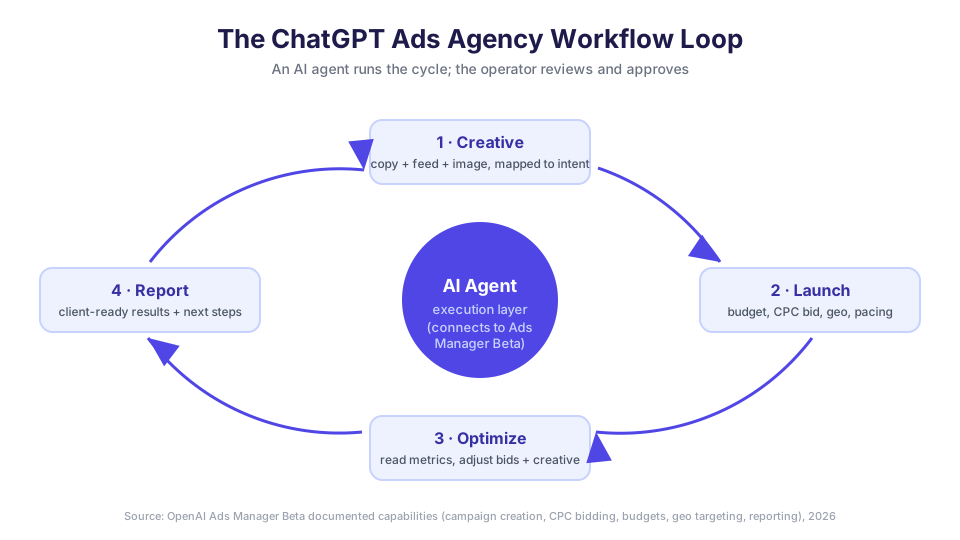
1. Creative. ChatGPT Ads are conversational, so the unit of work is the message that fits the moment, not a banner. Start from intent: identify the specific questions a target customer is likely to ask ChatGPT, then write copy and pick a destination that answers that intent. For feed-driven campaigns, your "creative" is really feed hygiene — clean titles, descriptions, prices, and HTTPS product images, since ad text is pulled directly from the feed.
2. Launch. In the Ads Manager Beta, campaign setup now includes a choice of daily or lifetime budget, CPC bidding, and geo targeting. Per Search Engine Land, advertisers can target by state, designated market area (DMA), and zip code, and OpenAI is testing automatically selected calls to action like "Shop Now," "Book Now," "Sign Up," and "Learn More." Set conservative budgets at launch and let the data, not your intuition, allocate the next dollar.
3. Optimize. This is where an agency earns its retainer. Read the metrics — impressions, clicks, spend, and now conversions — and adjust bids, pause underperformers, and iterate creative. The Ads Manager's table views show aggregate totals across campaign, ad group, and ad level, so you can assess performance without exporting first.
4. Report. Translate the numbers into a result the client cares about: cost per acquisition, return on ad spend, and what you'll change next cycle. A clean, repeatable report is also your retention tool — it's the artifact that justifies next month's invoice. Attribution on a conversational surface has its own quirks, which is why we wrote a dedicated guide on ChatGPT Ads conversion tracking and user objects.
How an AI agent does the execution
Here is the part that actually changes the economics, and the part most "start an agency" guides skip. The four-stage loop above is almost entirely mechanical — and mechanical work is exactly what an AI ads agent does well. This is the operating model we run at Soku, an AI ads agent that sits as the execution layer between you and the ad platforms.
In practice, the agent runs the loop and the operator supervises:
- Connect. The agent authenticates into the advertiser account and pulls current campaign state, budgets, and performance — so it always works from live data, not a stale export.
- Build creative. It drafts intent-mapped ad copy and assembles or audits the product feed, then surfaces variants for the operator to approve before anything goes live.
- Launch. Once approved, it creates the campaign with the budget, CPC bid, and geo settings you specified, applying your launch checklist consistently across every account.
- Optimize. On a schedule, it reads the metrics, flags underperformers, proposes bid and creative changes, and — within guardrails you set — applies the safe ones automatically.
- Report. It compiles the client-ready summary: spend, clicks, conversions, CPA/ROAS, and the recommended next move, in the same format every time.
The human stays in the loop where judgment matters — strategy, approvals, client relationships — and the agent absorbs the repetitive execution. That is how one operator can credibly run a portfolio of ChatGPT Ads accounts instead of one or two. If you want the concrete version for this specific surface, we walk through it in how to run ChatGPT Ads with Soku.
Pricing the offer (briefly)
Because ChatGPT Ads expertise is scarce, you can price on value rather than hours. Three common structures, in rough order of how most agencies grow into them:
- Setup fee + monthly retainer. A one-time onboarding charge for verification, account setup, and the first build, then a flat monthly fee for ongoing management. Simplest to sell early.
- Percentage of ad spend. A standard 10–20% of managed spend; it aligns your incentives with the client's scale and rewards you as budgets grow.
- Performance/hybrid. A smaller base plus a bonus tied to CPA or ROAS targets. Powerful once you have enough account history to forecast outcomes — risky before that.
A useful qualification heuristic: an agency-managed offer makes sense when a client is already spending well into five figures monthly or simply can't dedicate the weekly hours to manage it themselves. We go deeper on numbers and packaging in how to price an AI ads agency.
Honest limitations of a brand-new beta
Selling a beta surface to clients responsibly means being upfront about what isn't settled yet.
- Access is gated and uneven. Approval and onboarding timing are outside your control, so don't promise hard launch dates before an account is live.
- The feature set is moving. Budgets, geo targeting, CPC bidding, and conversion measurement all arrived as updates over a few months. Expect the workflow you document today to shift, and build your playbook to be edited.
- Feeds can be finicky. At least one seller reported being unable to get a correctly formatted, successfully uploaded product feed to surface in the Ads Manager — a normal beta-phase rough edge, but plan for support overhead.
- Attribution is immature. On a conversational surface, multi-touch and assisted conversions matter, and the measurement story is still developing. Set client expectations around leading indicators, not just last-click.
- Scale and inventory are unproven at the long tail. This is a new auction with thin competition in some categories; results will be lumpier than on Google or Meta until the marketplace fills in.
None of this is a reason to wait. It's the reason early operators win: the agencies that learn this surface while it's awkward will own it when it's not. Set up the account, run the loop, let an agent carry the execution, and document everything — that compounding head start is the whole point of starting now.