 Soku AI
The hardest part of running an AI ads agency isn't the ads. It's the first ten clients. Once you have a handful of paying accounts and one real case study, demand starts to compound — referrals come in, your content gets read, you can be choosy. But getting from zero to that point is where most new agencies stall, usually because they default to the one tactic that almost never works at this stage: blasting a generic pitch at as many people as possible and praying.
This guide is the opposite. It's a step-by-step client-acquisition sequence built for an agency with no logo wall, no team, and no reputation yet — but with one unfair advantage a 2026 agency has that nobody had three years ago: an AI agent that lets you deliver real proof, fast. For the complete overview of building the agency itself, see How to Start an AI Ads Agency. This post zooms in on one chapter of that playbook: how you actually land the work.
Why "spray and pray" fails before you start
The instinct when you're hungry for clients is volume: scrape 2,000 emails, send the same "We help businesses grow with AI" message to all of them, and hope the math works. It doesn't — and not because outbound is dead. It fails because the message is generic. HubSpot's prospecting guidance is blunt about it: it's the haphazard, untargeted method of approach, not the number of activities, that makes spray-and-pray ineffective. A tightly targeted process gets better responses from better-fit companies with fewer touches.
The benchmark data agrees. The average cold email reply rate in 2026 sits around 3.4%, but teams that personalize against a real signal — a recent hire, a product launch, ads they're visibly running — hit 15–25% reply rates, five to seven times the average. When you only need ten clients, you don't need a 2,000-person list. You need a 50-person list and a reason to email each one of them specifically.
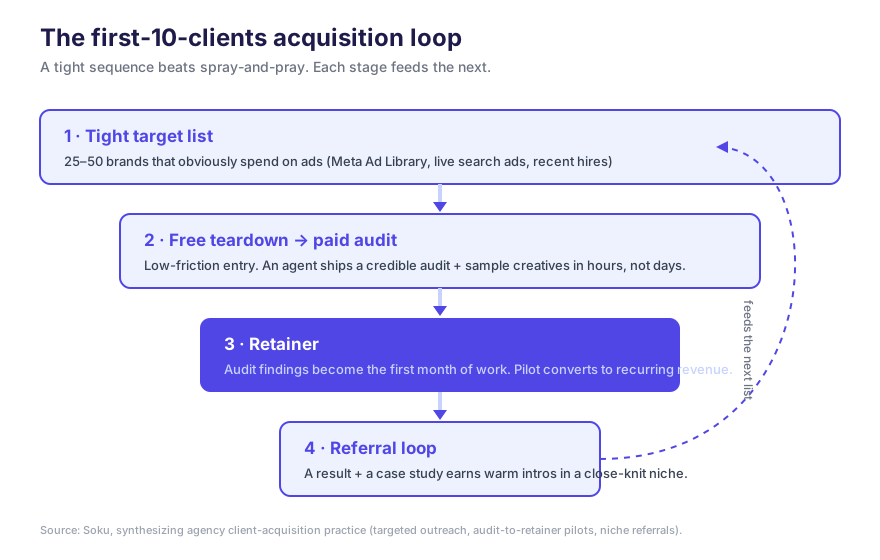
The whole strategy in one sentence: replace volume with relevance, and use speed of delivery as your proof. Here's the sequence.
Step 1 — Sharpen positioning until outreach lands itself
Before you write a single email, fix your positioning, because a sharp position does half the selling for you. "We're an AI ads agency" is not a position — it's a category. A position names a specific buyer, a specific outcome, and ideally a specific channel.
Compare two openers. The weak one: "We help businesses grow with AI-powered marketing." The sharp one: "We help DTC supplement brands cut Meta CAC by getting fresh creative live every week instead of every six weeks."
The second tells the reader exactly who it's for and what changes. Agencies that niche down consistently report that, over time, referrals and new business shift toward their specialty — but you get that flywheel only after committing to a lane narrow enough that prospects self-identify. Pick one industry and one painful, measurable problem. You can always widen later; you can't get traction while you're "everything to everyone."
A useful test: if your positioning statement would still be true for a generic chatbot agency, it's not sharp enough. Lead with the industry and the KPI, not the technology — "AI" is how you deliver, not what you sell.
Step 2 — Build a tight target list of brands that obviously spend on ads
Your list is your strategy. For an ads agency specifically, you have a luxury most agencies don't: you can see who's already spending. That's the qualifier — you're not trying to convince someone to start advertising, you're reallocating a budget that already exists.
Build a list of 25 to 50 brands in your niche using signals that prove active ad spend and a reason to talk now:
- They appear in the Meta Ad Library running active ads — you can literally see their creative and how stale it is.
- They show up as paid search ads when you Google your niche's core keywords.
- They recently posted a job for a growth or performance marketing role (a sign the function is understaffed or in flux).
- They just launched a product, raised funding, or rebranded (a timing trigger).
- They're a peer of a brand you'd love to work with — close-knit niches refer within themselves.
Keep this in a simple sheet with a column for the specific observation you'll reference. That observation is the difference between a 3% and an 18% reply rate. If you can't write a one-line reason this brand specifically should hear from you this week, take them off the list. A short list you can personalize beats a long list you can't.
Step 3 — Lead with a free teardown or paid audit, not a pitch
The single most reliable entry point for a new agency is not "can we get on a call." It's "I already did some work for you — want to see it?" An audit or teardown flips the dynamic: instead of asking for the prospect's time, you're giving them something useful and demonstrating competence before any money changes hands.
There are two flavors, and you'll use both:
- The free teardown is your outbound hook. You record a 3–5 minute Loom or write a one-page breakdown of their current ads: what's fatiguing, where the creative is weak, an obvious targeting or tracking gap, and two or three specific things you'd change. It costs you very little and it's wildly more compelling than a pitch.
- The paid audit is your low-friction first transaction. A $500–$1,500 paid audit de-risks the relationship for both sides: the client gets a deep, documented analysis with a prioritized action plan, and you get a paying engagement that's trivial to convert into a retainer because the audit is the first month's roadmap.
This audit-to-retainer motion is the workhorse of new-agency growth. Operator accounts describe exactly this path: a cold message with a one-page audit turns into a paid pilot, the pilot produces a visible result, and the result converts into a recurring retainer. The audit isn't a loss leader you hope leads somewhere — it's structured so that saying yes to the retainer is the obvious next step, because you've already surfaced the problems and scoped the fix.
The speed wedge: deliver the proof in hours, not days
Here's where a 2026 agency wins. The reason audits historically didn't scale as an outbound tactic is that they took too long — manually auditing an account and mocking up alternative creative could eat a full day per prospect, so you could only afford to do it for warm leads.
An AI ads agent collapses that. You can point an agent at a prospect's public ad activity and ad account and have it pull together a credible audit — what's running, where spend is leaking, which creatives are fatiguing — plus a small set of sample creatives in the prospect's style, in a couple of hours rather than a couple of days. (This is the same operating leverage covered in the AI ads agency tech stack guide.)
That changes the economics of outreach. When the marginal cost of producing real proof drops near zero, you can afford to lead with it for cold prospects, not just warm ones. The teardown stops being something you promise on a call and becomes the first thing a prospect sees from you. Nothing converts a skeptic like a brand-new agency simply doing the work first — and being visibly faster than the incumbent they're frustrated with is itself the pitch.
One practical note: label the sample creatives as concepts, and keep the audit honest. The goal is credibility, not a hard sell — overpromising a specific outcome is the fastest way to lose a sophisticated buyer.
Step 4 — Outbound that actually gets replies
Now the message. The structure that works in 2026 is the same three-part shape every high-reply cold email uses: a research-backed opener, one clear value proposition, and a low-friction CTA — kept under about 125 words, plain text, no HTML, no attachments on the first touch.
For an ads agency, the opener writes itself because you can reference what they're running. Here is a cold-email template structured around the teardown hook. Fill the brackets with the specific observation from your list, never a generic line:
Subject: quick note on [Brand]'s Meta ads

Hi [First name],

Saw [Brand] is running the [specific ad / offer] set in the
Meta Ad Library — the [hero video / carousel] has been live a
while, so it's probably starting to fatigue.

I run a small AI-driven ads studio focused on [their niche],
and I put together a short teardown of your current ads with
2–3 things I'd test first (plus a couple of sample creatives in
your style). No pitch — I'd just rather show than tell.

Want me to send it over? Two-minute watch.

[Your name]
A few rules that matter more than the wording:
- The subject line is lowercase and specific. It looks like a note from a person, not a campaign.
- The opener references their activity. "Saw you posted about X" or "saw you're running Y" is the Level-4 personalization that drives the reply-rate lift. If you can't write a true, specific opener, the prospect doesn't belong on your list.
- The CTA is tiny. You're not asking for a meeting; you're asking permission to send a free thing. The "yes" is almost free, which is exactly why it gets given.
- Follow up two or three times, each adding a new angle, not just "bumping this." A second email that says "I went ahead and recorded the teardown — here it is" outperforms any reminder.
The same template works as a shortened LinkedIn DM — comment thoughtfully on the prospect's posts for a week first, so your name isn't cold when it lands.
Set expectations on the math. Cold outreach to a well-built list lands roughly 3–7% of recipients in a conversation; warm and referred leads close at 30–50%. So your job in the first ten clients is to manufacture as many warm conversations as possible from a cold start — which is exactly what the teardown does, by making the first interaction valuable instead of extractive.
Step 5 — Build quiet authority in the niche
Outbound gets your first conversations; content makes the next ones easier and starts pulling inbound. You do not need to become an influencer. You need to be visibly competent in your one niche so that when a prospect Googles you after your email, they find evidence you know their world.
The highest-leverage content for a new ads agency is the teardown, made public. Take the same audit motion from Step 3 and publish anonymized or volunteered versions: "Here's what I'd change about how [category] brands run their Meta creative." It's genuinely useful, it demonstrates your eye, and it doubles as outbound raw material. Over time this is how authority and referrals compound in a niche — your specialty becomes the reason people think of you first.
Keep it narrow and frequent rather than broad and polished. A weekly short breakdown aimed squarely at your one buyer beats a quarterly essay aimed at everyone. The point isn't reach; it's that the 50 people on your list keep seeing evidence you understand their problem.
Step 6 — Turn every result into referrals
Referrals should become your number-one source of new business faster than you'd expect — in a tight niche, your clients know each other. The mistake is treating referrals as something that happens to you. They're something you ask for, deliberately, at the right moment.
The right moment is right after a visible win: a creative that beat the control, a CAC that dropped, a report the client was happy with. That's when you say, plainly, "If you know one other [niche] brand frustrated with their ads, I'd love an intro — I'll do the same free teardown for them I did for you." You're not asking for a favor in the abstract; you're offering to do for their peer the exact thing that earned their trust, and because your teardown is cheap to produce, you can honor that offer instantly.
Wrap each early win into a one-page case study — the situation, what you changed, the result. You need only one or two, because a new agency's biggest objection is "have you done this before," and a single concrete case study answers it.
Putting it together: a 90-day sequence to ten clients
None of these steps work in isolation; they work as a loop. Here's the realistic cadence for going from zero to ten.
| Weeks | Focus | Target |
|---|---|---|
| 0–2 | Lock positioning, build the 25–50 brand list, ship one public teardown | Foundation in place |
| 2–6 | Send personalized outreach with teardowns; run 1–2 paid audits | 2–3 paid pilots |
| 6–10 | Convert pilots to retainers, publish first case study, keep weekly content | 4–6 clients total |
| 10–13 | Ask every happy client for one intro; let referrals + inbound carry it | 8–10 clients |
The shape matters more than the exact numbers: you start with deliberate, manual, personalized effort, and as proof accumulates, the cheaper channels — content, referrals, inbound — take over. You're not trying to scale outbound to a thousand; you're trying to earn the first few results that make scaling unnecessary.
How Soku fits
Everything above hinges on one thing being fast: doing real work for a prospect before they've paid you. That's the part that historically made the teardown-led motion too slow to use at scale. Soku is the AI ads agent that closes that gap — point it at a prospect's public ad activity and account, and it assembles the audit and a set of sample creatives in hours, so the proof can lead your outreach instead of waiting behind a sales call. For a new agency, that turns "trust me" into "here, look" on day one.
Where to go next
- How to Start an AI Ads Agency — the full playbook this client-acquisition guide is a chapter of: operating model, niche, offer, stack, pricing.
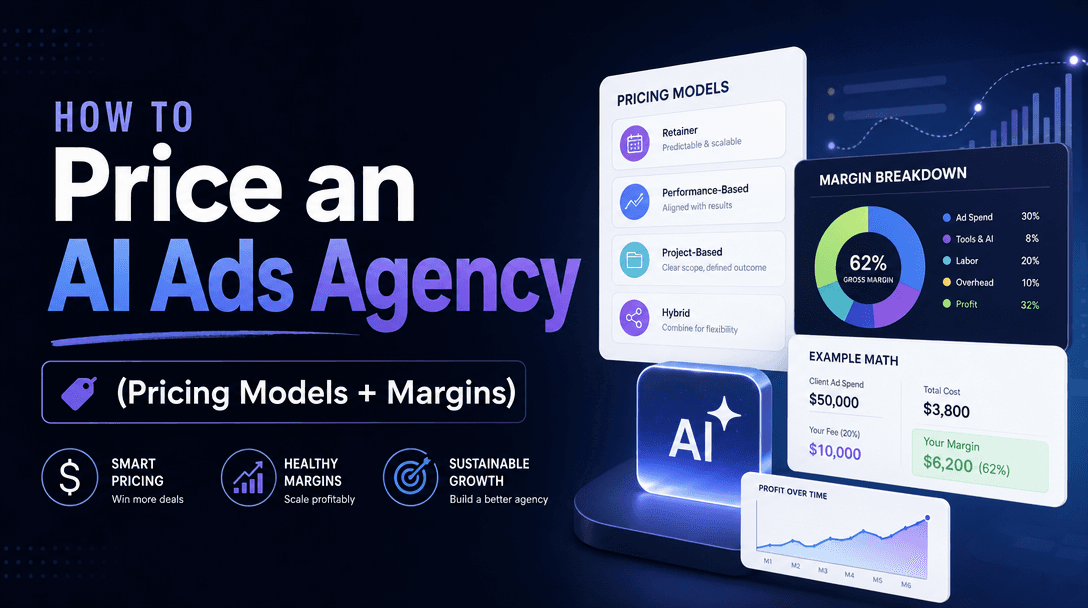
- How to price an AI ads agency — what to charge for the audit and the retainer, with real numbers and margin math.
- The AI ads agency tech stack — the tools (and the agent) that let you deliver audits and creatives fast enough to lead with them.
- How to start a ChatGPT ads agency — operating on OpenAI's new ad surface, where there's no incumbent agency to displace.
FAQ
How long does it really take to get the first client?
With a tight list and a teardown-led approach, the first paid audit can land in 2–4 weeks. Converting that pilot into a retainer typically follows within another few weeks, once the client sees a result. The full ten usually takes a quarter of consistent effort.
Should I do free teardowns or charge for the audit?
Both, at different points. Use the free teardown as your outbound hook to start a conversation, and offer the paid audit ($500–$1,500) as the low-risk first transaction once they're interested. The paid audit doubles as the first month's roadmap, which is what makes the retainer conversion natural.
What if I have no case studies yet?
That's exactly what the teardown solves. By doing real, specific work for a prospect before they pay — made possible by an agent that produces a credible audit in hours — you substitute demonstrated competence for a portfolio you don't have yet. Turn your first one or two results into one-page case studies and the objection disappears.
Is cold outreach still worth it in 2026?
Yes, but only the targeted, personalized kind. Generic blasts reply at ~3%; outreach that references a real signal about the specific brand replies at 15–25%. For an ads agency, you can always reference what they're running, which makes personalization easy. Volume is not the lever — relevance is.