 Soku AI
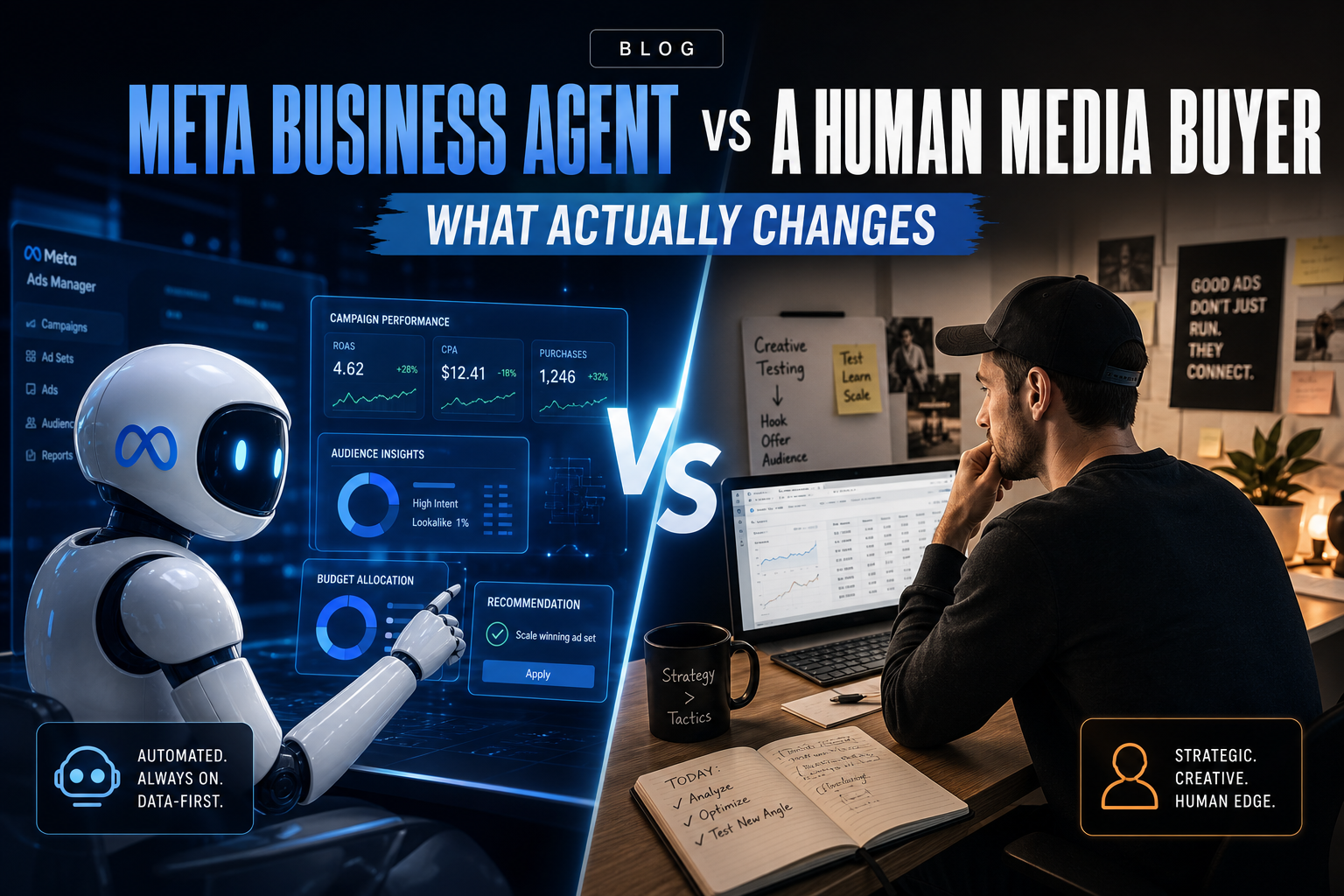
The question landing in every performance marketer's inbox this month is blunt: if Meta is building an agent that creates and runs the ads, what's left for me to do? Meta's recent Business Agent announcement and the Manus AI integration into Ads Manager have turned a slow-burning anxiety into a live one. Zuckerberg has been explicit about the destination: an advertiser supplies a business outcome and a payment method, and Meta's systems do the rest — campaign, creative, targeting, optimization.
So this post does the comparison directly. Not "AI is changing marketing" hand-waving, but a scored, criterion-by-criterion matchup between the Meta Business Agent (as it exists and as Meta says it will exist) and a competent human media buyer — and then a thesis you can actually act on about who still wins where.
For the complete overview — what the agent means for advertisers and how to turn it on — see the complete guide to Meta Business Agent.
First, what the agent actually is — and isn't — today
A lot of the panic comes from conflating two different things Meta shipped, so let's separate them.
The Business Agent that Meta announced in June 2026 is, at launch, a customer-service agent. It lives in WhatsApp, Messenger, and Instagram DMs; it answers product questions, recommends from your catalog, books appointments, qualifies leads, and decides when to hand off to a human. Over a million businesses already run agents on those surfaces, against more than a billion daily business threads. It is free to activate now, with paid subscription tiers coming "in the coming months." Notably, that announcement is about conversations, not campaigns.
The advertising side of the story is the Manus AI integration that rolled into Ads Manager starting February 17, 2026, roughly seven weeks after Meta closed the acquisition. Here's the part that matters and that most hot takes skip: as of mid-2026, Manus inside Ads Manager generates reports, detects anomalies, builds dashboards, supports audience research, and answers metric questions in plain English — but it does not autonomously change live campaigns. As the integration's own documentation puts it, "budget, targeting, and creative decisions remain entirely with the advertiser."
So the honest starting point is a gap. There is the agent Meta describes — the one that takes an outcome and a credit card and runs the whole funnel — and the agent that exists, which is an extremely capable analyst and customer-service layer that still asks you before it touches the money. Most of this comparison is about reasoning across that gap: scoring the agent on the trajectory Meta has committed to, while staying honest about where it is right now.
The seven criteria
A fair comparison needs criteria that map to what a media buyer is actually paid for — not a vague "who's smarter." We ranked both sides on seven jobs that together make up the role:
- Speed of execution — how fast a decision becomes a live change in the account.
- Cost at scale — the marginal cost of managing one more campaign, account, or dollar.
- 24/7 consistency — applying the same logic at 3am on a holiday as at 11am Tuesday.
- Creative judgment — knowing what to make next, not just rotating what exists.
- Account strategy — campaign architecture, naming, segmentation, conversion design.
- Accountability — who owns the outcome when the quarter misses.
- Brand-safety judgment — the calls that protect the brand, not just the CPA.
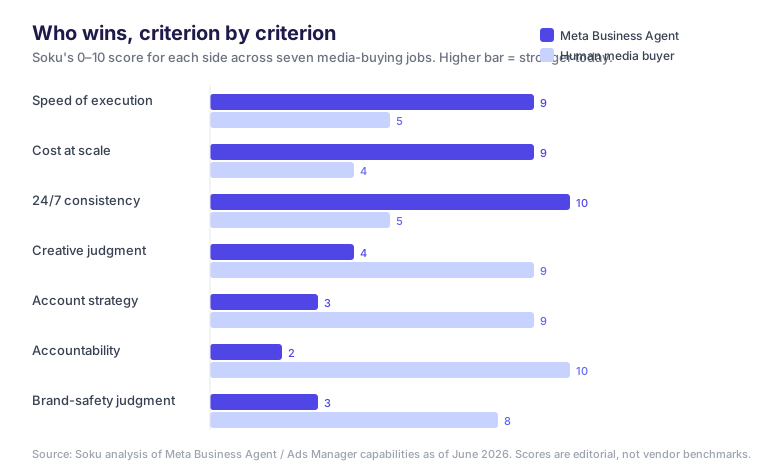
The scores below are Soku's editorial read of the agent's current and committed capabilities against a competent in-house or agency buyer. They're arguments, not vendor benchmarks — the reasoning for each is in the sections that follow.
Where the agent wins, and why it isn't close
Speed of execution — agent 9, human 5
This is the cleanest win for the machine, and it's structural, not incremental. A human buyer reviews accounts on a cadence — once or twice a day for most, hourly for the obsessive — and every change passes through attention, context-switching, and fatigue. An agent operating inside Meta's own stack closes the loop continuously: it can read an impression-level signal and adjust pacing before a human has finished their coffee. The relevant benchmark here isn't a percentage; it's latency. The agent's decision-to-action gap is seconds. The human's is hours. When Meta talks about evaluating tens of millions of ads per impression, it's describing a tempo no person operates at.
The human's 5 isn't an insult — it reflects that a sharp buyer still makes faster strategic calls (kill this angle, double the budget on that geo) than a system waiting for statistical significance. But on raw execution speed, this is over.
Cost at scale — agent 9, human 4
A media buyer's cost scales roughly linearly with the accounts they manage: more portfolios mean more headcount, and quality degrades past a certain span of control. An agent's marginal cost of managing the next campaign is close to zero. That's exactly why Meta is moving the agent behind a paid subscription — it's a software margin business, not a services one. McKinsey estimates up to 60% of marketing-operations tasks are automatable, and the execution layer is the densest concentration of those tasks. For an advertiser, the agent collapses a cost that used to scale with ambition.
The human's low score here is about unit economics at scale, not value — a single great buyer on a single account can still out-earn their cost many times over. But ask "what does it cost to manage 200 accounts well?" and the human model gets expensive fast.
24/7 consistency — agent 10, human 5
This is the most underrated agent advantage. Humans are inconsistent by design: the budget-pacing rule you apply rigorously on Monday gets fuzzy by Friday afternoon. An agent applies the same decision logic at 3am on a holiday weekend as at peak hours, and that consistency compounds — cleaner pacing curves, fewer overspend incidents, more predictable attribution. There's no heroics here, which is the point. The agent doesn't have good days and bad days. That alone eliminates a whole class of avoidable waste; WordStream found automated bidding cut wasted spend by roughly 14%, and consistency is a big part of why.
Where the human still wins, and why it's also not close
Now flip it. On the next four criteria, the human's lead is just as decisive — and crucially, these are the criteria that matter more as the first three get automated. When execution is commoditized, the differentiator moves up the stack.
Creative judgment — human 9, agent 4
This is the heart of the thesis. As targeting and bidding got automated, performance stopped being a targeting problem and became a creative-supply problem. Meta's algorithm now decides who sees what; your only real lever is the volume and diversity of ads you feed it. One agency reported that clients running significantly more creative volume saw +18% ROAS and +38% revenue year-on-year. The bottleneck moved.
And here's the distinction that the scorecard hangs on: the agent is excellent at creative rotation — testing, killing losers, scaling winners — but weak at creative judgment, which is knowing what to make next. Generative tools can produce a thousand variations of an idea; they cannot reliably originate the idea that's worth a thousand variations. Deciding that your skincare brand should stop running before/after shots and start running founder-story UGC because the market is fatigued — that's a read on culture, customer, and brand that the agent doesn't have. The agent gets a 4 because it genuinely accelerates production once a direction exists. The human gets a 9 because the direction is everything, and the direction is human.
Account strategy — human 9, agent 3
An agent optimizes within a structure. It does not decide that you should consolidate twelve ad sets into three to give the algorithm enough signal to learn, or that your conversion event is wrong, or that this product needs a separate campaign because its margin profile is different. Structuring accounts so the algorithm can actually learn is a strategic act performed on the system, and the agent is a participant in the system, not an architect of it. Its low score reflects that it's structurally inside the box it would need to redesign. This is also where small accounts get hurt by full automation: with thin data, the agent's optimization has nothing to optimize, and a human's structural judgment is worth more than ever.
Accountability — human 10, agent 2
This is the criterion nobody puts on a feature comparison, and it may be the most important. When a quarter misses, someone explains it to the CEO, defends the strategy, and decides what changes. An agent cannot be accountable — it has no stake, no judgment to defend, no relationship with the board. Meta itself draws this line: the agent reports and recommends, but "budget, targeting, and creative decisions remain entirely with the advertiser." That's not a temporary limitation; it's a governance reality. You cannot outsource accountability to a tool you don't control, that's optimizing toward the platform's metrics, run by the company that also sells you the inventory. The agent's 2 is generous.
Brand-safety judgment — human 8, agent 3
Closely related: the agent optimizes for what it can measure, which is conversions, not what it can't, which is whether this placement, this comment thread, or this aggressive claim is going to embarrass the brand. The conflict of interest is real and worth saying plainly — the agent is built by the platform whose incentive is to spend your budget, not to protect your brand. A human buyer is the firewall between "this works" and "this is worth the risk."
The full matchup, side by side
| Criterion | Meta Business Agent | Human media buyer | Who wins |
|---|---|---|---|
| Speed of execution | Seconds; continuous loop | Hours; reviewed on a cadence | Agent |
| Cost at scale | Near-zero marginal cost | Scales with headcount | Agent |
| 24/7 consistency | Identical logic, always on | Variable; fatigue and drift | Agent |
| Creative judgment | Rotates well; can't originate direction | Reads market, culture, brand | Human |
| Account strategy | Optimizes inside a structure | Designs the structure | Human |
| Accountability | None; no stake to defend | Owns the outcome | Human |
| Brand-safety judgment | Optimizes measurable metrics only | Weighs risk vs. reward | Human |
| Reporting & analysis | Strong today (Manus in Ads Manager) | Slower, manual | Agent |
| Live campaign autonomy | Not yet — recommends, doesn't act | Full authority | Human (for now) |
Notice the pattern. Everything the agent wins is execution and analysis — the mechanical, high-frequency, measurable layer. Everything the human wins is judgment — the strategic, low-frequency, hard-to-measure layer. That's not a coincidence; it's the shape of the whole transition.
The thesis: the agent doesn't replace the buyer, it deletes the buyer's busywork
Here's the defensible claim this all adds up to. The Meta Business Agent does not replace the media buyer. It deletes the part of the media buyer's job that was always the least valuable — the bid tweaks, the budget shuffles, the report-building, the 3am pacing checks — and in doing so it raises the value of everything that's left.
Three consequences follow, and they're worth being precise about:
The role doesn't shrink; it moves up. The buyer who spent 70% of their week in the execution weeds now spends it on creative strategy, account architecture, and offer design — the criteria where the human wins 9-to-3. The job description that survives is closer to "creative strategist and account architect who supervises an agent" than "person who logs into Ads Manager and adjusts bids."
Portfolio capacity goes up, not headcount down — for the buyers who adapt. Because the agent collapses cost-at-scale, a single strong buyer can now supervise far more accounts at higher quality. Salesforce found high-performing teams are 2.1x more likely to use AI; the leverage accrues to people who direct the agent, not to people who compete with it.
*The buyers who get replaced are the ones who were the execution layer.* This is the uncomfortable part. If your entire value was being a careful, consistent button-pusher, the agent is genuinely better at your job — faster, cheaper, never tired. The defensible position is upstream of execution, in the judgment the agent can't hold.
And one structural caution that should sit underneath the whole optimistic read: the agent is not a neutral tool. It's built by the company that sells you the inventory, optimizes toward the platform's definition of success, and is moving behind a paid subscription. Handing it full autonomy means trusting your spend to a system whose incentives are not identical to yours. The human's accountability score of 10 isn't nostalgia — it's the reason you keep a hand on the wheel.
What this means for how you actually work
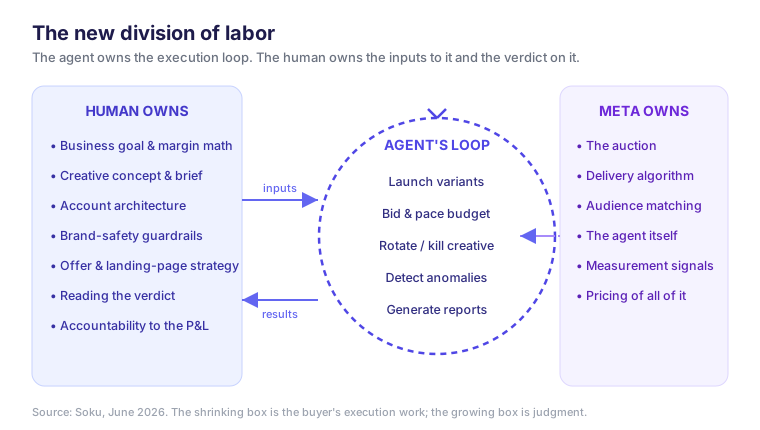
If you're a buyer or you run a team, the practical move is to reorganize around the division of labor in the diagram above rather than fight it:
- Let the agent own the loop. Pacing, bid management, rotation, anomaly detection, reporting — hand these over the moment Meta lets you. Competing on consistency with a machine is a losing game.
- Keep both hands on the inputs. The creative brief, the account structure, the conversion definitions, the brand guardrails — these are your inputs to the agent's loop, and they determine its ceiling. A great agent on a bad brief still loses.
- Own the verdict. Read what the agent did, decide whether the strategy is working, and be the one accountable for the answer. That's the irreducible core of the job.
- Don't single-thread on one platform's agent. A Meta-native agent optimizes for Meta. The strategic layer — and your leverage — lives in working across channels, where the platform's incentives stop and yours take over.
A decision matrix for 2026 teams
Use this matrix before you replace a role or over-hire around work the platform is already automating.
| Account situation | Best operating model | Why |
|---|---|---|
| Low spend, low conversion volume | Human-led, agent-assisted | The agent does not have enough signal; a human should protect budget and simplify structure. |
| Mature DTC account with clean catalog and steady purchases | Agent-led execution with weekly human creative review | Advantage+ and Business Agent can handle pacing and conversations; the human should focus on offer and creative supply. |
| Multi-market or multi-brand account | Human strategy with agent runbooks per market | Localization, margin, and brand rules differ too much for one generic automation policy. |
| Agency managing many similar accounts | Agent-assisted portfolio triage | The agent is strongest at surfacing anomalies and repetitive fixes across accounts; humans handle client judgment and strategy. |
| B2B lead-gen with long sales cycle | Human-led qualification design, agent-assisted first response | The first reply can be automated, but fit, buying committee, and sales handoff rules need close human control. |
The pattern is clear: the more repeatable and data-rich the account, the more execution moves to the agent. The more ambiguous, strategic, or brand-sensitive the decision, the more valuable the human becomes.
What to measure if you keep both
Hybrid teams need different scorecards from traditional media-buying teams. Do not only ask whether CPA improved. Ask whether the work moved to the right layer.
| Metric | Healthy signal | Unhealthy signal |
|---|---|---|
| Human hours per account | Down for reporting, pacing, and issue triage | Down for creative strategy or account architecture |
| Agent intervention quality | Most recommendations are accepted or correctly ignored with a documented reason | Buyers ignore the agent because its suggestions are noisy or unauditable |
| Creative test velocity | More distinct hypotheses shipped per month | More variants of the same weak idea |
| Handoff quality | Sales receives fewer but better qualified threads | The inbox fills with low-intent conversations |
| Cross-channel budget quality | Meta decisions are reviewed against Google, TikTok, and blended revenue | Meta optimizes in isolation and steals credit from other channels |
This is the reason Soku frames the role as orchestration, not replacement. The best media buyer with an agent should manage more signal, more accounts, and more creative tests without becoming a dashboard operator again.
How Soku fits
This is exactly the seam Soku is built for. Soku is an ads agent that owns the execution loop — launching, pacing, rotating, and reporting across Meta, Google, and ChatGPT Ads from a single conversation — but it's deliberately not the platform selling you the inventory. That independence is the point: you get the speed, cost, and consistency advantages of an agent (the three criteria where the machine wins) without surrendering the cross-channel strategy and accountability (the criteria where you should keep winning) to the auction operator itself.
The future of media buying isn't agent or human. It's a human who's stopped doing the work an agent does better, supervising an agent that's stopped pretending to do the work a human does better. Get that split right and you don't get replaced — you get leverage.
For the full picture of where Meta's agent is headed — including what it means for advertisers and the activation checklist — read the complete guide to Meta Business Agent.