 Soku AI

Every seller knows the math: cold email reply rates sit in the low single digits, while a warm introduction converts to a meeting a third of the time or better. The problem was never whether warm paths exist — between alumni networks, former colleagues, and people who already engaged with your content, they almost always do. The problem is that finding them is hours of manual cross-referencing nobody does for more than their top handful of accounts.
That just changed. With Claude Fable 5's launch on June 9, one of the most striking early results is exactly this workflow: an Anthropic GTM benchmark that connects the model to relationship data via MCP, gives it freedom to pick its own filters, and asks for the warmest path into a target company. The model found people who studied at the same school in the same years, worked the same jobs, and had engaged with the requester's content before — and assembled the result into a full tiered relationship map. By the benchmark owner's account, the best warm-intro paths any Claude model has produced.
This post breaks down how the workflow actually works, how to reproduce it with your own data, and what it means for how GTM teams should structure prospecting. It's part of our Claude for Marketing & Sales guide.
Why this is an agent problem, not a search problem
Sales databases have had filters forever. The reason warm-path discovery stayed manual is that it's not one query — it's a composition of queries that depends on who you are:
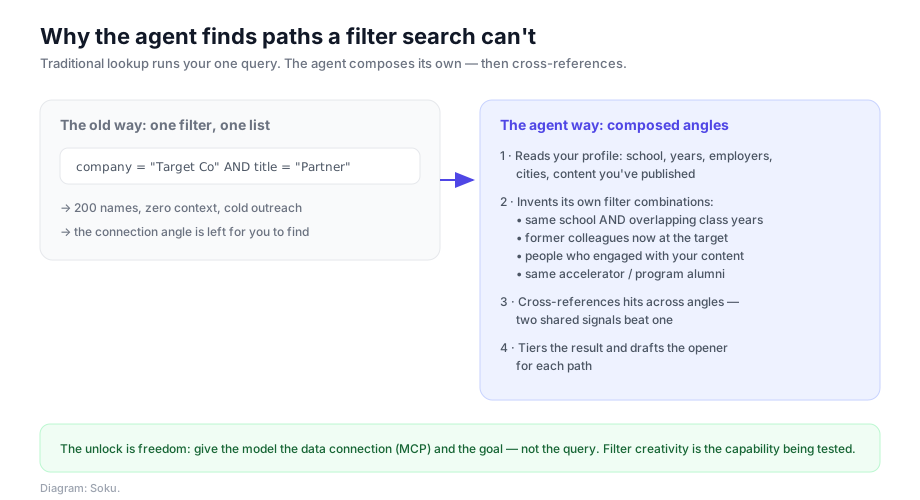
A recruiter-style filter search answers the question you asked. The agent answers the question you meant: "who at this company is most likely to take my call?" That requires reading your background first, inventing the angles (same school + same years, ex-colleagues now at the target, content engagers, program alumni), running each one, and then — the step humans skip — cross-referencing, because someone who shares two signals with you is categorically warmer than someone who shares one.
This is exactly the shape of work where Fable 5's "longer task, larger lead" profile shows up. Filter creativity across a dozen self-directed queries, with judgment applied at each step, is a long-horizon agentic task wearing a sales costume.
The output: a tiered warmth map
The deliverable that makes this workflow operational isn't a list — it's a map with an action attached to each tier:
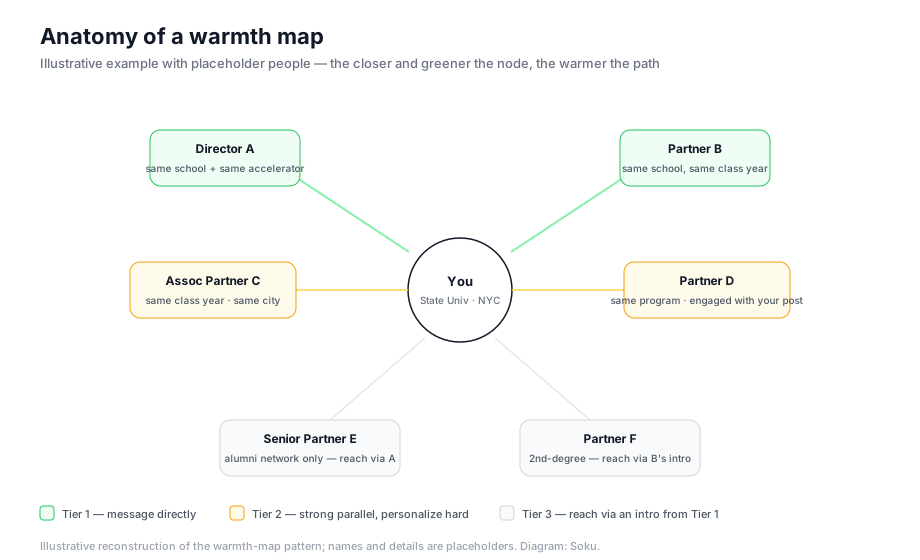
- Tier 1 — message directly. Multiple strong shared signals (same school and same program, or an ex-colleague). The opener writes itself, because it's true.
- Tier 2 — strong parallel. One solid signal (same class year, same city, engaged with your post). Worth a direct message, but the personalization has to carry more weight.
- Tier 3 — reach via intro. Senior targets with only weak direct signals — but reachable through a Tier 1 person. The map tells you who to ask for the forward.
The tiering is the part that converts research into pipeline: it sequences the outreach (Tier 1 first, then use those conversations to unlock Tier 3) instead of dumping forty names into a sequence tool.
How to reproduce it with your own stack
The benchmark version uses Anthropic's internal MCP setup, but the pattern is reproducible with any relationship-data source the model can query — a CRM MCP server, an enrichment platform like Clay, or LinkedIn exports. Three ingredients:
- A data connection, not a data dump. Connect the source via MCP so the model can run its own queries iteratively. Pasting one pre-filtered CSV defeats the purpose — the value is in the model deciding what to look for next based on what it just found.
- Your context. The model needs your school, employers, years, cities, and content history to invent angles. Profile export or a short paragraph both work.
- A goal-shaped prompt, not a query-shaped one. You're delegating the filter design. Something like:
Find me the warmest connection paths into {company}.

My background: {school, years, employers, cities, programs, where I publish}.

Use the connected data tools however you see fit — invent your own
filter combinations and run as many queries as you need. Look beyond
the obvious: shared schools and years, former employers, accelerators,
people who engaged with my content, second-degree paths through my
strongest ties.

Cross-reference: people matching multiple signals outrank single-signal
matches. Return a tiered map — Tier 1 message directly, Tier 2 strong
parallel, Tier 3 reach via intro (name who to ask) — with a one-line
opener for each person grounded in the genuine shared context.
The phrase doing the work is "however you see fit." Constrain the model to your one favorite filter and you've rebuilt the search box you already had.
Where it fits in a GTM motion
- Account-based everything. For a 40-account target list, warmth maps turn "spray the buying committee" into "enter each account through its warmest door." Run it per account; the maps compound with your team's collective networks.
- Founder-led sales. Founders have unusually rich path networks (investors, accelerator cohorts, ex-colleagues) and no SDR team to do the digging. This is the highest-leverage automation available to them.
- Channel partnerships and BD. The same workflow maps paths into potential partners — where a warm entry matters even more than in sales.
- Paired with paid. Warm outreach and paid channels answer different moments; the research artifact from one (which roles, which pain language) feeds targeting and creative in the other.
Two honesty notes. First, the example that popularized this came from an internal Anthropic benchmark — your results will depend heavily on the depth of the data you connect; thin data produces thin maps. Second, the map is leverage, not license: the model finds genuinely shared context, and outreach that uses it honestly ("we overlapped at X") works precisely because it's true. Fabricating closeness you don't have burns the very network the map revealed.
FAQ
What is an AI warm intro finder?
A workflow where an AI model with access to relationship data (CRM, enrichment tools, network exports) composes its own searches to find the warmest connection paths between you and a target company, then returns a tiered map with suggested next actions.
Why is Claude Fable 5 better at this than earlier models?
The workflow is long-horizon agentic work — many self-directed queries with judgment between them. Fable 5's gains are concentrated exactly there; Anthropic's own GTM benchmark of this task produced its best-ever warm-intro results on the model.
What data do I need to connect?
At minimum, your own background and a queryable people-data source via MCP — a CRM, an enrichment platform, or network exports. The richer the data, the better the map.
Is this just for sales teams?
No — the same workflow maps paths for partnerships, fundraising, recruiting, and PR. Anywhere a warm entry beats a cold one, which is everywhere.
Can Soku do this?
Soku's agent is built for exactly this class of multi-step GTM research — connected to your marketing stack, it digs, cross-references, and hands back the actionable artifact instead of a raw list. Try it free.