 Soku AI
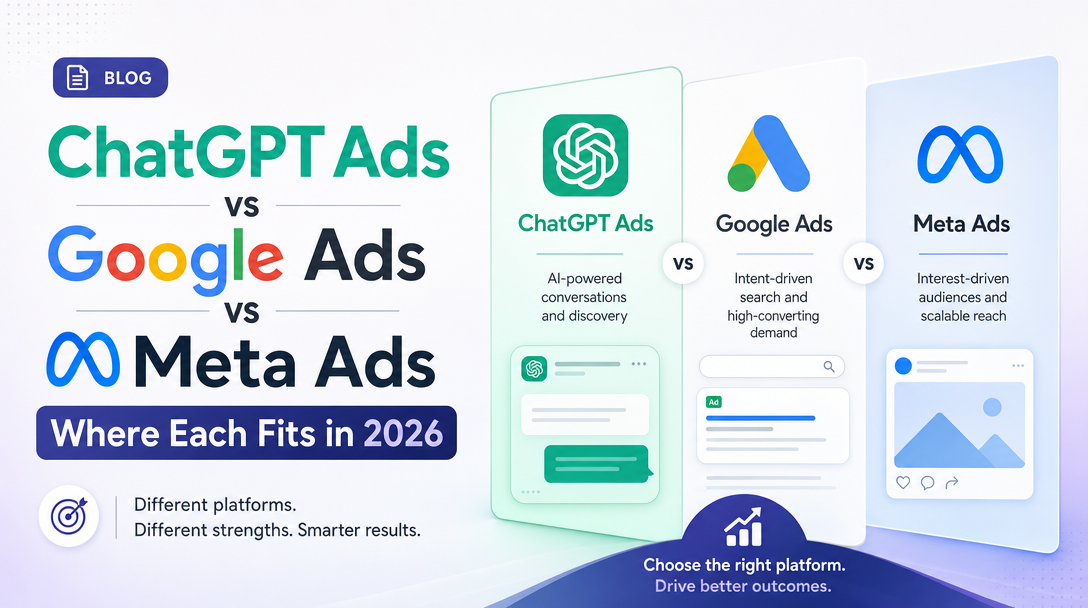
Every few years a new ad channel shows up claiming a seat at the table, and the question is always the same: does it take budget from the incumbents, or does it do a job the incumbents can't? With OpenAI's self-serve Ads Manager now open with no minimum spend, ChatGPT ads just became a real option for every media buyer — so the question is now practical, not theoretical.
The short answer: ChatGPT ads are neither a Google substitute nor a Meta substitute. They intercept a third moment — the middle of an AI-assisted research session — that neither incumbent can reach. Here's the full comparison, benchmark by benchmark.
This is part of our ChatGPT Ads series: the Ads Manager hands-on covers the platform itself, the setup guide covers tracking, and the explainer covers the background.
The fundamental difference: which moment you're buying
Google Ads is demand capture. Someone types "best crm for startups" and you bid to be the answer. Intent is explicit, mature, and priced accordingly — Google has spent 25 years perfecting that auction, and competitive B2B terms routinely run $20–50 CPMs-equivalent and double-digit CPCs.
Meta Ads is demand creation. Nobody on Instagram is searching for your product; your creative interrupts a feed and manufactures the want. It's the volume engine — cheap impressions ($4.82–19.81 CPM depending on methodology), enormous reach, and performance that lives or dies on creative iteration speed.
ChatGPT ads intercept mid-research. A user spends five or six messages narrowing down what they actually need — "CRM for a 10-person team, needs to sync with Gmail, under $50/seat" — and then a single sponsored card renders below the answer. The conversation has already done the qualification work a search query never could. Targeting runs on context hints (descriptions of relevant conversation topics), not keywords or audiences; there are no lookalikes, no retargeting lists, and at most one ad per response.

The numbers, side by side
| Dimension | ChatGPT Ads | Google Ads (Search) | Meta Ads |
|---|---|---|---|
| Targeting model | Context hints (conversation topic) | Keywords + intent signals | Audiences + algorithmic delivery |
| Pricing | CPC $3–5, CPM ~$25–45 | CPC varies widely; $20–50 for competitive B2B | CPM ~$5–20 by vertical |
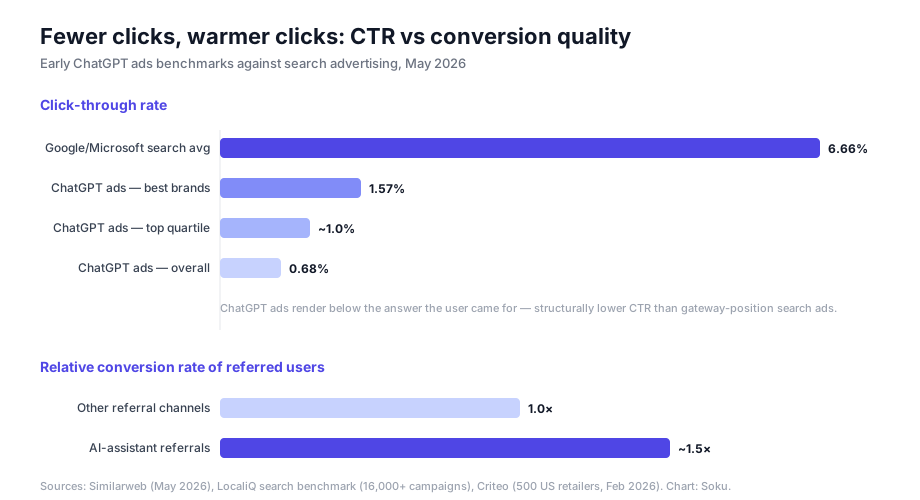
| CTR benchmark | 0.68% overall; best brands 1.57% | ~6.66% search average | ~1–2% feed typical |
| Conversion quality | ~1.5× other referral channels (Criteo) | Strong, intent-driven | Varies; creative-dependent |
| Measurement maturity | Weeks old; pixel + CAPI since May 2026 | Two decades of tooling | Mature (pixel + CAPI standard) |
| Creative format | 16–24 char headline, 32–48 char copy, 1 image | RSAs, extensions | Image, video, carousel — unlimited iteration |
| Audience reached | Free + Go tiers only (paid tiers ad-free) | Everyone who searches | ~3.9B across Meta apps |
| Minimum spend | None (since May 5, 2026) | None | None |
Three readings of that table matter more than the rest:
The CTR gap is structural, not a quality verdict. Similarweb's May 2026 data puts ChatGPT ads at 0.68% CTR against a 6.66% search average — but a search ad is a gateway users must pass through, while a ChatGPT ad is a suggestion rendered after the user already got their answer. Comparing the two on CTR is comparing a toll booth to a billboard at the highway exit.
Conversion quality is where ChatGPT ads earn the test. Criteo's analysis across 500 US retailers found AI-referred users convert at roughly 1.5× other referral channels. Fewer clicks, but each one arrives pre-qualified by the conversation.
Measurement maturity is the real risk gap. Google and Meta give you battle-tested attribution; ChatGPT's pixel and Conversions API shipped in May 2026, reporting lags, and roughly 60% of attributable conversions land outside the immediate click window. Budget allocated here is budget allocated to a channel you can only judge on a 28-day window with brand-new tooling. Plan for that, or don't test yet — the mechanics are in our attribution deep-dive.
Where each channel wins in practice
Run Google when intent already exists. Branded terms, high-intent category terms, and anything with proven search volume. Nothing else converts explicit intent as reliably, and AI hasn't changed that — though Google itself is hedging: ads now appear on 25.56% of AI Overview results, up from 5.17% in March 2025.
Run Meta when you need to manufacture demand at scale. New products, impulse categories, visual brands, retargeting pools. The creative treadmill is the cost of admission — which is exactly the work AI creative tooling for Facebook and Instagram ecommerce ads has been absorbing.
Test ChatGPT when your category is researched conversationally. Software, travel, education, considered consumer purchases. Two structural caveats: your audience must include free-tier ChatGPT users (paid plans are ad-free, so senior enterprise buyers may never see you), and your category must be eligible (health, finance, dating, and politics are excluded).
The B2B nuance cuts both ways. The ad-free paid tiers filter out many decision-makers — but G2's 2026 buyer survey found 51% of B2B software buyers now start research in an AI chatbot rather than Google, up from 29% a year earlier. The research is happening in the channel even when the eventual signer is on an ad-free plan.
How to split a test budget across the three
For a team spending $30–50k/month on the incumbents, a sane 90-day structure looks like:
- Keep Google and Meta at current levels — ChatGPT ads test money should come from experimentation budget, not from working spend that's hitting CPA targets.
- Allocate $5–15k total to ChatGPT ads over 60–90 days: one high-intent topic, one ad group with 5–10 tight context hints, 4–6 "Brand: Benefit" creative variants, CPC bids at $3–5.
- Instrument everything before the first dollar — pixel plus server-side conversions, same conversion definitions as your other channels (setup walkthrough here).
- Judge on a 28-day window against a pre-committed threshold: scale if blended CPA lands within ~1.5× your Google Search CPA; reallocate if it runs above 2× with no trend; hold in between.
- Watch the auction evolve. OpenAI began testing multi-advertiser placements with second-price auctions on June 9 — early-mover pricing won't last forever.
The operational tax of a third channel is real: another dashboard, another creative spec, another reporting export. That's the part Soku removes — the agent runs Meta, Google, and ChatGPT Ads from one conversation, with one tracking layer and one set of conversion definitions, so the marginal cost of testing channel #3 is a setup afternoon rather than a new workflow.
FAQ
Should I move budget from Google or Meta to ChatGPT ads?
Not yet. Treat ChatGPT ads as an experiment funded from testing budget. The channel's measurement is weeks old; the incumbents' performance is a known quantity.
Are ChatGPT ads cheaper than Google Ads?
Per click, often comparable or cheaper ($3–5 CPC vs double-digit CPCs on competitive search terms). Per converting customer, early data suggests ChatGPT clicks may be worth more — but sample sizes are still small.
Can I run the same creative across all three?
No. ChatGPT's 16–24 character headline limit is stricter than anything on Google or Meta. Plan on writing channel-specific copy — or having an agent compress your value props to spec.
Does ChatGPT ads have retargeting?
No. There are no retargeting lists or behavioral audiences. Users who opt into "Personalized Ads" get relevance tuned by their chat history on OpenAI's side, but advertisers never target individuals.
Which channel should a small ecommerce brand test first?
Meta first (demand creation + mature tooling), Google second (capture the demand Meta creates), ChatGPT third — once the first two have stable CPAs to benchmark against.