Soku AI
On June 9, 2026, Anthropic released Claude Fable 5 — its most capable publicly available model ever, and the first public member of its "Mythos" class. The launch made mainstream news (CNBC, TechCrunch) mostly for its safety story. But for marketing and GTM teams, the interesting part isn't the headlines — it's a specific line in Anthropic's announcement: "the longer and more complex the task, the larger Fable 5's lead."
That sentence describes most of the marketing work that actually matters: multi-account research, full-funnel audits, campaign planning across channels. This post covers what shipped, what the numbers say, and where the model changes day-to-day GTM work — it's the launch overview in our Claude for Marketing & Sales guide.
What actually shipped
Three things, in one launch:
- Claude Fable 5 — a Mythos-class model made safe for general availability, at
claude-fable-5in the API. State-of-the-art on nearly every tested benchmark: software engineering, knowledge work, vision, scientific research. - Claude Mythos 5 — the same underlying model with some safeguards lifted, available only to a small group of cyberdefenders and infrastructure providers through a US-government collaboration (Project Glasswing). Not something marketers will touch; worth knowing the name so the coverage makes sense.
- A new safety mechanism — on a small set of high-risk topics (cybersecurity, biology), Fable 5 queries get answered by Claude Opus 4.8 instead. Anthropic says the fallback triggers in under 5% of sessions, and for business work — analysis, content, research, agentic workflows — the restrictions are effectively invisible.
Pricing is $10 per million input tokens and $50 per million output — double Opus 4.8's $5/$25, but less than half of what the earlier Mythos Preview cost. Context window is 1M tokens; max output 128K.

The benchmark that matters for GTM work
Most launch-day benchmark talk centered on coding, where the gap is dramatic — 80.3% on SWE-Bench Pro against 69.2% for Opus 4.8, 58.6% for GPT-5.5, and 54.2% for Gemini 3.1 Pro. You're not shipping code, so why care?
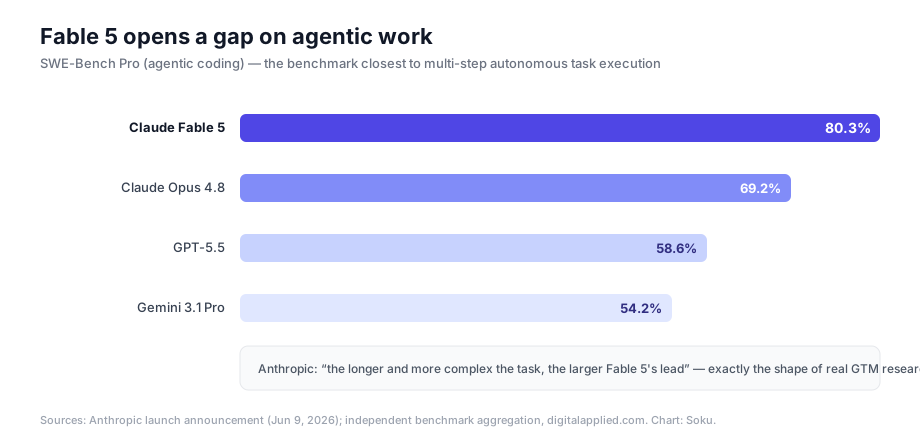
Because agentic coding benchmarks are the best public proxy we have for long-horizon autonomous work: many steps, tool calls, intermediate judgment, no human correction in the loop. A model that holds together for an 80-step refactor is the same model that holds together for "research these 40 target accounts, score them, and build me an outreach plan" — which is why Fable 5 also tops knowledge-work benchmarks (GDPval-AA 1932) and ranks near the top of agentic tool-use evaluations.
The practical translation: previous models were great at tasks (write this email, summarize this report). Fable 5 is the first one that's reliably great at projects.
Three GTM jobs that just changed
1. Account research and warm-path mapping. The most striking early demos are in sales intelligence: give the model CRM/enrichment data access via MCP and the freedom to choose its own filters, and it composes multi-angle searches a human SDR wouldn't think to chain — same school + same year + same former employer + engaged with your content — and assembles a relationship map. One Anthropic GTM benchmark of exactly this workflow produced the best warm-intro paths any Claude model has found. We break the full workflow down (with the prompt pattern) in our warm intro finder guide.
2. Full-funnel campaign analysis. "Audit my Meta account" is a project, not a task: pull structure, compare cohorts, trace creative fatigue across months, reconcile attribution. The longer-horizon profile means fewer dropped threads in exactly this kind of work. Our hands-on ad copy and analysis test shows where the difference is visible against the previous generation — and where it isn't.
3. Agent-operated marketing stacks. If you run AI agents that operate tools — through Meta's, Google's, or TikTok's ads MCPs, or platforms like Soku — the model upgrade arrives without workflow changes. Same connectors, same prompts, more multi-step work completing without intervention.
What it costs to actually use
A worked example: a deep account-research run that consumes ~200K input tokens (CRM exports, enrichment data, web research) and produces ~15K output tokens costs about $2.75 on Fable 5 versus ~$1.38 on Opus 4.8. If the Fable 5 run completes in one pass what previously took two or three corrected attempts, the math favors the more expensive model — failed agent runs bill tokens too.
The sane budget split, given the tiers:
| Work | Model | Why |
|---|---|---|
| Deep research, multi-step agent runs, account mapping | Fable 5 | The "longer task, larger lead" profile is the whole point |
| Daily analysis, content drafts, strategy | Opus 4.8 | 95% of the quality at half the price |
| High-volume copy variants, summaries | Sonnet 4.6 | Volume work doesn't need frontier reasoning |
| Classification, tagging, routing | Haiku 4.5 | Speed and cost |
The honest caveats
- It's day two. Benchmarks are vendor-reported plus early third-party aggregation; independent re-testing takes weeks. Treat the deltas as directional.
- The safety fallback exists. Under 5% of sessions, concentrated in topics marketers rarely touch — but if you operate in security or health-adjacent categories, test your specific prompts before committing workflows.
- Frontier models are not the bottleneck for most teams. If your campaign data isn't connected and your conversion tracking is broken, Fable 5 will produce beautifully reasoned analysis of incomplete data. Fix the plumbing first; the model upgrade compounds on top of it.
FAQ
What is Claude Fable 5?
Anthropic's most capable publicly available AI model, released June 9, 2026 — the first public model in its Mythos class. It leads benchmarks in agentic coding, knowledge work, and tool use, with its advantage growing on longer, more complex tasks.
How much does Claude Fable 5 cost?
$10 per million input tokens and $50 per million output tokens via the API — 2× Opus 4.8, but less than half the earlier Mythos Preview pricing. Access is included in Claude's paid consumer plans.
Is Fable 5 different from Claude Mythos 5?
Same underlying model. Fable 5 is the generally available version with safety guardrails; Mythos 5 has some safeguards lifted and is restricted to a small group of cyberdefense partners.
Should marketing teams switch to Fable 5 immediately?
For long, multi-step work (account research, full-funnel audits, agent workflows) — test it now, the gains are largest exactly there. For routine tasks, Opus 4.8 and Sonnet 4.6 remain the better cost-performance picks.
Does Soku use Claude Fable 5?
Soku's agent runs on the strongest available frontier models and routes work to the right tier for the task — model upgrades land in your workflows without you changing anything.