 Soku AI
Most attribution projects fail in the same place. Not at the model — at the plumbing. A team picks a sophisticated model, points it at data where Meta and Google are both claiming the same purchase, where half the email traffic is tagged Newsletter and the other half newsletter, and where the CRM has no idea which ad a lead came from. The model runs. It produces numbers. The numbers are confidently wrong, and because they are precise, they get believed.
This guide is the setup, not the theory. What to instrument, in what order, which model your conversion volume can actually support, and the specific failure modes that make a cross-channel report lie to you.
Two numbers frame the problem. As of 2026, 75% of companies have adopted multi-touch attribution, up from 58% in 2024. And 60–75% of marketers say their own attribution lacks rigor and trust. Almost everyone has built one. Most people do not believe theirs.
What cross-channel attribution actually is
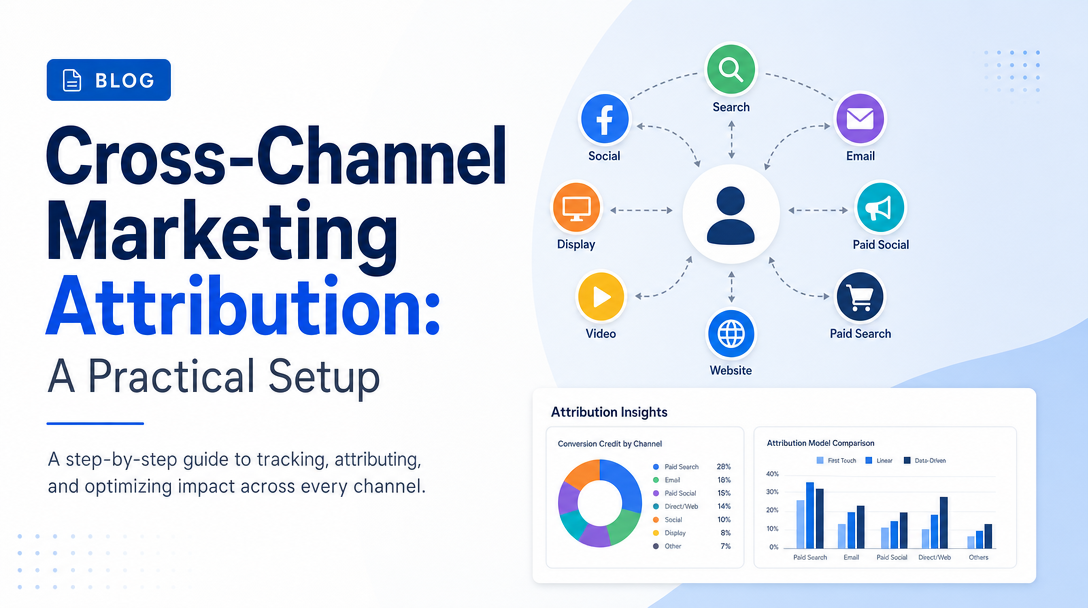
Cross-channel attribution connects site activity, campaign tags, ad exposure, and conversions so you can see which touchpoints preceded a conversion — across platforms, rather than inside one of them.
The word doing the work is across. Every ad platform already reports attribution. The problem is that each one reports it about itself, using its own window, its own identity graph, and its own definition of a conversion. Add up what Meta, Google, and TikTok each claim and you will routinely exceed your actual revenue. That is not a bug in any one platform; it is the predictable result of three referees each awarding the same goal.
So cross-channel attribution is not "a better model." It is the discipline of getting to one set of facts that all three platforms can be compared against.
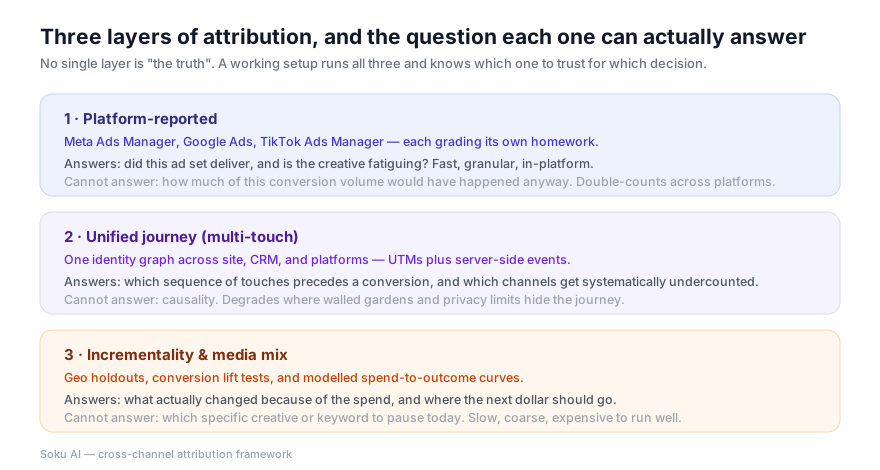
Layer 1: platform-reported
This is what you already have. Meta Ads Manager, Google Ads, TikTok Ads Manager, each grading its own homework.
It is genuinely useful, and the mistake is not using it — the mistake is asking it the wrong question. Platform-reported data is fast, granular, and close to the lever. It tells you whether an ad set is delivering, whether a creative is fatiguing, whether a keyword's cost per action moved this week. Those are in-platform decisions and platform data is the right input for them.
What it cannot tell you is how much of that conversion volume would have happened anyway, or how much of it another platform is also claiming. Never use platform-reported numbers to split budget between platforms. That is the single most common attribution error, and it is not subtle — it is asking three biased witnesses to divide an estate.
Layer 2: the unified journey
This is the layer people mean when they say "attribution project." One identity spine across site, CRM, and platforms, so a single conversion can be traced back through the touchpoints that preceded it.
Three things have to be true before any model on top of it means anything.
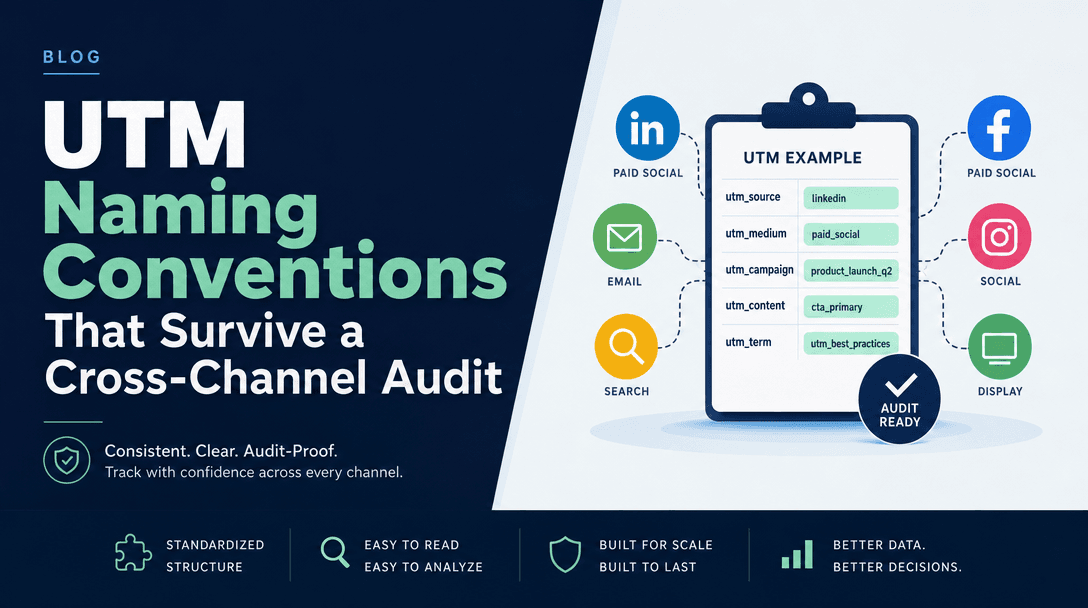
Every channel is tagged, consistently. Campaign tagging is the join key for the entire system. If utm_medium is paid-social in one campaign, Paid Social in another, and [cpc](/glossary/cpc) in a third, your channel report is fiction before a model touches it. This is boring, and it is the highest-leverage hour in the whole project — enough so that it gets its own deep dive: UTM naming conventions that survive a cross-channel audit.
Conversions are collected server-side. Browser-based tracking has been eroding since iOS 14, and third-party cookie deprecation plus GDPR, CCPA, and ATT have made client-side collection structurally incomplete. Server-side event collection — Meta's Conversions API, Google's enhanced conversions, TikTok's Events API — is no longer an optimization. It is the baseline for having data at all.
The CRM knows where a lead came from. For anything with a sales cycle, the conversion that matters is not the form fill. If the original campaign context is not written onto the lead record and carried through to closed-won, your attribution stops at the top of the funnel and every downstream number is an assumption.
The honest limit of this layer: it shows correlation, not causation. It tells you which sequence of touches tends to precede a conversion. It does not tell you which of those touches caused it. And it degrades exactly where you most want it — walled gardens and privacy limits obscure a large share of the journey, and no vendor's identity graph fully solves that.
Layer 3: incrementality and media mix
The third layer answers the question the first two structurally cannot: what changed because of the spend.
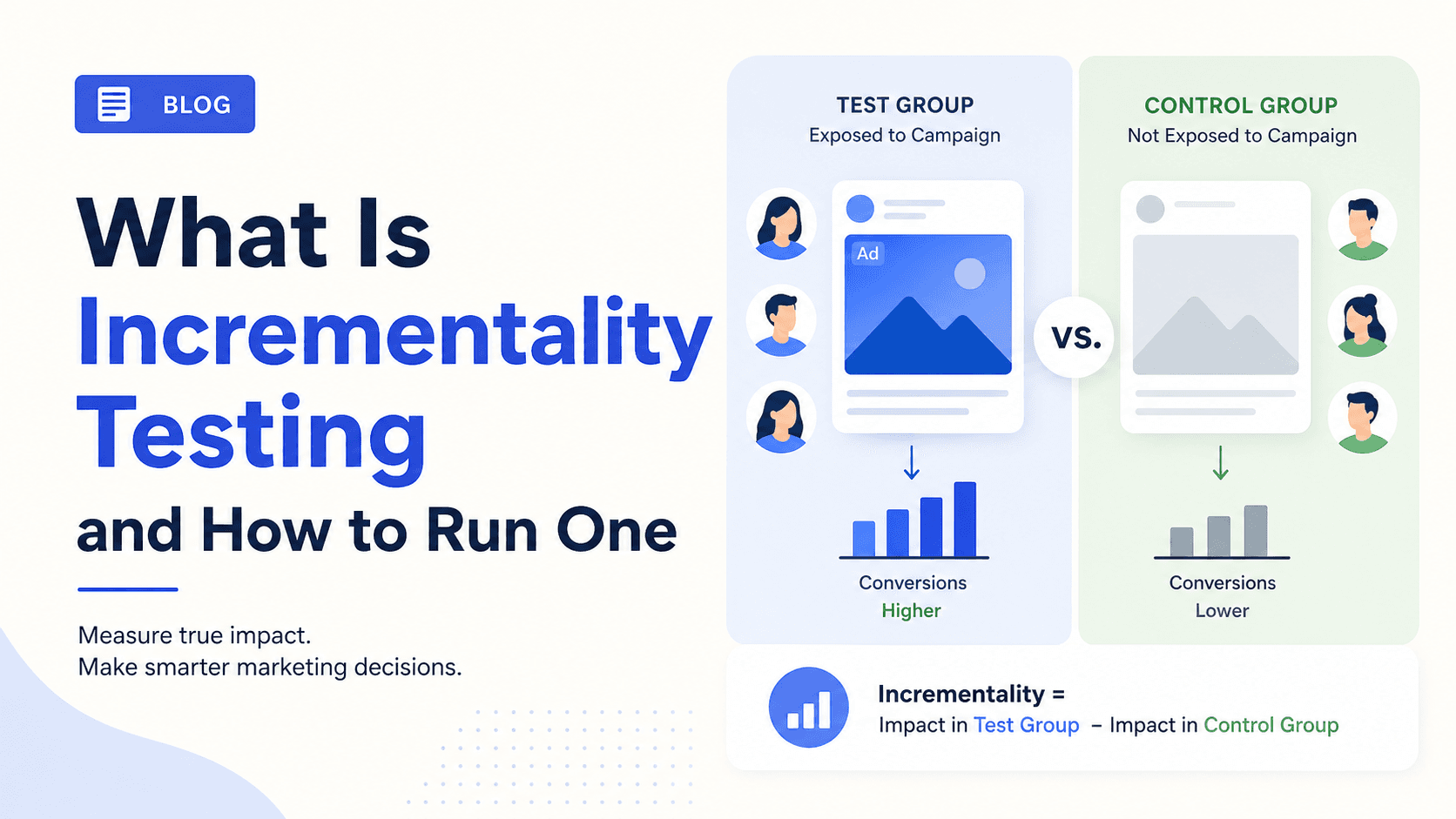
Incrementality tests — geo holdouts, conversion lift studies, deliberate spend-off periods — are the only way to get a causal read on a channel. They are slow, they cost real money in withheld spend, and they answer one question at a time. They are also the only thing in this entire stack that produces a number you can defend to a CFO.
Media mix modelling sits alongside them, using historical spend and outcome data to model the shape of returns per channel. It needs years of history, it is coarse, and it cannot tell you which creative to pause today. Used for annual budget allocation rather than daily decisions, it is sound.
There is a live disagreement here worth naming rather than smoothing over. Measured argues multi-touch attribution is effectively dead and that incrementality should replace it. TapClicks argues MTA and MMM have to work together, each covering the other's blind spot. Both positions are defensible because they are answering different questions. MTA is a diagnostic — it finds channels that are being systematically undercounted. Incrementality is a verdict — it decides whether a channel earns its budget. Treating a diagnostic as a verdict is what earned MTA its bad reputation.
The failure mode nobody instruments: demand you can measure but never capture
Here is a gap that sits outside all three layers, using our own data.
Soku's Search Console property recorded 3,160 clicks from 172,064 impressions over the 90 days from 2026-05-05 to 2026-08-03 — a 1.84% site-wide click-through rate at an average position of 13.3. That top-line number is unremarkable. What is interesting is where the gap concentrates.
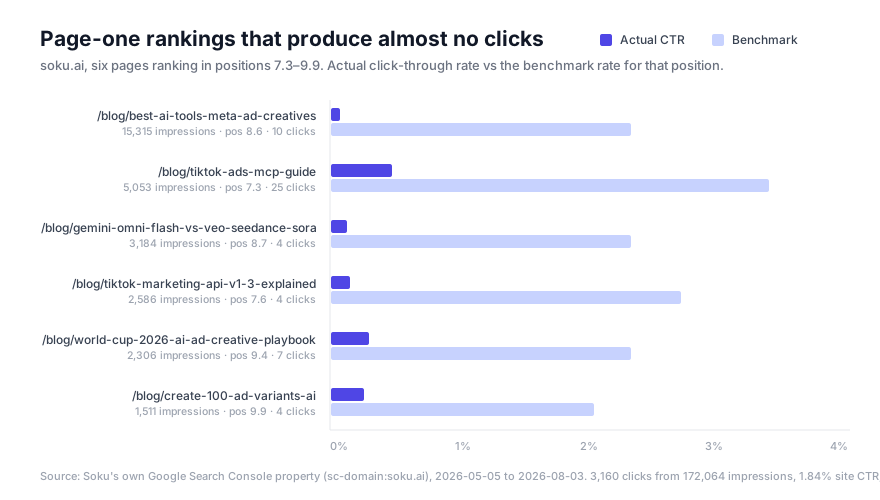
Six pages rank on page one — positions 7.3 to 9.9 — and convert almost none of that visibility into a session. /blog/best-ai-tools-meta-ad-creatives served 15,315 impressions and produced 10 clicks: a 0.07% CTR against a roughly 2.4% benchmark for that position. /blog/tiktok-ads-mcp-guide served 5,053 impressions at position 7.3 and produced 25 clicks.
Every attribution model in this article is blind to those 15,315 impressions. They are real, measured demand from a real audience, and because nobody clicked, no session exists, no UTM fires, no touchpoint is recorded, and no model — last click, data-driven, or a $60k MTA vendor — will ever mention them. From the attribution stack's point of view, that page does not exist.
The general lesson: attribution measures captured demand. Anything that generates awareness without producing a click is invisible to it by construction, and that invisibility is not evenly distributed — it lands hardest on exactly the upper-funnel channels attribution is already accused of undercounting. Which is why the diagnosis for these six pages is a title-and-snippet problem, not a ranking problem, and why no amount of model sophistication would have surfaced it. It took a data source that counts impressions, not conversions.
If you take one operational habit from this guide, make it this: pair every attribution review with an impression-level source — Search Console for organic, platform impression share for paid — so you can see the demand that never became a touchpoint.

Choosing a model your data can support
Attribution models are usually debated as a matter of philosophy. In practice it is a matter of volume. Below its threshold, a model does not degrade gracefully — it silently becomes a different model.
The clearest example is GA4. It defaults to data-driven attribution, and it removed first-click, linear, time-decay, and position-based as primary options in November 2023. But GA4's DDA needs roughly 300–400 monthly conversions per conversion action to model anything. Below that, it falls back to last click — and the report still says "data-driven." A team can spend a quarter arguing about what the data-driven model is telling them while looking at last-click numbers with a different label.
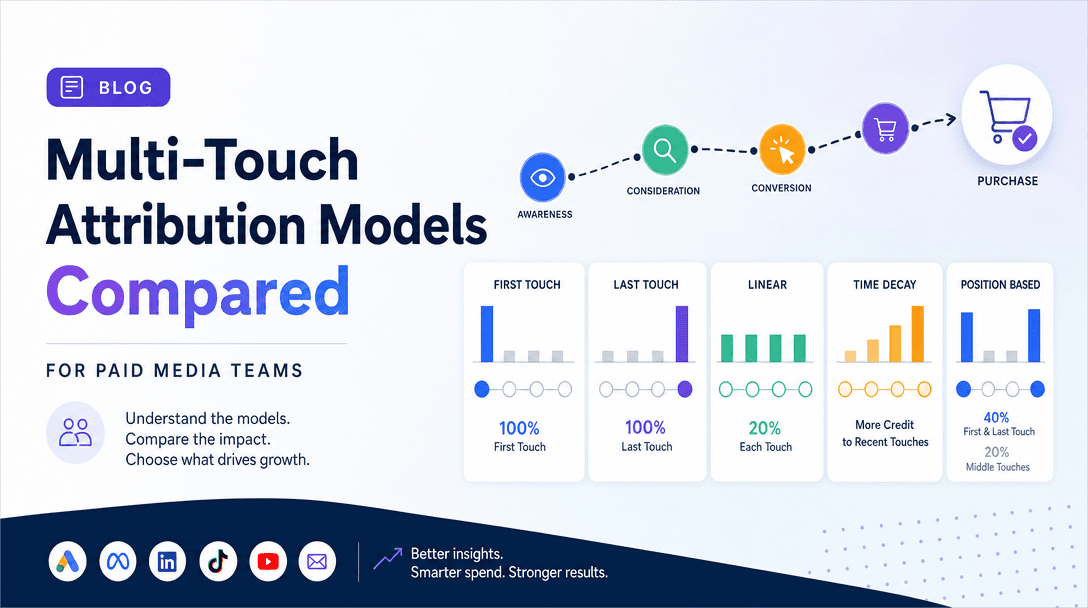
The full ranked breakdown of which model to run at which volume, and what each one is honestly for, is here: Multi-touch attribution models compared for paid media teams.
The short version: pick the most sophisticated model your volume genuinely supports, and not one step further. A well-understood last-click report beats a data-driven model nobody can validate.
A build order that works
Sequence matters more than tooling. Each step is worthless without the one before it.
- Inventory every channel that spends or sends traffic. Paid search, paid social, display, email, organic social, affiliate, referral, direct. One row per channel, one owner per row.
- Standardise campaign tagging and enforce it. Closed vocabularies for source and medium, a documented pattern for campaign and content, and a builder that everyone uses. Enforcement means a link that violates the spec does not ship.
- Move conversion collection server-side. Conversions API, enhanced conversions, Events API. Deduplicate against client-side events so you do not trade undercounting for double-counting.
- Carry campaign context into the CRM. Write source, medium, campaign, and content onto the lead at creation and keep them through to closed-won.
- Pick a model matched to your volume. See the thresholds above. Document what it can and cannot answer.
- Reconcile platform totals against your own numbers weekly. Not to make them match — they will not — but to know the size and direction of each platform's bias so you can read its reports with a correction factor.
- Add incrementality tests for your two largest channels. This is what upgrades attribution from a report into a decision.
- Pair it with an impression-level source. Search Console and impression share, for the demand that never clicked.
Steps 1 through 4 are unglamorous and account for most of the value. Teams that skip to step 5 are the 60–75% who do not trust their own numbers.
Failure modes to check for
| Symptom | Usual cause | Fix |
|---|---|---|
| Platform conversions exceed actual revenue | Every platform claiming the same conversion | Reconcile against one internal source of truth; never sum platforms |
| A channel shows near-zero conversions | Last-click credit going to the closing channel | Run a holdout before cutting the budget |
| GA4 "data-driven" looks like last click | Below the 300–400 monthly conversion threshold | Check volume per conversion action, not in total |
| Channel report has duplicate rows | Inconsistent utm_medium casing or vocabulary | Closed vocabulary plus a link builder |
| Paid social conversions fell off a cliff | Client-side tracking loss, not performance loss | Server-side event collection with deduplication |
| Attribution stops at the form fill | CRM never received campaign context | Write UTM fields to the lead record at creation |
| High-ranking pages produce no traffic | Title and snippet problem, invisible to attribution | Pair reviews with impression-level data |
Where Soku fits
Soku is an ad automation agent, which means it lives on the decision side of this stack rather than the dashboard side. It connects to Meta, Google, TikTok, and ChatGPT Ads, reads the campaign and creative layer, and acts on it — generating variants, launching structured tests, and reporting which creative and which hook actually carried the spend.
That matters for attribution in one specific way. The hardest part of a cross-channel setup is not building the report; it is keeping the tagging and test structure disciplined enough for the report to stay true six months later. When variants are generated and launched by the same system that reports on them, the campaign and content tags are consistent by construction rather than by policy — which removes the most common source of attribution drift.
Soku does not replace an incrementality program, and it is not a media mix model. It makes the layer underneath them trustworthy.
Where to go next
- Choosing a model: Multi-touch attribution models compared for paid media teams — the volume thresholds, what each model is honestly for, and when to stop upgrading.
- Getting the tagging right: UTM naming conventions that survive a cross-channel audit — the spec, the closed vocabularies, and the validation rule.
- Proving causality: Incrementality testing for ad campaigns — how to run a holdout that produces a defensible number.
- Platform-specific tracking: ChatGPT Ads attribution and conversion tracking — what the newest ad surface does and does not report.
FAQ
What is cross-channel marketing attribution? It is the practice of connecting campaign tags, site activity, ad exposure, and conversions across every platform you spend on, so conversions can be evaluated against one consistent set of facts rather than each platform's self-report.
Why do my platform numbers add up to more than my revenue? Because each platform attributes the same conversion to itself, using its own attribution window and identity graph. This is expected. Reconcile against one internal source of truth and never sum platform-reported conversions.
Is multi-touch attribution dead? It is no longer credible as a causal verdict, which is what its critics mean. It remains useful as a diagnostic for finding channels that platform-reported data systematically undercounts. Pair it with incrementality testing rather than choosing between them.
How many conversions do I need for data-driven attribution? GA4's data-driven model needs roughly 300–400 monthly conversions per conversion action. Below that it quietly falls back to last click while still labelling the report data-driven — so check volume per action, not your total.
What is the first thing to fix? Campaign tagging. It is the join key for the entire system, it costs an afternoon, and no model on top of inconsistent tags produces a report worth reading.
Can attribution measure brand and awareness spend? Not directly. Attribution only sees demand that produced a click. Awareness that does not generate a session is invisible to it, which is why brand spend needs incrementality tests, media mix modelling, or impression-level sources instead.