Soku AI
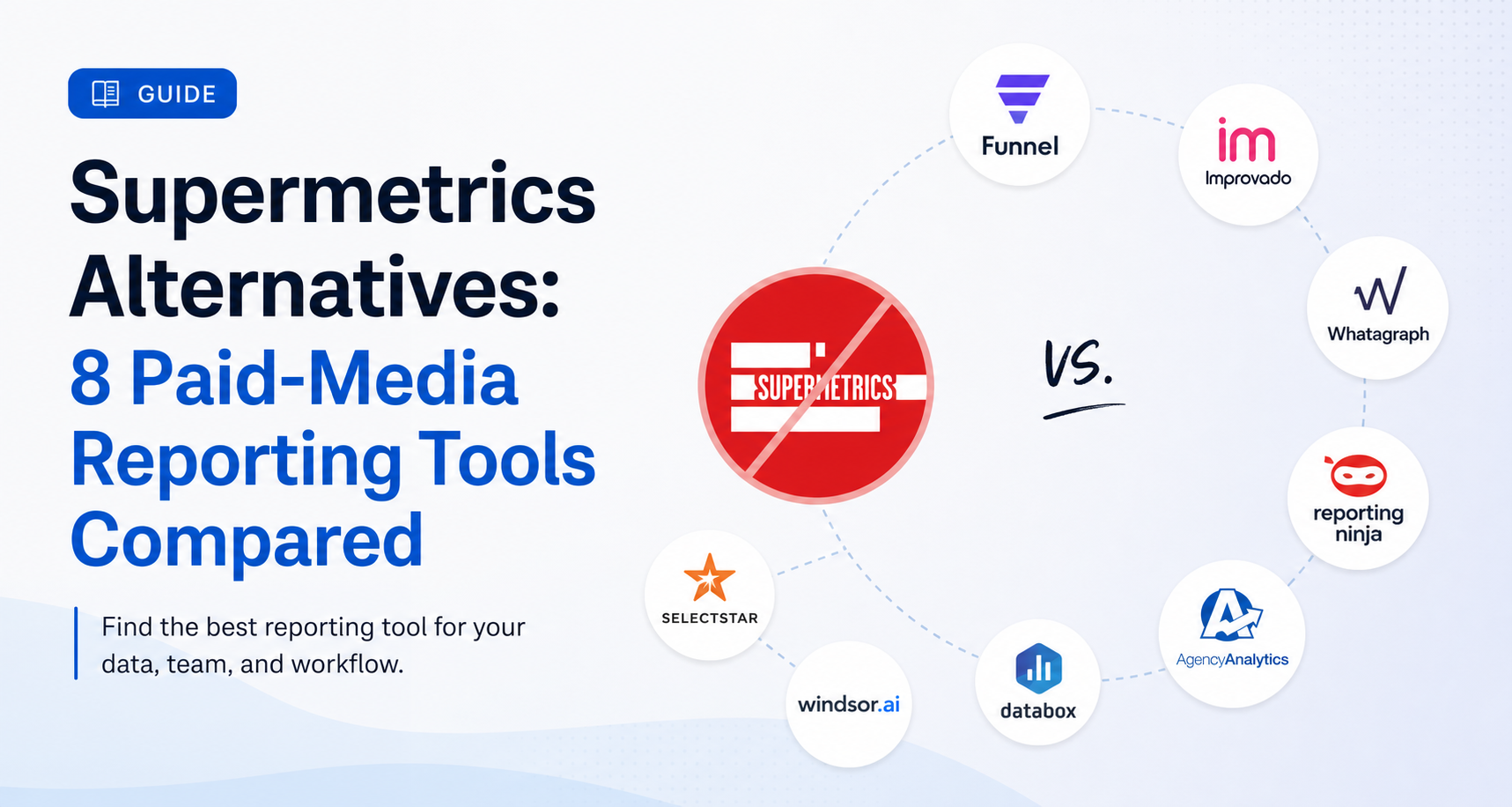
Every article ranking for "Supermetrics alternatives" right now was written by a Supermetrics alternative. Reporting Ninja ranks Reporting Ninja first. Funnel ranks Funnel first. Improvado ranks Improvado first. Porter Metrics, Windsor, Coupler, 1ClickReport — all of them, all ranking themselves at the top of their own comparison.
That is not a scandal, it is just what a $515 CPC does to a search term. (supermetrics competitors genuinely carries a $515.47 cost-per-click in the US — one of the most expensive keywords in all of martech, against only ~50 monthly searches. Every vendor in the category is bidding for the same handful of switchers.)
We are in an unusual position to write this one honestly: Soku is not a Supermetrics competitor. We do not sell a data connector, a warehouse pipeline, or a Looker Studio destination. So this comparison has no thumb on the scale — and it starts with the question the vendor-authored lists all skip, because answering it honestly loses them sales.
First: which layer are you actually trying to replace?
"Supermetrics alternative" is four different products depending on what broke. Almost every bad switching decision comes from swapping a tool at one layer for a tool at another.
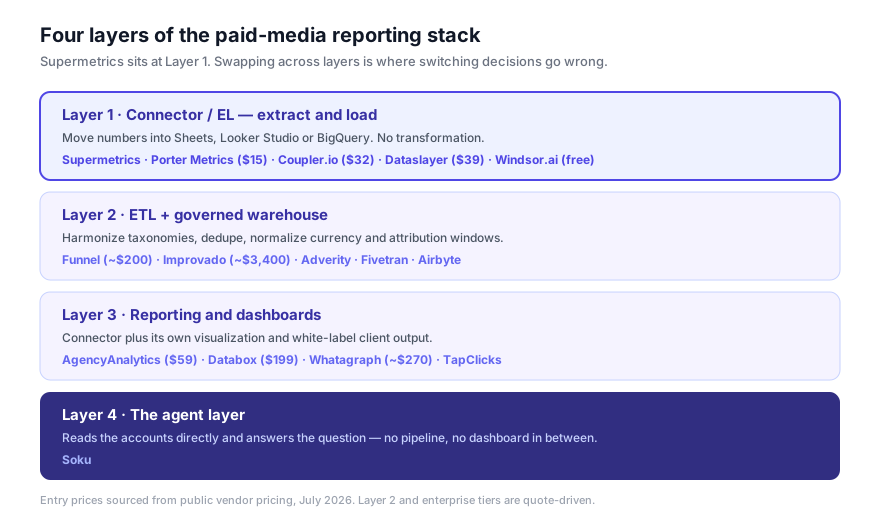
Layer 1 — Connector / EL (extract and load). Move numbers out of Meta, Google, TikTok, and LinkedIn into a destination you already have (Sheets, Looker Studio, BigQuery). No transformation, no opinions. This is what Supermetrics is. Alternatives: Porter Metrics, Coupler.io, Dataslayer, Power My Analytics, Windsor.ai.
Layer 2 — ETL + governed warehouse. Extract, then transform — harmonize taxonomies, dedupe, normalize currency and attribution windows — and land governed tables. Alternatives: Improvado, Funnel, Adverity, Fivetran, Airbyte.
Layer 3 — Reporting and dashboards. Connector plus its own visualization layer and client-facing white-label output. Alternatives: AgencyAnalytics, Whatagraph, Databox, TapClicks, Reporting Ninja.
Layer 4 — The agent layer. Reads the accounts directly and answers the question, instead of building the artifact you were going to read the answer off. This is a genuinely different bet, covered at the end.
If your complaint is "Supermetrics got expensive," you want Layer 1 or 3. If it is "our numbers don't reconcile across channels," no Layer 1 tool will fix that and swapping one connector for a cheaper connector will reproduce the problem exactly. That is the single most useful sentence in this article.
What Supermetrics actually costs in 2026
Verified directly against supermetrics.com/pricing — last checked 28 July 2026:
| Plan | Billed monthly | Billed annually | Data sources | Destinations | Refresh | Users | Accounts / source |
|---|---|---|---|---|---|---|---|
| Starter | $49/mo | $39/mo | 3 | 1 core | Weekly | 1 | 3 |
| Growth | $199/mo | $159/mo | 7 | 1 core | Daily | 2 | 7 |
| Pro | $499/mo | $399/mo | 10 | 1 core | Hourly | 3 | 10 |
| Enterprise | Custom | Custom | All | Core + warehouse | On-demand | Custom | Custom |
Read the Destinations column again. Every published tier includes one. That single line is what actually drives the migration traffic, and it is worth doing the arithmetic on.
The per-destination multiplier
An agency running five clients across Google Ads, Meta, and LinkedIn, delivering into both Looker Studio and Google Sheets, does not pay the Pro sticker price. It pays Pro plus a second destination plus account overages — a real-world modelled total of roughly €660–€700+ per month against a €399 headline.
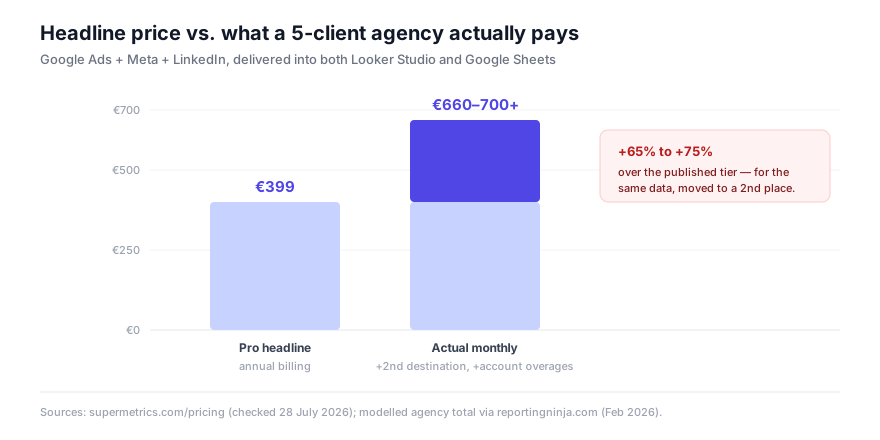
The trap is not that the price is high. It is that the price is not proportional to the value delivered: the second destination is the same data, moved twice. You are billed on plumbing topology rather than on data volume or number of accounts. Any evaluation that compares headline prices without modelling destinations, seats, and accounts-per-source is comparing the wrong numbers.
The 8 alternatives
| # | Tool | Layer | Entry price | Best for |
|---|---|---|---|---|
| 1 | Porter Metrics | 1 — Connector | from $15/mo | Small agencies living in Looker Studio |
| 2 | Coupler.io | 1 — Connector | from $32/mo | Sheets-first teams wanting light transformation |
| 3 | Windsor.ai | 1 — Connector + attribution | Free plan, then usage | Teams who also need multi-touch attribution |
| 4 | AgencyAnalytics | 3 — Reporting | from $59/mo | Client-facing agencies who want the dashboard included |
| 5 | Whatagraph | 3 — Reporting | from ~$270/mo | Small agencies wanting 55+ sources and templates |
| 6 | Databox | 3 — Reporting | from $199/mo | In-house teams tracking KPIs across marketing and sales |
| 7 | Funnel | 2 — ETL | from ~$200/mo | Brands needing harmonized data across 500+ platforms |
| 8 | Improvado | 2 — ETL, enterprise | from ~$3,400/mo | Enterprises with a governance and data-team requirement |
Prices are entry points sourced from public vendor and comparison data as of July 2026. Layer 2 and enterprise tiers are quote-driven and will not match these numbers at your volume — treat them as an order of magnitude, not a quote.
1. Porter Metrics — the cheapest honest swap
Layer 1. From $15/mo.
Porter is the closest thing to a like-for-like Supermetrics replacement at the low end: connectors into Looker Studio and Sheets, priced per what you connect rather than per destination topology. For an agency running a handful of clients and delivering Looker Studio reports, this is usually where the switching maths works out most cleanly.
Honest limitation: it is a connector. It does not transform, harmonize, or reconcile. If your reason for leaving is that Meta and GA4 disagree about conversions, Porter will hand you the same disagreement for less money.
2. Coupler.io — connector with a transformation step
Layer 1 (leaning 2). From $32/mo.
Coupler adds light in-flight transformation to the connector job, which matters more than it sounds: a lot of "we need a warehouse" projects are actually "we need to rename and combine six columns consistently" projects.
Honest limitation: the transformation ceiling is real. Genuine multi-source harmonization with governance is a Layer 2 problem.
3. Windsor.ai — connector plus attribution
Layer 1 + attribution. Free plan, then usage-based.
Windsor is the only tool in the low-cost tier that bundles multi-touch attribution rather than treating it as someone else's problem, and it has a genuine free plan — the only one here.
Honest limitation: usage-based pricing rises with sources, so the free plan is a starting point rather than a destination. And bundled attribution is still modelled attribution — it does not resolve platform-reported conversion conflicts, it just gives you a third opinion.
4. AgencyAnalytics — the agency reporting default
Layer 3. From $59/mo.
If what you actually want is "the client report exists and is branded," AgencyAnalytics replaces both the connector and the dashboard tool. That is a different purchase from a Supermetrics swap, and for client-facing agencies it is frequently the cheaper end state, because you stop paying for two products.
Honest limitation: you are inside their visualization layer. If your reporting needs are unusual, or your clients demand Looker Studio specifically, the constraint bites.
5. Whatagraph — templated reporting at volume
Layer 3. From ~$270/mo.
Whatagraph aggregates 55+ data sources and ships 95 dashboard templates with drag-and-drop widgets. For a small agency that needs to produce many similar reports quickly, the template library is the product.
Honest limitation: reviewers consistently flag rapid cost increases as usage grows. Model your year-two bill, not your trial.
6. Databox — KPI tracking beyond paid media
Layer 3. From $199/mo.
Databox is aimed at in-house teams tracking a KPI set that spans marketing, sales, and product rather than paid media alone.
Honest limitation: breadth over depth. Paid-media-specific analysis — placement, ad-set, creative-level diagnosis — is shallower than a dedicated ads tool.
7. Funnel — harmonization at brand scale
Layer 2. From ~$200/mo, Flexpoint-based.
Funnel pulls from 500+ marketing, analytics, and sales platforms into a central Data Hub where it is stored and harmonized. Harmonized is the operative word and the actual reason to move up a layer: it resolves the taxonomy problem that connectors cannot.
Honest limitation: Flexpoint pricing is genuinely hard to forecast before you are running. Use their estimator and pad it.
8. Improvado — enterprise ETL with governance
Layer 2, enterprise. From ~$3,400/mo.
Improvado includes all connectors on every plan and a managed warehouse, and targets organizations where data governance is a compliance requirement rather than a preference.
Honest limitation: the entry price is roughly seven times Supermetrics Pro. This is only a "Supermetrics alternative" in the sense that a warehouse is an alternative to a filing cabinet — if you evaluate it as a cheaper connector you will be badly surprised.
Also worth knowing
Dataslayer (from $39/mo) and Power My Analytics (from ~$49.95/mo) are further budget Layer 1 options. Adverity and Fivetran are Layer 2, both quote-driven; Fivetran prices on monthly active rows and may carry separate dbt Cloud costs. Stitch starts around $100/mo. Airbyte is the open-source Layer 2 route — free software, real engineering time.
The switching decision, honestly
Three cases where switching genuinely pays:
- You need two destinations. This is the clearest win. The per-destination model is where Supermetrics' price diverges from value fastest, and almost any Layer 1 or Layer 3 alternative prices this better.
- You want the dashboard included. Moving to AgencyAnalytics or Whatagraph collapses two line items into one.
- You need harmonization, not extraction. Then move up a layer to Funnel, Improvado, or Adverity. Do not swap connectors.
And one case where it does not: if your problem is that nobody reads the report. This is more common than the pricing complaint and no tool on this list solves it. Swapping connectors changes who bills you, not whether the weekly PDF changes a decision. Which brings us to the fourth layer.
The fourth option: don't build the report
Every tool above exists to move numbers to a place where a human will look at them and decide something. The reporting layer is a means, and somewhere along the way the industry started buying it as an end.
Soku takes the other route: connect the ad accounts and GA4 directly, and ask the question. "Why did CPA rise on Meta last week, and is it the creative or the audience?" gets answered against live account data — without a pipeline, a destination, or a dashboard in between. When the answer implies a change, Soku produces it as an executable action you approve.
That is not a fit for everyone. If you owe a client a branded PDF every Monday, you need a reporting tool and you should buy one of the eight above — a white-label deliverable is a real requirement and an agent does not produce it. If your finance team needs governed tables in a warehouse, you need Layer 2. But if you are paying $400–700 a month to move numbers into a dashboard so that someone can look at them and decide what to change in the ad account, it is worth asking whether the dashboard was ever the point.
For the reporting-workflow view of the same question, see our guide to AI media buying tools and the AI marketing agents comparison.
Frequently asked questions
What is the cheapest Supermetrics alternative?
Porter Metrics at around $15/mo is the cheapest genuine like-for-like connector, and Windsor.ai has the only real free plan in the group. Both are Layer 1 tools — they move data without transforming it, which is the same job Supermetrics does on its published tiers.
Why is Supermetrics considered expensive?
The headline tiers are competitive ($39–$399/mo billed annually). The cost escalates through add-ons: every published plan includes exactly one destination, so delivering into both Looker Studio and Google Sheets requires paying twice for the same data, on top of overages for extra data sources, accounts per source, and user seats. A modelled five-client agency with two destinations lands near €660–700/mo against a €399 headline.
Is Funnel or Improvado a direct Supermetrics replacement?
Not directly. Both are ETL platforms that transform and harmonize data, where Supermetrics extracts and loads it. They solve a different problem — cross-channel taxonomy reconciliation — and are priced accordingly, with Improvado's entry around $3,400/mo. Choose them because you need harmonization, not because you want a cheaper connector.
What is the best Supermetrics alternative for agencies?
For client-facing agencies, AgencyAnalytics (from $59/mo) is usually the strongest end state, because it replaces both the connector and the dashboard tool in one line item and ships white-label output. Whatagraph is the alternative if you need a larger template library, at a higher entry price.
Do I need a data warehouse to replace Supermetrics?
No. A warehouse solves harmonization and governance, not extraction. If your reports are fine and only the bill hurts, stay at Layer 1 and switch connectors. Add a warehouse only when multiple sources genuinely need to be reconciled into a single governed model — that is an engineering project with an engineering cost, not a procurement swap.
Which alternative handles multi-touch attribution?
Windsor.ai is the only tool in the low-cost tier that bundles it. Bear in mind that any attribution model is a model: it produces a defensible third number, not the true one, and it will still disagree with what Meta and GA4 each report. For the underlying problem, see our writing on cross-channel measurement.