 Soku AI
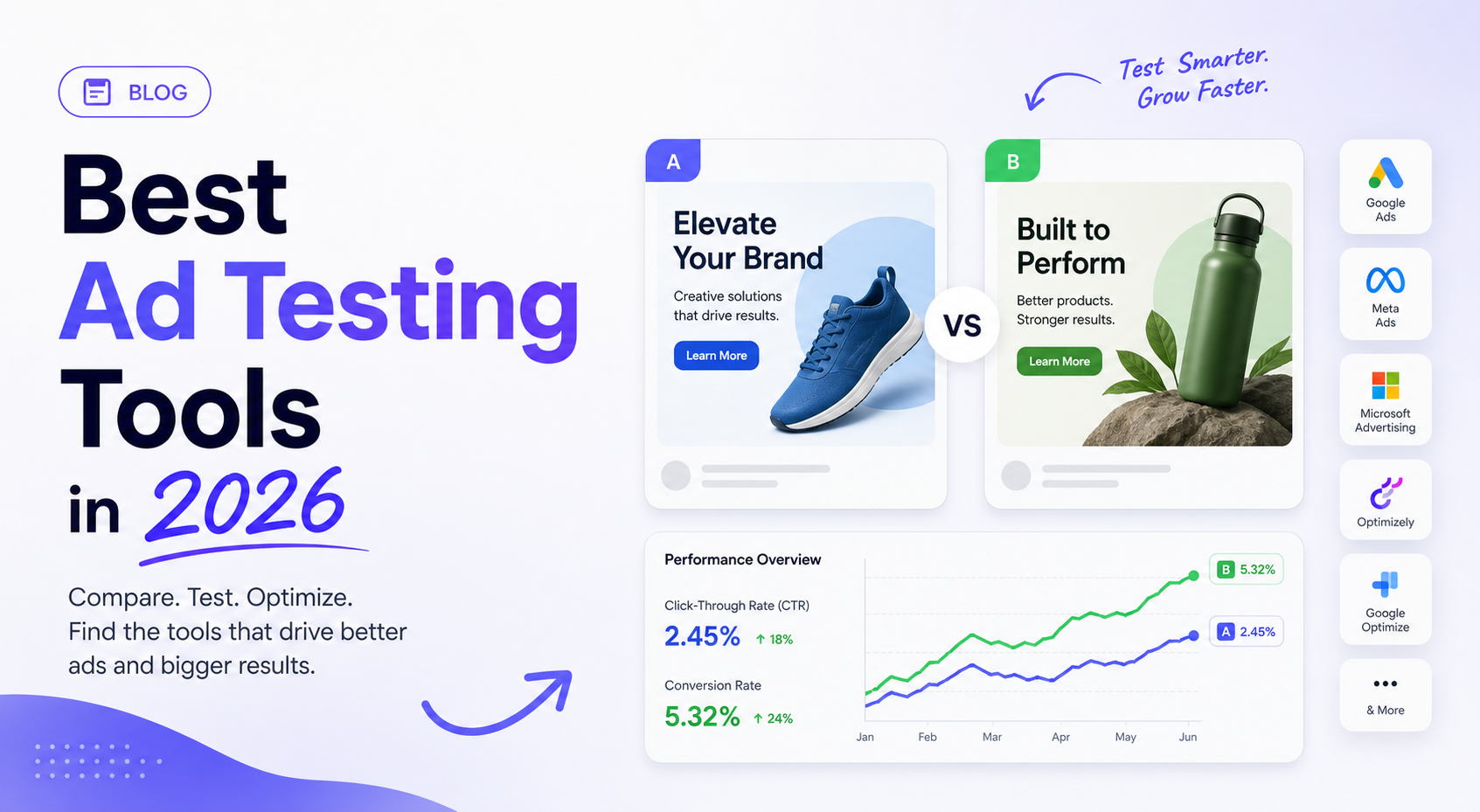
Search "best ad testing tools" and every list will hand you the same undifferentiated pile: Kantar next to Motion next to Foreplay next to Meta's native A/B tool. Those four products cannot be ranked against each other, because they do not do the same job. One surveys humans before you spend a cent. One reads your ad account after the money is gone. One is a swipe file. One runs a randomized split.
Buying the wrong category is the most expensive mistake in this space, and it is invisible until six months in when you realize the tool you bought does not answer the question you keep asking.
So this guide does two things no other page on this SERP does. First, it sorts the market into the four jobs it actually contains. Second — and this is the part that matters more than any tool choice — it does the statistics on whether your creative tests are valid at all, because most of them are not, and no platform on this list will tell you so.
Ad testing is four different jobs
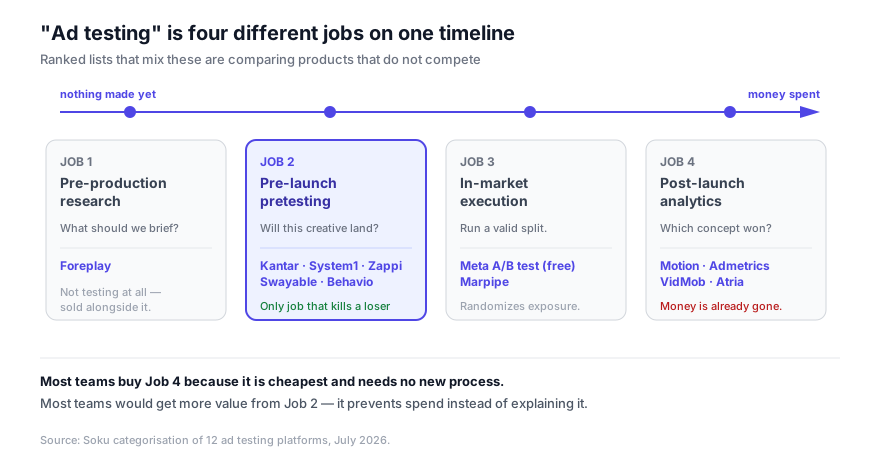
Job 1 — Pre-production research. Before anything is made: what are competitors running, what has worked in this category, what should we brief? Not testing at all, though it is sold alongside it. Foreplay is the category definition here — a pre-launch research and briefing tool for swipe files and creative briefs.
Job 2 — Pre-launch pretesting. Creative is made but not yet running. You show it to a panel of real humans and measure response before committing budget. Kantar LINK+, System1, Zappi, Swayable, Attest, Behavio, OnePulse. This is market research, and it is the only category that can kill a bad creative before it costs anything.
Job 3 — In-market experiment execution. The creative is live and you want a valid comparison. Meta's native A/B test tool, Marpipe for multivariate. These actually run the split — which, as the next section explains, is not the same as putting five ads in one ad set.
Job 4 — Post-launch creative analytics. The money is spent and you want to know which concept won and why. Motion, Admetrics, VidMob, Atria, Triple Whale. These read your ad account and attribute performance to creative attributes.
Most teams believe they need Job 3 or 4 and would get more value from Job 2 — because pretesting kills losers before they cost money, while in-market testing only tells you which loser lost more slowly. Most teams buy Job 4, because it is the cheapest and requires no new process.
The thing that invalidates most creative tests
Before any tool recommendation, two problems worth more than any product on this list.
Problem 1: running five ads in one ad set is not a test
This is the single most common misconception in paid social. You put five creatives in an ad set, the platform spends most of the budget on one, and you declare that one the winner.
You have not run an experiment. Meta's delivery system allocates impressions according to its prediction of which creative will perform for each user — so exposure is not random, and the creatives are not shown to comparable audiences. The winner won partly because the algorithm decided early it would win and gave it the impressions to prove itself. You measured the algorithm's prediction, not the creative.
This is exactly what the native A/B test tool exists to fix: it randomizes the split so the comparison is valid. It is also why an in-account "test" and a real experiment produce different answers, and why teams get burned scaling a "winner" that then underperforms.
Problem 2: you are calling winners at a sample size that cannot support them
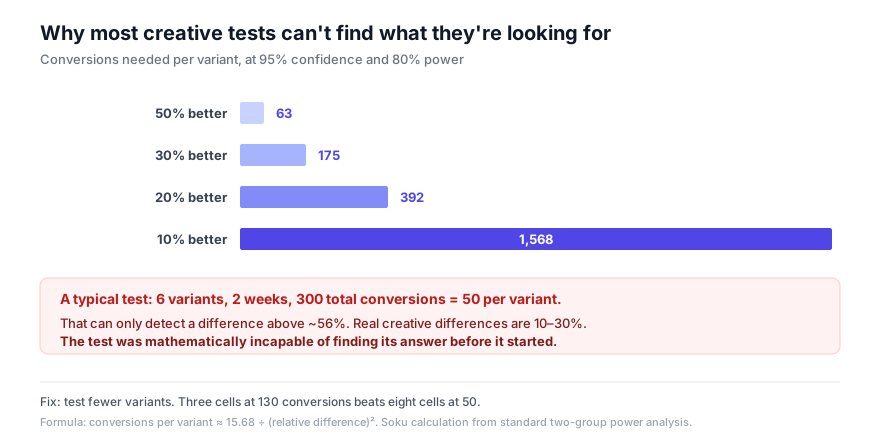
The same arithmetic that governs incrementality testing governs creative testing, and almost nobody applies it. To detect a relative difference between two variants at 95% confidence and 80% power:
Conversions needed per variant ≈ 15.68 ÷ (relative difference)²
| Difference you want to detect | Conversions needed per variant |
|---|---|
| 50% better | 63 |
| 30% better | 175 |
| 20% better | 392 |
| 10% better | 1,568 |
Now consider a typical creative test: 6 variants, two weeks, 300 total conversions. That is 50 conversions per variant — enough to detect roughly a 56% difference and nothing finer. Real creative differences are usually 10–30%. The test was mathematically incapable of finding what it was looking for before it started.
Two consequences follow, and both are counterintuitive:
Test fewer variants, not more. Splitting a fixed conversion budget across 8 creatives guarantees every cell is underpowered. Three variants with 130 conversions each beats eight with 50.
Distrust your biggest winners most. Underpowered tests that do reach significance systematically overestimate effect size. When a small test says a creative is 80% better, the most likely explanation is noise, and scaling on it is how teams end up confused about why performance regressed.
None of the twelve tools below will stop you doing this. It is worth fixing before you buy any of them.
The 12 tools
| # | Tool | Job | Entry price | Best for |
|---|---|---|---|---|
| 1 | Kantar LINK+ | 2 — Pretesting | Custom | Benchmark scale across 90+ markets |
| 2 | System1 | 2 — Pretesting | Custom | Emotional-response prediction |
| 3 | Zappi | 2 — Pretesting | Custom subscription | Continuous concept + ad testing |
| 4 | Swayable | 2 — Pretesting | Enterprise | Randomized message testing |
| 5 | Behavio | 2 — Pretesting | Mid-market | Best price-to-method for growing brands |
| 6 | OnePulse | 2 — Pretesting | Per-survey | Fastest turnaround |
| 7 | Meta A/B Test | 3 — Execution | Free | Valid randomized splits inside Meta |
| 8 | Marpipe | 3 — Execution | ~$1,000+/mo | Multivariate creative testing |
| 9 | Motion | 4 — Analytics | $999/mo+ | Creative reporting for Meta-heavy teams |
| 10 | Admetrics | 4 — Analytics | Mid-market | Automated testing + attribution together |
| 11 | VidMob | 4 — Analytics | Enterprise | AI scoring of creative attributes |
| 12 | Foreplay | 1 — Research | from ~$59/mo | Swipe files and creative briefing |
Prices are public entry points as of July 2026. Category 2 pretesting is almost entirely quote-driven — treat "custom" as genuinely custom, not as a hidden low number.
Pre-launch pretesting (Job 2)
Kantar LINK+ is the scale player. LINK+ measures digital, TV, print, and outdoor creative and comes in automated, self-serve, or fully serviced forms, on a respondent network spanning 90+ markets. What you are buying is the benchmark database — knowing your ad scored 68 is meaningless until you know the category average.
Limitation: built for brand advertising cycles. Timelines and price do not fit a weekly performance-creative cadence.
System1 pioneered emotional-response measurement, on the premise that emotional intensity predicts long-term brand effects better than stated intent. Strong methodology, genuinely differentiated.
Limitation: the emotional framework maps well to brand film and poorly to a direct-response static with a 20% off code.
Zappi is the always-on option — a subscription platform for continuous concept and ad testing with predictive analytics, rather than discrete studies. For teams shipping creative continuously, that cadence match matters more than raw methodological depth.
Limitation: custom subscription pricing that is hard to compare without going through sales.
Swayable runs randomized controlled message tests pre-launch. Rigorous, enterprise-priced, and the closest thing in this category to a true experiment.
Behavio is positioned as the best price-to-quality option for growing brands — real behavioural-science method without enterprise pricing. This is the practical entry point into Job 2 for most performance teams.
OnePulse optimizes for speed over depth. When the question is "do people understand this claim" and you need an answer today, that trade is often correct.
In-market execution (Job 3)
Meta's native A/B test is free, built in, and the single most underused tool in this article. It is the only way to get a genuinely randomized comparison inside Meta rather than a delivery-biased one. If you take one action from this guide, use it for your next creative comparison instead of stacking ads in an ad set.
Limitation: Meta only, and it consumes budget you might rather spend on the winner.
Marpipe does true multivariate testing — isolating which element (headline, image, CTA) drove the difference rather than which whole creative won. That is a materially better question, and it is also why it needs far more volume than a two-way test. Budget around $1,000+/mo and check your conversion volume against the table above before committing.
Post-launch analytics (Job 4)
Motion is a post-launch creative analytics platform that tracks which ad concepts are winning inside your ad account, with Starter at $999/month for up to $50k of monthly ad spend and higher tiers quote-only (verified 2026-10-21). For Meta-heavy teams needing creative reporting the whole team can read, it is the default for good reason.
Limitation: it reports on what your account did. It inherits every validity problem in the underlying data, including the delivery-bias issue above — a "winning concept" in Motion is a concept the algorithm favoured.
Admetrics combines automated creative testing with attribution, which is a genuinely useful pairing: creative results and measurement quality are the same problem viewed from two ends.
VidMob applies AI scoring to creative attributes at enterprise scale, tagging thousands of assets to find which visual features correlate with performance.
Limitation: correlation across a large asset library is a hypothesis generator, not a causal finding. Confirm with an actual randomized test.
Pre-production research (Job 1)
Foreplay from around $59/mo is the cheapest useful tool on this list and does not test anything. It collects competitor and category ads into organized swipe files and turns them into briefs. Pair it with the TikTok ads library workflow for sourcing.
How to choose
If you have never pretested: start at Job 2 with Behavio or OnePulse. The highest-leverage change available to most teams is killing bad creative before it costs money, not analyzing it more precisely afterwards.
If your tests keep contradicting themselves: you have a validity problem, not a tooling problem. Use Meta's native A/B tool, cut your variant count, and check the sample-size table. This costs nothing.
If nobody can see what's working: Job 4. Motion is the safe default; Admetrics if you also need the attribution layer.
If creative volume is the bottleneck: none of these help. That is a production problem — see our guide to AI tools for Meta ad creatives and the 100-variants workflow.
If you're an enterprise brand with a benchmark requirement: Kantar or System1, and accept the timeline.
Where Soku fits
Soku is not a pretesting panel and does not replace Job 2. What it does sit across is the gap between Job 3 and Job 4: reading creative performance across Meta, Google, and TikTok together, and — the part that matters given everything above — telling you when a difference is large enough to act on and when you are looking at noise. A creative result that reaches significance in one channel and not another is a different decision from one that holds everywhere, and that comparison is hard to make inside any single platform's reporting.
The point is not more dashboards. It is fewer wrong calls at the moment you decide to scale.
Frequently asked questions
What is the difference between ad testing and creative testing?
In practice they are used interchangeably, but the market contains four distinct jobs: pre-production research (Foreplay), pre-launch pretesting with human panels (Kantar, System1, Zappi, Behavio), in-market experiment execution (Meta A/B, Marpipe), and post-launch creative analytics (Motion, Admetrics, VidMob). Ranked lists that mix them are comparing products that do not compete.
Is running multiple ads in one ad set a valid A/B test?
No. Meta's delivery system allocates impressions based on its prediction of which creative will perform, so exposure is not randomized and the audiences seeing each creative are not comparable. You are measuring the algorithm's prediction as much as the creative. Use the native A/B test tool, which randomizes the split properly.
How many conversions do I need for a valid creative test?
Roughly 15.68 ÷ (relative difference)² per variant. Detecting a 20% difference needs about 392 conversions per variant; a 10% difference needs about 1,568. A six-variant test with 300 total conversions can only detect differences above about 56%, which is far larger than real creative effects — so it will find nothing, or find noise.
How long should a creative test run?
Long enough to hit the conversion count above, and at least one full conversion cycle so delayed conversions are counted. Duration is the wrong variable to fix first — conversions per variant is the binding constraint, and running longer only helps because it accumulates conversions.
What is the cheapest ad testing tool?
Meta's native A/B test tool is free and is the most methodologically valuable thing in this article. Foreplay from around $59/mo is the cheapest paid tool, though it is research and briefing rather than testing. Motion and comparable analytics tools start near $200/mo.
Should I pretest creative before launching?
If you can afford it, yes — it is the only category that prevents spend rather than explaining it after the fact. Panel pretesting also sidesteps the sample-size problem entirely, because a survey panel gives you hundreds of responses per variant immediately, where an in-market test has to buy each conversion.
Does AI creative scoring actually predict performance?
AI attribute scoring (VidMob, AdCreative.ai's predictive scores) finds correlations across large asset libraries, which makes it a useful hypothesis generator. It is not a causal finding, the models are generally not inspectable, and it is trained on other advertisers' results rather than your account. Treat a high score as a reason to test, never as a reason to skip testing.