 Soku AI
Every vendor in martech now sells an "AI marketing agent." Almost none of them mean the same thing by it, and the buyer's guides currently ranking for this term make the problem worse: they list platforms alphabetically, quote whatever autonomy the vendor claims, and never answer the one question that determines whether you get value — how far can this thing act without you, and where?
That gap is not accidental. Autonomy is the hardest thing to verify and the easiest thing to overstate. A tool that drafts three subject lines and a tool that reallocates $40,000 of Meta budget overnight are both marketed as "agents," and both appear on the same ranked lists with the same adjectives.
So this comparison is built around a single rubric we apply consistently to all 12 platforms: the autonomy ladder — what the system reads, what it proposes, what it writes, and what stands between the proposal and the write. Then we map each platform to the surface it actually controls, because an agent with full write access to your email tool is worth nothing if your problem is paid media.
For the conceptual groundwork — what separates an agent from a rules engine, and the 2026 adoption data — start with our pillar, AI Marketing Agents in 2026: What They Are and How They Differ From Automation. This page is the commercial companion to it: which specific product to buy, and why.
The autonomy ladder: the only comparison axis that matters
Marketing software has been "automated" since the 2000s. What changed in 2026 is not automation, it's delegation — how much judgment you hand over. Five levels, and every product on this list sits at exactly one of them for any given surface:
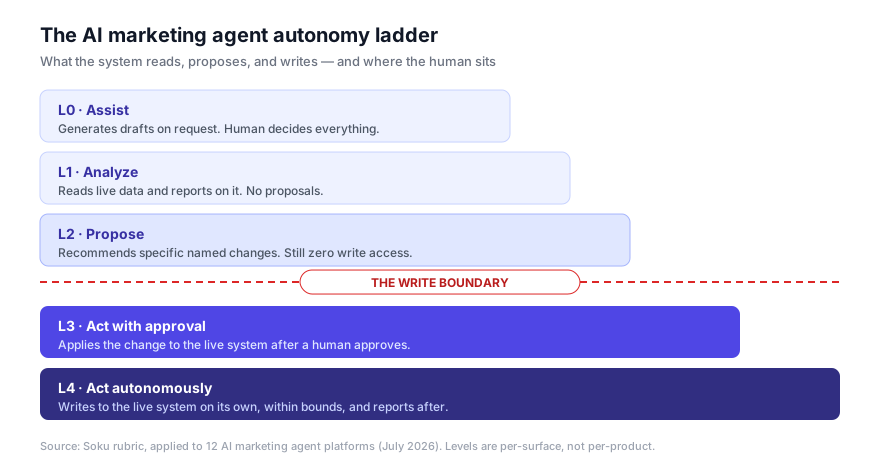
- L0 — Assist. Generates drafts on request. A human decides everything, including whether to use the output. Most "AI features" bolted onto existing suites are here.
- L1 — Analyze. Reads your live data and reports on it. No opinions, no proposals. Dashboards with a language layer.
- L2 — Propose. Reads the data and recommends specific, named changes: pause this ad set, shift this budget, send this segment that message. Still zero write access.
- L3 — Act with approval. Produces the change as an executable action and applies it to the live system after a human approves. This is the first level where the agent closes the loop.
- L4 — Act autonomously. Writes to the live system on its own, within configured bounds, and tells you afterwards.
Two things follow from this framing that no other guide on page one states plainly.
First, L2 is where most "agents" actually live, and L2 is not a labor saving. If the system tells you what to do but you still open the ads manager and do it, you have bought a smarter dashboard. The time cost of executing was never the bottleneck for most teams — the cost was knowing what to execute and then executing it consistently. Only L3 and L4 remove the second half.
Second, L4 is not strictly better than L3. Full autonomy over an ad account means an agent can spend real money on a wrong inference at 3am. The mature pattern in 2026 — and the one Meta's own official connector enforces by making every created object land paused — is L3 with a fast approval surface. The question to ask a vendor is not "is it autonomous?" but "what lands paused, and what doesn't?"
The second axis is surface: where the agent has credentials. An agent is only as useful as the system it can touch.
| Surface | What write access means there |
|---|---|
| Paid media (Meta, Google, TikTok ad accounts) | Budgets, bids, campaign/ad-set structure, creative rotation, pausing |
| Lifecycle messaging (email, push, SMS) | Segment definitions, journey branches, send timing, content |
| CRM / sales | Lead scoring, routing, enrichment, outreach sequences |
| Content / brand | Copy, assets, landing pages, publishing |
Cross-referencing those two axes is the whole comparison. A platform at L4 on lifecycle messaging and L0 on paid media is a genuinely excellent product — for a lifecycle team.
The 12 platforms at a glance
| # | Platform | Primary surface | Autonomy ceiling | Entry pricing |
|---|---|---|---|---|
| 1 | Soku | Paid media (Meta, Google, TikTok, GA4) | L3 — act with approval | Free tier; paid plans published |
| 2 | Salesforce Agentforce | CRM + marketing cloud | L3–L4 (configurable) | $125/user/mo flat, or consumption |
| 3 | HubSpot Breeze | CRM + marketing hub | L2–L3 | Credit-based; ~$1/qualified lead |
| 4 | Klaviyo K:AI + Composer | Lifecycle (ecommerce) | L2–L3 | Bundled with Klaviyo plans |
| 5 | Braze Operator + Agent Console | Lifecycle messaging | L2–L3 | Enterprise, quoted |
| 6 | Iterable Nova | Lifecycle messaging | L2–L3 | Enterprise, quoted |
| 7 | Blueshift Launchpad | Lifecycle + native CDP | L2–L3 | Not publicly disclosed |
| 8 | Adobe Journey Optimizer | Real-time orchestration | L2–L3 | Enterprise, quoted |
| 9 | Superscale AI | Paid social + creative | L3 | $99/mo |
| 10 | Albert.ai | Media buying | L4 | ~$2,000/mo |
| 11 | Omneky | Ad creative production | L2–L3 | Custom / enterprise |
| 12 | Jasper | Content + brand | L0–L2 | $69/mo |
Short answer: if your problem is paid media, look at Soku, Superscale, or Albert.ai. If it's lifecycle messaging, look at Klaviyo, Braze, Iterable, or Blueshift. If it's CRM-wide orchestration and you already run the suite, Agentforce or Breeze. If it's content volume, Jasper — but understand you are buying L0–L2, not an agent that closes any loop.
The paid-media agents
1. Soku — cross-channel paid media, L3 with an approval gate
Best for: performance teams who want an agent that reads Meta, Google, TikTok, and GA4 together and executes changes — without handing over unsupervised spend authority.
Soku connects to your ad accounts and analytics with real credentials, builds a picture across channels rather than per-platform, and turns that into named actions: pause this ad set, shift this budget, rebuild this audience. Those actions are produced as executable proposals; nothing reaches a live ad account until a human approves it.
That approval gate is the design decision worth understanding, because it is where most of the disagreement in this category sits. The argument for L4 is speed. The argument for L3 — the one we build on — is that ad-account writes are irreversible spend, and an agent's confidence is not correlated with its correctness. When Soku's Autopilot runs its first cold-start scan on a brand, it reads account structure, recent performance, and brand context, then submits proposals; the write happens on your click.
Honest limitation: Soku is a paid-media and analytics agent. It does not own lifecycle email, CRM records, or a CDP. If your bottleneck is a 14-step onboarding journey across email and push, a lifecycle platform on this list is the better buy, and the two coexist fine.
Pricing: free tier to start; paid plans published on the pricing page.
2. Superscale AI — paid social and creative, L3
Best for: ecommerce and DTC teams whose bottleneck is creative volume feeding paid social.
Superscale positions itself as a full-stack marketing agent covering creative production, publishing to ad platforms, and media-buying decisions, with a published entry price of $99/mo. Its ranking methodology explicitly scores autonomous multi-step execution and creative ownership, which is a more useful set of criteria than most competitor lists use.
Honest limitation: its own comparison content is the primary public source for its capability claims — there is little independent evaluation, and the published detail on integration breadth beyond Meta, TikTok, and Google is thin.
3. Albert.ai — autonomous media buying, L4
Best for: teams that genuinely want unsupervised optimization and have the spend to justify it.
Albert is the clearest L4 product on this list and one of the longest-running: it takes media-buying decisions and executes them across channels without per-change approval. It is priced accordingly, at roughly $2,000/mo at entry.
Honest limitation: L4 is a real trade. You are buying a system whose reasoning you cannot inspect before it spends. That is defensible at scale with strong guardrails and painful below it. Evaluate it on what bounds you can actually configure, not on the autonomy claim.
4. Omneky — ad creative production, L2–L3
Best for: brands producing high creative volume who want performance signal folded back into generation.
Omneky generates ad creative across placements and ties output to performance data. Pricing is custom and enterprise-oriented, with no public list price.
Honest limitation: creative generation is upstream of the decisions that actually move CAC. Pair it with something that owns the buying side, or you have solved the cheaper half of the problem.
The lifecycle and CDP agents
This is where 2026 saw the most simultaneous shipping. Every major customer engagement platform launched an agent in the first half of the year, which means the differentiation is not "do they have one" but what data it sits on.
5. Klaviyo K:AI and Composer — L2–L3, ecommerce lifecycle
Klaviyo shipped a proactive marketing agent alongside Composer, a prompt-driven campaign builder, as part of a release including 75+ new features. For ecommerce teams already on Klaviyo, the agent sits directly on order and browse data you have already piped in, which is the single biggest determinant of whether an agent's proposals are any good.
Honest limitation: the moat is the data, not the agent. If you are not already a Klaviyo shop, this is not a reason to migrate.
6. Braze Operator and Agent Console — L2–L3, lifecycle messaging
Braze shipped both a dashboard assistant (Operator) and a custom agent builder (Agent Console). The builder is the more interesting half: it lets you define agents against your own workflows rather than accepting the vendor's idea of what should be automated.
Honest limitation: enterprise pricing, quoted. Agent Console's value depends on you having the internal capacity to design agents, which is a real cost most evaluations omit.
7. Iterable Nova — L2–L3, goal-driven lifecycle
Nova is framed as a goal-driven ecosystem combining agents, decisioning, and insights rather than a single assistant. Goal-driven is the right framing — it is the difference between "write me a subject line" and "increase 30-day retention on this cohort."
Honest limitation: as with all of these, quoted enterprise pricing and a long implementation. Budget months, not weeks.
8. Blueshift Launchpad — L2–L3, lifecycle on a native CDP
Blueshift's argument is that the agent and the customer data platform are the same product, so there is no data pipeline to build first. Its published case studies cite concrete numbers — 364 templates audited, 1.8 million profiles across 8 states, and 84% faster strategy planning — which is more specificity than most vendors offer.
Honest limitation: Blueshift does not publish list pricing, and the cited results are single-vendor case studies without independent benchmarks. Treat them as directional.
9. Adobe Journey Optimizer — L2–L3, real-time enterprise orchestration
AJO is the real-time, event-triggered orchestration engine in Adobe's stack (as distinct from Adobe Campaign, the older batch execution engine), and Adobe has been embedding agentic capability across both.
Honest limitation: this is an enterprise platform with enterprise implementation. The agent layer does not change that.
The CRM-wide and content agents
10. Salesforce Agentforce — L3–L4, CRM and marketing cloud
Agentforce is the most commercially aggressive product in the category, scaled to 18,500 customers, and it is also the clearest example of why pricing deserves its own analysis. Salesforce now runs three parallel pricing models: Flex Credits at $500 per 100,000 credits (roughly 20 credits, or $0.10, per standard action), $2 per conversation for customer-facing agents, and a flat $125 per user per month.
Those models are not interchangeable. The break-even is arithmetic: at 20 credits per action, a conversation costing $2 in Flex Credits is exactly 20 actions. Below that, credits win; above it, the per-conversation model does. Buying the wrong one is a straightforward way to overspend.
Honest limitation: Data Cloud is quoted separately and is not cheap — public analyses put it in the $65,000–$175,000 annually range. Agentforce's autonomy ceiling is high and genuinely configurable, but the total cost of a working deployment is far above the headline seat price.
11. HubSpot Breeze — L2–L3, mid-market CRM
Breeze is the mid-market answer, and it has moved to consumption pricing in the same direction as Salesforce: the Prospecting Agent now consumes 100 HubSpot Credits per lead, roughly $1 per qualified lead, where it was previously bundled for early adopters.
That shift is the most important structural signal in this whole category, and it is worth stating explicitly: AI agent pricing is converging on consumption and outcomes, not seats. Both leaders repriced in the same direction within the same period. Model your cost on volume of agent actions, not headcount, or your year-two bill will surprise you.
Honest limitation: Breeze is strongest where HubSpot is strongest — CRM and inbound. Paid-media execution is not its surface.
12. Jasper — L0–L2, content and brand
Jasper is an agentic content workspace at $69/mo, with genuine strength in brand-consistent content production at volume.
Honest limitation, and the reason it is last on a list ranked by autonomy: Jasper does not write to your ad accounts, your CRM, or your lifecycle platform. It is an excellent L0–L2 product being marketed into an L3–L4 category. If you buy it expecting an agent that closes a loop, you will be disappointed by a tool that is very good at the thing it actually does.
What the ladder reveals when you chart it
Scoring all 12 on autonomy ceiling and surface produces a distribution that the alphabetical lists hide:
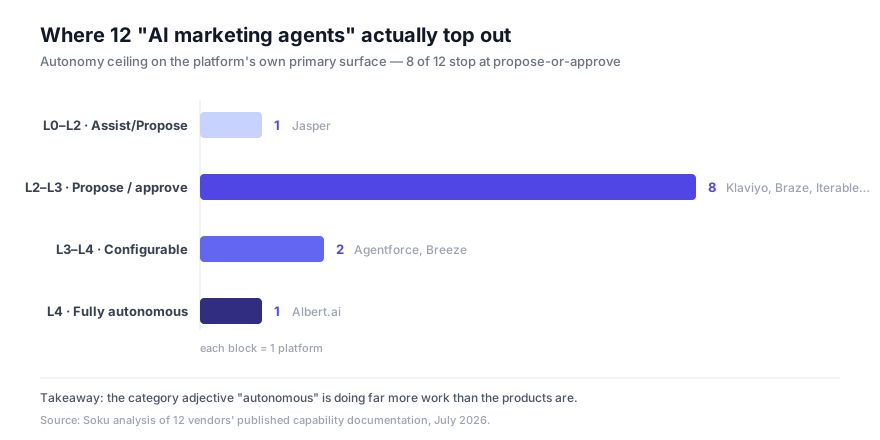
Eight of twelve top out at L2–L3. One is L4. That is the honest state of the category in mid-2026: most products marketed as autonomous agents stop at proposing, or at acting inside a single owned surface with a human in the loop. The marketing language has run well ahead of the delegation you can actually buy.
This is not a criticism of the products. L3 with a good approval surface is, in our view, the correct design for anything that spends money. It is a criticism of how the category is sold — and a reason to test the specific claim rather than the category adjective.
How to choose, in four questions
1. Which surface is your bottleneck? Write it down before you take a demo. Paid media, lifecycle, CRM, or content. Every product on this list is excellent on one and weak on the others, and the single most common buying error is picking a strong agent for the wrong surface.
*2. What is the vendor's autonomy ceiling on that surface?* Not overall. Ask specifically: can it write to the live system, and what lands paused? A vendor that cannot answer this precisely is at L2.
3. What does a working deployment actually cost? Include the data layer. Agentforce's seat price is not the number; Data Cloud is. Consumption pricing means your bill scales with usage, so model action volume, not headcount.
4. What happens when it is wrong? Ask for the failure modes. Every product on this list has them and none publish them. The answer tells you whether you are talking to someone who has run this in production.
Frequently asked questions
What is the difference between an AI marketing agent and marketing automation?
Automation executes rules you wrote in advance. An agent reasons toward a goal and decides the steps itself, which lets it handle cases you never specified. Practically, the difference shows up at L2 and above: automation cannot propose something you didn't anticipate, and an agent can. See our full breakdown of agents versus automation.
Which AI marketing agent is best for paid advertising specifically?
Look at the products whose credentials reach ad accounts: Soku, Superscale, and Albert.ai. Lifecycle and CRM agents — Klaviyo, Braze, Iterable, Agentforce, Breeze — do not buy media, regardless of how autonomous they are on their own surface.
Can an AI marketing agent run my ad account without supervision?
Technically yes at L4, and Albert.ai is built for exactly that. Whether you should is a different question. Ad-account writes are irreversible spend, and the industry's own guardrail conventions — including Meta's official connector landing every created object paused — point toward approval-gated execution as the mature default. For a fuller treatment of the guardrails, see our AI media buyer guide.
How much do AI marketing agents cost in 2026?
The range is enormous: $69/mo for a content workspace, $99/mo for a paid-social agent, ~$2,000/mo for autonomous media buying, and $125/user/mo plus a separately quoted data platform for enterprise CRM agents. The important shift is structural — both Salesforce and HubSpot moved to consumption and outcome pricing in 2026, so cost scales with agent actions rather than seats.
Is "ai marketing agent" the same as "ai agents for marketing"?
The search terms differ but the intent is the same, and both are commercially expensive queries — ai marketing agent carries roughly 1,900 US monthly searches at a $29 CPC. The high CPC is itself a signal: this is a category where buyers convert, which is why the SERP is crowded with vendor-authored lists that rank their own product first. Including, in fairness, this one — which is why we published the rubric rather than just the ranking.
Where to go next
- What an agent actually is, and the adoption data: AI Marketing Agents in 2026 — the pillar for this cluster.
- If your surface is paid media: Best AI Media Buying Tools, Ranked and the AI media buyer guide.
- If you are evaluating the broader stack: The Best AI Marketing Tools (2026).
- If you want the creative layer: Best AI Tools for Facebook & Instagram Ad Creatives.