 Soku AI
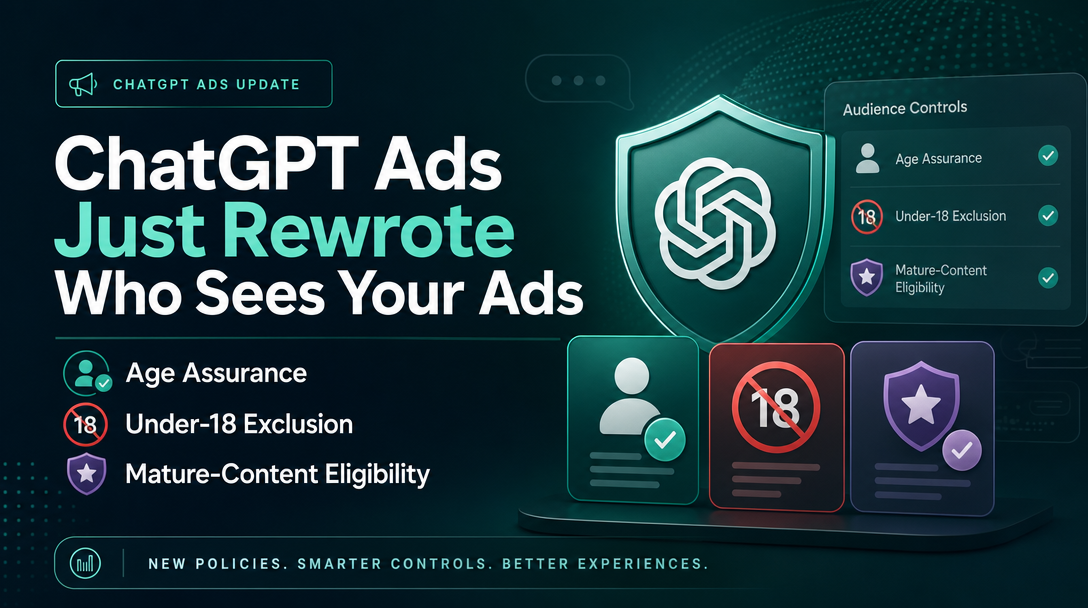
OpenAI rewrote the part of its ChatGPT Ads documentation that decides who is allowed to see your ads. The change landed in the help centre on 2026-08-07, touched at least three official pages, and did two separate things: it replaced a loose description of under-18 exclusion with an actual age-assurance model, and it disclosed — in a subordinate clause, with no announcement — that a mature-content ad tier exists.
Neither change gives advertisers a new control. Both change the shape of the audience you are buying. This post is the before-and-after wording, what follows from it, and an explicit line between what OpenAI states and what is our reading.
All quotations below were captured from OpenAI's own pages on 2026-08-07 and are cited to the exact article.
What Actually Changed
1. Under-18 exclusion became an age-assurance model
The old wording described prediction as an aside. The new wording describes a system.
On Ads in ChatGPT, the summary line changed:
Before: "During our test, we will not show ads in accounts where the user tells us or we predict that they are under 18."
After: "We do not show ads to accounts identified as belonging to people under 18."
Three things moved in that sentence. "During our test" disappeared, which reframes the exclusion from a temporary condition of the beta to a standing property of the product. "Tells us or we predict" — two mechanisms, described casually — became "identified as", a single determination. And the hedge is gone.
The same page's "Who will see ads?" answer was rewritten more substantially:
Before: "Ads may appear for users on the Free and Go plans. Plus, Pro, Business, Enterprise, and Edu accounts will not have ads. During our test, we will not show ads in accounts where the user tells us or we predict that they are under 18. For logged-out users, we have designed the experience to show ads that are appropriate for all ages since we do not have age information."
After: "Ads may appear for users on the Free and Go plans. Plus, Pro, Business, Enterprise, and Edu accounts will not have ads. We do not show ads to accounts identified as belonging to users under 18, based on account-level age information and age prediction where available. Ads shown in logged-out experiences are appropriate for all audiences, while mature-content ads are limited to eligible logged-in users."
Ads in ChatGPT: The Basics — the advertiser-facing page rather than the user-facing FAQ — received the matching edit:
Before: "We do not show ads to users on Plus, Pro, or any Business plan, or to any users who tell us or we predict are under the age of 18."
After: "We do not show ads to users on Plus, Pro, or any Business plan, or to any accounts identified as belonging to users under 18, based on account-level age information and age prediction where available."
The consistency across the user-facing and advertiser-facing pages is the tell that this is a deliberate policy-language update rather than a copy edit.
2. OpenAI enumerated the age-prediction signals
This is the genuinely new disclosure. The "Will minors see ads?" answer went from one sentence to a description of the model's inputs:
Before: "Ads do not appear in accounts where someone tells us—or we predict—they are under 18."
After: "We do not show ads to accounts identified as belonging to users under 18, based on account-level age information and age prediction where available. The model considers a combination of behavioral and account level signals, including stated age, how long the account has existed, typical times of use, usage patterns over time, and the general topics a person discusses."
Five named signals, where previously there were none:
| Signal | OpenAI's wording |
|---|---|
| Stated age | "stated age" |
| Account tenure | "how long the account has existed" |
| Time-of-day usage | "typical times of use" |
| Longitudinal behaviour | "usage patterns over time" |
| Conversation topics | "the general topics a person discusses" |
The last one is the notable entry. OpenAI is stating that what a user talks about with ChatGPT feeds an age classifier that gates ad eligibility. That is a defensible child-safety design, and it is also the clearest published statement so far that conversation content influences ad serving — even though it does so by deciding whether ads appear at all, not which ad appears.
3. A mature-content ad tier was disclosed
Read the second half of the new "Who will see ads?" answer again:
"Ads shown in logged-out experiences are appropriate for all audiences, while mature-content ads are limited to eligible logged-in users."
The previous version explained the all-ages constraint on logged-out experiences as a consequence of missing information: OpenAI showed all-ages ads "since we do not have age information". The new version keeps the constraint but reframes it as one side of a two-tier system, and names the other side.
What OpenAI states: mature-content ads exist as a category, and they are limited to eligible logged-in users.
What OpenAI does not state: what qualifies as mature content, what makes a user eligible, whether advertisers can buy into this tier, whether it is live or planned, or where it sits relative to the prohibited categories in the ad policies. None of that is published. We are flagging the disclosure because it is new and consequential, not because it is actionable today.
4. Brazil went live; Mexico is queued
In the same window, the Ads Manager Availability table changed two rows: Brazil moved from "Coming Soon" to "Available", and Mexico was added as "Coming Soon". Unrelated to the age work, but it is inventory news and it shipped the same day.
5. What did not change
Worth stating plainly, because a monitoring tool will flag it and a careless reading will report it:
- The ad policies did not change.
openai.com/policies/ad-policiesstill reads "Updated: July 15, 2026". Our capture diffed that page, but the difference was a document title and an expanded language selector — page furniture, not policy. Prohibited categories and creative requirements are where they were. - Plan eligibility did not change. Free and Go may see ads; Plus, Pro, Business, Enterprise and Edu do not.
- Atlas did not change. Ads still do not appear in the ChatGPT Atlas browser during the test.
What This Means For Advertisers
Everything below this line is Soku's reading, not OpenAI's text.
You gained no controls and lost no controls. There is no age-assurance setting in Ads Manager, no reporting dimension for it, and no way to target or exclude on the five named signals. If you were hoping the enumeration implied forthcoming demographic targeting, nothing in the wording supports that — the signals are described as inputs to an exclusion, not as an audience surface.
Your addressable audience probably got slightly smaller and slightly cleaner. "Tells us or we predict" is the language of a best-effort filter. "Identified as belonging to users under 18, based on account-level age information and age prediction where available" is the language of a system that runs by default. Our read is that this tightens the exclusion. OpenAI has published no figure, so treat the direction as informed inference and the magnitude as unknown.
The 18-to-22 boundary is where this will show up, if anywhere. An age classifier built on account tenure, time-of-day and conversation topics will be least certain about the youngest adults — a new account, used in the evening, discussing games or study, belonging to a nineteen-year-old, looks a lot like the profile the classifier is built to exclude. If your product skews young-adult, that is the cohort to watch, and it is the one most likely to move.
Do not diagnose an early-August delivery change as a campaign problem without checking the date first. This is the operationally useful takeaway. A platform-side eligibility change and a creative-fatigue curve look identical in a reach chart. Write 2026-08-07 on your account timeline now, so that when someone asks in three weeks why impressions stepped down, the first hypothesis is the right one.
Brand-safety posture is unchanged but better documented. If you were asked whether your ChatGPT Ads could serve to minors, you can now point at named mechanisms rather than a sentence about prediction. For regulated categories and for brands with published child-safety commitments, that is a genuine improvement in what you can evidence, even though the underlying behaviour may not have moved much.
Do not build a plan around mature-content ads. One clause in a FAQ is a disclosure, not a product. Until OpenAI publishes categories, eligibility rules and a buying surface, anyone selling you a "ChatGPT mature-content strategy" is selling you a subordinate clause.
The Practical Checklist
- Timestamp it. Add 2026-08-07 to your account annotations for every ChatGPT Ads campaign.
- Snapshot your baseline. Capture the trailing 14 days of impressions, reach and CPM before the change works through delivery, so you have a genuine before.
- Watch reach, not CPA, for the signal. An eligibility change hits available impressions first. CPA moves later and for more reasons.
- Re-check availability if you sell in LATAM. Brazil is live now; Mexico is queued.
- Leave the policy review alone. Ad policies did not change on this date; a review triggered by this update would be looking in the wrong document.
- Re-read the FAQ, not the announcement. There was no announcement. Both substantive changes landed as edits to existing help articles, which is how most ChatGPT Ads changes have arrived so far — and the reason a diff-based watch on the documentation beats waiting for a blog post.
Sources
Every quotation above was captured on 2026-08-07 from:
- Ads in ChatGPT — general FAQs
- Ads in ChatGPT: The Basics
- Ads Manager Availability
- OpenAI Ad policies — unchanged, "Updated: July 15, 2026"
Where this post separates fact from reading, the "What This Means For Advertisers" section is ours and everything above it is OpenAI's. If you want the settings that are locked at campaign creation rather than the audience that is eligible to see the result, that is a different constraint and it lives in our guide to conversion-optimized oCPC campaigns.