 Soku AI
Similarweb Review (2026): How Accurate Is It?
We pulled Similarweb's estimates for our own site and checked them against Google Search Console. Organic search came out 2.1x too high over the quarter, with the August trend pointing the wrong way. Tested 2026-10-13.
Prices and limits last verified against the vendor on 2026-10-13.
This page is an evaluation, not a list of substitutes or a price sheet. The ranked alternatives are on Similarweb alternatives, and the full plan table is on Similarweb pricing. Here we answer one question for a site whose real numbers we can see: when Similarweb estimates a website's traffic, how close does it get?
How We Tested
Stated up front, because it decides how much weight the verdict deserves:
- The site: soku.ai, our own domain. We see its real Google Search Console data, so we can check Similarweb against measured numbers. It's a small, fast-growing site: about 1,400 to 2,900 Google clicks a month over the test period.
- Similarweb's side: on 2026-10-13 we pulled two Similarweb datasets for soku.ai, worldwide, through the AIsa API gateway that resells Similarweb data (the same gateway behind Soku's Similarweb connector): the monthly visits trend for April to September 2026, and the marketing-channel split for July to September 2026. These are Similarweb's figures; the gateway only relays them. The two calls cost $0.45 and $1.575.
- Our side: Google Search Console for
sc-domain:soku.ai, monthly totals, worldwide and US. - What we compared: Similarweb's Organic Search channel against Search Console clicks. These aren't identical. Similarweb counts visits from every search engine; Search Console counts clicks from Google only. So Search Console is a floor: organic search visits from all engines should be at least roughly the Google click count, and above it by however much Bing, DuckDuckGo and others send.
- What we didn't test: the Similarweb interface, exports or support (we have no seat); paid search, direct, social and referral estimates (we don't publish ad spend, and our own session analytics depends on cookie consent, so it undercounts and isn't a fair yardstick); and any site other than our own.
The Result: Organic Search, Month by Month
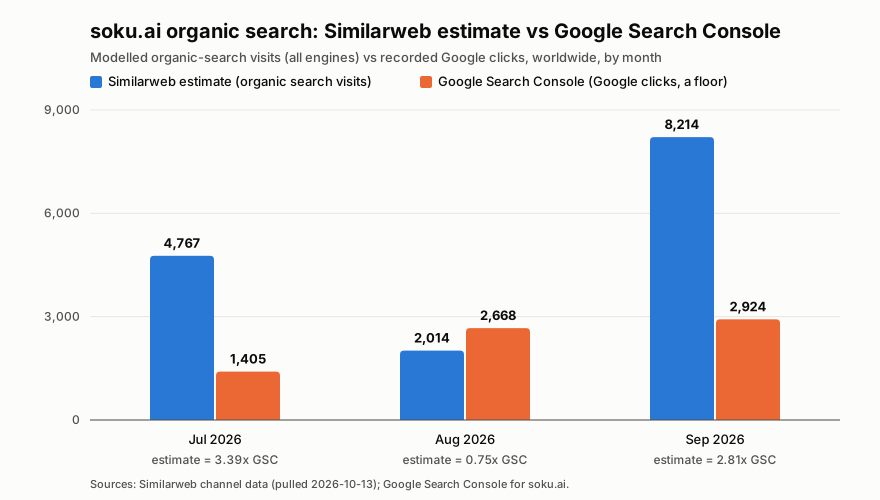
| Month (2026) | Similarweb organic search visits (all engines) | Search Console Google clicks | Estimate ÷ Search Console |
|---|---|---|---|
| July | 4,767 | 1,405 | 3.39x |
| August | 2,014 | 2,668 | 0.75x |
| September | 8,214 | 2,924 | 2.81x |
| Quarter | 14,995 | 6,997 | 2.14x |
Similarweb: marketing-channel sources, worldwide, monthly, pulled 2026-10-13, figures rounded to the nearest visit. Search Console: sc-domain:soku.ai, calendar-month totals, worldwide.
Three findings:
- The level was too high in two of three months. For July and September, Similarweb's organic estimate was roughly three times our Google clicks. For other engines to explain the gap, they'd have to send soku.ai about twice as many visits as Google. We didn't measure Bing directly, but that would be unusual for an English-language site, so we read most of the gap as model error rather than missing engines.
- August broke the floor. Similarweb estimated 2,014 organic search visits from every engine combined. Google alone sent 2,668 recorded clicks. An all-engine figure below the Google-only count is wrong in the direction no definitional difference can explain.
- The trend pointed the wrong way. This is the finding that matters most if you use Similarweb to watch competitors move:
| Change | Similarweb organic search | Search Console Google clicks |
|---|---|---|
| July → August | −58% | +90% |
| August → September | +308% | +10% |
If you were tracking soku.ai as a competitor through Similarweb, you'd have concluded our SEO collapsed in August and exploded in September. What actually happened is that Google clicks nearly doubled in August and grew modestly in September.
The rest of what Similarweb returned
For context, without a yardstick to grade it:
- Total visits (all channels): June 6,748; July 8,079; August 10,232; September 25,618. For April and May 2026, Similarweb returned no estimate (null), even though soku.ai was live and getting Google traffic: Search Console shows 1,466 clicks for June alone.
- September channel split: Direct 10,385; Organic Search 8,214; Organic Social 5,653; Referrals 788; Paid Search 519; Display Ads 54; Email 5; Paid Social 0.
- We can't confirm the direct, social or paid figures, so we don't. The organic social jump (235 in July to 5,653 in September) and the total of 25,618 in September are the numbers we'd most want to check with complete first-party analytics before believing them.
Caveats on our own test
- One site, one quarter. A small site is the hardest case for any panel-based model. Similarweb's estimates for large sites, where its panel sees many more visitors, may be much closer. We didn't test that.
- Clicks aren't visits. A Google click usually becomes one visit, but not always, and Similarweb deduplicates differently. That's why we treat Search Console as a floor rather than an exact target, and why the quarter-level 2.1x matters less than the August floor breach and the reversed trend.
- Data vintage. We pulled Similarweb's data on 2026-10-13. Similarweb can revise recent months as more data arrives; a later pull might show different figures for September.
What Similarweb Says About Its Own Data
Similarweb's methodology article describes four inputs:
- Direct measurement: "millions of websites' and apps' first-party analytics," which sites share with Similarweb, plus partners.
- Contributory network: "a collection of consumer products that aggregate anonymous device behavioral data."
- Partnerships: organizations including internet operators, measurement companies and demand-side platforms.
- Public data extraction: indexing public pages, combined with census data such as country population.
Those inputs feed machine-learning models that Similarweb says are cross-validated "to ensure scale and trend accuracy." Its Google Analytics comparison article gives three reasons figures differ from a site's own analytics: methodology (Similarweb deduplicates visitors), imperfect tag installation on the measured site, and inconsistent comparisons. It suggests using direct measurement to calibrate.
Read together with our test: the inputs are documented, the accuracy claim is general, and the help center itself expects differences from site analytics. For a small site that hasn't connected its analytics to Similarweb, the model is working from panel and partner signals alone, which fits what we saw.
Strengths
- Breadth. Web, apps, AI search visibility, retail, B2B sales and stock data from one vendor. No other tool on our alternatives list covers that range.
- A full channel split, even for a small site. Similarweb returned monthly visits and an eight-channel split for a site our size. The shape is a starting point, even where the levels are off.
- Documented method. The methodology and the "why it differs from GA" article are public. That's more than many estimate vendors publish.
- Serious business tier. Daily data, 100+ countries, up to 37 months of history, APIs, MCP and data feeds, according to the pricing page.
Limits
- Small-site accuracy. In our test, levels ran up to 3.4x off, one month fell below a hard floor, and month-to-month direction was wrong twice.
- Thin self-serve plans. Self-serve plans list 3 or 6 months of history and 1 user, and their cards don't list country filters, the API or MCP. Those appear in custom business packages.
- Ads at the top. Ad intelligence is only in the $542-a-month (billed annually) self-serve bundle. See Similarweb pricing for the full table.
- Opaque data costs. API and data-credit prices aren't published.
Who It Fits
A good fit:
- Strategy, corporate development and investor teams sizing markets, categories and large competitors, where panel estimates are at their most reliable and breadth matters.
- Teams that need app, retail or AI-search intelligence alongside web data from one contract.
- Analysts who treat the numbers as relative and calibrate against sites whose real figures they know.
A poor fit:
- Small teams benchmarking themselves. Your own analytics is free and measured; a model of it isn't worth paying for.
- Anyone watching small competitors' month-to-month moves. In our test the direction of change was wrong for two consecutive months.
- Performance marketers who mainly want competitor ads. Cheaper ad-research tools exist, compared in our best ad spy tools roundup.
Verdict
Similarweb is a broad, well-packaged market-intelligence product whose estimates should be read as rough shapes, not measurements, especially for small sites. On the one domain we can check, its organic search figures were too high over the quarter, broke below Google's own click count in one month, and reversed the real trend twice. If your decisions depend on direction and scale for large players, it can still earn its price. If they depend on how a small competitor did last month, verify before you act, and never use it in place of your own analytics.
Frequently Asked Questions
How accurate is Similarweb?
For our own small site, not very. We pulled Similarweb's organic search estimates for soku.ai for July to September 2026 and compared them with Google Search Console. Similarweb estimated 14,995 organic search visits; Search Console recorded 6,997 Google clicks, so the estimate was 2.1 times higher over the quarter. Month by month it ranged from 3.4 times too high in July to below Google's own click count in August, and it showed August organic traffic falling 58% when Search Console showed it rising 90%. One site and one quarter, so treat it as an example, not a benchmark.
Is Similarweb accurate for small websites?
Our test suggests caution. soku.ai gets a few thousand Google clicks a month. Similarweb returned no visit estimate at all for April and May 2026, then figures from June that moved in ways our Search Console data didn't. Similarweb's methodology blends panel data, partner data, public data and sites that share their analytics, and a small site gives that model less to work with. For large sites and market-level comparisons, panel estimates are generally more stable; we didn't test that here.
Why is Similarweb different from Google Analytics?
Similarweb's help center gives three reasons: different methodologies for counting sessions and visitors (Similarweb deduplicates visitors), analytics tags that are installed incompletely or too broadly on the site being measured, and inconsistent comparisons such as different date ranges, devices or metrics. Its methodology article says its estimates are built from four sources: direct measurement from sites that share analytics, a contributory network of consumer products, partnerships including ISPs and DSPs, and public data extraction.
Is Similarweb worth it?
For market-level work across many large sites, such as category share, audience overlap or sizing an acquisition target, it's one of the broadest datasets available, especially on the business packages with 100+ countries and up to 37 months of history. For a small team that mainly wants to benchmark itself or a few small competitors, the self-serve plans ($125 to $542 a month billed annually) buy estimates that, in our test, didn't track reality month to month. Use your own analytics for yourself.
Did you test Similarweb hands-on for this review?
We tested its data, not its interface. We didn't buy a Similarweb seat, so we can't report on the dashboards, AI Studio, exports or support. We pulled Similarweb's visits trend and marketing-channel data for soku.ai on 2026-10-13 through a third-party API gateway, compared the organic search figures with our Google Search Console data, and read Similarweb's pricing page and help center the same day. We didn't grade the paid search, direct or social estimates, because we don't publish our ad spend and our own session analytics depends on cookie consent, so it undercounts.
What does Similarweb do well?
Breadth and packaging for large organizations: website, app, AI search, retail, sales and stock intelligence from one vendor; business packages with daily data, 100+ countries, up to 37 months of history, APIs, MCP and data feeds; and a methodology that is at least documented. It also returned a full channel split for our small site, which is useful as a rough shape even when the levels are off.
See also the best Similarweb alternatives and the full Similarweb pricing breakdown.