 Soku AI
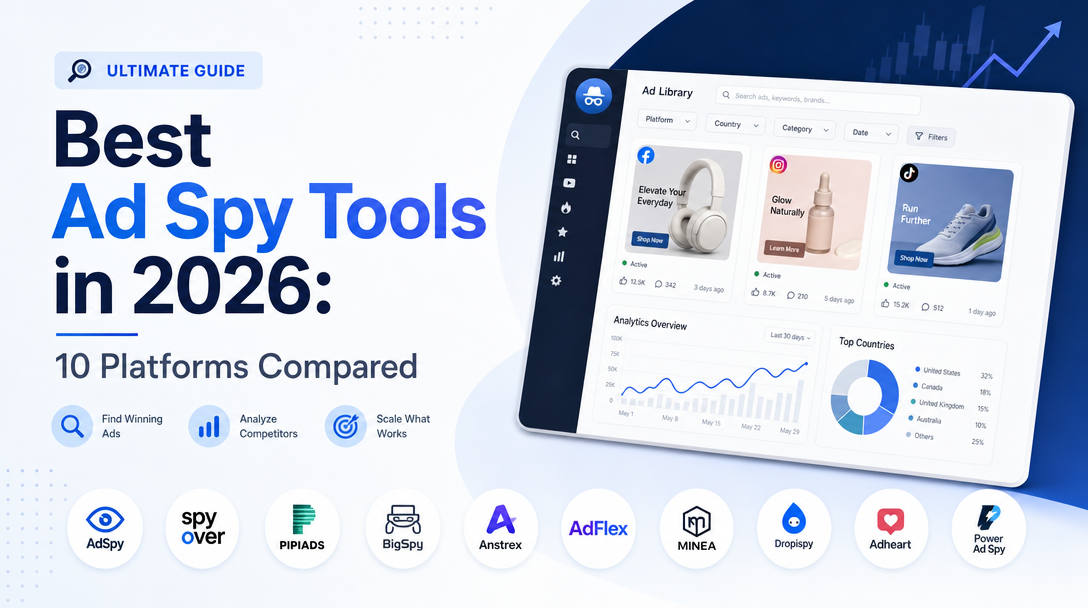
Every "best ad spy tools" list has the same problem: it ranks ten paid products against each other and never mentions that four of the best sources are free, official, and operated by the ad platforms themselves.
That omission is not incidental. It hides the only question that matters when you are choosing one of these — what is the paid layer adding on top of a public data source? — because most paid ad spy tools are, at their core, an interface over ad libraries that anyone can query for nothing.
Sometimes that interface is worth 179 USD a month. Sometimes it is not. You cannot tell which without knowing what the free layer already gives you.
This compares all ten, free and paid, with pricing verified against each vendor on 2026-08-11 where they publish it, and an explicit note where they do not.
First: the coverage wall that limits everything on this list
Before any comparison, the constraint that applies to every tool here, paid or free.
Ad spy tools do not have a secret window into ad accounts. They see what the platforms' ad transparency systems expose, which is a deliberately partial view governed by regional transparency law rather than by advertiser curiosity.
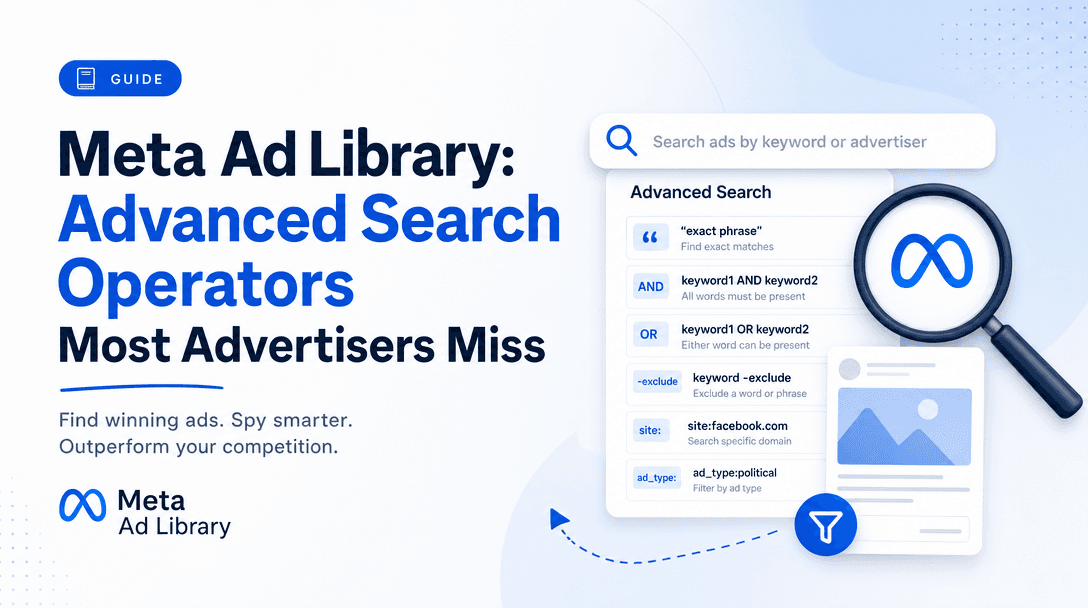
The most consequential limit is on Meta, and it is documented in Meta's own API reference: full archive access to all commercial ads depends on which country you query, while political and issue ads are covered far more comprehensively everywhere. We covered this in detail in Meta Ad Library search operators, including the widely repeated boolean-operator advice that Meta's documentation supports none of.
The practical consequences apply to every product below:
- No spend data is real spend data. Any "estimated ad budget" figure is a model, not a disclosure. Treat it as a directional ranking signal and never as a number.
- Absence is not evidence. A competitor missing from a tool may be running ads the transparency system does not expose in your region.
- Longevity is the strongest available signal. How long an ad has been running is the one field that is both reliably exposed and genuinely informative — advertisers turn off ads that lose money.
Any tool promising more than this is selling confidence rather than data.
The four free official sources
These are first-party, free, and the upstream source for much of what the paid tools resell.
1. Meta Ad Library
The largest and most useful free source, covering Facebook and Instagram. Searchable by advertiser or keyword, filterable by country, platform, media type and delivery date, and it shows how long each ad has been running. There is also a documented API for programmatic access.
Best for: almost everyone, as the starting point. If your competitive research is Meta-shaped, start here and only pay for something once you can articulate what it adds.
Limits: the coverage wall above; no saved boards or team workflow; the UI hides several filters the API exposes.
2. TikTok Creative Center / TikTok Ad Library
TikTok publishes both a Creative Center — trending creative, formats and audio, organised for inspiration — and a separate Ad Library for transparency queries. The Creative Center is unusual among these sources because it is explicitly built to be useful rather than merely compliant, with trend and performance framing.
Best for: short-form video creative direction and format trends. Genuinely good, and free.
Limits: TikTok-only, and the trending view is curated rather than exhaustive.
3. Google Ads Transparency Center
Covers Search, Display, YouTube and Shopping. Searchable by advertiser, filterable by format and region, showing verified advertiser identity and date ranges.
Best for: seeing whether a competitor runs Google at all, and in which formats — a question no Meta-focused tool can answer.
Limits: thinner per-ad detail than Meta's library, and no keyword-level insight.
4. LinkedIn Ad Library
Ads from LinkedIn advertisers, searchable by company, with date ranges.
Best for: B2B, where LinkedIn is often the primary paid channel and where almost no paid ad spy tool has meaningful coverage.
Limits: basic interface, no analytics layer.
The honest summary of the free tier: if you research competitors monthly rather than daily, and you work in one or two channels, these four cover most of what you actually need. The paid tools below are buying you cross-platform search, saved workflow, and team collaboration — not fundamentally different data.
The six paid platforms
Pricing verified on each vendor's own pricing page on 2026-08-11. Where a vendor does not publish pricing, or we could not reach it, that is stated plainly rather than filled in with a third-party estimate.
5. Foreplay — 59 USD/month
The clearest positioning of the paid group: it is a creative workflow tool that happens to include ad discovery, rather than a database with a UI.
| Plan | Monthly | Annual (per month) | Annual saving |
|---|---|---|---|
| Basic | 59 USD | 49 USD | 120 USD |
| Workflow | 175 USD | 149 USD | 310 USD |
| Agency | 459 USD | 389 USD | 820 USD |
| Enterprise | custom | custom | — |
Additional users are 20 USD each on every tier. Annual billing saves 15% and includes unlimited Spyder. Brand tracking via Lens covers 1 brand on Workflow and 10 brands on Agency. There is a 7-day free trial.
Best for: teams whose actual problem is organising and briefing from swipe files, not finding ads. The per-user pricing is honest and predictable, which is rarer here than it should be.
Watch: the jump from Basic to Workflow is nearly 3×, and brand tracking lives above that line.
6. PowerAdSpy — 69 USD/month
The widest published network coverage of the group, and the most aggressively tiered.
| Plan | Monthly | 3-day trial |
|---|---|---|
| Basic | 69 USD | 1 USD |
| Standard | 129 USD | 7 USD |
| Premium | 179 USD | 7 USD |
| Platinum | 279 USD | 7 USD |
| Titanium | 349 USD | 7 USD |
| Palladium | 399 USD | 7 USD |
Read the feature matrix before the price, because networks are gated by tier. Basic covers Facebook, Instagram, Google and YouTube. Standard swaps in Pinterest and LinkedIn but drops Google and YouTube from the listed set. Full coverage — adding Reddit, Quora, Native and GDN — arrives only at Palladium at 399 USD.
Two more gates worth knowing: Estimated Ad Budget and Competitor Tracking both start at Platinum (279 USD), with tracking limits of 5 brands / 35 competitors at Platinum, 10 / 70 at Titanium, and 20 / 140 at Palladium.
Best for: buyers who genuinely need many networks in one place and will use the higher tiers.
Watch: the 69 USD headline is a narrower product than most comparison posts imply, and competitor tracking — the feature most people are buying — is four tiers up.
7. Minea — 49 USD/month
E-commerce and dropshipping oriented, with product discovery alongside ad search.
| Plan | Monthly | Quarterly (per month) |
|---|---|---|
| Starter | 49 USD | 39 USD |
| Premium | 99 USD | 79 USD |
| Business | 199 USD | 158 USD |
Magic search is metered per tier — 50/month on Starter, 100/month on Premium. Free registration is available. An annual option is shown alongside monthly and quarterly.
Best for: e-commerce operators doing product research and ad research as one activity.
Watch: if you are not in e-commerce, much of what you are paying for is product discovery you will not use.
8. BigSpy — pricing not verifiable
Markets itself as "the largest ads database" with coverage across Facebook, Instagram, TikTok, YouTube, Twitter, Pinterest, Yahoo, Unity and AdMob, and advertises a free tier.
We could not verify its pricing. The pricing page did not render its plan table to a non-browser client on 2026-08-11, returning a load error instead. Rather than quote a third-party figure, we are recording that as unverified.
Best for: breadth of network coverage, on the evidence of its own feature pages. Check the price yourself in a browser before committing.
9. AdSpy — pricing page not found
Long-established and widely cited in this category, usually for Facebook and Instagram depth.
On 2026-08-11, adspy.com/pricing returned HTTP 404. Every third-party figure circulating for this product traces back to older sources we cannot confirm against the vendor, so we are not repeating any of them. The same discipline we applied to Arcads, which published no pricing page when we checked it on 2026-08-07, applies here.
Best for: unclear until the vendor publishes a checkable price.
10. Anstrex and Dropispy — unreachable
Both are regularly listed in this category — Anstrex for native and push, Dropispy for dropshipping. Neither pricing page responded from our network on 2026-08-11 (connection failures rather than HTTP errors), so we have no verified figures and will not estimate.
How to choose, honestly
The decision is simpler than a ten-row table suggests.
Start free, and stay there until something hurts. The four official libraries cost nothing and are the upstream source for much of the paid layer. If you cannot name the specific thing they fail to do for you, you are not ready to buy.
Then identify which of three problems you actually have:
- "I cannot find the ads." → You probably can, free, in the official libraries. Buy nothing yet.
- "I can find them but cannot organise them." → This is Foreplay's problem. Swipe files, boards, briefs, team access.
- "I need networks the free libraries do not cover." → Native, push, Reddit, Quora, AdMob, Unity. This is PowerAdSpy's higher tiers or BigSpy, and it is a real reason to pay.
Then check the gate before the headline price. Both tiered products on this list put the feature most buyers want above the entry tier — competitor tracking on PowerAdSpy at 279 USD, brand tracking on Foreplay at 175 USD. The advertised entry price is rarely the price of the thing you came for.
What no ad spy tool does
The limit that matters most, and it applies to every tool above equally.
None of them can tell you whether a competitor's ad worked. They can tell you it existed, what it said, and — usefully — how long it ran. They cannot see spend, conversions, ROAS or profitability, because no ad transparency system exposes those and no amount of interface polish invents them.
This produces a specific and expensive failure mode. A team subscribes, builds a swipe file of competitor creative, briefs against it, ships it, and then evaluates the result against… the same competitor swipe file. The loop never closes on their own performance data, because the tool that found the inspiration cannot read the outcome.
Competitor research is a hypothesis generator. The hypothesis is tested in your own accounts, against your own conversions, on your own audience — where a competitor's winning angle routinely loses because their product, price and audience are not yours.
The useful question is therefore not "which ad spy tool has the biggest database", but "what happens after I find the ad?" If the answer involves manually reconciling creative you made against performance you read somewhere else, that reconciliation is the actual bottleneck, and a bigger database will not touch it.
That is the gap Soku is shaped for: competitor ad intelligence sits in the same loop as generating the creative, deploying it across Meta, Google and TikTok, and reading spend and conversion data back — so the inspiration and the verdict live in one place instead of two.
All pricing on this page was read from each vendor's own pricing page on 2026-08-11. Four vendors — BigSpy, AdSpy, Anstrex and Dropispy — did not serve a verifiable price table to us on that date, and are marked as unverified rather than estimated. Vendors change prices; re-check before purchase.
Related: Meta Ad Library search operators · Best ad testing tools